Your Monthly News & Updates | |
|
|
Not surprisingly, many booths were decorated for fall, and it is this introduction of apples, corn, and pumpkin that should remind us all of a simpler time. It wasn’t so long ago that September wasn’t associated with ‘back to school’ but rather harvest season. Reading some of the hand written journals held at the Medfield Historical Society, we know that school generally wouldn’t begin until after the close of harvest at Thanksgiving.
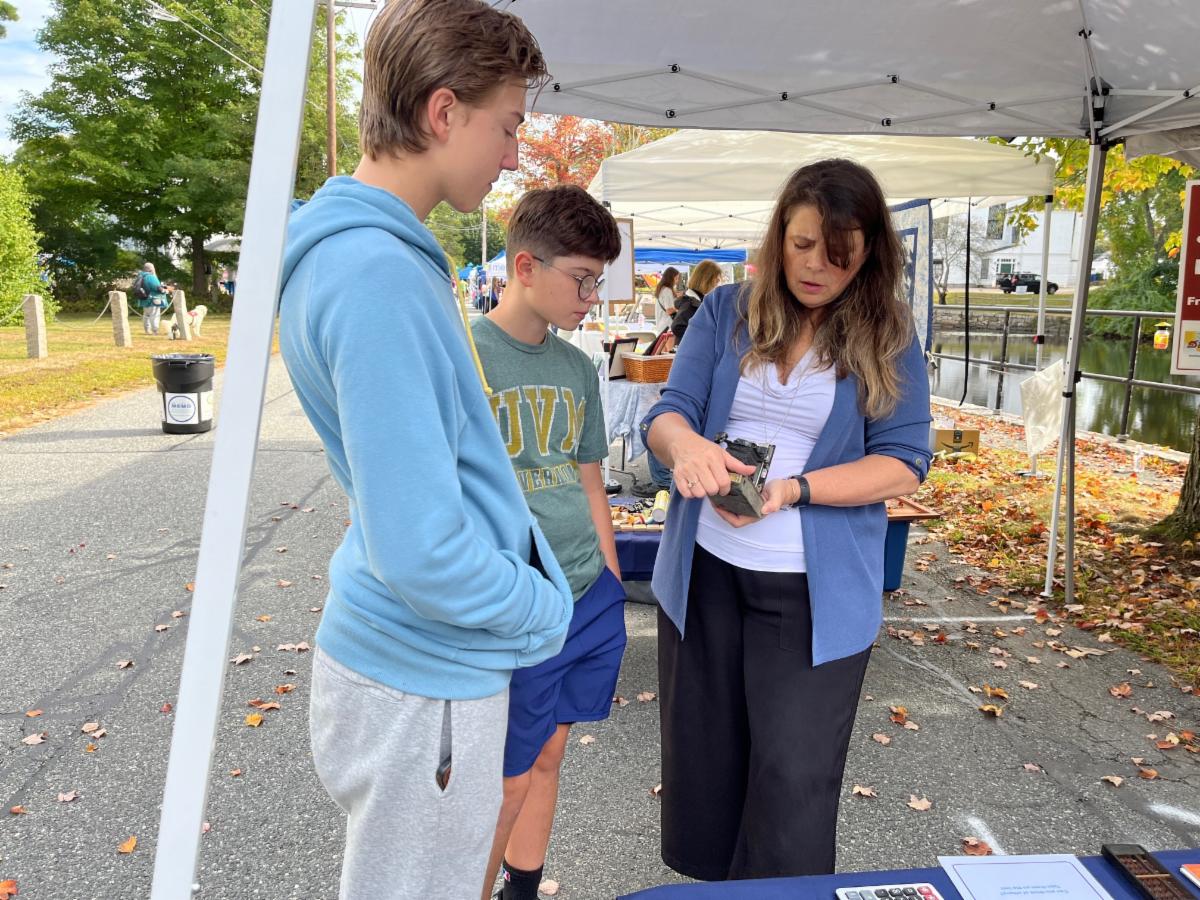
Hopefully you were able to stop by our booth this year. I might be biased, but I thought it was truly spectacular. One of our many dedicated volunteers assembled a table of items that are all replaced today by modern cell phones – this included maps, a rotary phone, calculator, flashlight, cameras, video cameras, and even a typewriter. (Watching some of the kids attempt to dial their phone number on the rotary phone was hysterical.)
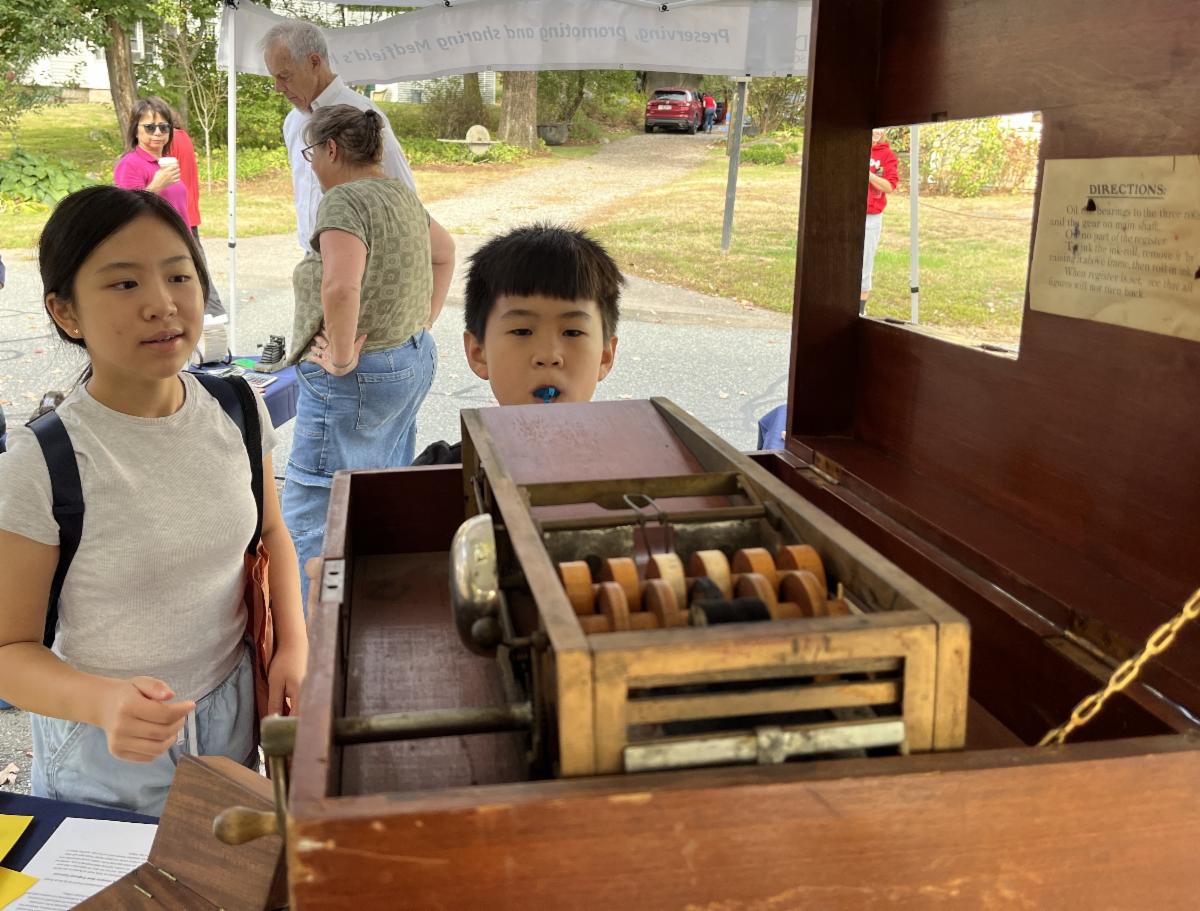
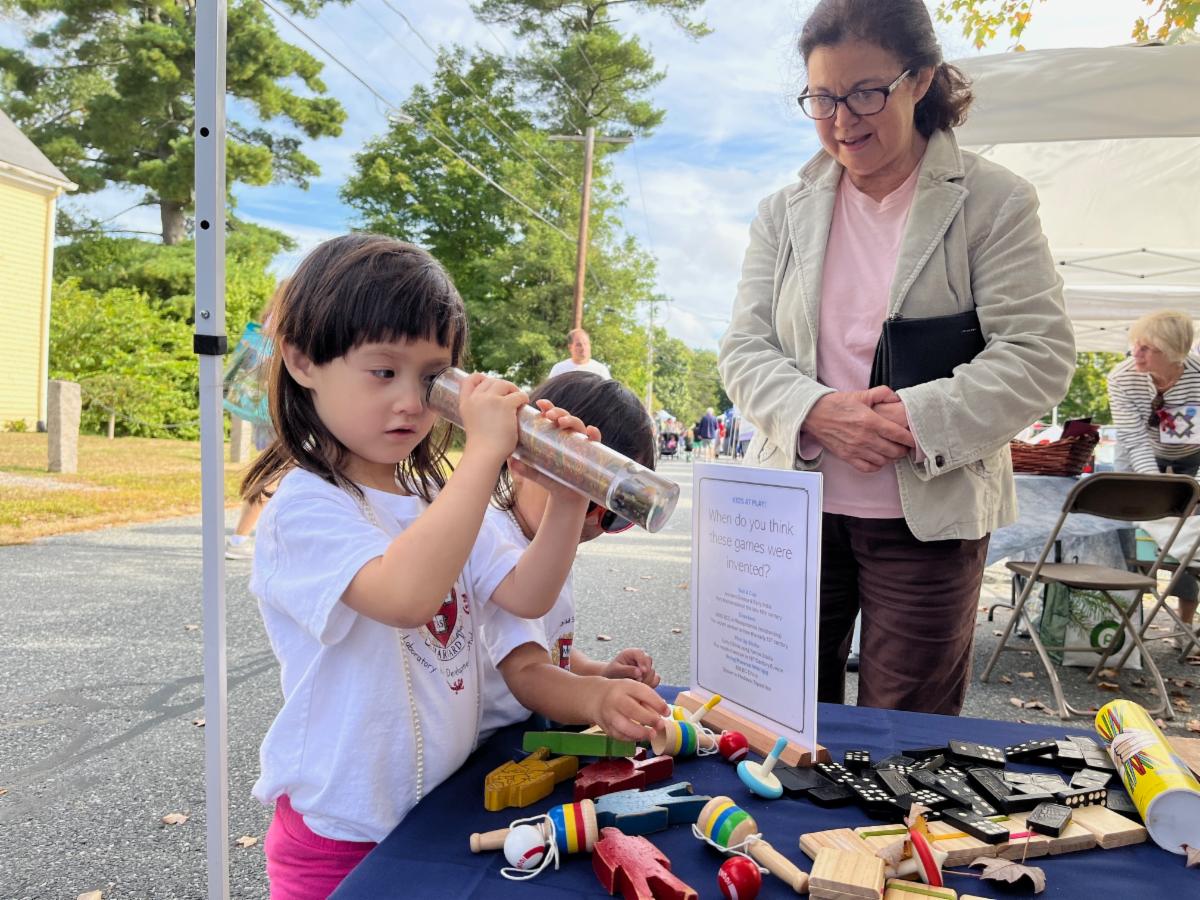
A second low table was covered in old fashioned toys which kept the little ones engaged. And at the back of our booth, we featured a real wooden voting box used in Medfield back in the early 1900s.
The question on our ballot was, “Should kids be allowed to have internet smartphones before high school?” Some of the conversations were quite funny as we tried to make a distinction between a basic cell phone which could be used for keeping in contact with parents, and a smartphone which also includes access to the internet and apps. Even though it has only be a short while since “basic” cellphones were the norm, most kids believe that they weren’t even made anymore. Hundreds of people of all ages voted, and we will be tallying the votes and sharing them with you here next month.
Until then, happy reading!
|  | |
|
|
PeggySue Werthessen
President
| |
Jay Hurd on “Isabella Stewart Gardner, Medfield, and Baseball” | |
|
Monday, Oct 7, 2024
7:00 pm
First Parish Unitarian Universalist Church
26 North Street, Medfield
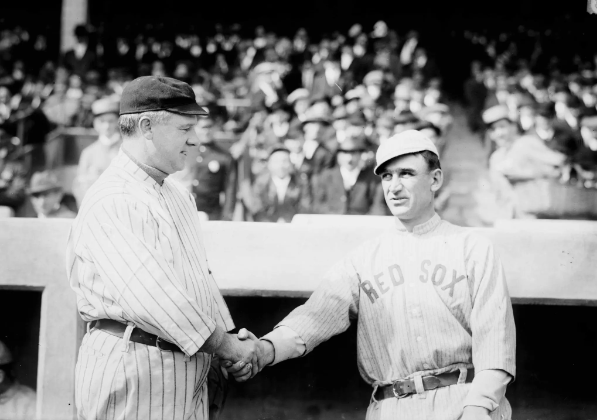
In his presentation Jay Hurd will delve into the fascinating life of Isabella Stewart Gardner and consider her association with Medfield and her love of art and sports and, in particular, baseball.
| |
|
Isabella Stewart Gardner, an art collector, philanthropist, and patron of the arts, was well-known to artists, composers, musicians, and writers during the Gilded Age and a visible presence in Boston. She was friends to famous Medfield artists, Dennis Bunker and Charles Innes. She delighted in sports of all kinds and was a well-known Red Sox fan. Hers was a life of commitment to the beauty of the human form and the artists who captured this beauty on canvas, in dance, and even as baseball players.
A regular guest at her palatial home in Boston’s Fenway was Charles Martin Loeffler, composer and violinist from Medfield. On one visit, he brought a Medfield church boys’ choir for her entertainment. When Gardner learned they needed uniforms for their baseball team, she donated the funds to buy them, an example of her support for athletic pursuits as well as musical ones.
Jay Hurd, is a baseball historian, former librarian at Harvard’s Widener Library, and graduate of Medfield High School. He has presented at the National Baseball Hall of Fame Museum and historical societies on baseball topics.
The presentation is free and open to the public.
| |
Retired Massachusetts Superior Court Justice Dennis J. Curran on "The Salem Witchcraft Trials: What Really Happened?" | |
|
Thursday Oct 24, 2024
6:30 pm
Medfield Public Library
468 Main Street, Medfield
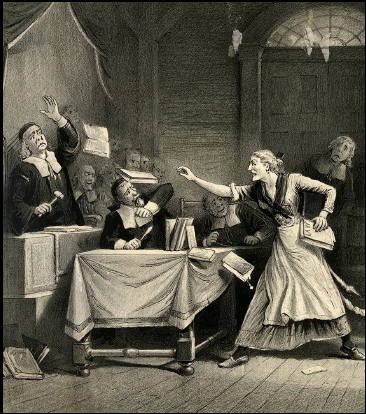
These trials constitute one of the most mysterious and fascinating events in American history. Discover the conditions that culminated in tragic circumstances that have haunted us for centuries. We will explode five myths behind the outbreak of allegations of witchcraft in colonial America, examine the villains and heroes involved, and try to determine the reasons behind a raging mass hysteria. Whether we live in 17 th century New England or today, people are susceptible to the same dark fears and influences. The Salem Witchcraft trials serve as a powerful reminder of the frailty of the human condition.
This program, co-sponsored by The Medfield Public Library and The Medfield Historical Society, is presented by the Honorable Dennis J. Curran, Justice, Massachusetts Superior Court (Ret.) from his lecture series “Great Trials That Changed History: A Judge’s Perspective. ”
The event is free, but tickets must be reserved by clicking here.
| |
"The Tragedies and Triumphs of Restoring a Historic New England Colonial" with Lee McColgan | |
|
Monday, Nov 4, 2024
7:00 pm
First Parish Unitarian Universalist Church
26 North Street, Medfield
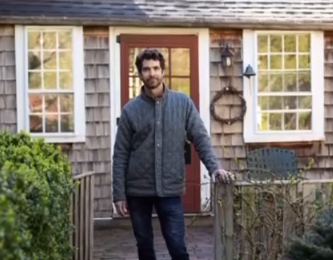
McColgan will tell his story of restoring the 300-year-old Loring House in Pembroke, Massachusetts. Trading his corporate career for a life of craftsmanship, McColgan spent 18 months battling deteriorating bricks, shattered windows, and a punctured foundation, all while learning from master preservationists. His talk will delve into the unexpected challenges of using period materials and techniques, the lessons learned from traditional crafts, and the emotional toll of living in a home under constant repair. McColgan will not only consider the physical restoration process but also reflect on the deeper philosophical connection between history and our homes, and the value of preserving the past to find meaning and purpose for the future.
Lee McColgan is the founder of Helve Historic Trades, specializing in woodworking, blacksmithing, and masonry. His craftsmanship has contributed to projects at notable sites such as Boston’s Old North Church and Louisa May Alcott’s Orchard House. His expertise has been featured in Architectural Digest, The Boston Globe, and The Wall Street Journal.
The presentation is free and open to the public.
| |
In Memory of Tim Flaherty, 1947-2024 | |
|
by David Temple
Tim Flaherty, 77, who had contributed dozens of articles that enriched The Portal over the last decade, died September 12, after suffering a stroke early in the summer.
He was born in Medfield and grew up in a house at 15 Pleasant Street; I knew him as I was growing up at 29 Pleasant Street. Tim attended Medfield schools, class of 1965. After graduating from Emerson College, he joined the Peace Corps and spent two years in Guatemala as well as some time in Africa.
But Tim returned to Medfield and lived most of his life here; he worked for the Massachusetts Department of Corrections as a bilingual case worker for 30 years.
Tim was a true townie. His mother was a Palumbo, one of the big Italian families that settled in on Frairy Street in the early 20th century. He wrote frequently about them.
Tim’s uncle was Joe Marcionette, who owned the Jenny gas station where the Middlesex Savings Bank now sits. Joe was a lifetime active citizen, selectman, all-around good guy, and volunteer in many activities to benefit youth. (As a schoolboy, I remember how Joe came to school one December day all dressed up as Santa Claus – and how he laughed when I greeted him with, “Good morning, Mr. Marcionette.”)
Tim’s Portal articles generated fan mail! They were all about his memories of growing up in midcentury Medfield – the kids, the characters, the schools, the teachers, the little businesses in a town of 5,000 people that was evolving from a farming community into a bedroom community, and the two major employers, the hat factory where the Montrose School now sits, and the state hospital.
You can read Tim's obituary here.
How about YOU?
Did you grow up in Medfield in the 1950s, 60s, or 70s? Did you like reading Tim’s articles? Do you have memories to share the way Tim did? Portal readers would love to hear your stories about local personalities, schools, fun activities! Good things you and your friends did? Or even bad things you did?
If so, please contact me via email or call 508-613-6606.
| |
In Memory of Sandra Munsey, First Medfield Selectwoman | |
|
by Chris McCue Potts
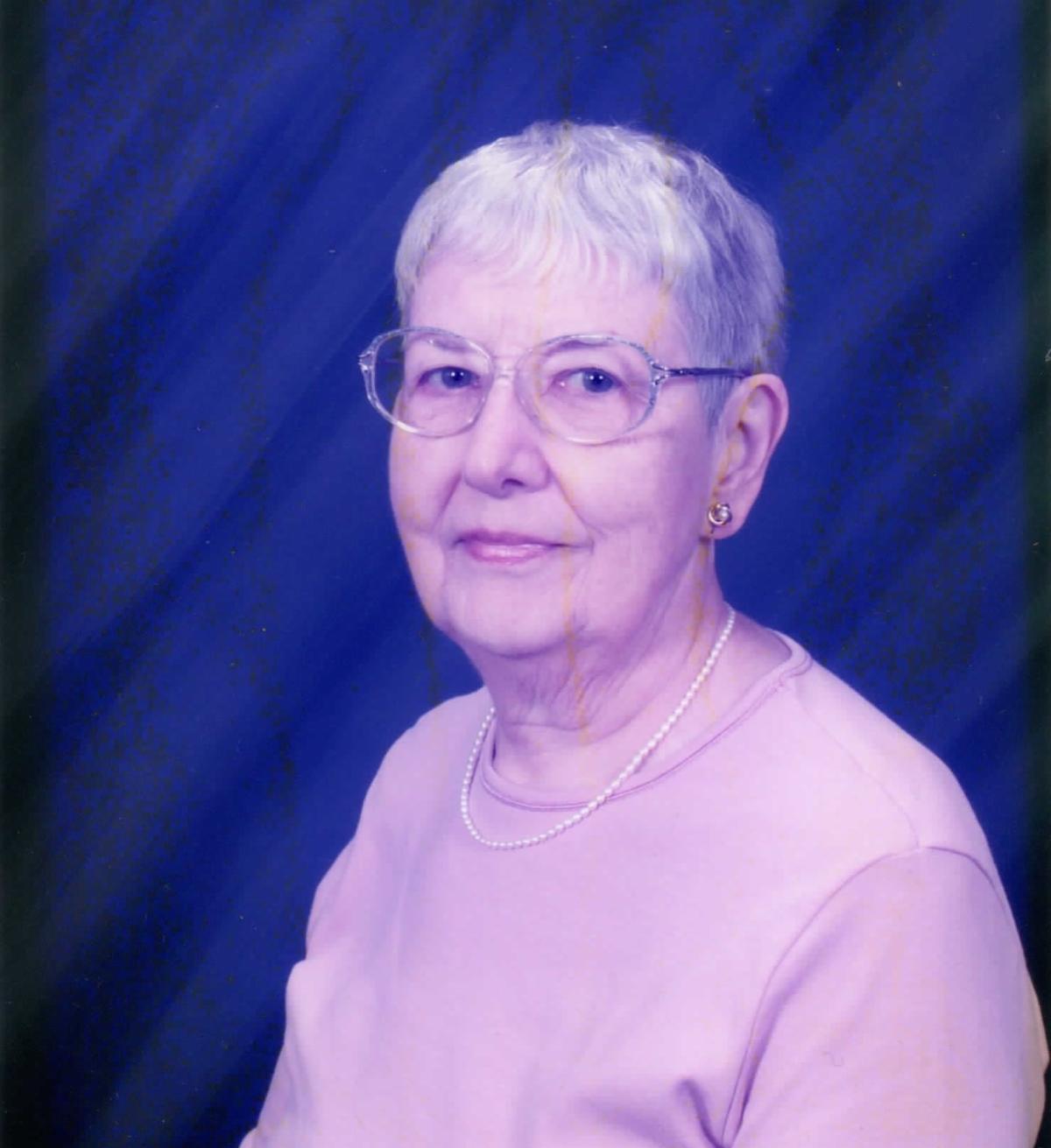
With two children in high school, and having recently earned her master’s in public administration, 39-year-old Medfield resident Sandra “Sandy” Munsey ran for selectwoman in the highly contested March 28, 1977 town election. With 928 votes that far surpassed the three other candidates running against her, Munsey became the first woman to serve on the Medfield Board of Selectmen – a seat she held until 1980.
She was also a long-time Medfield Historical Society member, who especially enjoyed helping with the annual pantry sale, according to former MHS President David Temple.
After a lifetime of service in numerous other roles, Sandy Goss Munsey passed away on Sept. 3, 2024 at the age of 87.
“My mother loved local government. Her father (Robert Goss) had been a selectman in Rye, New Hampshire, so she had grown up with it,” shared Sandy’s daughter, Carol.
As a Medfield High School student with other priorities, Carol admits she didn’t pay much attention to her mother’s role as a selectwoman, with one exception.
“My mother’s meeting minutes would be hand-delivered to our house by the police. It was probably just a practical thing since the officers were already out and about, but having the police come to our house sure raised a lot of eyebrows with classmates. Plus, my sister and I were latch-key kids who were home alone after school. It always seemed as if the police would arrive when we were doing things we weren’t supposed to!” Carol said with a laugh.
Despite the usual teenage distractions at the time, Carol soaked in the core values her mother held dear throughout her life – whether in town government roles, through paid employment, volunteer work, or as a wife and parent. She made a point of noting that her father (Donald) was very supportive of her mother.
“We were growing up in an era where the message was ‘You can do these things.’ My mother also had a strong sense about fairness, and would point out inequality. She had a high standard for herself in that regard, and she expected those around her to meet that same standard,” said Carol.
Read more >>
| |
Beyond Lowell Mason: Celebrating Another Medfield Music Luminary | |
This article was inspired by former Medfield resident Agnes Hungerford, who was also a Medfield music supporter and friend of the Allan family. Hungerford recently visited the Dwight-Derby House to unveil a new DDH display panel donated by her family, and spent some time talking about the Allan musical legacy. Future issues of The Portal will take a look at other musicians who have made Medfield their home over the years. | |
While Lowell Mason was one of Medfield’s most illustrious 19th century residents as the “father of music education,” numerous other musicians have helped to put Medfield on the map over the years – and in more recent times.
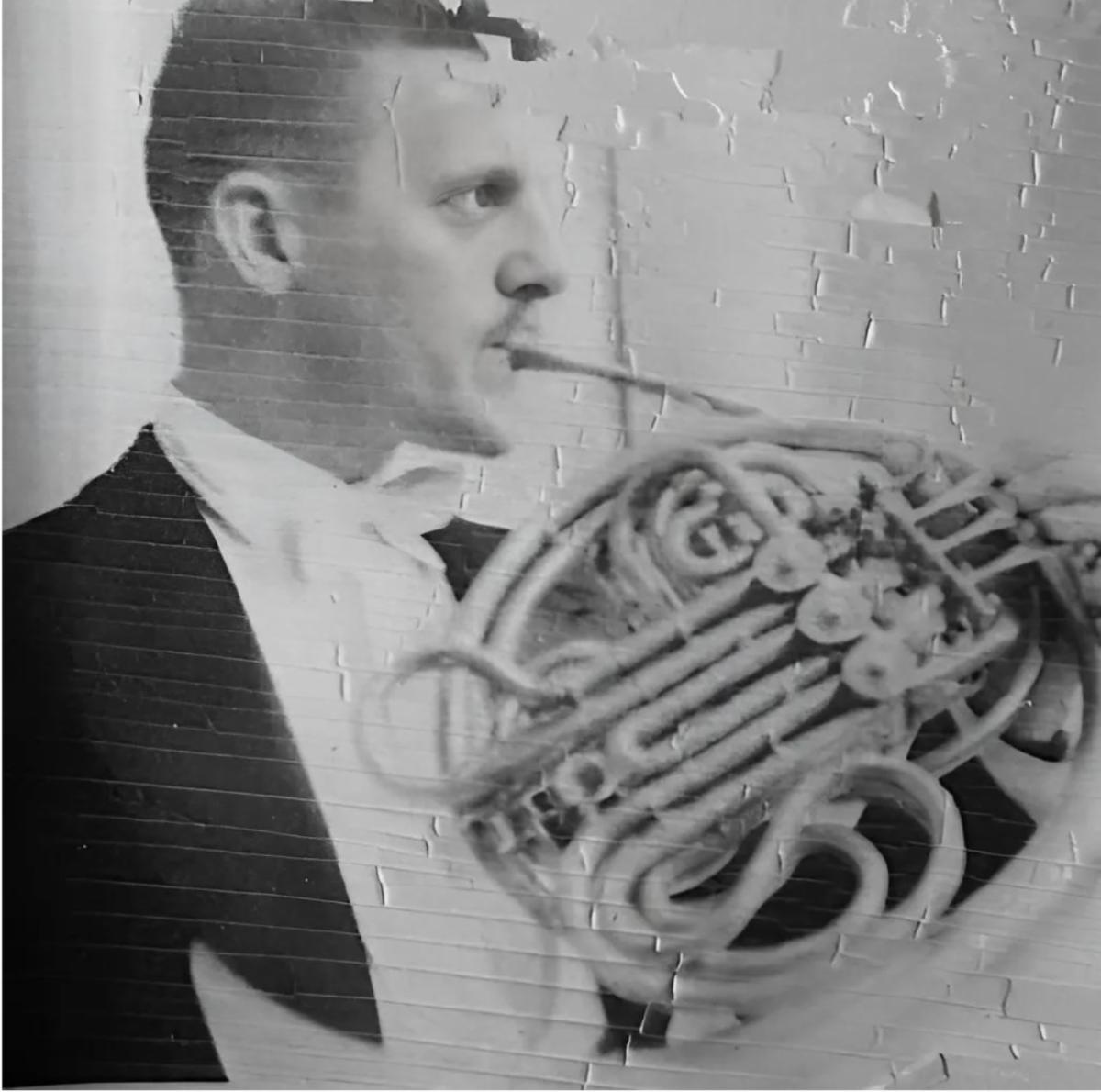
The late David Bremner Allan is one such person. A professional musician, Allan died in 2000 at the age of 72.
As his obituary notes, after graduating from Medfield High School in 1945 and a post-graduate year at Tilton School in New Hampshire, Allan joined the military and played trumpet as a member of the U.S. Army orchestra entertaining allied occupation troops in Germany. He was awarded the World War II Victory Medal, as well as the Army of Occupation Medal.
Upon Allan’s honorable discharge and return to the U.S., he resumed his education at Brown University, majoring in English Literature and earning his degree in 1952, while also pursuing his interest in music.
Read more >>
| Jobs for Medfield's Youth: 1840s Version | |
by Norma Vogel
As autumn settles in and children have returned to school, our volunteers have been busy preparing for Medfield Day, planning history-themed activities for children to learn about old and obsolete technology, specifically about tasks that can now be performed by apps in one’s cell phone.
Children starting school in 2024 will have career options that our foremothers and fathers could not have imagined. Today’s Medfield teachers, as in the past, will continue to prepare Medfield students to prosper in their own time, with its innovations and challenges, but this seems like the perfect opportunity to glance at how Medfield teachers of the distant past prepared their students for their careers.
| |
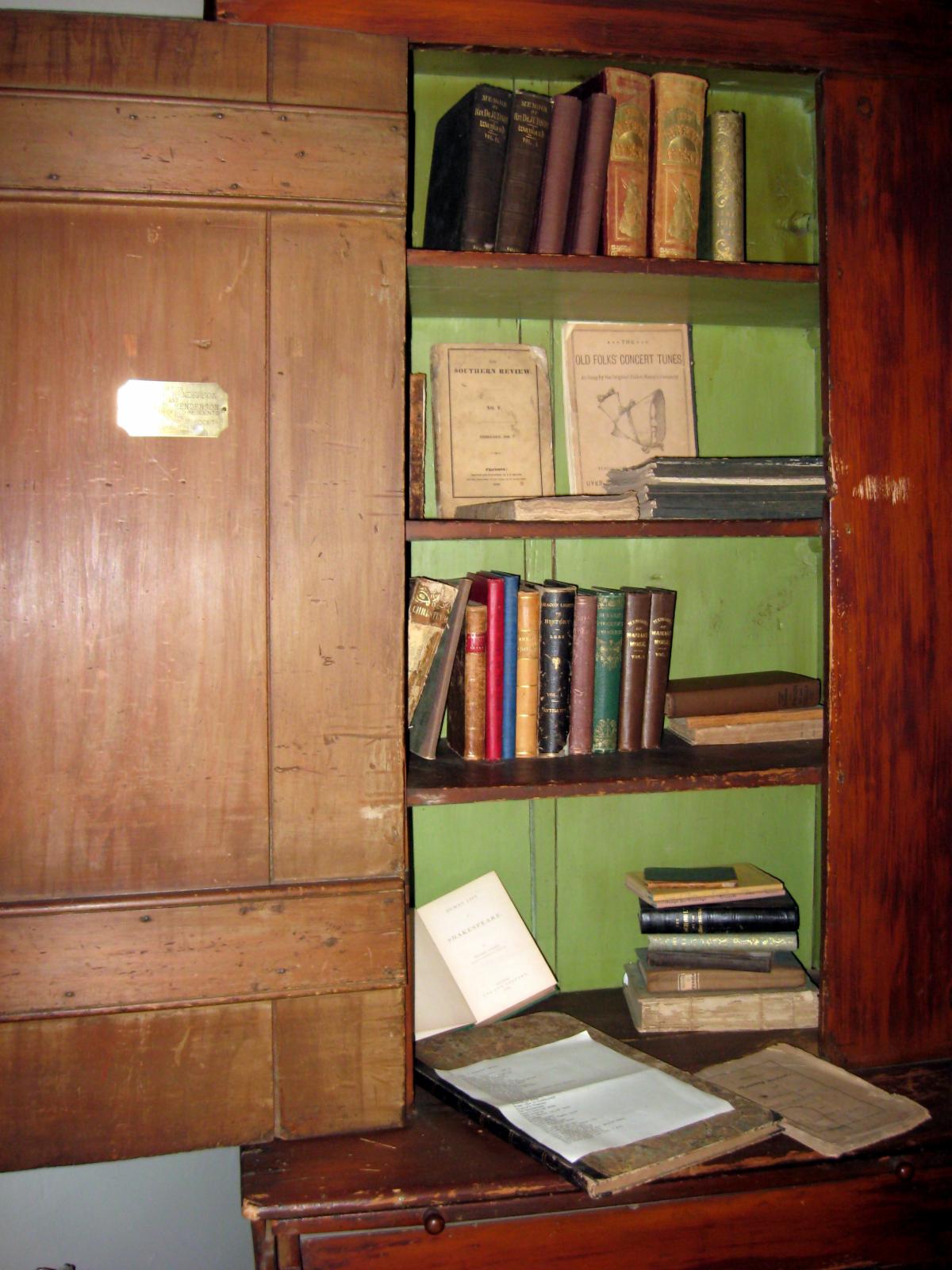
One of the lesser-known treasures at the Historical Society is a very small wooden cupboard with three shelves lined with books. This collection comprised the North School Library. Early Medfield had three school districts designated as North, Center, and South.
Back in the 1700-1800’s, Medfield was divided into three school districts: a north, a center and a south district. The first North School was built in 1732 and was located on North Street, just north of Dale Street. A new North Schoolhouse was built in 1761 at the corner of North and Harding Streets and was replaced in 1803. The 1803 school was taken away in 1849 and a new North Schoolhouse was erected further north at the corner of North and School Streets. This school was later called the Lowell Mason School and remained in use until 1920, when it closed. It was later destroyed by fire. This is the reason the street was called School Street. (Medfield Hometown Weekly)
This book cupboard is very portable, and probably dates from the school that was built in 1803 at North and Harding Streets, although it could have been used in the newer 1849 structure. Among its treasures, which include a very early edition of Stowe’s Uncle Tom’s Cabin along with other literary classics and textbooks on various subjects (some of which have penciled annotations from presumably bored students), is this curious volume: Popular Technology; or, Professions and Trades.(sic) by Edward Hazen, A.M., who also authored several other educational reference books, including The Speller and Definer (1830) and A Practical Grammar (1846).
Read more >>
| Origins of a Familiar Phrase or What Every Docent Should Know | |
by Geoff Sauter
In spite of all of all of Medfield’s wonderful historic assets, we are unfortunately lacking a museum displaying an original 18th century tavern. This is unfortunate because in their day, taverns were an important way for local residents and travelers to exchange news, conduct business, and socialize. As museums they can tell us a lot about life in the 18th and 19th centuries.
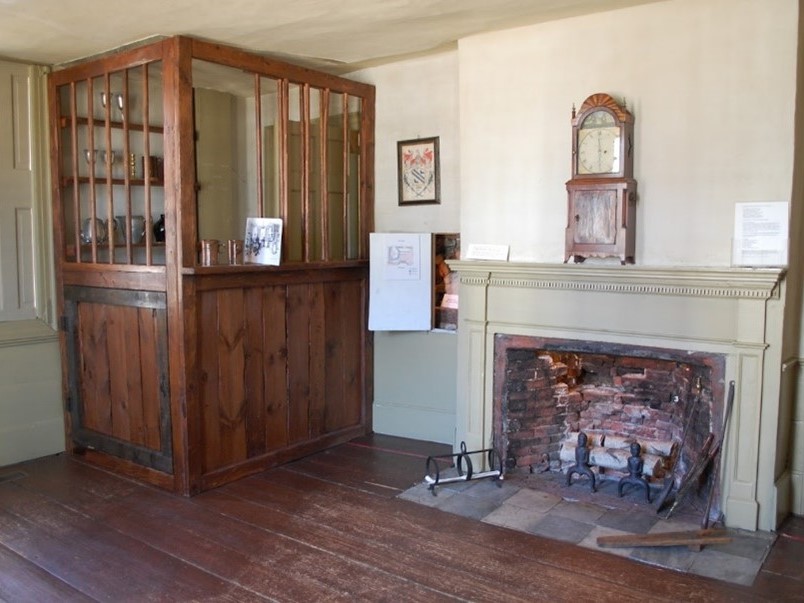
In the past year, I have visit toured two taverns that had not been modernized to current standards, the Barnard Tavern at Old Deerfield Village, and the tavern inside the Old Fort House Museum in Fort Edward New York. While both tours were enlightening, the Old House tavern revealed the source of a phrase that we commonly use today: “Bar and Grille.”
As it was explained by a docent, it was customary for the innkeeper to close the bar in the evening and go to bed leaving guests alone in the tavern. To prevent unauthorized confiscation of the beverages (grog, etc.) behind the bar, movable grates– called grilles – that could be locked were installed.
| |
Courtesy: Old Fort House Museum, Fort Edward, NY | |
Courtesy: Golden Bar Tavern, Weston, MA | |
|
I have always assumed that “bar and grille” meant an establishment that in our times served alcohol and food, but it seems clear that the grille part of the term has 17th or 18th Century origins in liquor security rather than kitchen equipment. Who knew?
Since becoming aware of this factoid I have spent some time looking for other colonial taverns with grilles and have found very few. One notable exception is the Golden Bar Tavern in Weston, MA, a museum which is unfortunately only open on one Sunday a month for two hours.
So, the grilles have for the most part disappeared. The oldest tavern in Massachusetts, the Warren Tavern in Charleston, Massachusetts, has burgers, seafood, clam chowder, and chicken birria quesadillas on the menu and does takeout. But no grille over the bar.
| |
People and Places of the Past | |
One Shining Day for Unsung Heros | |
|
It was the summer of 1961, and I was sitting comfortably at the top of the huge apple tree that was in the back yard of my family’s home on Pleasant Street. I even put a small cushion at the top where several branches converged.
It was summertime, and the living was easy. There were no Beatles or Rolling Stones, no British invasion yet. West Side Story, a musical smash hit on Broadway, became even greater as a movie that year. Alan Shepard was the first American in space. John F. Kennedy was our president. As far as anyone knew, other than Green Beret advisors, American troops were still not involved fighting in Vietnam. A gallon of gas cost 23 cents. The only Medfield restaurant that served pizza was Fayo’s, a small Italian eatery in a spot now occupied by Casabella. The only thing missing in Medfield was a public swim pond, but everything else seemed right with the world.
| |
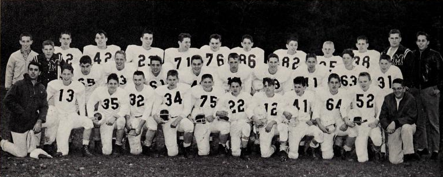
Kneeling, L. to R.: Ass’t coach Longton, B. Allen, T. Flaherty J. Blake, L. Bowman, B. Curry, J. Horgan, P. Simpson, J. Horgan, R. Kerr, K. Magnunsen, Head coach Keyes. 2nd Row, L. to R.: J. Donahue, M. Horgan, A. Dick, R. Baker, J. Miner, M. Rogers, D. Clarke, D. Olive, L. DeSorgher, C. MacIntosh. 3rd Row, L. to R.: Manager B. Hurd, C. Fisher, D. Vliet, J. Halloran, S. Harrison, E. Borman, B. Callachan, T. Flanagan, M. Scribner, J. Cook, M. Donahue, Trainer C. Daley. | |
|
There were just two weeks to go before starting double sessions practice for the Medfield High School football team. Football season began in the last week of August and continued until school started after Labor Day. The sun was shining on that day when Bob Curry and Lee DeSorgher stopped by my house. They were enthusiastic self-appointed ambassadors of freshmen football, and they came to ask if I was planning to try out for the team.
Read more>>
| | | | |