Illinois Civics Hub Newsletter | | A newsletter for Illinois teachers to support the implementation of the Illinois middle and high school civics course requirements and K–12 social science standards. | |
Illinois Civics Hub and Illinois Democracy Schools featured in recent NASBE Journal
| |
The approaching 250th anniversary of the nation’s Declaration of Independence presents states with an opportunity to inspire and prepare students to become engaged, thoughtful citizens.
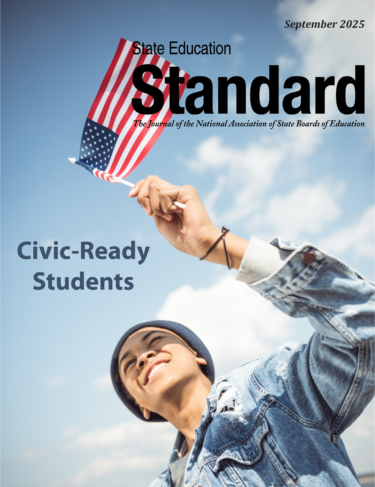
Alexandria, VA—Ahead of the nation’s 250th anniversary in 2026, the latest issue of NASBE’s State Education Standard explores how states can expand and improve civics learning to prepare the next generation of citizens.
While authors in this issue offer varied perspectives and propose different actions for state leaders, they agree on a central point: high-quality civics education is essential to preserving and strengthening American democracy. More and better civics, they argue, will inspire students to become engaged, thoughtful citizens, equipped with the knowledge, skills, and agency to participate in civic life and engage in reasoned, respectful discourse across differences.
Harvard University’s Danielle Allen, Paul Carrese of Arizona State University, and iCivics’ Louise Dubé lead the issue by revisiting a project they launched five years ago to reinvigorate civics learning. Their consensus report on the key elements of high-quality civics learning has guided districts and states across the country.
Chester E. Finn Jr. of the Hoover and Fordham Institutes lays out six ways state leaders can bolster civics education and suggests they have broad public backing to take action.
Jessica Sutter, a former DC state board member, and Audra Watson from the Institute for Citizens and Scholars present data showing young people’s dimmed attitudes toward democratic participation. They urge states and districts to focus on increasing opportunities for student civic engagement.
Turnaround for Children’s Dr. Pamela Cantor, MD; Fernande Raine of History Co:Lab; and Susan Rivers of iThrive Games Foundation explore the intersection of civics and adolescent development with an essay on what research reveals about how experiencing civics in action engages young people and serves their developmental needs.
To encourage schools to place greater emphasis on nurturing future citizens, a dozen states are acknowledging excellence in civics learning through diploma seals and other means, write Andrea Benites, Lisa Boudreau, and Shawn Healy from iCivics. They urge more states to follow suit.
Kei Kawashima-Ginsberg, a leading expert in youth civic engagement, and Mary Ellen Daneels from Illinois Civics Hub describe the decade following Illinois’s mandate of a high school civics course. They highlight the work of Illinois Democracy Schools, which were created through collaborative community and organizational efforts to foster faithful implementation of high-quality civic learning.
NAGB’s Martin West, also a Massachusetts state board member, underscores the need to improve civics education and explains how the national civics test can shed light on the lackluster state of civics education nationally, and soon, individual state progress.
Bernice Butler, executive director of the DC state board, and Anna Mayer, its former student member, describe how the board has made youth involvement in governance meaningful. Ross Wiener, an education consultant, details three ways state boards can ensure that students’ everyday school experience models what it means to live into America’s ideals of government.
Finally, in the NASBE Interview, Thinking Nation’s Zachary Cote urges states to foster students’ historical thinking as a key civic disposition. He shares examples of how improved teaching of history builds more informed citizens.
Read the September issue of the State Education Standard,
“Civic-Ready Students.”
| |
Register for the 2025 CDP Law Related Education Conference
| |
The Constitutional Democracy Project’s Professional Development Conference for Teachers in Civics, Law, and Government is a one-of-a-kind working conference that brings together teachers, professors, lawyers, judges, civic leaders, cultural institution scholars, civic education specialists, and others to highlight best practices for teaching young people awareness of the law, the legal system, and their rights and responsibilities as engaged citizens.
Guardians of Democracy: Law, History, & the Classroom is a one-day professional development conference for educators and is the theme for this year's conference.
Whether you’re a middle or high school teacher, instructional coach, or civic education advocate, this conference offers tools to strengthen your teaching and deepen your students' commitment to democratic ideals. Don't miss this opportunity to enhance your skills, share resources, and connect with fellow educators dedicated to navigating and teaching complex, contentious subjects.
There is a $25 registration. A link for payment will be sent upon registration. Invoices can be issued upon request.
When: Friday, October 31, 2025, 8:30 a.m.–2:30 p.m. (CT)
Where: Conviser Law Center, Chicago-Kent College of Law, 565 W. Adams Street, Chicago (1 block west of Union Station)
Who: Middle, High School & Pre-service Teachers
CPDU Credit is Available
Use this link to find out more!
| |
Volunteer for NCSS 2026 in Chicago
| |
NCSS 2026 needs you!
In preparation for the 2026 National Council for the Social Studies Annual Conference, we are looking for volunteers to help make this a wonderful experience. We need volunteers to organize and provide logistics before and during the conference. The 2026 NCSS Conference will be held on December 4-6 at the Hyatt Regency Center in Chicago.
Those who volunteer on the Local Arrangements Committee may qualify for free or discounted conference registration contingent on the number of hours you serve.
Explore opportunities serve on this Google Form!
| | |
Artificial intelligence is evolving quickly, shaping conversations both in policy circles and in classrooms. On one hand, policy debates continue over regulation, ethics, and the role AI should play in society. On the classroom side, teachers are examining practical ways AI could enhance learning. This webinar series offers educators a chance to learn about the current policy landscape alongside considering how AI may be used to support civil discourse in the classroom. Join Sphere on October 2 from 7:30–9:00 p.m. (ET) via Zoom to explore this conversation further.
Sphere invites you to join this webinar designed to bring clarity and spark conversation. In the first part of the webinar, leading scholars, Jennifer Huddleston of the Cato Institute and Tatiana Rice of The Future of Privacy Forum, will unpack the current AI policy landscape and explore the opportunities and challenges it presents. In the second part, practicing Sphere alumni educators, Kimberly Hammers of Chesapeake Public Schools and Sasha Litzenberger of Mesa Public Schools, will share how they are experimenting with AI to foster civil discourse skills.
- This session will be presented via Zoom.
- All Sphere alumni and interested educators and administrators for grades 5–12 are eligible to attend.
- Earn a professional development certificate for attending.
Register Here!
| |
Talk. Decide. Act.
Virtual Workshop Series from NIFI
| |
The National Issues Forums Institute (NIFI) is pleased to announce a new workshop series for fall 2025. Each one-hour workshop will focus on one aspect of NIFI’s renewed commitment to help more Americans talk, decide, and act better together.
During the workshop series, NIFI staff, board members, and special guests will provide an introductory overview of moderating for deliberation, framing issues for deliberation, and using deliberation to help individuals move beyond “just talk” to decide and act together.
We hope you’ll make plans to join us for this workshop series and share it with those in your network!
Registration for TALK on October 9 is open now.
TALK: October 9, 2025
SAVE THE DATES:
-
DECIDE: November 6, 2025
-
ACT: December 4, 2025
| |
CAN THE PRESIDENT DO THAT?
Four Videos for Tackling an Age-Old Question
| |
The limits on executive power have shrunk since the creation of the Constitution as the size and scope of national government has grown. If you’re looking for ways to address these historical and contemporary questions, try some of these resources from Retro Report.
Executive Orders
Two of our World War II-era films deal with the use of executive orders and the power of the president to create policy without congressional approval:
War Powers
-
How the Korean War Changed the Way the U.S. Goes to Battle: This short doc provides a clear case study in how constitutional powers can be altered without changing the document itself. Your students will learn about a war that was cast as a “police action,” and in turn empowered the executive branch.
The Power of the Purse
-
Who Controls the Purse? Presidential Power and the Fight Over Spending: Does the president have to spend the money that Congress has appropriated or do appropriations bills set the limits on what the government can spend? This short doc shows a clash between President Nixon and members of Congress in the 1970s that helps us grapple with these constitutional questions.
More Videos for Government Class
| |
Bill of Rights Institute October Remote Trainings
| |
Join the Bill of Rights Institute in October for our new remote trainings! Each remote training will help educators gain insights into new teaching methods, primary sources, and free classroom resources.
From the Oval to the Bench: Landmark Cases on Executive Authority
How have the powers of the presidency been shaped and challenged through landmark Supreme Court cases? We are tackling this question on Wednesday, Oct. 8.
This remote training is designed to help teachers gain new tools to help students analyze foundational debates over executive authority. Participants will utilize BRI resources, such as Life, Liberty, and the Pursuit of Happiness and Supreme Court DBQs, along with primary sources and case studies.
Each resource can be used in the classroom to build critical thinking, constitutional reasoning, and civic understanding for students.
Presenter: Lori Rech, Regional Manager, Programs
Date: Wednesday, Oct. 8, 2025
Time: 6:00-7:00 p.m. (CT)
REGISTER
Inquiry in the Age of AI: Using BRI to Ground Student Thinking
Learn how to harness the benefits of artificial intelligence (AI) in the classroom with the Bill of Rights Institute. Register for our Inquiry in the Age of AI: Using BRI to Ground Student Thinking Remote Training on Tuesday, Oct. 14.
During the remote training, participants will explore how they can use AI as a support for primary sources and lessons using BRI resources. The remote training will share model strategies to strengthen your students’ curiosity, judgment, and writing in today’s digital landscape by asking better questions, evaluating sources thoughtfully, and constructing evidence-based arguments.
Presenter: Shawn McCusker, Senior Manager, Program Partnerships
Date: Tuesday, Oct. 14, 2025
Time: 6:00-7:00 p.m. (CT)
REGISTER
| |
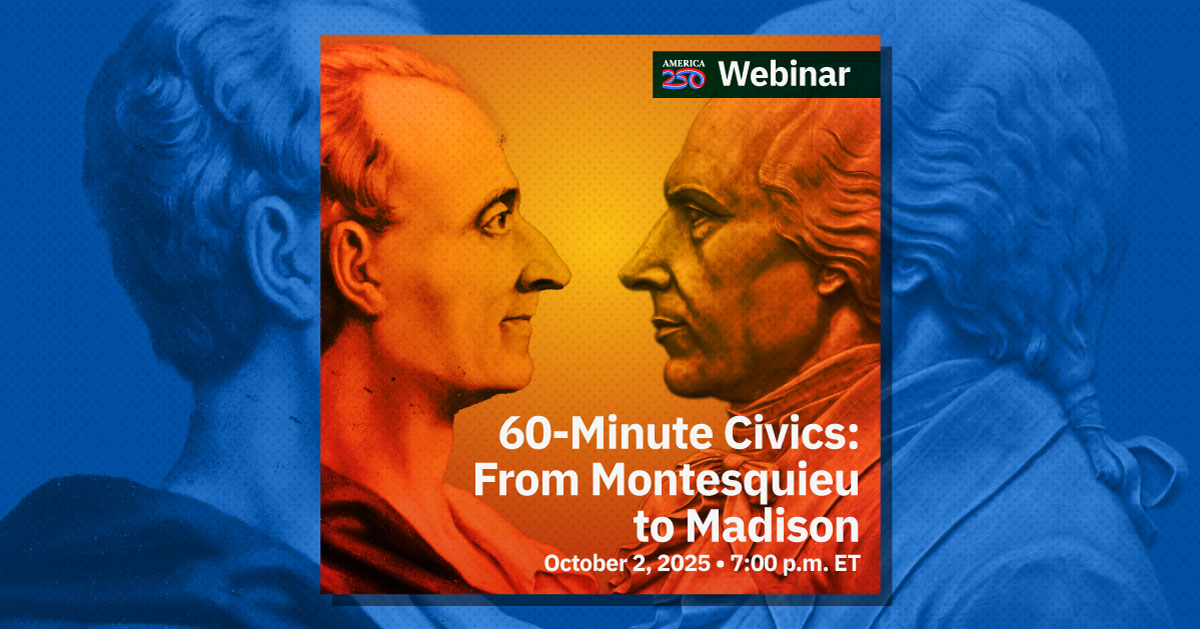
60-MINUTE CIVICS
From Montesquieu to Madison:
The Dilemmas of Republics Large and Small
| |
October 2, 2025
6:00–7:00 p.m. CT | Free Virtual Program
How can a republic survive when it grows in both physical size and population? Political philosophers and America’s founders grappled with this enduring question. In this America 250 webinar, we’ll trace the intellectual journey from Montesquieu to Madison, exploring the dilemmas of designing a government capable of balancing liberty, stability, and scale. Understanding these historical debates can shed light on today’s tensions between national unity and local autonomy in a diverse, modern democracy. This discussion will directly connect to We the People: The Citizen & the Constitution, Units 1 and 2.
Register Here
| |
Digital Citizenship Week is October 20–24, 2025!
| |
In the age of AI, helping kids maintain their digital well-being has never been more important. For this year's Digital Citizenship Week, Common Sense Education got brand-new, updated resources that address these issues with engaging activities that your students will enjoy. Join with thousands of teachers and students worldwide to promote digital literacy and citizenship in your classroom!
Common Sense Education has calendars with suggested activities for each day of the week and for every grade level, K–12. You can try out just one lesson or participate all week.
Visit the Digital Citizenship Week Page
| |
Back-to-School Toolkit: Teach Civics & News & Media Literacy with Free Resources
| |
This back-to-school season, empower students to find information they can trust, share, and act on. With free classroom resources from the News Literacy Project, educators can ensure all students have the knowledge and ability to participate in civic society as well-informed, critical thinkers.
The News Literacy Project, a nonpartisan education nonprofit, supports middle and high school civics educators with free resources to develop students’ foundational news and media literacy skills. NLP’s Checkology® virtual classroom features interactive lessons, infographics, and classroom-ready activities that explore news media bias, misinformation, the First Amendment and more.
To get started, explore NLP’s Back-to-School Toolkit, which includes the News Literacy Starter Pack and engaging resources like Daily Do Now slides.
All materials are free — simply register for and log in to Checkology to access the full collection. (And new this year: Checkology is now available on Clever for seamless district-wide integration!)
| | |
Interested in applying for the 2026 Supreme Court Summer Institute? Join us for a brief informational webinar on the Institute and its application process.
October 6, 2025, 6:00-6:30 p.m. (CT)
REGISTER NOW
| |
Invitation: 20–25 Minute Survey on School Climate Trends
| |
International School Climate Center invites educators, mental-health professionals, and school-climate leaders to share insights in a 20–25 minute online survey examining how research, policy, and practice are shaping school climate across the United States. Your experience in classrooms, schools, and districts is essential to building a clearer picture of what’s working and where support is needed.
This project is sponsored by the Center for Character and Citizenship at the University of Missouri–St. Louis. At the end of the survey, you’ll be able to opt in to receive a summary of findings and indicate whether you’re open to future contact for follow-up questions. If you prefer, you may also email Jonathan Cohen, Ph.D. at ISClimate@umsl.edu to express interest.
Thank you for considering this request and for the work you do every day to support students and school communities.
Start the survey: https://umsl.az1.qualtrics.com/jfe/form/SV_6qZljJtaoxuoAF8
| |
Enhance Your Knowledge as a Holocaust Educator
| |
Take some time in October to enhance your knowledge and skills as a Holocaust educator by joining the Echoes and Reflections free online courses. They will be offering their course on the Holocaust & WWII as well as a course on media literacy.
Courses offer a certificate of completion for 4-10 credit hours and are available for continuing education credits. View below to learn more and sign up today!
Examining the Holocaust and World War II
Explore The U.S. and the Holocaust, a film by Ken Burns, Lynn Novick & Sarah Botstein, to learn how to teach about America’s response to the Holocaust within the context of WWII. This course focuses on topics such as antisemitism, immigration, xenophobia, and the "Final Solution."
The course is open for four weeks, and participants complete it at their own pace. Completers can earn 6-10 credit hours as well as graduate credit through the University of the Pacific.
This course was developed in collaboration with Florentine Films, PBS LearningMedia, and the United States Holocaust Memorial Museum.
Course Dates: October 6-November 2, 2025
REGISTER
Decoding Propaganda: Empowering Critical Thinking through Media Literacy
How was propaganda used in Nazi Germany to escalate the events of the Holocaust? How can learning about this history help inform students in how they interact with today's media? Examine propaganda deployed by the Nazis to discriminate against Jews and other minority groups and gain tools to facilitate classroom discussions and support students to analyze media in today’s world.
The course is open for two weeks, and participants complete it at their own pace. Completers can earn 4 credit hours as well as graduate credit through the University of the Pacific.
Course Dates: October 13-26
REGISTER
| |
Beyond History Class: Teaching America’s 250th
| |
The nation's 250th anniversary is on the horizon, presenting a once-in-a-teaching-generation opportunity to bring the Declaration of Independence to life. But its power extends far beyond the history classroom—it can be woven into every subject area.
Join our free, interactive webinar on October 2 at 6 p.m. CT as we explore how to weave the Declaration's enduring themes into your entire curriculum.
In this practical, interactive session hosted by Natacha Scott, iCivics’ Director of Educator Engagement, you will:
- Analyze the Declaration of Independence through a fresh, interdisciplinary lens.
- Discover practical, standards-aligned strategies to connect the Declaration’s themes to your curriculum and pacing guide.
- Develop and share strategies with fellow educators for fostering rich civic dialogue in any classroom.
Don't miss this opportunity to gain the interdisciplinary strategies needed to make America’s 250th a truly unforgettable learning experience.
REGISTER
| |
2025 Geography Education in the 21st Century
Virtual Conference
| |
The Illinois Geographic Alliance, LLC (IGA) and the Department of Geography, Geology, and the Environment at Illinois State University are excited to announce the 2025 Geography Education in the 21st Century virtual conference, a conference for geography educators that focuses on methods, lessons, and resources for teaching geography.
What: Virtual conference for geography educators that includes a keynote and breakout sessions*
When: Saturday, November 1, 2025, from 8:30 a.m. to 12:00 p.m. CT
Where: Zoom (Link will be emailed to you a day or two prior to the conference.)
Who: This virtual conference is applicable for a wide range of geography educators, including pre-service (i.e., college students) and in-service elementary school teachers, middle school/junior high teachers, high school teachers, and community college/university instructors and professors.
Why: This conference is a fantastic opportunity for you to connect with geography educators from around the state. The conference includes a keynote and a variety of breakout sessions* presented by experienced educators.
Cost: Registration is free! PD hours (CPDUs) are provided to in-service Illinois K-12 educators at no charge.
Registration: Please complete the online registration form to register for the conference.
Questions: Please contact the Illinois Geographic Alliance, LLC, at IGA@IllinoisState.edu
*Note: We are looking for presenters for the breakout sessions! If you or one of your colleagues is interested in sharing a lesson, activity, resource(s), or experience, please reach out to the Illinois Geographic Alliance, LLC, at IGA@IllinoisState.edu by October 15, 2025.
| |
Four Score Speaker Series
| |
Join ALPLM on Thursday, October 9, from 7 p.m. to 8 p.m. (CT), for a conversation with author Dr. Saladin Ambar on his latest book, Murder on the Mississippi: The Shocking Crimes That Shaped Abraham Lincoln. In Murder on the Mississippi, award-winning historian Saladin Ambar unearths the horrors that shaped a young Abraham Lincoln’s worldview, pushing him to find his political voice in one of the earliest and most pivotal speeches of his career—the Lyceum Address—in which he referenced each of these three crimes. Confronted by lawlessness, racial terror, and his own inner demons, Lincoln’s battle was political, deeply personal, and reflective of a nation already at war with itself.
Through gripping storytelling and meticulous research, Murder on the Mississippi sheds new light on Lincoln’s transformation from a struggling young legislator to a man ultimately willing to risk everything to save a nation from itself. The forces that shaped him then—violence, division, and the specter of tyranny—are forces we still reckon with today. This is not just a story of Abraham Lincoln. It is a story of America.
Saladin Ambar is Professor of Political Science and Senior Scholar at the Center on the American Governor at Rutgers University’s Eagleton Institute of Politics. He is Co-Director of the Democracy Committee for New Jersey’s Reparations Council and contributed to the Lincoln Presidential Foundation’s docuseries on the Lyceum Address. He hosts the podcast This Moment in Democracy and has been a fact-checker and contributor for the Smithsonian Channel, CNN’s Race for the White House, and PBS’s MetroFocus. He is the father of teenage triplets and lives in Philadelphia.
REGISTER
| |
The American Story from the National Archives
| |
The National Archives Museum will soon unveil the new 10,000-square-foot permanent exhibit titled The American Story. Opening ion October 23, it will showcase pivotal documents, original records and artifacts, and countless other treasures that tell our nation’s story, complete with interactive displays and state-of-the-art technology.
For those unable to visit Washington, D.C., the National Archives is offering a "virtual" first look in the lead up to this exciting reopening. Each week, they will take you through the various galleries, showcasing original records that will be featured. This week, the National Archives will walk you through the first two galleries: Chartering Freedom and Land and Home.
The Declaration of Independence enshrined the nation’s founding ideals of freedom and equality. The Constitution recognized that the realization of those principles would require a “more perfect union.” The Emancipation Proclamation symbolized the progress to fulfill the ideals upon which the United States was founded. At the heart of this gallery are phygital displays of the Declaration of Independence and the Emancipation Proclamation, milestones in our ongoing dialogue about freedom in our country.
For more than 250 years, generations of Americans have championed the pursuit of freedom that has brought the nation closer to its revolutionary ideals. “Chartering Freedom” explores those ideals.
Keep Reading
| | |
Finding reliable information can feel like navigating a jungle of claims, clickbait, and AI-generated content. If students don’t know how to vet what they see, they can unknowingly perpetuate bias and misinformation. Build a practice of engaging with media responsibly in your classroom with these resources.
Above the Noise
Each episode from this award-winning video series comes with a lesson plan, a student viewing guide, and additional resources to support classroom discussions.
Youth Voices on Misinformation
Have your students reflect on the consequences of (and solutions for) misinformation with the Call for Change Youth Media Challenge project. Come to our free online workshop on October 7 to learn all about it!
| | |
The annual U.S. Media Literacy Week is hosted by the National Association for Media Literacy Education (NAMLE) this year October 27-31. The mission is to highlight the power of media literacy education and its essential role in education all across the country. U.S. Media Literacy Week calls attention to media literacy education by bringing together hundreds of partners for events and activities around the country. The theme for U.S. Media Literacy Week celebrates one of the five components of media literacy’s definition each day of Media Literacy Week: Access, Analyze, Evaluate, Create, and Act.
Visit the NAMLE website to learn more.
| | |
The 2026 National Civics Bee® invites students in grades 6–8 to explore an issue in their community, propose a solution, and compete for recognition and prizes. The essay application portal is open now and closes on Feb. 3, 2026, at 11:59 p.m. HST.
LEARN MORE
| |
Global Writing Competition for Young Writers Ages 13-19
| |
Write the World and the Supreme Court Historical Society are proud to announce a global online writing competition for young writers, ages 13-19, centered on the theme “The Rule of Law.” The competition, to run from October 6 to October 27, 2025, invites teens from around the world to engage with one of the foundational principles of democratic life — and to do so in their own voices, through the power of the written word.
The competition welcomes entries, from 50 to 1,000 words, in three genres: personal narrative, opinion editorial, and creative writing (e.g., poetry, songwriting, short story). Students may enter one, two, or all three categories. Final entries will be judged by distinguished federal judges, with one judge presiding over each genre. The winner in each category will receive $100 cash prizes, and the top peer reviewer in each category will receive $50. The winning and other exemplary pieces will be published by both Write the World and the Supreme Court Society in their websites, blogs, and newsletters.
Winners will be announced on November 14, 2025. Encourage teens you know to enter.
More Details
| |
Illinois Inclusive History Calendar
| |
The Illinois State Board of Education has designated October as:
- LGBTQ+ History Month
- Filipino American History Month
- Italian-American Heritage Month
- National Disability Employment Awareness Month
Check out the I3 Inclusive History calendar for resources to celebrate.
| |
ICSS Fall Conference: United We Teach: The Social Studies Classroom as a Laboratory for Civic Trust”
| |
2025 Illinois Council for the Social Studies Fall Conference
Harper College, Palatine, Illinois
Friday, October 17, 2025
REGISTER
| |
Fall Guardians of Democracy Microcredential Courses
| | | | |