Official Newsletter of BERTOLINO LLP | | | |
Our Firm
Tony R. Bertolino, Esq.
Managing Partner
Sheri L. Middlemas
Chief Operating Officer
Senior Associates:
Troy Beaulieu, Esq.
LaJuana Acklin, Esq.
Kerry Bloodsaw, Esq.
Associates:
Amy Cadwell, Esq.
Legal Support:
Laura S., J.D.
Colleen Rainey, Paralegal
Evan Looney, Legal Assistant
Client Success:
Jasen Dalus, Manager
Donald "DJ" Collora, Liaison
Jessica Martinez, Intake Specialist
London de la Teja
Accounts Receivable Manager
Cimone Murphree
Public Education & Regulatory
Awareness Manager
Dena Lackey
Marketing Specialist
| | |
Texas Educators New Reporting Requirements under Senate Bill 571
By Tony Bertolino, Esq.
Texas teachers now face new reporting obligations, and understanding these requirements is essential to maintaining compliance and protecting your teaching certificate. Recent updates from the Texas Education Agency (TEA), including strengthened misconduct reporting rules, mandatory timelines, and expanded categories of reportable behavior, mean that teachers, administrators, and school staff must know exactly when and how to file a report when the matter involves suspected abuse, neglect or harm of a child. TEA expects timely, accurate reporting through designated channels such as the Misconduct Reporting Portal (MRP). Failing to meet these obligations can lead to serious legal consequences.
Educational professionals, including teachers and superintendents, have mandatory reporting duties under Texas law if they suspect abuse, neglect, or harm to any child. Senate Bill 571 (SB 571) outlines these mandatory reporting requirements for professionals under state law and the consequences for failing to comply.
Various individuals have a legal duty to report suspected child abuse, neglect, or harm, including the following:
- All adults; and
- All school professionals, including teachers, teacher aides, school nurses, coaches, school administrators, custodians, and other staff.
These individuals cannot pass on or delegate the duty to report to another person. Internal reporting (e.g., within the school district) alone is insufficient to fulfill the legal duty to report. So reporting concerns to your supervisor is not enough. Reports must also occur within 24 hours of the time that an individual learns about suspected abuse, neglect, or harm.
Individuals who make good-faith reports about abuse, neglect, or harm to a child, even if their concerns are ultimately unfounded, are protected from civil and criminal liability for their actions. Texas law presumes an individual made a report in good faith unless proven otherwise.
Failing to report suspected abuse, neglect, or harm to a child can result in severe consequences. Those consequences can include criminal charges, civil penalties, and loss of state educator licensing or certification. In some cases, the charges can rise to the level of a felony if the failure to report is intended to conceal misconduct.
SB 571 strengthens existing law concerning reports of child abuse, neglect, and harm by school employees by mandating faster reporting and a clear framework for making reports. Some of the new provisions in this law include the following:
- Principals must report alleged educator misconduct to their superintendents within 48 hours of knowing about the misconduct;
- Superintendents must report qualifying misconduct allegations to the Texas Education Agency (TEA) or the State Board for Educator Certification (SBEC) within 48 hours of knowing about the misconduct;
- Superintendents must submit all required misconduct reports through the TEA Misconduct Reporting Portal.
School superintendents must remember that reporting misconduct to TEA does not fulfill their misconduct reporting duties under Texas law. They must still complete required reports to local law enforcement and the Department of Family and Protective Services (DFPS).
Reportable misconduct includes any misconduct involving school employees, contracted service providers, and any individual who works directly with students. If a school employee’s conduct may pose a risk to one or more students, TEA can investigate the matter even if the employee is not licensed or certified. SB 571 expands reportable misconduct to include boundary violations and inappropriate communications.
Likewise, the duty to report to “law enforcement” encompasses only certain recognized law enforcement agencies, including:
- Texas Department of Public Safety (DPS)
- City police departments
- County sheriff offices
- County constable offices
School and charter school police departments do not qualify as “law enforcement” agencies under SB 571. Therefore, school personnel must fulfill their legal obligations by reporting to the correct law enforcement agency.
In addition, Texas educators generally must complete required training on student safety and abuse prevention. Newly employed educators, or those who have not previously completed the training, must complete it. Similarly, if the training is updated, all educators must complete it, even if they completed similar training in the past. The required training covers the following topics:
- Child abuse, sexual abuse, and trafficking;
- Warning signs of abuse and neglect in children; and
- Special signs of abuse and neglect in children with significant cognitive disabilities, including non-verbal signs.
TEA offers a free training course meeting state requirements, or educators may complete an equivalent course used in their school system.
Finally, TEA reminds educators to report suspected harm to children immediately and not investigate situations on their own. Doing so may impede law enforcement investigations and inadvertently harm the child(ren) involved. Even when in doubt, it is better to err on the side of reporting rather than not reporting. Again, individuals must report suspected abuse themselves, not just report it to their superior or another person.
| |
"Sheri-isms" in Action: October Edition
Stop Feeding the Monsters Under Your Desk
by Sheri Middlemas
| |
" You do not need a silver bullet or a call to the Ghostbusters."
- Sheri Middlemas
Every professional has monsters. Some hide in overflowing inboxes, others lurk in neglected paperwork, incomplete records, unanswered complaints, and that compliance task you have been moving to tomorrow’s list since last week.
They are sneaky little creatures. They thrive on avoidance, grow stronger with procrastination, and multiply when we assume a problem will resolve itself. For licensed professionals, these monsters can do more than disrupt your day; they can put your professional license at risk.
That complaint you meant to address? It could become a formal grievance. That regulatory letter you haven’t opened? It may contain a critical deadline. That shortcut you have been taking in your practice? It could raise questions about your compliance with licensing rules.
Here’s the thing: Problems rarely improve with age, and your professional license is too valuable to leave unprotected.
Your license represents years of education, hard work, sacrifice, and professional achievement. It allows you to earn a living, serve your clients or patients, and build a career. Protecting it should not be an afterthought or something you consider only when your licensing board begins asking questions.
Prevention is Your Flashlight
The good news? You do not need a silver bullet or a call to the Ghostbusters. You need awareness, preparation, and a willingness to take ownership.
Know your regulatory obligations. Maintain appropriate documentation. Keep up with applicable rules and requirements. Address concerns promptly rather than hoping they will just disappear. If you do receive a Board complaint do not ignore it, do not assume it will work itself out, and do not miss a deadline for action because you are afraid to open the envelope.
Do Not Let the Monsters Become Part of the Furniture
One of the biggest risks in a regulatory profession is becoming so accustomed to a questionable practice that it starts to feel normal. “We’ve always done it this way” is not a compliance strategy. Neither is assuming that no news from your licensing board means all is well.
Review your practices. Correct problems as soon as they are identified. Ask questions when requirements are not clear. Recognize when a concern calls for professional guidance. Remember, the goal is not simply to respond when your license is under attack, it is to take reasonable steps to protect it before a threat develops.
The Bottom Line
This October, look under your professional desk:
-
Know the rules. Ignorance of a licensing requirement is not a reliable defense.
-
Adress concerns early. Small problems can become serious regulatory matters.
-
Take every board communication seriously. Deadlines matter.
-
Get help when you need it. You do not have to navigate a licensing threat alone.
Your license is more than a credential, it is your livelihood, your reputation, and the foundation of your professional future. Stay informed, stay compliant, and protect your license.
| |
Welcome to the Team
Jessica Martinez!
We are pleased to welcome Jessica Martinez to Bertolino LLP as our newest Intake Specialist.
Jessica brings a diverse professional background in client service, financial services, insurance, and real estate, along with a genuine passion for helping others. As one of the first points of contact for individuals reaching out to our firm, she is committed to making every person feel heard, understood, and supported during what can often be a stressful or uncertain time.
A Fort Worth native, Jessica is bilingual in English and Spanish and believes everyone has a story worth hearing. Her compassionate approach, strong communication skills, and ability to simplify complex information help clients feel comfortable and confident as they take their first steps with our firm. She holds an Associate's degree from Tarrant County College and is continuing her education through paralegal studies.
Outside of work, Jessica enjoys spending time with her husband and children, discovering new restaurants, and exploring new places. With a curious mind and a great sense of humor, she describes herself as a "professional overthinker" who loves meaningful conversations, asking questions, and making people laugh.
Jessica's warmth, dedication to helping others, and commitment to professional growth make her a wonderful addition to our team. We are excited to welcome her to Bertolino LLP and look forward to the positive impact she will make in supporting the licensed professionals who turn to our firm for guidance.
| | |
Texas Appraiser Licensing and Certification Board v. TN
Facts: TN hired Bertolino LLP to defend against a complaint filed with the Board by a consumer in a residential mortgage finance transaction. The complainant made accusations that TN had violated state law, the Uniform Standards of Professinal Appraisal Practice (USPAP), and Board rules in connection with his appraisal of a residential property as part of the mortgage finance transaction. These allegations threatened to harm TN’s professional reputation and exposed him to risk of discipline from the Board.
Outcome: Bertolino LLP evaluated TN’s situation, assessed the applicable law and we compiled the necessary documents, arguments and evidence to defend against the accusations and show the Board this complaint was unsubstantiated and required dismissal. Bertolino LLP’s legal team developed a well-written response demonstrating the complaint lacked merit and ought to be dismissed. The Board assessed our submission and agreed to dismiss the charges with a non-disciplinary warning and took no action against our client. This allowed TN to return to taking care of his clients without spending more time dealing with this unsupported complaint.
| | |
Avoiding Regulatory Problems Impacting Your Career by Standing Mindful of Boundaries
by Troy Beaulieu, Esq.
| | |
In my time defending licensed professionals and my prior experience as a state regulator, I have discovered that many times thoughtful attention to appropriate boundaries in someone’s professional life can help prevent misunderstandings, problems or issues that give rise to regulatory complaints.
Many times, complaints filed with someone’s state regulator involve allegations that professional boundaries were crossed, inappropriate communication took place, or some form of harassment took place. This is often the result not of intentional misconduct by license holders simply failing to stay mindful of professional boundaries. Ensuring that workplace professional relationships and client/patient relationships and conversations do not cross into personal, private or non-work-related contexts which may offend someone, cause hurt feelings, confusion or misunderstanding is critical to staying out of regulatory trouble. Such conduct can often lead to facing a regulatory complaint with accusations of professional misconduct. In fact, in certain industries and professions, such communications may be viewed by your licensing agency as a per se violation of the law that supports disciplinary action, civil liability or in extreme cases, criminal consequences. To void these legal problems, I have listed below some best practices that will help you minimize the risk of getting a complaint based on this sort of issue.
Avoid social media, text communications or other electronic communications through unofficial work channels with professionals, coworkers, clients or patients.
Avoiding these sorts of communications with colleagues, coworkers and other professionals reduces the risk that you may inadvertently offend someone you have a professional / working relationship with, or cross boundaries with a client or patient and it helps insulate you from a potential complaint that you’ve somehow done something wrong, offended, harassed or crossed boundaries. This is especially significant for mental health, health care, education or other professionals who typically have specific prohibitions on relationships beyond their professional client / patient connection, and where such conduct can expose the license holder to significant legal liability impacting their license to practice.
Refrain from discussing politics, religion or other personal topics or issues at work with colleagues, or with clients or patients
Many sensitive or divisive topics can spark an emotional response by people, and you may be unaware of someone’s strong feelings on a topic. Things like abortion, the death penalty, gun rights / gun violence, politics, or religion can generate sudden and unexpected conflict in a professional setting. This can expose to you to the risk of a misunderstanding or issue that generates a discrimination or harassment complaint or other allegations of misconduct lodged with your regulatory agency. Staying clear of these topics in the workplace and avoiding such discussions with coworkers, patients and clients further reduces the risk of receiving these sorts of complaints that threaten your professional reputation, livelihood and license.
Document communications in writing through official communication tools
When you need to communicate about matters involving the professional relationship with colleagues, clients or patients, utilize the industry or employer recognized communication tools for doing that and document all your communications so there is no ambiguity, confusion or lack of clarity. This provides a valuable written record of any communications that took place to demonstrate the discussions were of a professional and work-related nature and done through appropriate tools / channels only. Many licensed professionals are required to maintain records reflecting their communications with clients and patients and can face liability for failing to do so.
Avoid relationships and social interactions beyond the professional realm with coworkers, colleagues, clients or patients
Licensed professionals should avoid personal, romantic or other non-professional relationships or interactions with colleagues, co-workers, patients or clients to reduce their risk of regulatory complaints. In fact, some relationships are outright prohibited by law and can even expose certain license holders to criminal liability (for example, a psychologist who has a romantic relationship with a client or an educator who has an inappropriate relationship with a student may face criminal felony charges). License holders should be mindful to avoid meeting with these individuals in non-work-related contexts or participating in social events, or activities with them. Going out to dinner, going drinking at a bar, or having people over to your house can all create increased legal risks and expose license holders to allegations of inappropriate conduct, boundaries violations or improper contact. Staying well clear of these relationship boundaries helps reduce the risk of allegations, misunderstandings and a regulatory complaint that requires defending your professional reputation against misconduct accusations.
Overall, licensed professionals should be very careful about the professional relationships they develop with co-workers, colleagues, clients or patients.
The law provides specific boundaries, rules and requirements which can be unique to your industry or license. Failure to follow those parameters can expose you to regulatory or civil liability, and in extreme cases even criminal liability. By following these recommendations about how to handle yourself in a professional context you will reduce the risk that your professional reputation, your livelihood and the license you have worked hard to acquire come under attack and require defense against accusations of misconduct.
| | |
Engage with your regulatory agency like never before! Navigating the laws that govern your license and profession can be challenging. That’s why we’ve created Know Your Regulator, an educational resource designed to help license holders take charge of their careers. Stay informed with important agency updates, gain valuable insights, and discover opportunities to enhance your professional license by following and subscribing to our podcast and Youtube channel.
The Latest Episode of the Know Your Regulator Podcast is out now:
Episode 86: TEA’s Do Not Hire Registry Explained (SB 571)
Texas teachers, bus drivers, custodians, and school staff are landing on the Texas Education Agency’s Do Not Hire Registry at record numbers in 2026, and most educators have no idea how little due process stands between an allegation and a listing. In part one of this two-part series, host Cimone Murphree sits down with three Bertolino Law Firm attorneys, managing partner Tony Bertolino, Director of Legal Services Troy Beaulieu, and Senior Associate Kerry Bloodsaw to break down what Texas Senate Bill 571 changed and what every Texas educator needs to know to protect their teaching certificate.
In this video, you’ll learn:
- What the Texas Do Not Hire Registry is and who it covers.
- The difference between “not eligible for hire” and “under investigation”.
- How SB 571 expanded TEA reporting requirements to non-certified staff and contractors.
- Why reporting deadlines are now as short as 48 hours.
- How TEA investigations can overlap with criminal cases.
- Why an allegation is not the same as proof of misconduct.
Episode 86:
TEA’s Do Not Hire Registry Explained (SB 571)
Watch Episode 86
| Empower your license and career, and stay ahead in your industry. Take advantage of our free educational resources by visiting Know Your Regulator Hub today! | |
Learn how you can proactively protect your license by engaging with your regulator and staying informed about regulatory developments in your industry.
With Bertolino LLP's insights regulatory insight, suggestions, and information, we can help you minimize your compliance risk profile and stay ahead of your competition by engaging with your regulator.
| |  | |
Recognition Days:
October 2026 Calendar
Team Bertolino is grateful for the expertise and dedication of these professionals. Thank you for your outstanding contributions to your respective industries.
October Professional Days
10.14: Emergency Nurses Day
10.09: Vet Nurse Day
10.18: Health Care Aide Day
10.18: National Veterinary Tech Week
10.21: Medical Assistant Day
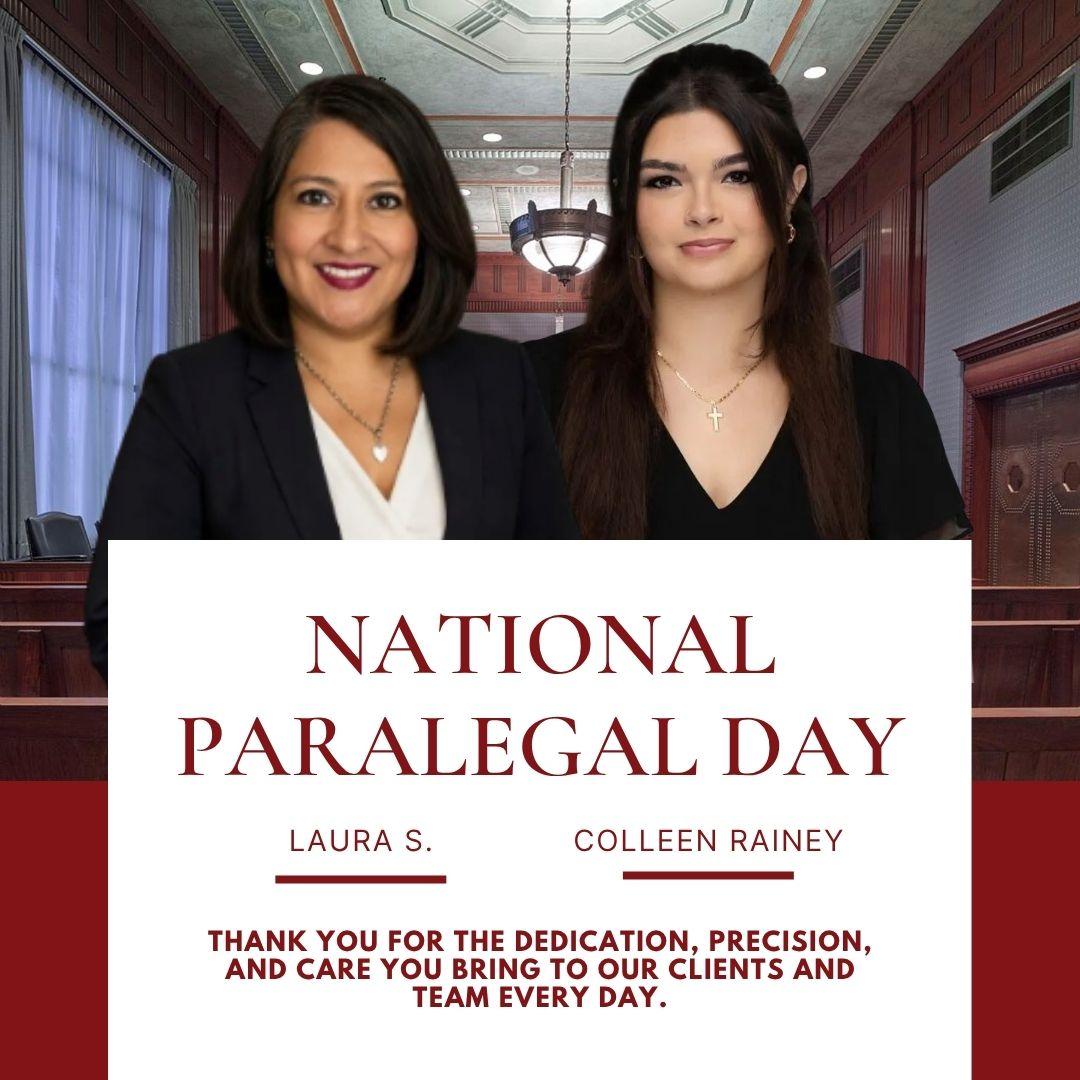
10.23: National Paralegal Day
| |
Celebrating
Team Bertolino LLP
Celebrating 19 Years of Bertolino LLP!
On October 29, 2026, Bertolino LLP proudly celebrates 19 years of dedication, service, and commitment to protecting the licenses, careers and livelihoods of Texas professionals. We are grateful to our incredible team, valued clients, and everyone who has been part of our journey. Thank you for helping us reach this milestone.
Here's to celebrating 19 wonderful years and many more to come!
| | How did you like this email? | | | |
|
State of the Firm Event
The Bertolino Law Firm gathered for our annual State of the Firm Address (SOFA), bringing together firm leadership and team members to share updates, celebrate an outstanding year of accomplishments for our clients, and recognize the teamwork and growth that made it all possible during September 2025 through August 2026.
Managing Partner Tony R. Bertolino led the celebration, introducing our updated Mission and Magic Statements and reinforcing our commitment to being 100% client-centric. Our four renewed core values: Trustworthy, Growth Mindset, Relentless Advocacy, and Compassionate Presence reflect who we are, how we serve Texas licensed professionals, and the trust we strive to earn every day.
Beyond the presentations, interactive team activities encouraged collaboration, strengthened our connections, and reinforced the compassion and shared commitment we bring to serving our clients and supporting one another. We also had fun celebrating our team spirit with personalized Bertolino Bulldogs footballs and jerseys!
As we look toward 2027, we're grateful for the clients who place their trust in us, proud of what we've accomplished together, and motivated to continue serving them with the care and dedication they deserve.
Our greatest success isn't measured by numbers alone, but by the people, purpose, and shared values behind everything we do. We're honored to stand beside Texas licensed professionals when their careers and livelihoods are on the line.
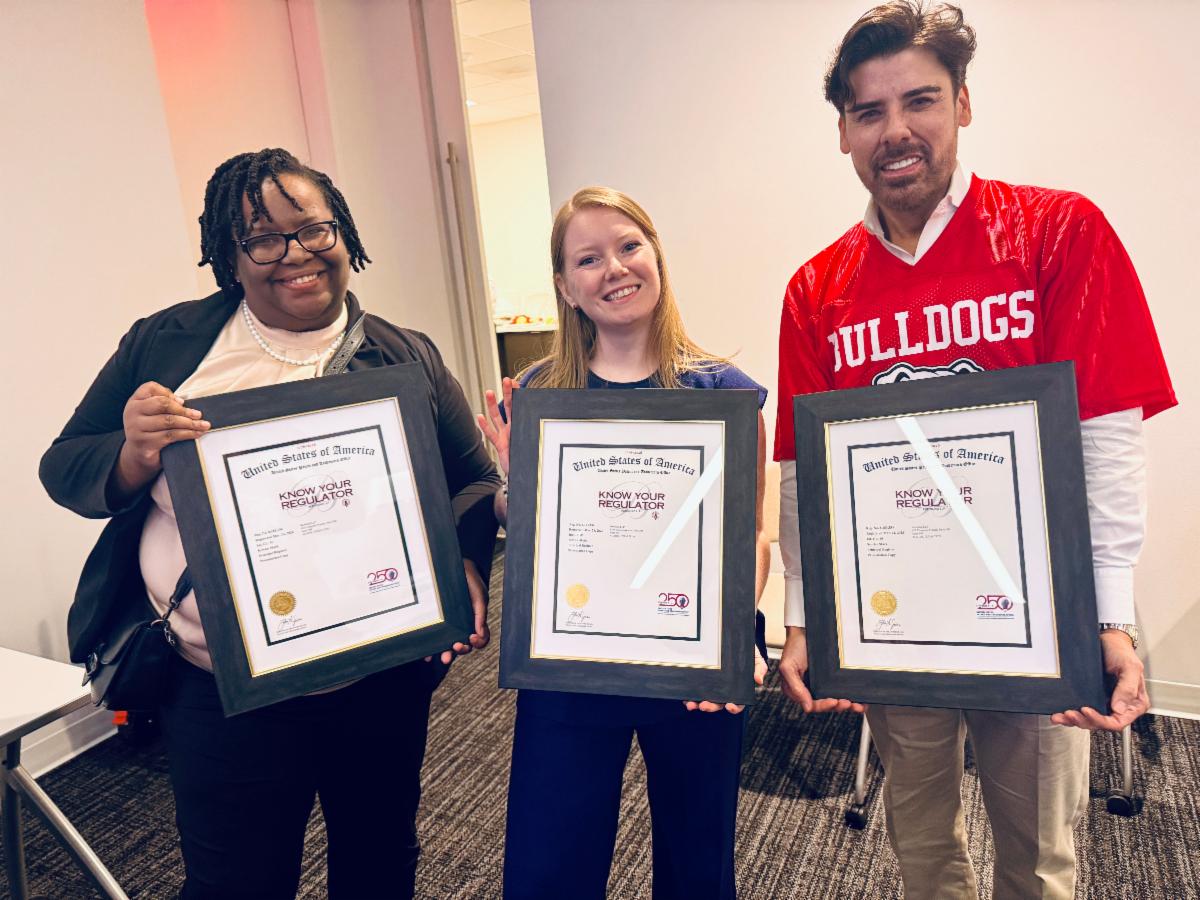
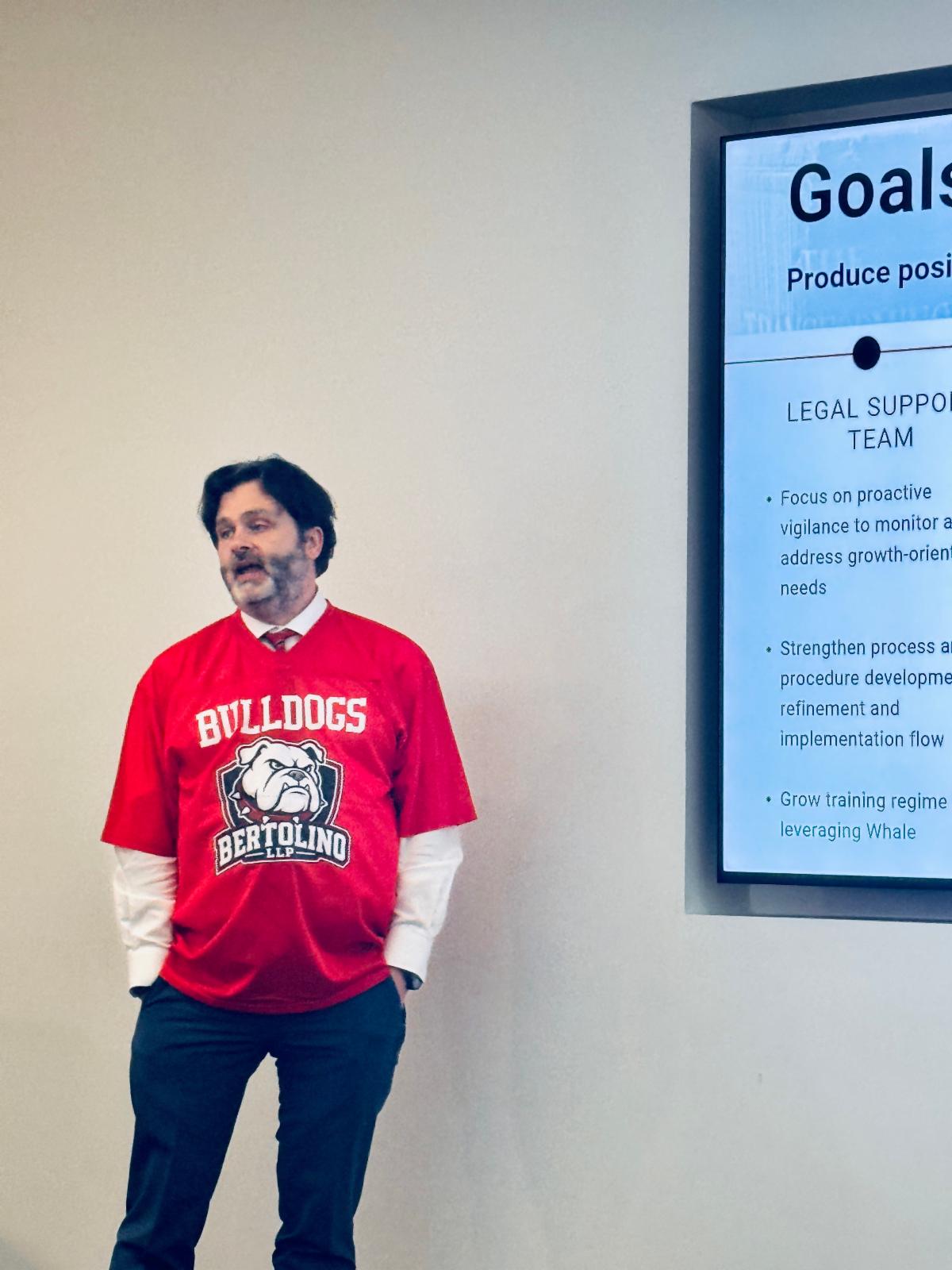
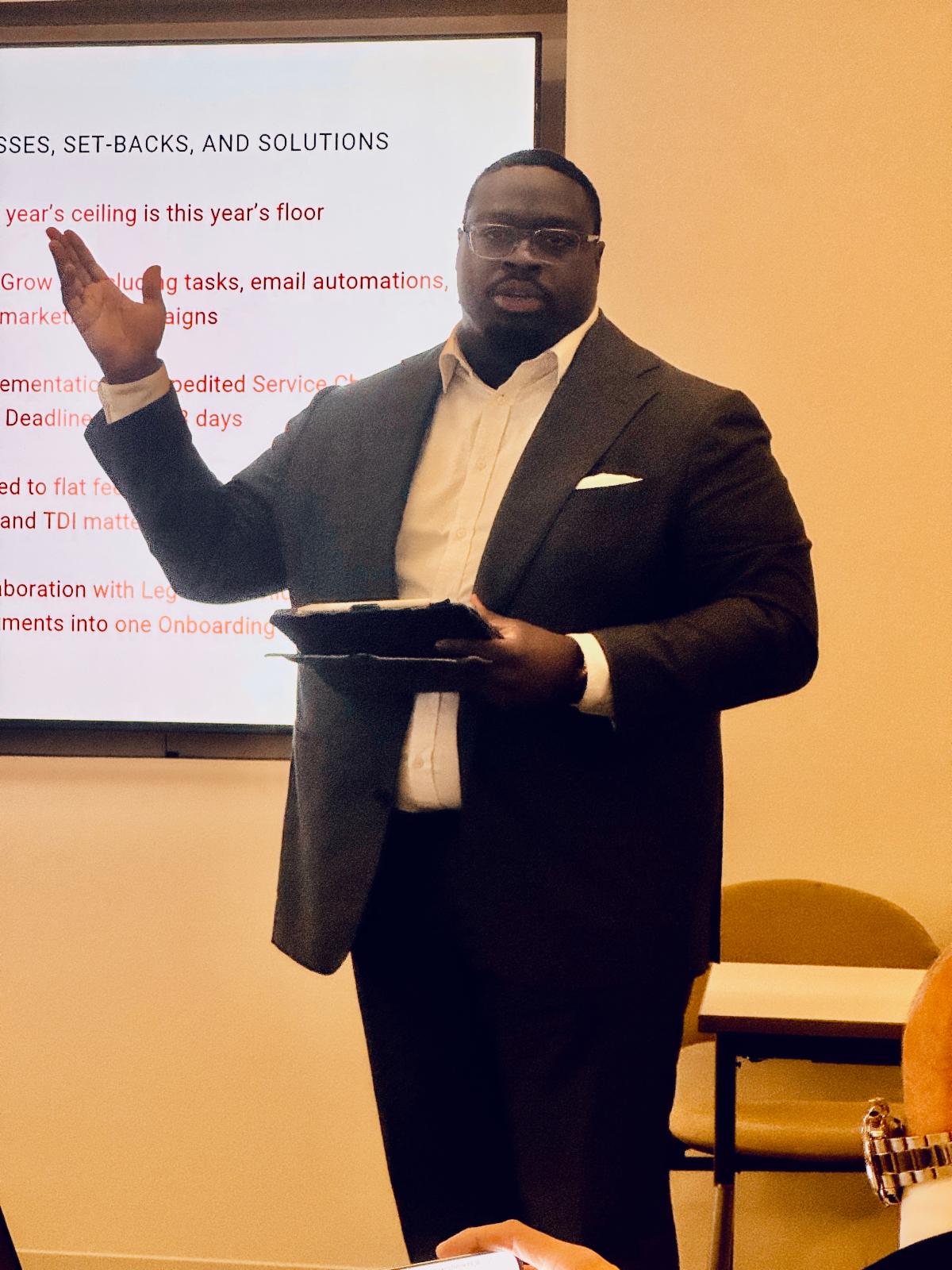
| | From left: LaJuana Acklin, Cimone Murphree, and Tony Bertolino proudly showcase our newly trademarked Know Your Regulator podcast at the annual State of the Firm Address (SOFA). The podcast continues to be an important part of our mission to educate and empower Texas licensed professionals . | | Troy Beaulieu, Director of Legal Services and Senior Associate, sports his Bertolino Bulldogs jersey while presenting the legal team's accomplishments for the year. | | Jasen Dalus, Client Success Manager, highlights the team's 2026 accomplishments, guiding potential new clients through the intake and onboarding process.. | | BERTOLINO LLP | (512) 476-5757 | 823 Congress Avenue, Suite 300, Austin, TX 78701 www.bertolinolaw.com | info@bertolinolaw.com | | | | |