|
🎃Pumpkin Investigation: Explore, Predict, Measure & Create
Best for: Preschool/Pre-K
Materials: Pumpkin, chart paper, markers, measuring tape/string, balance scale if available, container of water, child-safe tools for opening the pumpkin, spoons, magnifying glasses, paper, crayons/paint.
Start by placing a pumpkin where children can investigate it. Before cutting it open, encourage them to look, touch, describe, predict, and measure. Ask questions such as: What do you notice? How does it feel? How heavy do you think it is? How many lines does it have? What do you think is inside? Will it sink or float?
Then open the pumpkin and let the children investigate the inside. Scoop out the seeds, feel the pulp, smell the pumpkin, count or sort seeds, and compare what they discovered with their original predictions. Finish by letting children draw or paint what they observed.
Developmental domains you can incorporate:
-
🧠 Cognitive/Science: Make predictions, investigate the inside of a pumpkin, explore sink/float, and discuss how pumpkins grow.
-
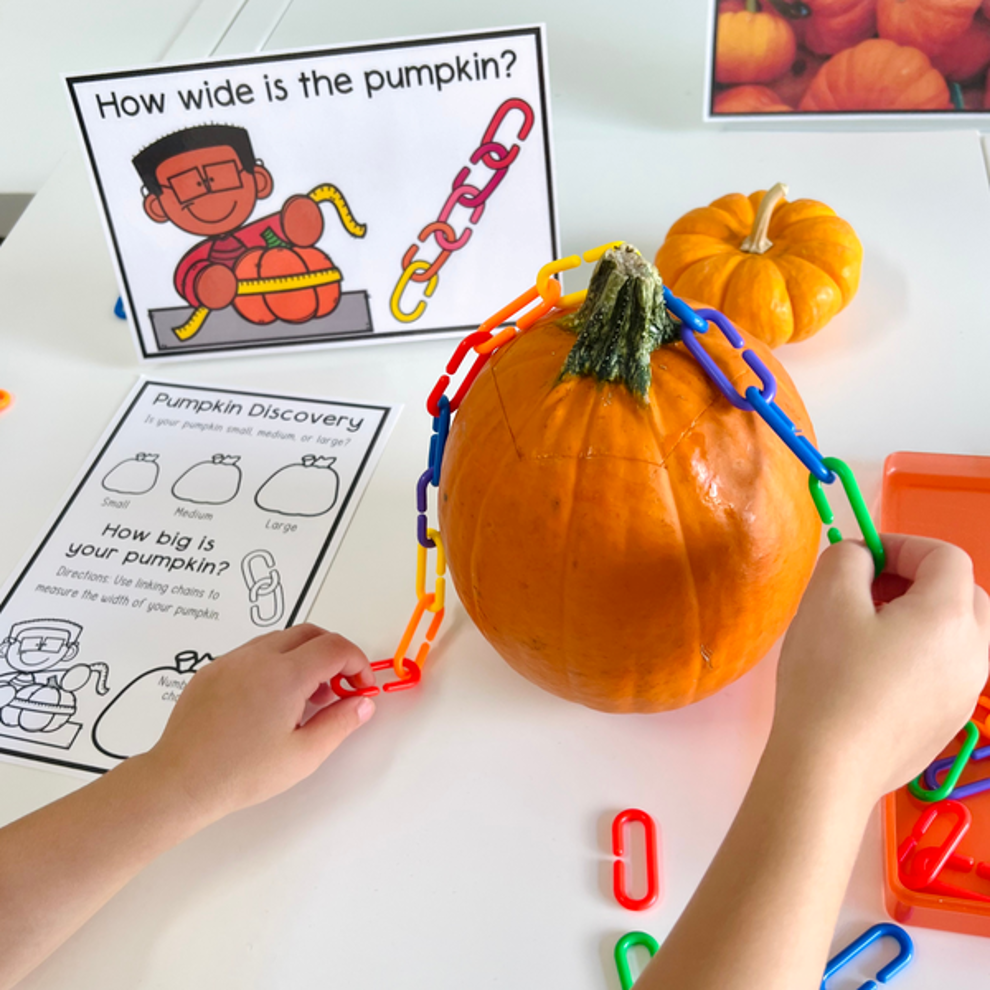
🔢 Math: Measure circumference and height, count seeds, compare quantities, estimate weight, sort seeds, and use words such as more, less, heavier, lighter, bigger, and smaller.
-
🗣️ Language & Literacy: Introduce vocabulary such as stem, rind, pulp, seed, smooth, rough, inside, and outside. Chart children's predictions and observations.
-
✋ Physical/Fine Motor: Scoop seeds, separate seeds from pulp, use tongs to pick up seeds, draw observations, and manipulate measuring tools.
-
❤️ Social-Emotional: Practice taking turns, sharing materials, working together, expressing opinions, and discovering that different predictions are okay.
-
🎨 Creative Arts: Draw the pumpkin before and after it is opened, make pumpkin prints, or create a representation using art materials.
-
👃 Sensory: Explore the pumpkin's texture, smell, weight, temperature, and different parts.
🍂 Take It One Step Further
After the investigation, wash and dry the seeds and place them in a learning center. Children can count, sort, make patterns, use them in ten frames, or glue them onto pumpkin drawings.
You could even turn the entire experience into a classroom question: “How many ways can we learn with one pumpkin?” That makes a wonderful example for educators of how one meaningful activity can address multiple developmental domains without creating separate activities for every learning goal.
🍂 The Differentiation Is in the Expectation
The pumpkin doesn't have to change—the learning opportunity does.
An infant may touch the pumpkin.
A toddler may name it.
A two-year-old may compare it.
A preschooler may predict what is inside.
A Pre-K child may measure and document it.
A school-age child may develop and test a hypothesis.
NC FELD Alignment
Approaches to Play and Learning (APL)
-
APL-1: Children show curiosity and express interest in the world around them.
Health and Physical Development (HPD)
-
HPD-5: Children develop small muscle control and hand-eye coordination to manipulate objects and work with tools.
Emotional and Social Development (ESD)
-
ESD-5: Children demonstrate the social and behavioral skills needed to successfully participate in groups.
Language Development and Communication (LDC)
-
LDC-2: Children participate in conversations with peers and adults in one-on-one, small, and larger group interactions.
-
LDC-4: Children speak audibly and express thoughts, feelings, and ideas clearly.
|