|
Medicare Appeals: An Example of how Life Rewards Action
I try to bring Medicare issues to your attention frequently. It is difficult for lawyers to make money practicing Medicare law; but Medicare affects the lives of millions of both elderly and disabled citizens. And many times, it is not the lawyer who makes a real difference in citizens dealing with institutions and Medicare. So, I like to remind you all of what you should do with you are told “no.” Below is a true story.
Hospitalized but "Not Admitted"? How One Family Won Back Medicare Nursing Home Coverage
A hospital bed, a wristband, days of tests and treatment — and yet, on paper, you were never "admitted." For people on Traditional Medicare, that single label can decide whether a nursing home stay is covered or costs thousands out of pocket.
Since February 2025, patients have a new tool to fight back: an expedited appeal when a hospital switches them from inpatient to observation status. One Connecticut family's experience shows how much that appeal can be worth.
A fall, a hospital stay, and a quiet reclassification
Mrs. J (a pseudonym) is 91 and lives with advanced dementia. One April day, while fighting a urinary tract infection, she fell at home. Her husband and her home health aide couldn't safely move her, so she went to the hospital by ambulance.
In the emergency department, doctors found broken ribs and low oxygen levels. She was in severe pain, more confused than usual, and couldn't get out of bed.
A physician admitted her as an inpatient, and she was moved up to a regular floor. Then the hospital changed course. It reclassified her as an outpatient "under observation," saying she didn't meet Medicare's criteria for inpatient care. While her care barely changed, her coverage changed a lot.
Why one word mattered so much
Traditional Medicare covers care in a skilled nursing facility (SNF) only after a hospital stay of at least three days as an inpatient. Time spent in observation doesn't count, no matter how sick you are or how long you stay.
Mrs. J clearly needed more care than she could get at home. But without inpatient status, a SNF stay for rehab and nursing would have cost her family nearly $500 a day. Meanwhile, the hospital was pressing for a quick discharge. The family felt stuck between unsafe care at home and a bill they couldn't plan for.
The appeal: about an hour, once everyone understood the question
Mrs. J's authorized family member reached out to the Center for Medicare Advocacy (CMA). There they learned about expedited appeals for patient status changes, a right that exists because of CMA's class action lawsuit over observation status. The family then:
1.Got a Medicare Change of Status Notice from the hospital.
2.Called the Medicare contractor named on the notice —
Acentra Health, a Quality Improvement Organization.
3.Described Mrs. J's medical condition and why she needed
inpatient care.
The first answer was a denial. But the family noticed something off: the Acentra representative kept talking about her "discharge" date. They explained that they weren't disputing when she left the hospital. They were disputing the switch from inpatient to observation.
With the question clarified, Acentra took another look. Within an hour, it reversed the hospital's decision.
The payoff: two covered nursing home stays and over $22,000 saved
With her inpatient status restored, Mrs. J had three inpatient days (the discharge day doesn't count). That qualified her for Medicare-covered SNF care, and she received four weeks of rehabilitation.
After she left the SNF, Mrs. J fell again and went back to the hospital. This time she was never admitted as an inpatient, so that stay alone couldn't qualify her for SNF coverage. But because she needed SNF care again within 30 days of her first covered stay, Medicare covered another 18 days.
All told, one successful appeal led to two covered stays at the facility of her choice, with estimated savings of more than $22,000. Her family member said the appeal "had a profound impact on our family."
What families should know
Don't treat a reclassification as final. If you or a loved one was admitted as an inpatient and later switched to observation, you may be able to appeal. Eligibility generally requires a formal inpatient admission, a later switch to observation services, and meeting a few other criteria. CMA's FAQ on the observation status court decision spells these out.
Ask for the notice. Hospitals are required to give eligible patients a
Medicare Change of Status Notice. Because these appeals are still new, you may need to request it directly.
Timing is flexible, but earlier is better. You can appeal while still in the hospital, which is ideal because it can spare you from paying for SNF care up front. You can also appeal from the SNF or after discharge, at any time.
A successful appeal after you've paid can lead to Medicare coverage and a refund.
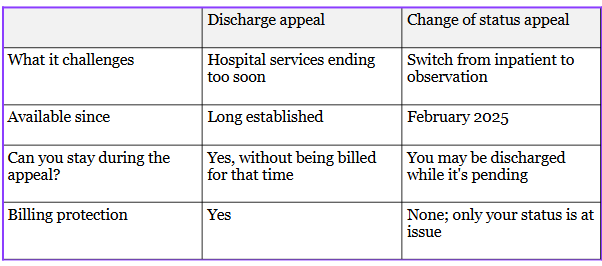
Name the right appeal. Mrs. J's first denial came from mixing up two different appeals. Be explicit about which one you're filing:
|