| |
Fall foliage begins to show near Wilbur Cross on Tuesday, Sept. 8, 2026. (Sydney Herdle/UConn Photo) | | | | |
Office of Outreach and Engagement
Fall '26 Webinars
| | Community-Engaged Scholarship in Promotion, Tenure, and Reappointment | | |
Wednesday, September 30, 2026
12:30pm – 1:30pm
| | Presented last spring and back by popular demand, this workshop provides a broad overview of community-engaged scholarship and offers practical guidance for faculty seeking to make a strong case for their community-engaged research and teaching in promotion, tenure, and reappointment. The workshop will review recommendations developed by UConn’s Community Engagement Incorporation into Promotion, Tenure, and Reappointment Task Force. | | Making Community-Engaged Scholarship Visible: Writing a Strong Faculty Dossier | | |
Tuesday, October 20, 2026
11:30am-12:30pm
| This interactive workshop will help faculty clearly document and communicate community-engaged scholarship in promotion, tenure, reappointment, and annual review materials. Participants will learn how to distinguish engaged scholarship from traditional service, articulate the intellectual contributions and reciprocal partnerships underlying their work, and identify evidence of scholarly quality and community impact. Through guided reflection and a hands-on writing exercise, participants will begin revising a project description into a compelling dossier narrative that connects their community-engaged work to institutional criteria and a broader scholarly trajectory. Participants are encouraged to bring a current dossier narrative, annual review entry, or description of a community-engaged project. | |
Intro to Community-Engaged Teaching and the Community-Engaged Scholars Fellowship | | |
Wednesday, November 11, 2026
11:30am – 12:30pm
| | This introductory webinar will explore the principles and practices of community-engaged teaching and highlight strategies for building reciprocal, mutually beneficial community partnerships. Participants will also learn about UConn’s Community-Engaged Scholars Fellowship, which supports faculty and staff in developing or revising a community-engaged course or program. | | | | |
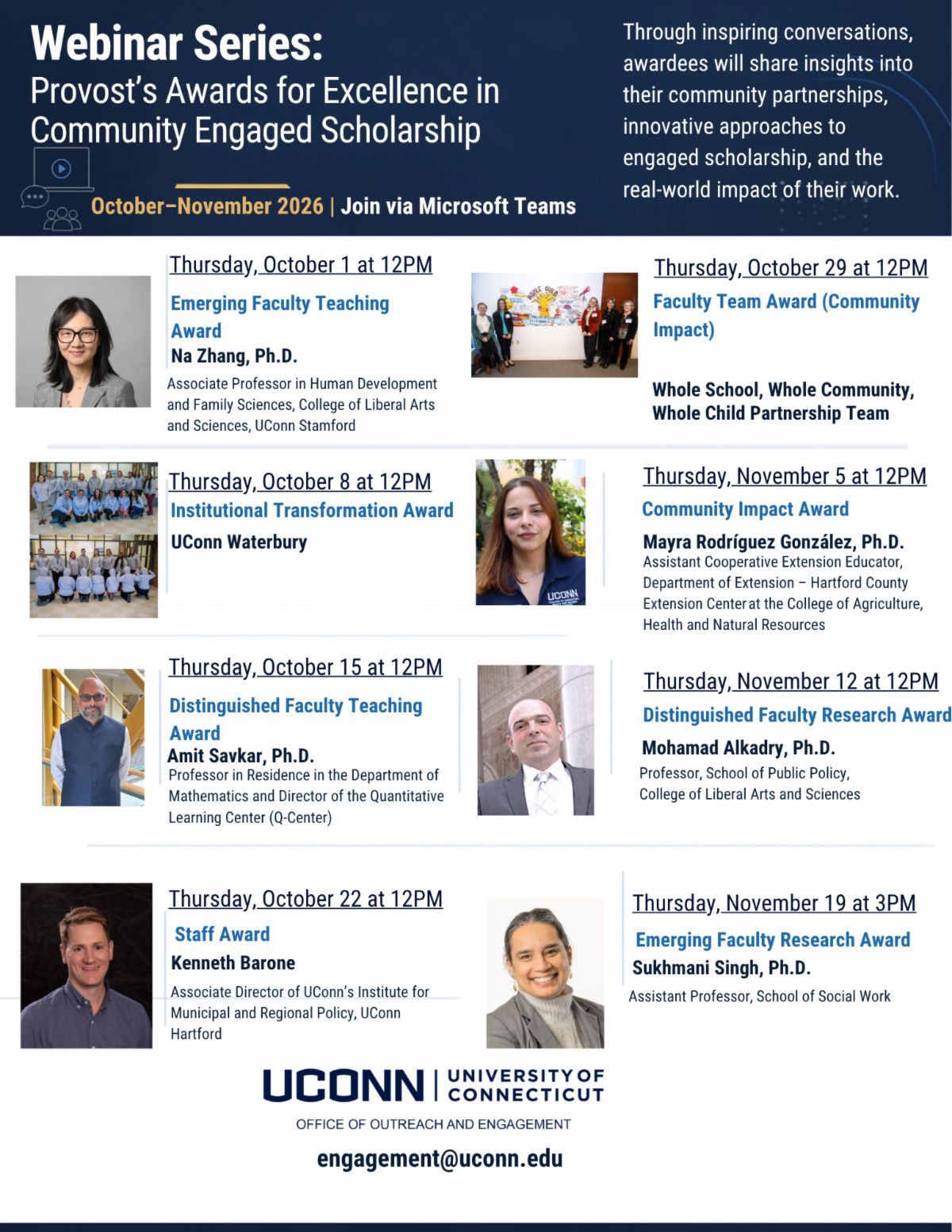
Webinar Series Featuring 2026 Award Recipients | | Join us on this inspiring webinar series from October 1 through November 16 featuring the 2026 award recipients of the 2026 Provost’s Awards for Excellence in Community Engaged Scholarship. Links located below this flyer. | | | | |
|
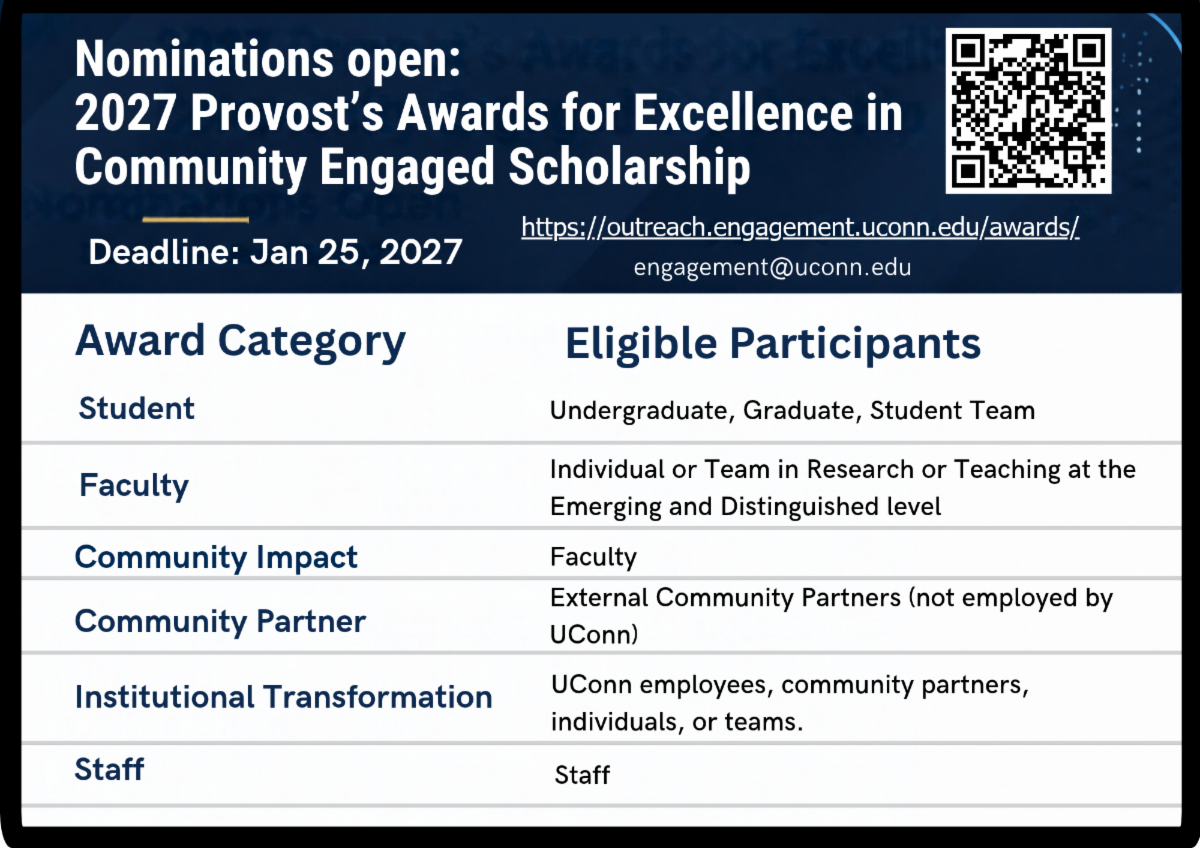
Nominate a student, colleague and community partner for their work on Excellence in Community Engagement. Nominations are open through Jan 25, 2027. Self-nominations are not accepted. Please reach out to engagement@uconn.edu with any questions.
https://outreach.engagement.uconn.edu/awards/
| | | | |
Congratulations to UConn sophomore Neha Shanavas on being named a Newman Civic Fellow!
| | |
Pursuing degrees in Molecular & Cell Biology and Health Policy & Informatics, Neha is a scholar, entrepreneur, and civic leader committed to addressing public health challenges through research, policy, and community action.
Her remarkable work includes advocating for evidence-based substance-use prevention, contributing to the distribution of 50,000 drug deactivation and disposal pouches across Connecticut, and representing youth-led prevention efforts at a United Nations meeting in Vienna. She is also the co-founder and CEO of ChromaShield, LLC, and serves as a teaching assistant at a Connecticut correctional facility through the Second Chance Educational Alliance.
Neha’s guiding conviction, “follow the person, not the issue”, reflects her dedication to developing thoughtful, people-centered solutions that bridge research, policy, and practice.
We are proud to celebrate Neha and this well-deserved recognition!
| |
From the president
Neha Shanavas is a sophomore pursuing degrees in molecular & cell biology and health policy & informatics. A scholar, entrepreneur, and civic leader, her work is shaped by a commitment to addressing public health challenges at the intersection of addiction medicine, policy, and community action. As a member of the Governor’s Prevention Partnership Youth Advisory Board, Neha has promoted evidence-based substance abuse prevention through legislative testimony, media advocacy, and public education. Her testimony before the Connecticut General Assembly helped advance legislation resulting in the distribution of 50,000 drug deactivation and disposal pouches across Connecticut. In recognition of her efforts, she was honored by the Community Anti-Drug Coalitions of America (CADCA) with their 2025 Outstanding Youth Leadership Award. She presented on the power of youth-led substance abuse prevention efforts at the 2026 Meeting of the United Nations Committee on Narcotic Drugs in Vienna. In addition to her work as co-founder and CEO of ChromaShield, LLC, an early-stage healthcare startup developing low-cost wearable technology to detect early tissue injury, Neha serves as a teaching assistant at a Connecticut correctional facility through the Second Chance Educational Alliance. As a Fellow, she seeks to strengthen her ability to bridge research, policy, and community practice.
Radenka Maric
Read more here.
| | | | |
Mapping UConn’s Community Engagement | | |
The Office of Outreach and Engagement, in partnership with Institutional Insights & Innovation (i3), recently launched an updated Community Engagement Database to make it easier to see where and how UConn is engaging with communities across Connecticut and beyond.
At the center of the project is Armaan Arellano '28 (ENG & BUS), a Double Major in Computer Science and Accounting and a Student Administrative Assistant in the Office of Outreach and Engagement, working closely with Brian Kelleher, a Staff Engineer in Institutional Insights & Innovation (i3).
Armaan helped redesign and rebuild the database, including a new interactive map and a streamlined process for submitting community-engaged activities.
Faculty and staff can now use the database to search and filter activities, explore UConn’s engagement geographically, and learn more about individual projects and community partnerships.
Users can also submit their own community-engaged teaching, research, service, and other activities directly through the site.
The database currently brings together voluntarily reported information from several University sources, but it cannot tell the full story of UConn’s community engagement without your help.
We encourage faculty, staff, and units to explore the map and submit any missing activities.
Explore the Community Engagement Database and Submit Your Activity
The launch is only the first step. The Office of Outreach and Engagement and i3 will continue working together to incorporate additional University data sources, explore connections with Lincus, and develop a dashboard to track and visualize volunteer hours across UConn.
| | | | |
Krimerman Community Engagement Grants | | |
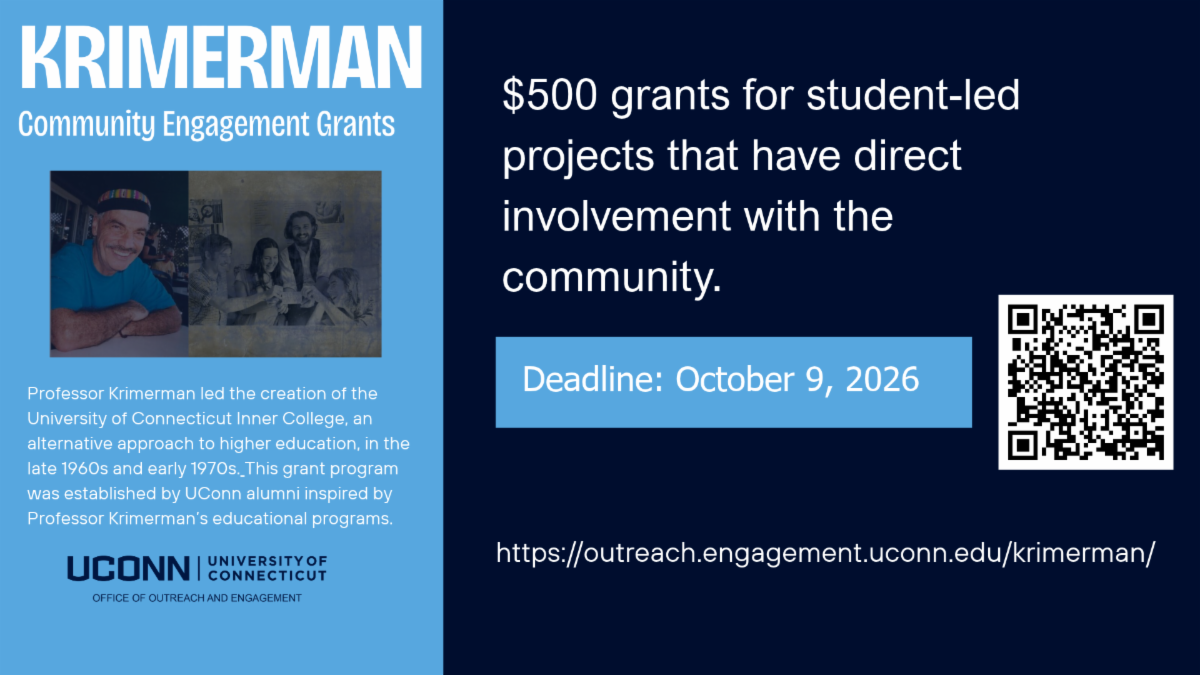
The Krimerman Community Engagement Grants represent the legacy of Professor Leonard I. Krimerman. Professor Krimerman led the creation of the University of Connecticut Inner College, an alternative approach to higher education, in the late 1960s and early 1970s. This grant program was established by UConn alumni inspired by Professor Krimerman’s educational programs.
Krimerman Community Service Grants support student-led projects that have direct involvement with the community and may include, but are not limited to, the following types of activities:
1. Direct learning in which students are in direct contact with community members or organizations, such as working on-site at an agency or tutoring in an adult literacy program.
2. Indirect learning in which students engage with a cause or a community need through means that do not necessarily involve constant contact with beneficiaries, such as designing a study, developing information materials, or creating a website.
3. Civic action or advocacy in which students work to effect change in public policy, such as presenting at a town safety meeting or a legislative public hearing.
In this first iteration of the program, each grant will be $500. Therefore, we encourage applicants to use these funds to initiate, complete, or advance student independent projects.
Eligibility:
- Be an undergraduate student at the University of Connecticut.
- Maintain a good academic standing at the time of application and throughout the project.
- Have at least one semester left after the semester they apply.
- Be supported and mentored by a UConn faculty member who will actively support the project.
Timeline: Applications for Spring 2027 will be accepted until Friday, October 9, 2026. Students and their project advisors will be notified of the awards by November 2, 2026. By the end of the Spring Semester, awardees are required to submit a project profile in video or another visual format upon completion of the project.
Evaluation criteria: The selection committee will evaluate nominations based on the degree to which students articulate (1) how they have designed and will implement the project independently; (2) propose meaningful interactions with community partners; and (3) demonstrate a clear need for funding to complete a project.
Funding Categories: Open to any items needed to support initiation, completion, or advancement, such as transportation, materials, hosting meetings or creative exhibitions, data collection, etc.
| | | | |
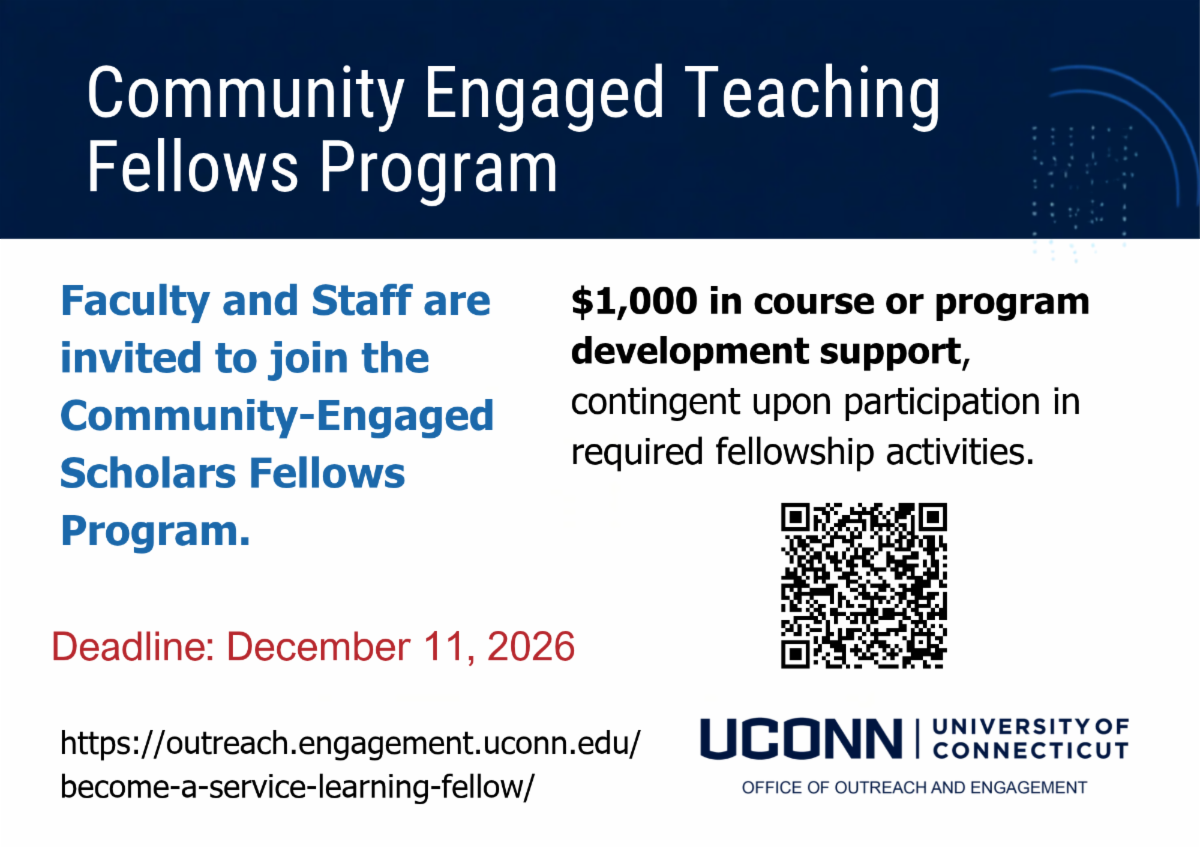
Join the Community Engaged Teaching Fellow's Program | | Faculty and Staff are invited to apply | | |
Faculty and Staff are invited to join the Community-Engaged Scholars Fellows Program.
Fellows will meet regularly during the spring semester to learn the theory and practice of community-engaged teaching and learning.
Participants will receive individualized support to develop reciprocal community partnerships and adapt or create course syllabi that align with both learning objectives and community priorities. Fellows will then implement their courses or programs in the summer, fall, or following spring semester and continue to meet during the fall to discuss progress, share experiences, and address challenges related to partnership-based teaching and learning.
The Fellowship provides the following:
- A year-long cohort-based professional development experience focused on community-engaged teaching and learning.
- Training in the theories, principles, and best practices of community-engaged pedagogy, including community-based learning, partnership development, reflection, and assessment.
- Individualized mentorship and consultation from experienced community-engaged faculty and staff throughout the fellowship year.
- Assistance in creating, revising, or enhancing a community-engaged course, project, or learning experience.
- Support in identifying, cultivating, and sustaining reciprocal partnerships with community organizations and agencies.
- Opportunities to engage with an interdisciplinary cohort of faculty committed to student success, civic learning, and community impact.
- Access to resources, readings, tools, and examples that support effective community-engaged teaching and learning.
- Ongoing participation in a community of practice dedicated to advancing community-engaged teaching and learning at UConn.
Fellowship Support and Funding
Fellows are eligible to receive up to $1,000 in course development support, contingent upon participation in required fellowship activities.
Applications for the 2027 cohort are due on Tuesday, December 11, and must be submitted via Kuali Build for review by the Community-Engaged Teaching and Learning Committee.
Email engagement@uconn.edu with any questions.
| | | | |
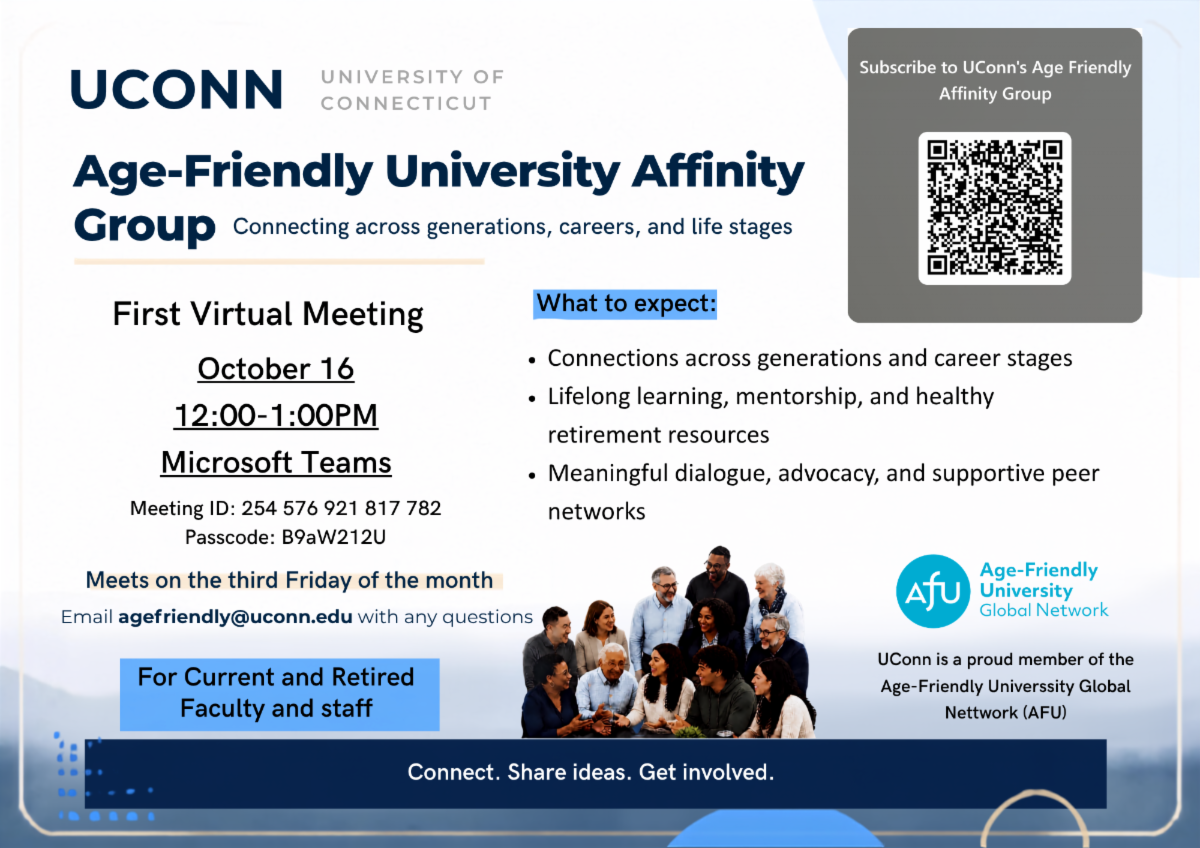
Join the UConn Age-Friendly University Affinity Group! | | |
|
The newly formed UConn Age-Friendly University (AFU) Affinity Group welcomes current and retired faculty and staff from across UConn, including Storrs, Hartford, Avery Point, Waterbury, Stamford, UConn Health, and UConn Law.
Our mission is to foster:
· Connection across generations and career stages
· Lifelong learning and mentorship
· Meaningful dialogue and advocacy
· Supportive peer networks
· Access to valuable resources, including OLLI, Connecticut’s senior citizen tuition waiver, and healthy-retirement programming
Join us and help build a more age-inclusive UConn community!
Use this form to join our mailing list and receive information about upcoming meetings.
Please email Lisa Kenyon-Pesce or Merly Downey at agefriendly@uconn.edu with any questions.
| | | | |
The UConn Hartford NextGen Elections Program is being funded through a grant from Campus Compact
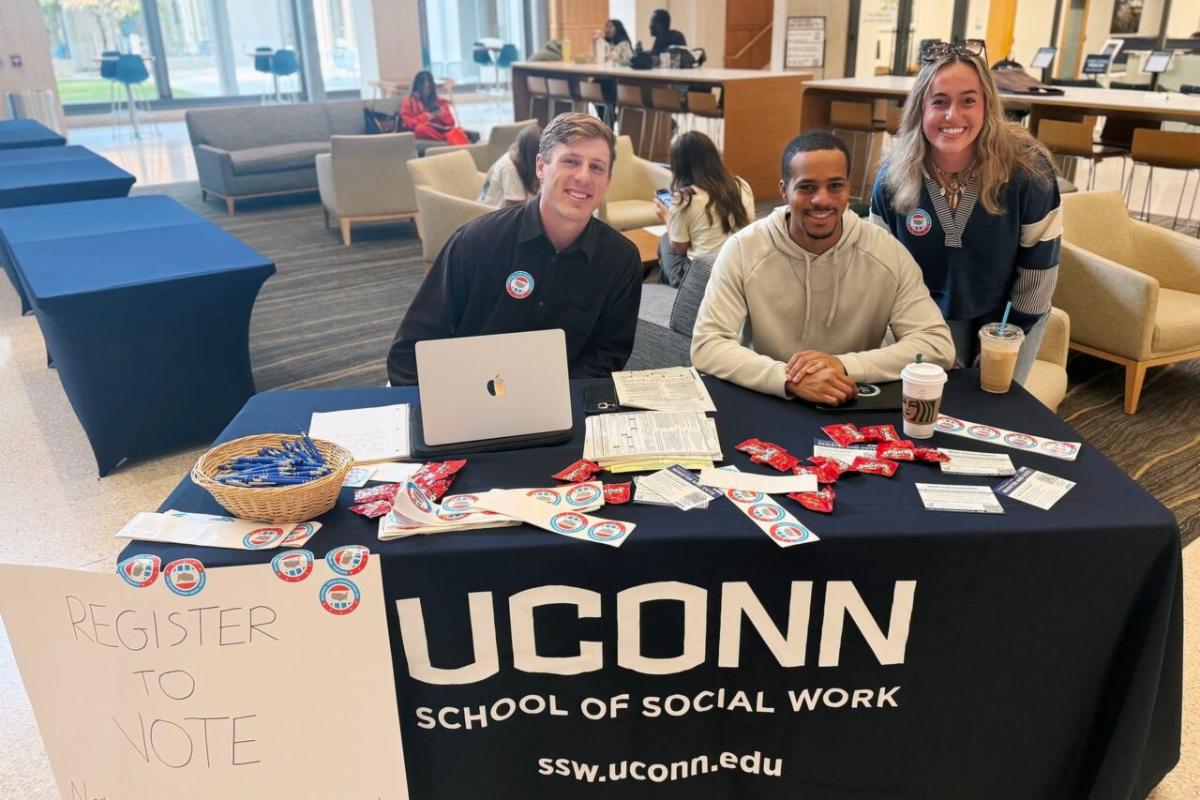
| Congratulations to Shannon R. Lane, LMSW, PhD, Director of the Nancy A. Humphreys Institute for Political Social Work, on receiving $5,000 through Campus Compact’s 2026 Election Rapid Response Mini-Grant Program! The funding will support the UConn Hartford Next Gen Elections Program, which will prepare students to serve as trained poll workers and election moderators across Connecticut while gaining hands-on experience in election administration and civic engagement. | | Several UConn students, in coordination with the School of Social Work’s Nancy A. Humphreys Institute for Political Social Work, host voter registration drives at the Hartford Times Building Atrium. | |
The UConn Hartford NextGen Elections Program, funded through a grant from Campus Compact, will prepare up to 10 UConn students, including social work students, to serve as poll workers and election moderators during Connecticut’s 2026 elections. This program is supported by the Connecticut Office of the Secretary of the State, based on a program they created in 2024-2025. That original program won the 2026 IDEAS (Innovation, Dedication, Excellence and Achievement in Service) Award from the National Association of Secretaries of State.
Students will complete approximately 10 hours of training through a combination of asynchronous and in-person sessions, including training with the Connecticut Secretary of the State. Participants will become certified Election Moderators for the State of Connecticut.
Following training, students will be connected with local election officials and assigned to polling locations, where they will work for at least two days during the 2026 election period. Connecticut’s 2026 general election early voting period is Oct. 19 through Nov. 1, with Election Day on Nov. 3.
Read more here.
| | | | |
Book Club: The Handbook of Broader Impacts | | |
The Office of Outreach and Engagement is excited to launch a new book club focused on broader impacts and community-engaged scholarship.
Our first selection, The Handbook of Broader Impacts, explores how research can create meaningful societal impact through community engagement, interdisciplinary collaboration, and institutional support. The book offers practical strategies and real-world examples for integrating broader impacts into research, teaching, and academic careers.
Faculty, staff, students, and campus partners from all UConn campuses are invited to participate. Meetings will take place virtually. The tentative schedule is below.
To join or learn more, please email engagement@uconn.edu with your interest.
| | | | |
|
The Osher Lifelong Learning Institute at the University of Connecticut (OLLI) is a dynamic, member-driven program designed for adults aged 50 and older who seek engaging, non-credit learning experiences. Offering a wide range of courses, lectures, and special events, OLLI provides opportunities for social and intellectual interaction, allowing members to participate as both teachers and learners. The program fosters the exchange of ideas and collaborates with other cultural, educational, and arts organizations. OLLI at UConn offers both in-person and online courses. With 450 members, OLLI attracts participants from within a 30-mile radius of Waterbury, as well as from across the state and beyond.
Contact: Fiona de Merell
Email: fiona.demerell@uconn.edu
Website: https://olli.uconn.edu/
| | | | |
Community-Engaged Teaching Course Designation Process | | |
Transition Guidance for Faculty
Key point
Community-Engaged Teaching designation happens after a course has gone through the course proposal review workflow and is ready to be scheduled through CourseLeaf.
Background
Effective July 2026, the University of Connecticut transitioned from the term Service Learning to Community-Engaged Teaching. This change reflects current scholarship and aligns UConn terminology with national best practices and the University's Promotion, Tenure, and Reappointment (PTR) Guidance Documents (2025) found in the Academic Affairs Governance Document Library.
Community-engaged teaching connects academic coursework with experiences that address community-identified priorities. It is grounded in reciprocal, sustainable partnerships that draw on both university and community knowledge and resources to enhance student learning, strengthen communities, and advance the public good.
Community-engaged courses include a clear connection between course content and community-based activities, meaningful collaboration with community partners, structured student reflection, and opportunities for students to develop civic knowledge and skills.
The Office of Outreach and Engagement (OOE) coordinates the designation process and helps faculty develop, strengthen, and document community-engaged courses. Faculty are encouraged to consult OOE while designing or revising a course. The formal designation is requested after curricular approval because it applies to a specific course offering and does not determine whether the course itself may be offered.
Benefits to Designating Your Course
Designating a course as Community-Engaged Teaching can:
· Enable the OOE to evaluate course materials and assist in promoting course visibility.
· Provide letters documenting community-engaged teaching for promotion, tenure, and reappointment.
· Connect faculty to other instructors who participate in hands-on, community-based learning.
Steps to Assign the Designation
1. After the course completes the curricular approval process, the faculty member or departmental scheduler selects the Community-Engaged Teaching attribute in the CourseLeaf scheduling system (CLSS).
2. OOE reviews the request and determines whether a syllabus review is needed. To allow time for review before Registrar deadlines, submit the designation as early as possible in the scheduling process.
3. If a review is needed, OOE requests the syllabus and the Community-Engaged Teaching and Learning Advisory Committee evaluates it using the Community-Engaged Course Designation Rubric.
4. OOE informs the instructor and department administrator whether the designation is approved or whether revisions are needed. Once approved, OOE updates its records, and the course section retains the Community-Engaged Teaching attribute for that offering.
When a Syllabus Review is Required
A syllabus review will generally occur when:
· The course is being submitted for its initial Community-Engaged Teaching designation;
· The course is being taught by a different instructor;
· The syllabus has undergone substantial revisions; or
· Three years have passed since the most recent review.
Faculty or departmental schedulers should continue selecting the Community-Engaged Teaching attribute each time the course section is scheduled. If the same instructor is using a substantially unchanged syllabus and the three-year review is not due, OOE will confirm the designation without conducting another full syllabus review.
Questions
Questions regarding the Community-Engaged Teaching designation process may be directed to the Office of Outreach and Engagement at engagement@uconn.edu.
| | | | |
Apply for up to $5K in Funding From Engagement Scholarship Consortium (ESC) | |
The Engagement Scholarship Consortium Research/Creative Activities Grants Program is now open!
Faculty and staff at ESC member institutions are eligible to apply for up to $5,000 to support a one-year engaged scholarship project. Projects may be domestic or international, and interdisciplinary and multi-institutional collaborations are encouraged.
If you have an idea that brings university and community partners together to address a meaningful issue, build new knowledge, or strengthen community-engaged practice, I hope you’ll consider applying.
- Application deadline: October 14, 2026
- Funding: Up to $5,000
- Grant period: January 1–December 31, 2027
Please share with colleagues who may be interested!
View the application guidelines and apply:
https://engagementscholarship.org/grants-and-awards/esc-grants-program/application-procedures-and-process
| | | | |
Engaging Community: A Toolkit for Reciprocal Teaching and Learning Beyond the Campus | |
Co-published by AAC&U and Campus Compact, Engaging Community: A Toolkit for Reciprocal Teaching and Learning Beyond the Campus is a free, open-access resource that helps educators design meaningful community-engaged learning experiences. Organized into six adaptable modules, the toolkit combines foundational concepts with lesson plans, companion videos, curated readings, interactive activities, and civic reflection prompts that support faculty learning communities, professional development, graduate education, and undergraduate courses.
Table of Contents
Use the links below to access learning materials and resources from each module of Engaging Community: A Toolkit for Reciprocal Teaching and Learning Beyond the Campus.
View the full publication
| | | | |
Campus Compact Workshops and News |
| | | |
UConn Today #CommunityImpact | | (wavebreakmedia via Shutterstock) | |
Community-Based Participatory Research to Address Unhealthy Food Environments
| | |
Unhealthy local food environments threaten the health and well-being of young people, and exacerbate health disparities in lower-income populations and communities of color.
Researchers at the UConn Rudd Center for Food Policy and Health and the Hispanic Health Council (HHC) believe engaging youth in the design and delivery of a program to improve their food environment is a path to impactful and lasting change.
This belief was at the center of a two-year community-based participatory research project supported by the Robert Wood Johnson Foundation. Throughout the project, the UConn and HHC team trained two cohorts of students from Hartford Public High School to be Adolescent Citizen Scientists (ACS) with the goal to identify, prioritize, and co-design a program to address the unhealthy food environment they experience. Topics covered in the training program developed by the researchers included nutrition, health equity, food marketing, research, program co-design, and communications.
Read More.
| | | | |