|
The focus of this month's newsletter is comparing the U.S. to other countries regarding 22 social issues, from arms sales to social welfare programs.
Economy
The United States has the largest economy in the world, with a nominal Gross Domestic Product (GDP) of about $32.38 trillion in 2026.
Military Spending
The U.S. spends the most on its military economy, with a 2025 budget of about $954 billion — the largest of any nation. The next largest countries are: China ($336 billion), Russia ($190 billion), Germany ($114 billion), and India ($92.1 billion). The U.S. share of global military spending is about 33%, and its budget represents roughly 3.1% of its GDP.
Stockholm International Peace Research Institute
The U.S. has the 2nd most nuclear weapons with 5,277. Russia has the most with 5,449. China has 600, France 290 and Great Britain 220.
Global Military
America has the 8th largest military in the world, with 2,100,000 with active personnel, reserves and paramilitary troops.
Visual Capitalist
Arms Sales
The United States is also the world’s largest arms exporter, controlling over 40% of the global arms trade and surpassing the combined share of the next 9 biggest exporters: France, South Korea, Russia, Italy, Germany, China, the United Kingdom and the Netherlands.
StatBase
Wars
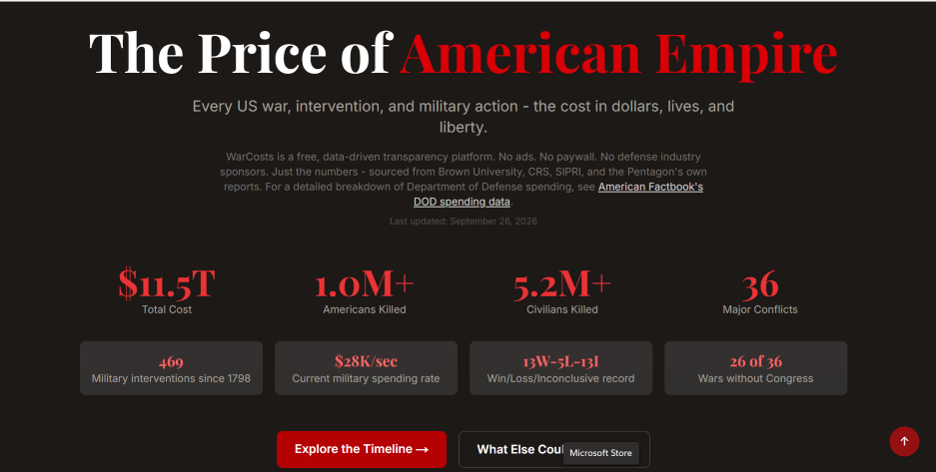
In the last 80 years, the U.S. has been in 26 major wars.
WarCosts
Since 2003, the U.S. has been involved in over 30 military conflicts, the United Kingdom - 19, Iran - 18, Russia - 17, Israel - 16, France - 16
Reddit
China has been involved in only 1 major war in the last 40 years.
Wikipedia
Poverty
Of 38 similar countries, the U.S. ranks 26th with an overall poverty rate of 17.8%. The poverty rate of children is 20.9% and the poverty gap (the percentage by which the average income of the poor falls below the poverty line) is 39.8%.
Organization for Economic Cooperation and Development
Hunger
In the U.S., over 44 million people — about 8.7% of the population, including 13 million children — face food insecurity annually. In addition, 40% of the population is “one paycheck away from poverty,” which contributes to food insecurity despite high overall income levels.
WhyHunger
The U.S.’s food insecurity rate is worse than some middle‑income nations like Mexico or Brazil, that have much lower hunger rates than the U.S., despite lower overall incomes.
World Population Review
Education
The U.S. spends 25% more per student ($20,387) than most other developed countries and ranks 6th in reading, 10th in science, and 26th in math.
Organization for Economic Cooperation and Development
81% of educational funds come from local property taxes, which means wealthier neighborhoods generate more money for their programs than
lower-income areas.
Education Resource Information Center
28% of Americans think the U.S. education system is the best in the world or better than most
other countries.
YouGov.org
Race Discrimination
74% of Americans say discrimination against people based on their race or ethnicity is a serious problem in the U.S.
Pew Research Center
28% of Americans think race relations in the U.S. are the best in the world or better than most
other countries.
YouGov.org
Gender Equality
The U.S. ranks in the lower half of the global gender equality rankings, with a Gender Inequality Index score of 0.18 (18% gap closed) and a Global Gender Gap score around 68–69% closed. Canada, Germany, and the UK score 0.07–0.09, while Sweden, Denmark, and Norway are
near 0.01–0.02.
World Population Review
52% of Americans think women's rights in the U.S. are the best in the world or better than most
other countries.
YouGov.org
Health Care
The U.S. spends nearly twice as much ($14,885 per person) on healthcare compared to similarly large and wealthy nations.
Peterson-KFF Health Care Tracker
31% of Americans think the U.S. health care system is the best in the world or better than other countries.
YouGov.org
Life Expectancy
Americans live approximately 4 years less than comparable countries, with an average of 78.4 years compared to 82.5 years.
Peterson-KFF Health Care Tracker
35% of Americans think life expectancy in the U.S. is the best in the world or better than in
other countries.
YouGov America
Incarceration
The U.S. incarcerated population rate of 542 per 100,000 is the 4th highest rate in the world.
Prison Studies Project
Gun Violence
Globally, the U.S. ranks at the 93rd percentile for overall firearm mortality, 92nd percentile for children and teens, and 96th percentile for women.
The Commonwealth Fund
The U.S. has among the highest overall firearm mortality rates, as well as among the highest firearm mortality rates for children, adolescents, and women, both globally and among high-income countries.
The Commonwealth Fund
Nearly all U.S. states have higher firearm mortality rate than most other countries. The rate of deaths due to physical violence by firearm in U.S. states are closer to rates seen in countries experiencing
active conflict.
The Commonwealth Fund
Capital Punishment
With 47 executions in 2025, the United States ranked 4th in the world — behind only Iran, Saudi Arabia, and Yemen, nations widely condemned for systematic human rights violations.
Death Penalty Focus
Immigration
15% of the U.S. population (45.3 million) are immigrants. Countries with a greater percentage of immigrants in their population are: United Kingdom (17%), France (18%), Canada (21%), Germany (21%), Sweden (21%), Ireland (22%), Iceland (25%), Austria (25%) and Australia (25%), New Zealand (27%) and Switzerland (27%).
Wikipedia
36% of Americans think U.S. treatment of immigrants is the best in the world or better than in
other countries.
YouGov America
Refugee Resettlement
The U.S. currently has one of the most restrictive asylum and resettlement systems among Western democracies, with a unique “adjudicative hold” on all asylum cases and record‑low refugee admissions.
Brennan Center
2026’s refugee ceiling is set at 7,500—the lowest in 45 years—down from over 100,000 in 2024.
Migration Policy Institute
Under recent executive actions, the U.S. Refugee Admissions Program (USRAP) shifted its focus to prioritize specific groups—primarily white South Africans (Afrikaners)—who accounted for over 99% of all U.S. refugee admissions through most of 2026.
Forum Together
The current administration has ended Temporary Protected Status (TPS) for 11 countries, affecting ~1.1 million people, and suspended most
resettlement programs
Migration Policy Institute
As of late 2025, over 3.9 million asylum cases await resolution.
Migration Policy Institute
Minimum Wage
The U.S. ranks 25th out of 130 countries in monthly minimum wage adjusted for cost of living, sitting at roughly $1,257 per month based on the $7.25 federal hourly floor.
Yahoo Finance
The U.S. minimum wage ranks lower than many high-income countries. For example, in 2024, Germany had the highest statutory minimum wage at $17.15/hour, followed by Luxembourg at $16.79/hour the UK at $15.91/hour, France at $15.78/hour, and Australia at $16.49/hour.
Visual Capitalist
11 Organization for Economic Cooperation and Development (OECD) countries, mostly in Europe, have higher statutory minimum wages than all 50 U.S. states.
Visual Capitalist
Even after adjusting for cost of living, U.S. states following the federal minimum cluster near upper-middle-income countries like Colombia and Peru.
Visual Capitalist
The Environment
The U.S. ranks 27th out of 177 countries evaluated on air and water pollution, climate policies, and ecosystem vitality. European nations like Estonia, Luxembourg, and the U.K. occupy the top spots.
Yale University
The U.S. is the world’s 2nd-largest annual emitter of carbon dioxide behind China, and the largest historical contributor to global greenhouse gases.
Investopedia
Carbon emissions in the U.S. are about 18.7 tons per person --- nearly 3 times those of countries like France, driven largely by car-centric urban design and high energy consumption.
Population Education
44% of Americans think U.S. air and water quality is the best in the world or better than in
other countries.
YouGov America
Voting Participation
Among peer democracies, the U.S. ranks 31st, with 62% participation – between Colombia (62.5%) and Greece (63.5%).
Pew Research Center
In the U.S., individuals usually carry the primary responsibility for registering themselves to vote, often with deadlines weeks before an election. In peer nations like Germany, Australia, and Canada, the government takes a hands-on role and automatically registers eligible citizens.
Institute for Responsive Government
41% of Americans think U.S. democracy is the best in the world or better than in
other countries.
YouGov America
Social Welfare Programs
The U.S. ranks 23rd globally in direct public
social spending.
Organization for Economic Cooperation and Development
This is roughly 19% of its Gross Domestic Produce (GDP), which is below the average of 22% in
similar countries.
Niskanen Center
U.S. safety-net cash assistance programs (like TANF or SNAP) heavily targets lower-income thresholds with strict work or eligibility criteria.
Niskanen Center
The U.S. spends significantly less per capita on early childhood education, parental leave, and unemployment support than peer nations.
The Commonwealth Fund
Human Trafficking
The U.S. has an estimated 3.3 victims of modern slavery per 1,000 people (roughly 1.09 million people on any given day). Globally, this places the U.S. closer to countries with lower prevalence rates, ranking 122nd out of 160 evaluated countries.
Walk Free Global Slavery Index
Unlike many European or Asian countries where a large majority of detected victims are foreign-born, the U.S. relies heavily on domestic trafficking. Estimates show that roughly 85% of trafficking cases in the U.S. involve domestic victims—frequently vulnerable youth, runaways, or individuals from the foster care system.
United Nations Office on Drugs and Crime
Religious Tolerance
While physical hostility is low, the U.S. exhibits measurable ideological and political polarization concerning the role of religion in public life. Christian nationalism and culture-war flashpoints remain prominent in American political discourse compared to other high-income secularized nations.
Pew Research Center
Happiness
The United States ranks 23rd in the world for happiness, lower than many wealthier nations and far from the Nordic leaders at the top.
Gallup
|