|
More Protection for Basking Sharks
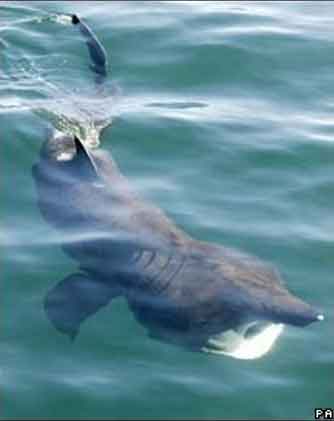
The basking shark, Cetorhinus maximus, is the second-largest living shark after the whale shark, and a plankton-eating shark species. Basking sharks are now protected under Ireland's Wildlife Act. It is also an offence to wilfully interfere with, or destroy, the breeding or resting places of the species. Basking shark is the second-largest living shark, after the whale shark, and one of three plankton-eating shark species. The act came into effect from midnight on Monday October 3, 2022, according to Minister of State for Heritage Malcolm Noonan and Minister for the Marine Charlie McConalogue.
Learn more
| |
|
The EU's Species Protection Authorities to Prohibit Import and Export of Mako Sharks from the South Atlantic
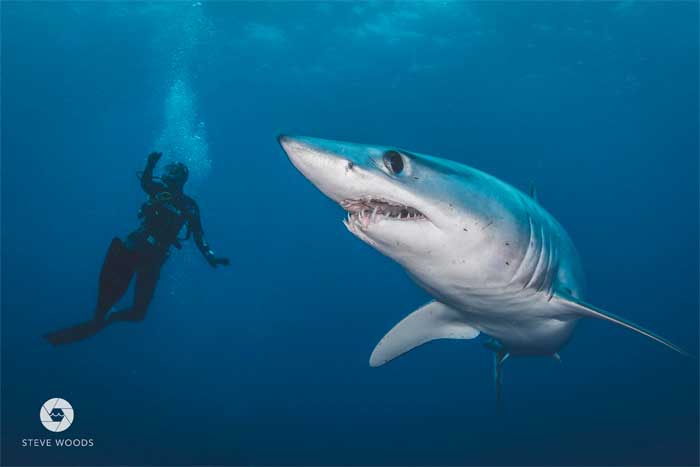
The EU's species protection authorities decided to prohibit all import and export of mako sharks from the South Atlantic. This extends the already existing ban for the North Atlantic since 2021 to the South Atlantic. This decision is an important milestone in stopping the massive over-exploitation of this endangered species and preventing the collapse of stocks in the Atlantic. As top predators, shortfin mako sharks (Isurus oxyrinchus) play a key role in the marine ecosystem and are vital for the conservation of biodiversity in the ocean. To date, the EU is still the largest catch nation for shortfin mako in the South Atlantic and responsible for the massive decline of this species, which can still be fished without limits. At international meetings in Brussels the fisheries department of the EU "DG Mare" typically represents the interests of the Spanish and Portuguese fishing fleets, while the EU species protection authorities work to protect endangered species from becoming extinct – two completely opposite positions.
ICCAT, the fishery management organization for the conservation of tuna, tuna-like species, and sharks in the Atlantic, meets in November and if the measures are adopted by ICCAT they are binding for all 52 members states, not just the EU.
| |
|
Hammerhead Shark in Maine Fishmarket
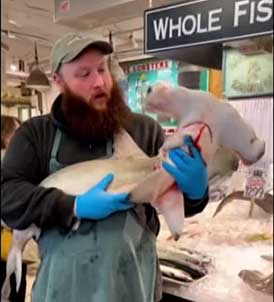
The Harbor Fish Market in Portland, Maine posted a video on their Instagram account showing a scalloped hammerhead shark for sale. In the video, a woman asks a man holding the shark what he's got, and he responds, "I got a hammerhead shark here. Just got two of them in." The man holding the shark said it's selling for $5.99 a pound. Nick Alfiero co-owner of Harbor Fish Market, said "It's a very limited fishery, and we probably will not see many of these in the future." He said the sharks came from near Cape Hatteras off the coast of North Carolina, and adds that the sharks were caught by gillnet fishers who are allowed to catch hammerheads if they're "caught in the nets and come aboard dead and cannot be thrown back alive."
Scalloped hammerhead sharks, a critically endangered species, are listed on CITES Appendix II. However, a spokesperson for NOAA Fisheries said, "Scalloped hammerhead sharks are not listed under the Endangered Species Act along most of most the coast of the USA, including Maine. Although they are listed as threatened under the Endangered Species Act in an area from Puerto Rico and south of the U.S. Virgin Islands."
Read more
| |
|
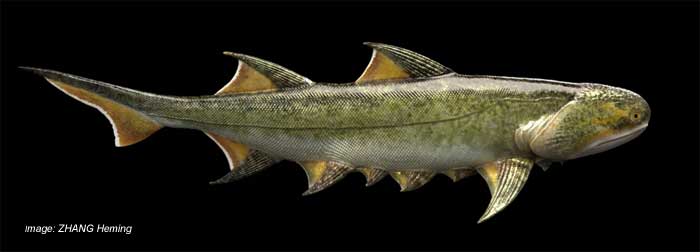
A Shark That Lived 439 years ago
A Paleozoic shark,
Fanjingshania renovata, with bony armor dates back to 439 million years. The fossil was retrieved from bone beds of the Rongxi Formation in Shiqian County, Guizhou Province, South China.
"The new data allowed us to place Fanjingshania in the phylogenetic tree of early vertebrates and gain much needed information about the evolutionary steps leading to the origin of important vertebrate adaptations such as jaws, sensory systems, and paired appendages." Professor ZHU Min from the Institute of Vertebrate Paleontology and Paleoanthropology (IVPP) of the Chinese Academy of Sciences.
The specimen is unusual in that it exhibit traits more commonly seen in bony fish or other animals, like us. What makes this fossil bizarre is that
Fanjingshania hails from the chondrichthyans, a group of animals with skeletons of cartilage, not bone, which may be explained by the fact that it could represent an early evolutionary branch of primitive chondrichthyans.
Learn more
| |
|
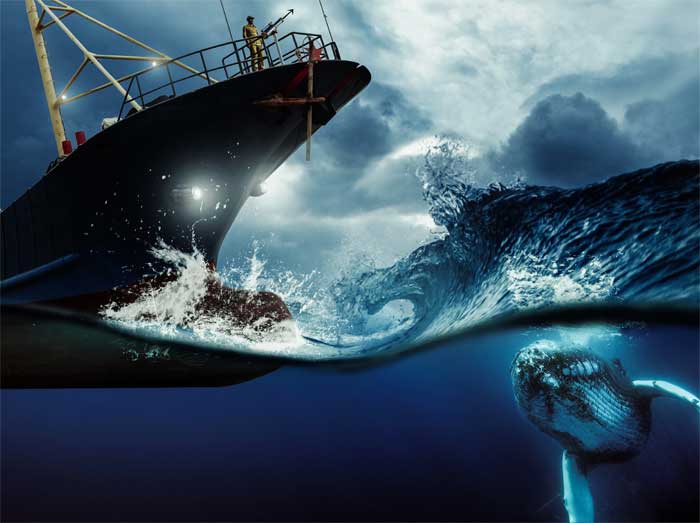
Norway Continues to Slaughter Whales in 2022
Norway kills more whales than any other nation. More than 15,000 have been killed by Norwegian whalers since 1986 when the International Whaling Commission (IWC) ban on commercial whaling took effect. In defiance of the international agreement, Norway has killed at least 580 whales this year even though the demand for whale meat continues to drop. A 2021 poll by NOAH, the Animal Welfare Institute (AWI) and Whale and Dolphin Conservation (WDC), revealed only 2% of Norwegians eat whale meat often, down from 4% in 2019. Among women, only 1% said they ate whale meat often, and no respondents under age 35 said they ate whale meat often. "Norway's market relies on Japan to keep its head above water,” said Kate O’Connell, marine wildlife consultant for Animal Welfare Institute. “Already this year, 226 tons of whale meat have been shipped to Japan; a second shipment of 124 tons is imminent."
Read more
| |
|
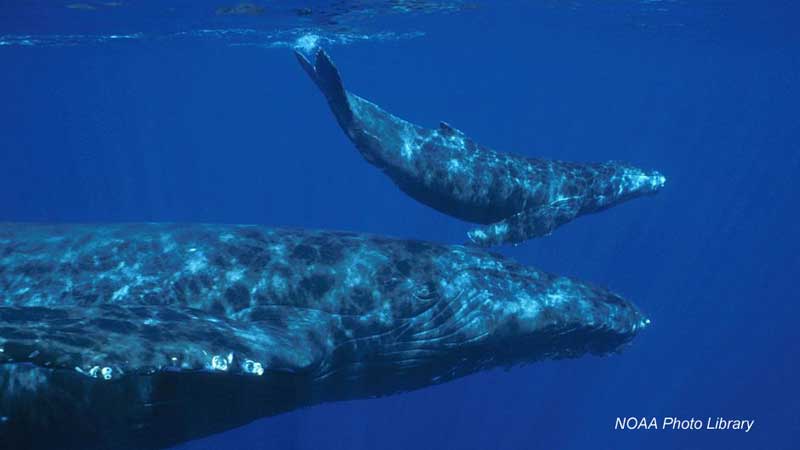
Australia's Humpback Whale Population Recovering
Humpback whales, Megaptera novaeangliae, have been protected in the southern hemisphere since 1963 and a worldwide moratorium on whaling was declared in 1986. In Australia, the whales have been making a slow recovery, but are still considered vulnerable. At the height of the commercial whaling industry, only 1500 humpback whales were remained alive. The west coast population has now recovered to approximately 90% of their known pre-whaling numbers while the east coast population recovered to 63% of its known pre-whaling population. Earlier this year Australian environment minister, Sussan Ley, announced that humpback whales are no longer considered to be endangered in Australian waters under the
Environment Protection and Biodiversity Conservation Act 1999 (EPBC Act). However, even if the whales were to be removed from the Australian threatened species list, the EPBC Act would still protect them as a matter of national environmental significance because they are a migratory species.
Read more
| |
|
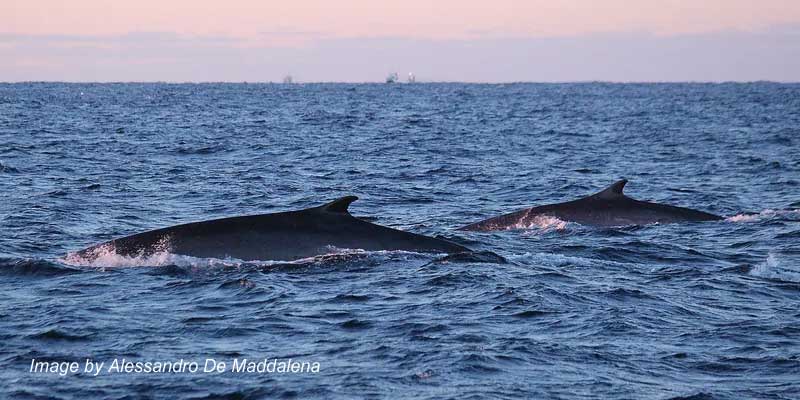
Long-term Tracking of Whale Feeding Behavior
Working in partnership with the manufacturer Telonics, Inc., Oregon State researchers developed a new satellite tag, known as the RDW. that allows monitoring of the whales' movements, including lunge-feeding, via satellite for multiple months. The tags were tested on 14 blue and 14 humpback whales off the coast of Southern California and allowed the researchers to observe key whale behavior events, identify important habitat and better understand whales' response to human activity such as ship traffic or military sonar. The tags also provide information about how much time whales are spending within the danger zone throughout their migration, and that information, will allow identification of areas of higher risk and enable making more informed decisions to help protect them from the threat of ship strikes.
Learn more
| |
|
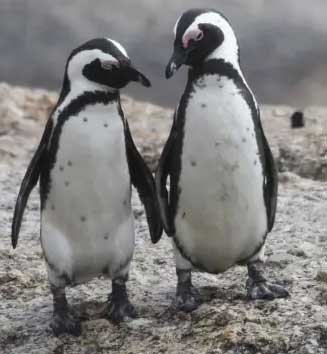
Penguins Pick Up Neighbors' Accents
African penguins form large colonies and have different types of relationships (with partners, colony-mates). They also have a variety of calls which they use to communicate with each other constantly.
We’ve all known a friend who came back from holiday in the UK with a British accent. This is known as social accommodation, and is common in humans. The more two people talk with each other, the more alike aspects of our voices can become. The ability of our voices to change in response to our environment is vital for learning new sounds, words, and languages at any age. It also widespread across the animal kingdom than scientists thought because penguins pick up accents too. The study suggests that the more penguins experience each other’s calls, the more alike their calls become.
Read more
| |
|
Marine History
Predicting Severe Storms : From Shark Oil to NOAA
| |
|
One of the earliest instruments for predicting the weather was the barometer which
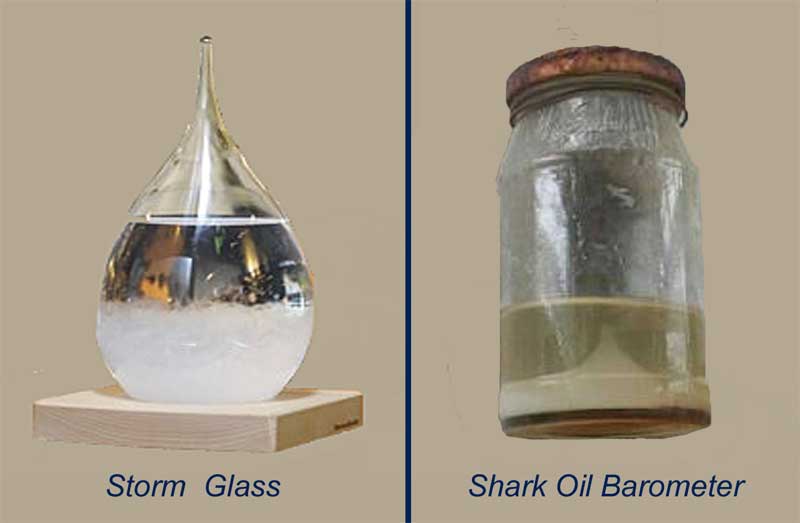
measures changes in atmospheric pressure. It was developed in 1643 by Evangelista Torricelli, an Italian physicist, mathematician, and a student of Galileo. But barometers were expensive which led to the appearance of storm glasses in mid-1800s. Storm glasses were used aboard the HMS Beagle, which also happened to have on board a young Charles Darwin. Clear fluid in a storm glass meant fair weather, if cloudy it forecast thunderstorms. The glass was not completely sealed so pressure changes may have had some kind of effect.
Shark oil barometers have been in use on the island of Bermuda for around 300 years, and are said to predict the weather with a reasonable degree of accuracy (although no one is quite sure how). They are not actually barometers because they do not measure atmosphere pressure. Each one consists of a sealed glass jar containing a small amount of oil extracted from a the liver of a young shark. When the shark oil is clear, the weather will be clear. When the oil turns cloudy, so will the skies. The oil is also said to spin when are serious storms or a hurricane is on its way. There are at least 40 different signals that can appear in given shark oil barometer; most have to do with the small amount of sediment in the oil. It is claimed the shark oil changes with the tides every six hours and phases of the moon, but many of the claims are anecdotal, and not much research has been done on shark oil barometers.
Today the science of meteorology provides advance warning of storms and hurricanes such as Ian which struck the US East Coast. The tools of this branch of atmospheric science rely on NOAA’s Weather and Climate Operational Supercomputer System (WCOSS), Doppler radar, weather satellites, ASOS (automated surface observing systems) highly advanced image-processing systems, and radiosondes for upper-air data.
| |
|
NJ State Museum Lecture Series:
World of Sharks
DATE: October 8, 2022
TIME: 2 pm EST
LOCATION: NJ State Museum, 205 W State St, Trenton, NJ 08608
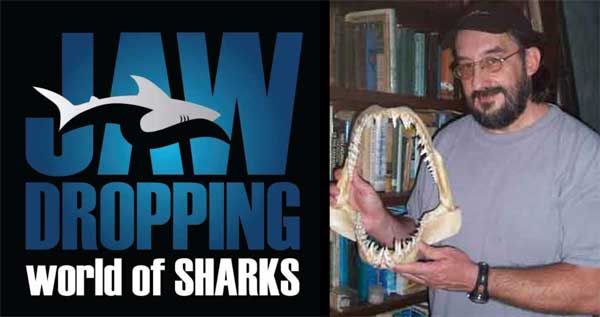
Dean Fessler, Shark Research Institute's Education Director, will be presenting "Demystifying the Maneater & JAWS ─ White shark research off South Africa and Guadalupe Island".
In person and streaming on the Museum's Facebook page
| |
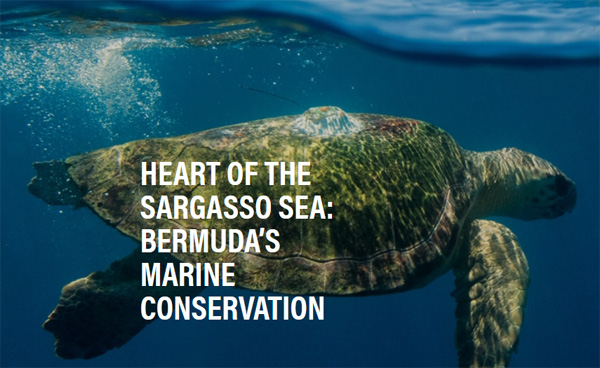
Heart of the Sargasso Sea: Bermuda’s Marine Conservation
DATE: Thursday, October 13, 2022
TIME: 6:00 – 10:00 PM
LOCATION: The Explorers Club, 46 East 70th Street, New York, NY, 10021
TICKETS: $100 include cocktails, diner and presentations by: Choy Aming, "Sharks of the Sargasso Sea”; Professor David Freestone, “Working to Conserve the Biodiversity of the Sargasso Sea through High Seas Governance"; Nan Hausern "Sound of Science - Bermuda Whale Song Project, Climate Change and Ocean Sound"; Dr. Gaëlle Roth, “A Turtle’s Lost Years in the Bermuda Triangle”.
Purchase tickets
| |
SUBMERGE Marine Science Festival
DATES: October 14 &15, 2022
TIME: 11:00AM to 3:00PM
LOCATION: Pier 84 at Hudson River Park, 555 12th Ave, New York, NY 10036
Come celebrate all things marine science during two fun-filled days, at Hudson River Park’s SUBMERGE Marine Science Festival! With live and in-Park activities led by their River Project team and STEM experts across New York, SUBMERGE brings marine science to life as you learn about NYC’s coastal waters. This interactive science festival invites the public to grow through awesome experiments, kid-approved entertainment and more!
It features a diverse array of hands-on marine science: talk shark with Dave Grant of the Shark Research Institute: meet local wildlife, and even a chance to get on the Hudson River. Registration is required for some activities; please check on Hudson River Park’s website to learn about individual program information as we get closer to the Festival date.
| |
|
Walter Munk Day
DATE October 15, 2022
TIME: 10 AM to 4 PM
LOCATION: Kellog Park, La Jolla Shores, San Diego, CA
Walter Munk was the “greatest living oceanographer,” widely recognized for his groundbreaking investigations of wave propagation, tides, currents, circulation and other aspects of the Ocean and Earth. The purpose of this event is to raise awareness of the fragility of our oceans and coastal environment. Numerous dignitaries will be in attendance, music, food, and Ocean Alley exhibitors will be offering interactive educational activities and games to engage the public and promote stewardship of the ocean.
| |
|
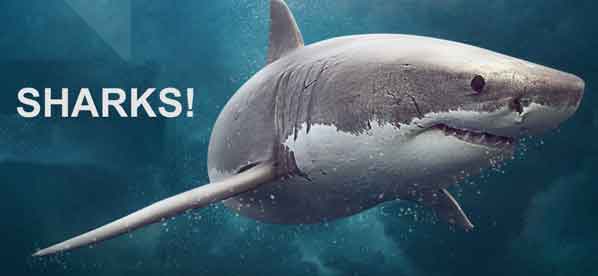
Sharks!
DATE: The exhibit is now open
LOCATION: The Australian Museum, The corner of College Street and William Street, Central Sydney, Australia.
Submerge yourself in the world of Sharks! In this immersive blockbuster exhibition created by Australian Museum experts. Visitors will go back in time to meet sharks’ ancient ancestors, come face-to-face with a huge whale shark, and uncover their extraordinary adaptations with interactive displays, touchable specimens and objects from the museum's collections. With cultural connections reaching back countless generations, visitors will discover how First Nations’ and Pasifika Peoples’ knowledge of sharks can help us protect them. With rising temperatures, industrial fishing and oceans choked by pollution, sharks are in great danger. Our attitudes and our actions will decide the fate of these ancient survivors. The exhibit features: Life-size shark models of 50cm epaulette shark and the 8m whale shark. The exhibit also features:
- Augmented reality interactives where you can play with a whale shark or explore the contents of a shark’s stomach,
- Real, touchable shark specimens from the Australian Museum collection,
- Plenty of jaw-some stuff for kids and families!
Experience this brand-new exhibition first in Sydney before it tours the world!
Learn more
| |
|
Notes
Fossil Shark Tooth Hunt at Calvert Cliffs, Maryland. Dave Grant will be leading a fossil shark tooth hunt to Calvert Cliffs in Autumn. If you'd like to come along, just send an email to info@sharks.org, put "Calvert Cliffs Trip" in the subject line, and Dave will send you more information.
SRI Headquarters will be closed November 14-25/26. SRI staff and scientists will be attending the Convention on International Trade in Endangered Species in Panama, supporting the listing of more shark and ray proposals.
Amazon.com is offering an opportunity to generate donations to the Shark Research Institute at no extra cost to you. Simply start your shopping at smile.amazon.com/ch/22-3110087, confirm "Shark Research Institute, Inc." as your charity of choice, and Amazon will make a donation to our organization.
You may join or renew your membership in the Shark Research Institute, or make a donation of any size at https://www.sharks.org/donate
Note: All donations are tax-deductible from U.S. federal income taxes as
charitable donations and help fund our field research, advocacy and education programs.
| |
Please share this free weekly newsletter with your friends and family to help grow our audience. All they need to do to receive the newsletter is simply sign up on our website’s home page (https:www.sharks.org)
We all have a lot of work ahead to protect sharks and the ocean,
and combat climate change while there is still time.
| | | | | |