|
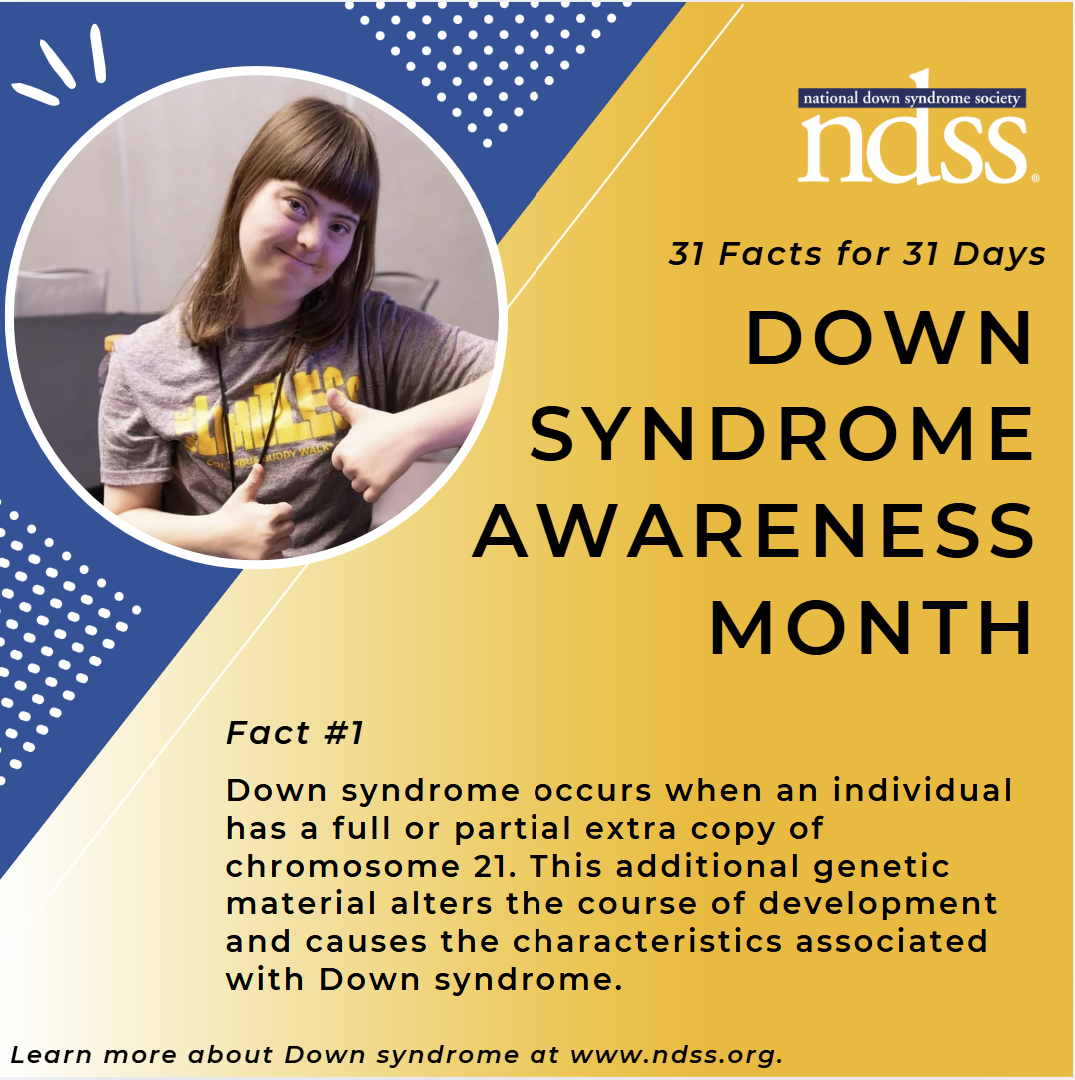
October is Down Syndrome Awareness Month
Celebrate the many abilities of our loved ones with Down syndrome
Join us in supporting the Down syndrome community during this special month. In the 1980s, NDSS participated in the efforts to have October proclaimed, “Down Syndrome Awareness Month,” or “DSAM,” and this designation continues today.
It’s a month to raise awareness and celebrate the many abilities of our loved ones with Down syndrome. DSAM seeks to break down barriers and focus on promoting advocacy for people with Down Syndrome. NDSS celebrates October in a different way each year and we invite you to get involved and spread the word. Use #DownSyndromeAwarenessMonth to post on social media, and don’t forget to tag NDSS so we can share your post!
About Down Syndrome
In every cell in the human body there is a nucleus, where genetic material is stored in genes. Genes carry the codes responsible for all of our inherited traits and are grouped along rod-like structures called chromosomes. Typically, the nucleus of each cell contains 23 pairs of chromosomes, half of which are inherited from each parent. Down syndrome occurs when an individual has a full or partial extra copy of chromosome 21.
This additional genetic material alters the course of development and causes the characteristics associated with Down syndrome. A few of the common physical traits of Down syndrome are low muscle tone, small stature, an upward slant to the eyes, and a single deep crease across the center of the palm. Individuals with Down syndrome possess varying degrees of cognitive delays, from very mild to severe. Most individuals with Down syndrome have cognitive delays that are mild to moderate. Although each person with Down syndrome is a unique individual and may possess these characteristics to different degrees, or not at all.
Aging successfully can be accompanied by challenges and obstacles for which adults with Down syndrome and their families and caregivers may feel inadequately prepared. Learning more about aging and the common concerns that may arise in later life can help individuals feel ready for what lies ahead. The NDSS has published a guidebook that aims to provide education and practical guidance for individuals with Down syndrome to more confidently prepare for a healthy adulthood into old age. You can view the entire guidebook by clicking the button below.
In recent decades, adults with Down syndrome are living into their 50s, 60s, and beyond, reaching new and exciting milestones in older age. Adults with Down syndrome experience a phenomenon of “accelerated aging,” meaning that certain conditions and physical features of aging arise at an earlier age than would typically be seen in the general population.
Generally, the effects of accelerated aging can be seen medically, physically, and functionally in individuals with Down syndrome. To family members and caregivers this might be observed as a general “slowing down” as individuals grow older. In addition, it is common for features of aging such as cataracts, hearing loss, or arthritis to develop earlier than what would be expected for their chronological age.
Complicating this picture is the fact that “normal aging” in adults with Down syndrome is not something that is neatly and predictably defined. Like all adults, they feel and express the effects of aging differently, so there is no exact timeline that can forecast these changes. In contrast, it is not typical, normal, or expected to experience a sudden, dramatic, or rapid decline with age.
These scenarios should always prompt further investigation and evaluation to uncover a root cause of these changes. In general, it is important to watch for any early changes or differences in individuals with Down syndrome as they grow older and to seek further help as needed.
It is important to recognize the special differences that people with Down syndrome will face as they age. This month, and beyond, let’s celebrate all the differences that make people with developmental disabilities truly amazing and continue to provide assistance as they age in place!
|