Our founder, Steve Susman, lamented the lack of real trial lawyers and real trial judges as a factor in the decline of civil jury trials that was relatively easy to change. Here is what we are doing to help.
ABA/NITA Legal Services Training
Butler Snow
Memphis 2023
“This training session is invaluable and the best such program I have ever attended, bar none.”
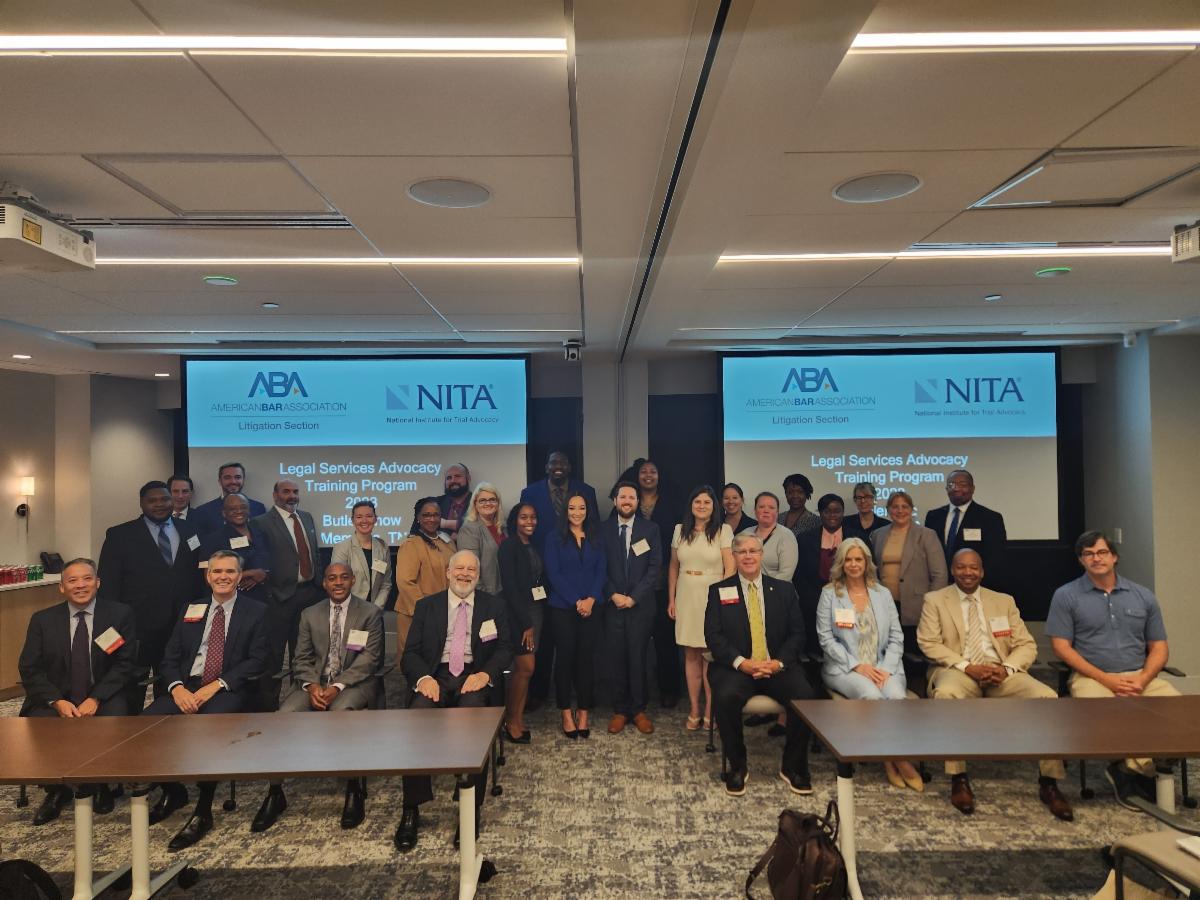
Above is just one of the comments received regarding the 2023 ABA Litigation Section/NITA trial advocacy training for legal services attorneys that was held at the law firm of Butler Snow in Memphis on August 17 and 18. Attorneys from Tennessee, Mississippi, Missouri and New Jersey attended the training. Program Director Hon. Mark Drummond (ret.) thanks everyone at Butler Snow for their hospitality and for making their offices available.
Past ABA Litigation Section Chair Danny Van Horn enlisted his partners at Butler Snow to assist in the training in addition to Butler Snow Pro Bono Counsel, Linda Seely, who was instrumental in organizing the training. Thanks to Christine McHugh, Public Service Programs Coordinator, for The National Institute for Trial Advocacy (NITA).
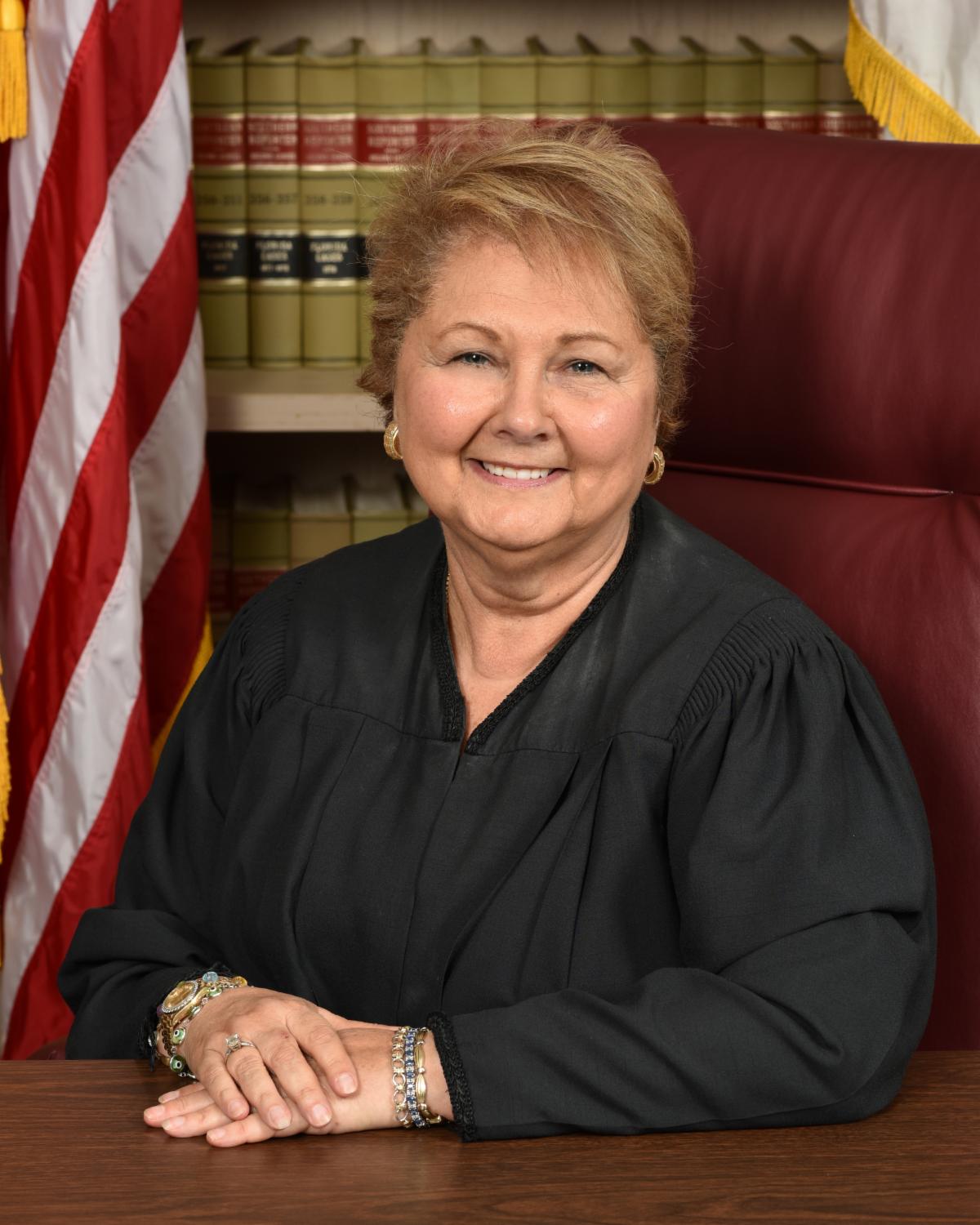
Judge Drummond thanks Hon. Bernice Donald (ret.), Hon. Andre Mathis, Janika White, Peter Gee, John Hutchins and Butler Snow partners Danny Van Horn, Amy Pepke, Will Perry, Keenan Carter and Brent Siler for sharing their knowledge and expertise with the attendees.
Welcome back, Mike
With this issue we welcome back one of our previous Research Fellows, Michael Elias Shammas. Mike was the author of one of our most quoted pieces on the constitutionality of remote jury trials. Since leaving the Civil Jury Project after his first stint here from 2019-2020, Mike completed a clerkship on the Sixth Circuit Court of Appeals from 2020-2021 and taught Legal Research & Writing at Tulane Law School from 2021-2023.
Future Events
October 4, 2023
We look forward to meeting virtually with Mark Farrant and his team to discuss the recent work on juror mental health initiatives in Canada which we reported on in our July 2021 newsletter.
April 4 & 5, 2024
We will assist in training the next generation of trial lawyers in legal services at the Bradley firm's office in Birmingham, Alabama. Anne Marie Seibel, chair of the Litigation Section of the ABA, has graciously offered her firm to host the 2024 training.
AI and the Future
“Therefore, we call on all AI labs
to immediately pause for at least six months
the training of AI systems more powerful than GPT-4.”
Well, that stopped me. I was about to download the latest artificial intelligence (AI) system that might help me with this column. For years my “technology” has been the thesaurus. However, after reading that more than 1,000 technology leaders and researchers were urging a pause, my download was on hold.
Images of HAL 9000, the Terminator, and Robocop gave me pause. I could just see the New York Times lede: The takeover of NORAD, our entire electric grid, and the distribution system for Krispy Kreme donuts has been traced to an AI download by a columnist writing for Litigation News.
But seriously, after reading what seemed to be an article a day on AI, there are some real concerns. Concerns that impact the work we do as attorneys. In my 40+ years as an attorney, we have gone from carbon paper to Xeroxing to email. The pandemic then drastically changed the way we do things. Little did I think that we would see yet another sea change so soon.
Each concern begins with a sentence from a news article followed by some scenarios on how AI might affect trial practice. My apologies for the number of question marks. I don’t have many answers, only questions.
Law School
“GPT-4 didn’t just pass the bar exam—it scored in the 90th percentile.”
The bar exam I took was pass/fail. Not sure if I was in the 90th percentile. Probably not. Already there are do-it-yourself programs such as LegalZoom. These programs, combined with competent and ethical AI, would be a powerful combination. This could be an asset for those whose legal needs are underserved. However, “human” attorneys should vet these before clients start linking things like bank accounts to these platforms.
What algorithm will handle the balancing of ethical issues, such as the outer limits of “zealous representation”? Ethics opinions from different states can vary on the same subject. How will the gray areas be addressed? Who will create the algorithm?
The Truth
“A brain wave reader that can detect lies.”
Will AI eventually replace the judge…or the jury? Someone once told me that there was an app for everything. One “lie detection” app touts, “Our fine-tuned, artificial intelligence engine now gives you an ability to see the likelihood of anyone’s lie.”
Not so fast, cautions Jake Bittle, who writes, “In reality, the psychological work that undergirds these new AI systems is even flimsier than the research underlying the polygraph.” However, Bittle’s article was written in 2020. It appears that the capability of AI systems has grown at an exponential rate.
I contacted Bittle by email, and although he has not done any further research on this topic, he responded, “My impression is that even with very advanced AI systems like the ones that have debuted in the past year, there would still be a ‘garbage in, garbage out’ problem. Facial expressions and vocal fluctuations are only of limited use as indicators of a subject’s inner psychological state, just as the galvanic skin response measured by a polygraph doesn’t always indicate that a subject is lying.”
Some law enforcement agencies are already using AI to profile people. One algorithm uses nationality to profile dangerous drivers. Will AI technology be used by law enforcement as one component of probable cause for an arrest?
Jury Selection
“Other companies sold…sentiment analysis software, in which an algorithm determines a person’s mood from facial expressions.”
In the movie Runaway Jury, Gene Hackman portrays an unethical jury consultant. He watches jury selection through a hidden camera. He provides advice via a hidden earpiece. Given how compact and powerful phones have become, will judges have to scrutinize all electronics brought into the courtroom?
Will attorneys try to convince judges that these AI tools be allowed? If allowed, will this favor those parties who can afford it? If some courts allow this and others do not, does this result in a patchwork justice system? How would jurors react if they knew that their every micro-expression and eye movement were being fed into an AI algorithm?
Evidence
“The new video-generation systems could speed the work of moviemakers and other digital artists, while becoming a new and quick way to create hard-to-detect online misinformation, making it even harder to tell what’s real on the internet.”
With just a few words AI can now generate pictures and videos. “Tree branch hiding stop sign” could give you a realistic image of just that. I realize that exhibits could be fabricated the old-fashioned way. But AI makes it much easier to fabricate and much less easy to discover the ruse.
Will courts place any limitations on the use of AI during depositions? With the entire casefile loaded, AI can now propose questions for the attorney that leave no stone unturned. Could AI also listen in and prompt objections for the defending attorney? What about the party that cannot afford this technology? Going one step further, could attorneys use AI to try and detect deception with the camera on a laptop or a phone? Again, will courts be uniform in addressing these issues?
With the power to create any scene, perhaps judges should enter a standing order in all cases that counsel has an ethical duty to disclose if AI was used to create any exhibit or as part of any deposition. The usual sanctions of costs, fees, barring of claims, dismissal, and referral to disciplinary commissions should be used for violators.
The Bottom Line
No one questions using the power of AI to tackle cancer or climate change. This powerful tool could have great value for our world and the future. However, it will also affect our legal world. Already employers and law enforcement are using powerful AI tools. The results of using these tools will necessarily flow into our courtrooms. How are the algorithms constructed? Who constructs them? Are we ready for this?
Some would argue I am overreacting. Some argue that AI just helps attorneys sift through words more efficiently. I chuckled at this from a recent article: “Law is seen as the lucrative profession perhaps most at risk from the recent advances in AI because lawyers are essentially word merchants.” This “word merchant” is still holding off on his AI download.
Resources
-
Cade Metz & Gregory Schmidt, “Elon Musk and Others Call for Pause on A.I., Citing ‘Profound Risks to Society,” N.Y. Times (Mar. 29, 2023).
-
Future of Life Institute, “Pause Giant AI Experiments, An Open Letter,” futureoflife.org (Mar. 22, 2023).
-
Casetext, “Casetext CIO co-authors study on impressive UBE score by GPT-4, the AI powering Cocounsel,” casetext.com (Mar. 28, 2023).
-
Paul Mozur & Adam Satariano, “ A.I., Brain Scans and Cameras: The Spread of Police Surveillance Tech,” N.Y. Times (Mar. 30, 2023).
-
data ai, Verity facial lie-detector.
-
Jake Bittle, “ Lie detectors have always been suspect. AI has made the problem worse.,” MIT Tech. Rev. (Mar. 13, 2020).
-
Cade Metz, “ Instant Videos Could Represent the Next Leap in A.I. Technology,” N.Y. Times (Apr. 4, 2023).
-
Steve Lohr, “ A.I. Is Coming for Lawyers, Again,” N.Y. Times (Apr. 10, 2023).
Published in Litigation News Volume 48, Number 4, Summer 2023. © 2023 by the American Bar Association. Reproduced with permission. All rights reserved. This information or any portion thereof may not be copied or disseminated in any form or by any means or stored in an electronic database or retrieval system without the express written consent of the American Bar Association.
As always, if your court or bar association is interested in a presentation on jury trials, the Civil Jury Project or jury improvement tools please call me at (217) 430-7459 or contact me at markd56.md@gmail.com.