|
Prevention Insights
A South Southwest PTTC eNewsletter
| | In the October 2026 Issue | |
-
Title: Artificial Intelligence and Prevention: What We Have Learned
- Featured Publication: Artificial Intelligence in Mental Health Services: Opportunities, Challenges, and Future Directions
- What's Happening Around the Region?
- Spotlight on Additional Resources
| | |
Artificial Intelligence and Prevention:
What We Have Learned?
| | |
By Iris Smith, Ph.D.
The rapid growth of artificial intelligence has led to global concern about accuracy, privacy, oversight and control of the technology and its applications. Generative AI (gen AI) can create original content such as text, images, video, audio or software code in response to a user’s prompt or request. These models are based on machine learning algorithms that simulate the learning and decision-making processes of humans and can create new content such as text, images, music, code or video. [1],[2] Large language models (LL AI) are programmed to identify patterns in text, capture deeper context and nuance and use reasoning to communicate with humans. LL AI and gen AI models can find patterns in data on their own without human supervision or predetermined responses. These applications have the capability to locate and process large amounts of data across multiple domains, enabling them to understand underlying concepts as well as absorb and apply current research. [3] These abilities make LL and gen AI applications useful in locating, summarizing and interpreting information at a much faster and often more accurate pace than human researchers and clinicians. Chatbots such as ChatGPT are examples of applications developed with gen AI. These applications can be useful in answering questions, drafting documents, and summarizing articles. [2] Recursive AI systems, which (theoretically) can operate with little or no human oversight not only to locate and process information but also to generate original outputs, which it then uses to improve the existing system (essentially “self-improvement”). [4]
Read the full article to learn more.
| |
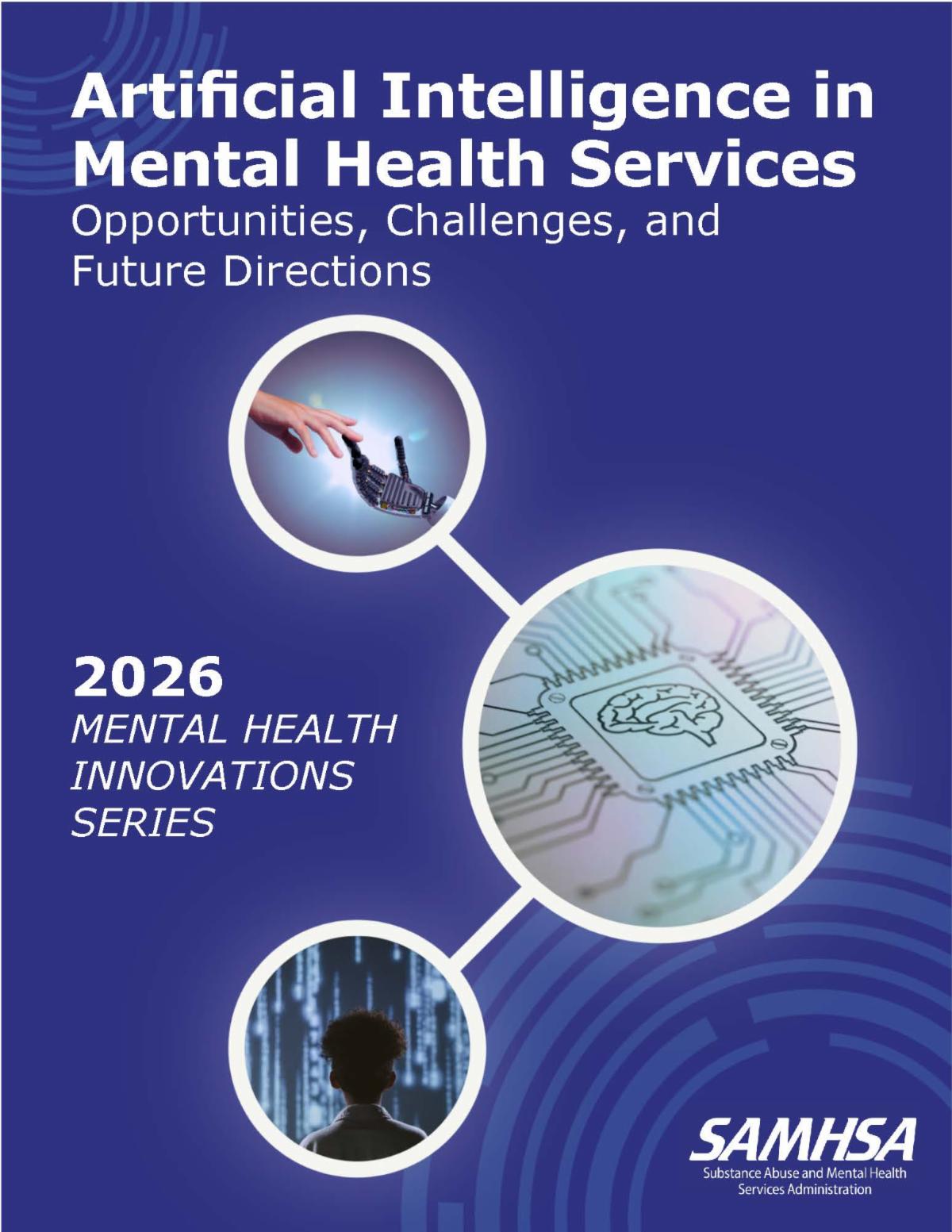
Artificial Intelligence in Mental Health Services: Opportunities, Challenges, and Future Directions | | |
The Department of Substance Abuse and Mental Health Services (SAMHSA) released a policy paper, Artificial Intelligence in Mental Health Services: Opportunities, Challenges, and Future Directions, which presents current evidence on AI and mental health services, and examines what is known or proposed in a rapidly evolving AI enterprise. Based on this information, the paper provides considerations for policymakers as they govern responsibly advancing AI into mental health and substance use disorder services.
ABSTRACT: Artificial intelligence (AI) has the potential to improve access to and better meet demand for mental health and substance use disorder care. AI tools are available anytime, have no waiting lists, are typically low cost, and can be accessed anonymously. The question is not whether these tools have value; it is whether that value can be realized safely and at scale given concerns about model transparency, decision-making, and accuracy. The urgency of the question of the safety of AI for mental health support is not abstract, and reports of risks associated with its use are part of the national discourse. Generative AI is already reshaping mental health behavior, yet these AI tools are inconsistently evaluated, largely unregulated, and capable of both benefits and harm. This paper reviews what these technologies can and cannot do, and what it will take to govern them responsibly to realize their positive potential.
Access the paper
| | What's Happening Around the Region | | |
We're Hiring
We are hiring for a full time position in the PTTC Prevention Fellowship Program.
Our PTTC Fellow will:
- Learn daily operations at their assigned prevention placement site for 26 hours/week
- Receive training from the PTTC
- Participate in learning and capacity development activities coordinated by the Prevention Science Mentor and Prevention Technology Transfer Center (PTTC) network staff
This field position based in Little Rock, Arkansas starts from the applicant's hiring date - September 29, 2027.
We invite you to apply.
| |
We are hiring a full time Training and Technical Assistance Specialist
The South Southwest Prevention Technology Transfer Center (SSW PTTC) and the Strategic Prevention Technical Assistance Center (SPTAC) housed in the Southwest Prevention Center, has an opening for a Training and Technical Assistance (T/TA) Specialist. This position may be located remotely or in the Norman, Oklahoma office.
The T/TA Specialist will support both centers providing T/TA to the substance misuse prevention workforce both individually and regionally; helping to resolve a workforce or system level challenges, developing and revising instructional materials/products; and delivering presentations.
We invite you to apply.
| | |
They're Hiring
- The Oklahoma Department of Mental Health and Substance Abuse Services (ODMHSAS) Prevention Division Central Office in Oklahoma City is seeking a leader to strengthen statewide prevention capacity across school-based prevention, Multi-Tiered Systems of Support (MTSS) in schools, higher education, and faith-based settings. The role also provides fiscal and programmatic oversight to ensure prevention initiatives align with ODMHSAS standards and best practices.
Apply here
- ODMHSAS Prevention Division at our Central Office in Oklahoma City is seeking a team member to partner with organizations and other prevention programs to plan and develop needed services, connect them with technical assistance and training, and monitor programs to ensure they meet ODMHSAS standards and evidence-based requirements.
Apply here
| | |
Clearing the Air: Cannabis Policy and Prevention
November 17, 1:00 pm - 2:30 pm CT
This training will explore the evolving cannabis policy landscape, including the current status of federal cannabis rescheduling, changing regulations, and the growing commercialization of cannabis products. Participants will examine how these developments may influence youth substance use risk factors, public health, and community prevention efforts. The session will also highlight practical considerations and strategies to help prevention professionals navigate policy changes and respond effectively to emerging cannabis-related challenges.
| |
AI Crash Course for Prevention Professionals: Tools, Tips, and Responsible Use
October 22, 1:00 pm - 2:30 pm CT
Dive into the world of generative artificial intelligence (AI) with an engaging 90 minute webinar that demystifies Large Language Models (LLMs) and their practical applications within the prevention space. This webinar will offer a blend of theory and hands-on activities, including brainstorming AI-driven intervention strategies for substance misuse prevention scenarios. It promises to enhance your understanding of AI's potential in substance misuse prevention work, while also highlighting the critical issues of misinformation and environmental impact inherent in these technologies.
| |
What’s Ahead at the SSW PTTC?
We’re developing our annual workplan and have several exciting learning opportunities in the works! Be on the lookout for an online course exploring the intersection of substance misuse and suicide, along with webinars on emerging drug trends, strategic planning, and other timely prevention topics. Need support strengthening your prevention efforts? Remember, we also offer logic model technical assistance to help you connect your strategies, activities, and intended outcomes. Stay up to date on our training and technical assistance opportunities by visiting the PTTC Network Website.
| |
Spotlight on Additional Resources | | Navigating AI in Prevention Work | | |
AI 101: Using AI to Support Substance Use Prevention
This fact sheet provides background on AI, a framework for deciding when and how to use AI, and specific AI applications within the context of SAMHSA’s Strategic Prevention Framework.
View the fact sheet
| |
Prevention in the Digital Age: AI, Peer Support, and Behavioral Health Innovation
Discover how peer support and AI can work together to advance prevention, promote mental wellness, reduce substance use-related harms, and improve access to behavioral health services in rural communities. Review emerging models, implementation considerations, and practical strategies for integrating technology into prevention-focused behavioral health care.
Access the webinar
| |
Navigating AI in Prevention: A Practical Guide for Professionals
Explore ways to use artificial intelligence (AI) thoughtfully to support more effective, efficient, and ethical work. This two-part series provides a clear, decision-based framework for integrating AI and methods to enhance community engagement and program efficiency while upholding the highest standards of data privacy and digital dignity.
Watch Part 1
Watch Part 2
| | |
Suicide Prevention Resource Center: Best Practices Registry
The Suicide Prevention Resource Center (SPRC) at the University of Oklahoma compiles evidence-based suicide prevention programs with implementation guidance for prevention professionals and grantees. Each intervention listed on the Best Practices Registry (BPR) has been reviewed for alignment with the most current guidance on suicide prevention.
Explore the BPR
| |
Substance Use Prevention Workforce: Results of a National Assessment Now Available
NASADAD, on behalf of SAMHSA, conducted the first ever national needs assessment of the substance use prevention workforce and developed a report on the findings. The U.S. Department of Health and Human Services (HHS) Substance Abuse and Mental Health Services Administration (SAMHSA) Report to Congress on the substance use prevention workforce is now available on the SAMHSA website.
View the report
| |
CDC: Overdose Prevention Data Channel
Access national and state-level trends for fatal and nonfatal overdoses, data from multiple CDC surveillance systems, and evidence-based prevention strategies. Connect to CDC programs, tools, and resources to support your prevention and response efforts, and discover how CDC-funded programs support communities.
Learn more
| | “AI shouldn't be built to replace human potential; it should be built to expand it. The most critical benchmark of any technology is how effectively it empowers individuals and connects communities.” - Álvaro Celis. | | | | |