News for Farmers
& Food Producers | | |
|
Hello,
The wheel of the year keeps turning! There is a slowing down, as the day light retreats - but also a bit of frenetic energy as the colder winds whip, urging us to make our preparations for the fast approaching winter.
It's been a busy month with our Farmer First Aid Workshop, Berkshire Grown Winter Farmers Market planning, and our Feast From the Fields event.
In my spare time, I've lent a hand at farms nearby. I enjoy these opportunities to help out friends, and it also helps me to experience a day in the life of other types of farmers. I now know what it takes to tag and band beef calves and load chickens into the trailer for processing. But the highlight was harvesting all of the dahlias we could before the frost crept in!
With the harvests comes grant season! While grants all have their own schedules and timelines, September through April are when we see a heavier saturation of grant opportunities released and due for submission. I've included some grant opportunities below. If you have a specific project or opportunity that you're looking to fund, drop me a line and I can keep an eye out for specific opportunities for you.
Wishing you the best as you transition to the slower days of autumn. Don't hesitate to reach out if there's any way we can support you!
Best Regards,
Alyssa VanDurme
Program Manager, Business Members
| | Vendor Applications Open! | | |
Seeking vendors for Berkshire Grown's Winter Farmers Market at Housatonic Dome and Holiday Farmers Markets at Williamstown Elementary School!
Click the button below to apply!
Questions? Email me at Alyssa@berkshiregrown.org.
| | |
Berkshire Grown Winter Farmers Markets at the Housy Dome
1064 Main Street - Housatonic, MA
Saturdays - 10 AM – 1 PM
Nov 21, 2026 - FULL
Dec 19, 2026 - FULL
Jan 16, 2027
Feb 20, 2027
Mar 20, 2027
Apr 17, 2027
| |  | |
Berkshire Grown Holiday Farmers Markets at Williamstown Elementary School
115 Church St,
Williamstown, MA
Sundays - 10 AM – 1 PM
Nov 22, 2026
Dec 20, 2026
| | Technical Assistance Program | | |
Is there a specific area of your farm or business where you could use support?
Berkshire Grown's Technical Assistance (TA) Program helps you develop the skills and expertise necessary to achieve your goals or solve a particular problem in your business.
Some recent TA topics include: Bookkeeping, Human Resources, Grant Writing, Crop Planning, CSA Management, Marketing, and more.
This program is NO COST to farm business members of Berkshire Grown. Berkshire Grown compensates the TA Provider for their time and expertise.
Reach out so we can discuss next steps!
| | |
Massachusetts Disaster Relief Funds - Deadline extended to 10/30!
Applications are now available for farmers who suffered losses in 2023 and 2024 due to weather may be eligible for this one-time loss-recovery program. Crop, infrastructure, timber, and other losses totaling more than $2,500 may be eligible.
Applications are open until October 30, 2026. Please read the RFR carefully for details about eligibility and reporting requirements.
This block grant program, funded by USDA and administered by MDAR, will cover portions of eligible losses, including:
- Crops, such as fruits and vegetables
- Future economic losses from the loss of perennial plants
- Infrastructure, such as buildings and plasticulture
- Timber
- Bare-ground practices necessary to mitigate land loss.
Losses for most categories must represent 15% of the value of the lost crop or infrastructure, and claims must total $2,500 or more for each applicant. All eligibility requirements and additional details can be found in the RFR under “Attachments” at COMMBUYS link here.
Deadline for applications is September 30, 2026 at 4:00pm. Late applications will not be considered.
A video explanation of the program, including a walk-through of the application form, can be found here.
Questions about the program may be submitted to ndr2@mass.gov before August 21. Answers to general questions, but not questions about specific applications or circumstances, will be posted online here.
Program Information and Application
MDAR NDR II Program Page:
https://www.mass.gov/how-to/natural-disaster-recovery-ii-program-for-agriculture-ndrii-2023-2024
NDR II Request for Response (RFR) — COMMBUYS:
https://www.commbuys.com/bso/external/bidDetail.sda?docId=BD-27-1002-1003-001-132016&external=true&parentUrl=bid
MDAR Program Questions: ndr2@mass.gov
Resources and Technical Assistance for Farmers
Given the quick turnaround during a traditionally busy time of year for many farmers, we are also compiling organizations and resources that may be able to assist farmers in understanding the program, documenting losses, or navigating the application process.
-
Massachusetts Farm Bureau / Karen Schwalbe, Executive Director — Statewide; 508-481-4766; karen@mfbf.net
-
Cape Cod Cranberry Growers Association / Brian Wick, Executive Director — Southeastern MA; bwick@cranberries.org
-
Mass Association of Dairy Farmers / David Shepard, President — Statewide; elmviewfarm1715@gmail.com
-
Mass Association of Dairy Farmers / Rena Sumner, Executive Director — Statewide; madfoffice@gmail.com
-
Mass Nursery and Landscape Association / Rena Sumner, Executive Director — Statewide; mnlaoffice@gmail.com
-
Mass Flower Growers Association / Michael Paduch, President — Statewide; mike.crystallake@gmail.com
-
Southeastern Massachusetts Agricultural Partnership (SEMAP) / Honey Bee Puder — Bristol, Norfolk, and Plymouth counties; hpuder@semaponline.org
-
CISA (Community Involved in Sustaining Agriculture) / Kristen Wilmer — Western MA, especially Franklin, Hampden, and Hampshire counties (and neighboring counties); kristen@buylocalfood.org; 413-352-9717
-
CISA is holding an in-person application support session in South Deerfield on 9/15 from 5-7pm (link here).
-
Berkshire Grown / Margaret Moulton, Executive Director - Berkshire county; margaret@berkshiregrown.org
| | |
Farm Aid's Disaster Assistance for Farmers- Resource Guide
It’s easy to assume that natural disasters are unlikely to impact your farm, especially when so many other issues demand your immediate attention. Natural disasters are occurring with increasing frequency and severity (EPA, n.d.) and farmers are on the front lines of impact. While it may seem impossible to prepare for all disasters, planning and forethought can improve your operation’s resilience and recovery. This process based resource guide was developed to support you every step of the way through post disaster recovery.
| |
|
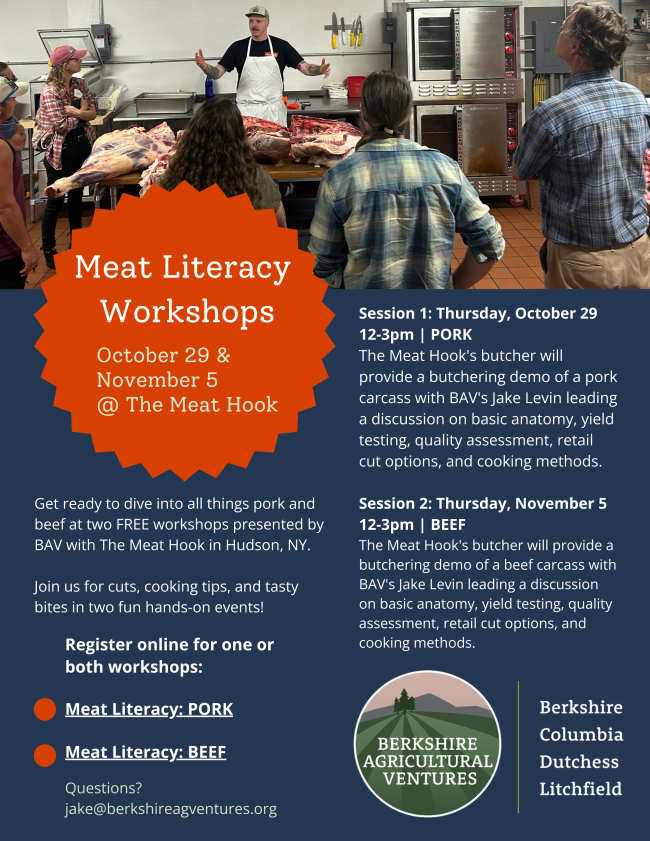
Meat Literacy Workshops
Berkshire Agricultural Ventures is partnering with The Meat Hook to host two upcoming free hands-on Meat Literacy Workshops in Hudson, NY.
These sessions are designed for local producers and community members interested in learning more about cuts, cooking methods, and carcass breakdown. Each workshop features a live carcass butchering demo alongside discussions on basic anatomy, yield testing, quality assessment, and retail cut options.
Workshop Details
-
Location: The Meat Hook, Hudson, NY
-
Cost: FREE
- Session 1: Pork
-
Date & Time: Thursday, October 29 | 12:00 PM – 3:00 PM
-
Highlights: Live pork carcass butchery demo by The Meat Hook’s butcher, paired with a discussion on yield testing, retail cuts, anatomy, and cooking led by BAV's Jake Levin.
- Session 2: Beef
-
Date & Time: Thursday, November 5 | 12:00 PM – 3:00 PM
-
Highlights: Live beef carcass butchery demo by The Meat Hook’s butcher, paired with an anatomy, quality assessment, and yield testing discussion led by BAV's Jake Levin.
How to Join:
- Click here to register for Pork
- Click here to register for Beef
| |
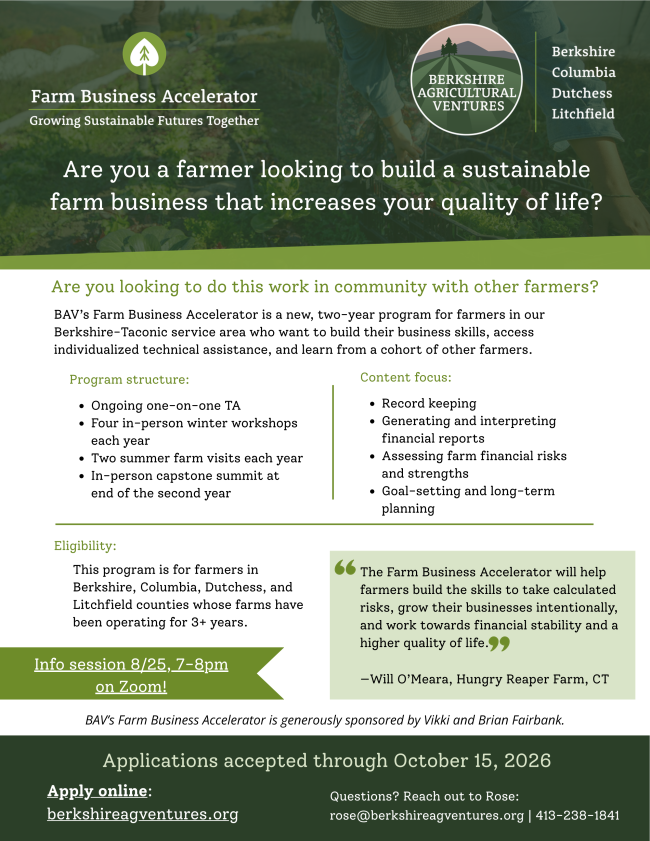
Berkshire Agricultural Ventures Farm Business Accelerator Program
BAV’s Farm Business Accelerator is a new, two-year program bringing individualized 1:1 technical assistance, expert perspectives, peer learning, farm visits, and implementation funds to a cohort of farmers across Berkshire, Columbia, Dutchess, and Litchfield counties. The program begins in November 2026.
Program participants will develop and share business skills around:
- Record keeping
- Generating and interpreting financial reports
- Creating holistic goals
- Assessing farm financial risks and strengths
-
Long-term planning for your farm’s needs
Program components include:
- Four in-person workshops each year
- Two farm visits each year
- Ongoing one-on-one technical assistance from a provider focused on your farm’s individual needs
- An in-person capstone summit, which will complete the program after the second year
By combining hands-on workshops with individualized technical assistance, creating opportunities for farmer-to-farmer learning, and providing implementation funds, this program creates a rigorous, supportive, and sustained learning opportunity that will unfold over two years.
Eligibility
- Farmers in Berkshire, Litchfield, Columbia, and Dutchess counties are eligible for this regionally focused program.
- Farms should be in at least their third year of operation; more established or generational farms are eligible and encouraged to apply.
- Farmers should have financial records and some understanding of basic bookkeeping or be available to get up to speed with BAV’s assistance prior to November.
- There is a $150 per-farm fee upon acceptance. All participants will receive implementation funds upon course completion each year.
Deadline & More Info
| |
Grants, USDA Programs, and Local Expertise for Implementing New Practices to Manage Weather-Related Risks
Date & Time: November 4 @ 4:00 pm - 6:00 pm
Cost: Free
Location: Zoom (link provided with registration)
Register here
Farmers often need both planning and financial support to implement new practices or add new enterprises to manage more frequent extreme weather. This webinar will showcase state, federal, and private funding programs, community lenders that can provide bridge loans for reimbursable grants, and technical assistance providers who can support planning and grant application preparation and help farmers work with federal agencies.
Presenter Margaret Christie will discuss approaches to securing grant funding, including how to decide whether to submit a proposal and tips for strengthening your application. She’ll provide an overview of available technical assistance, and representatives from the Massachusetts Department of Agricultural Resources and USDA’s Natural Resources Conservation Service will be available to answer questions in breakout rooms.
Long-time CISA staffer Margaret Christie frequently gives presentations on grant sources and grant preparation for farmers and works individually with farmers to plan and prioritize projects for grant applications and to prepare grant applications. She sits on the Advisory Committee of the Pioneer Valley Grows Investment Fund, which frequently provides bridge loans to farmer grant recipients.
| | |
|
Food Safety & Processing Workshops
Better Process Control School: Acidified Foods Only
Date: November 2–3, 2026
Location: Worcester Food Hub, Worcester, MA | 2-Day In-Person Training
Cost: $650
Get the training you need for acidified food processing! This course covers key principles of microbiology, sanitation, thermal processing, and container closure evaluation for processors of shelf-stable acidified foods regulated under 21 CFR Part 114.
✅ FDA-approved training manual
✅ Lunch and coffee breaks
✅ Digital certificate with a passing exam score of ≥80%
✅ Taught by UMass Amherst faculty
💲 Small-Scale Processor Discount: Register by September 30 and receive $250 off using promo code Acidifed_BPCS26.
🔗 Register: https://www.umass.edu/agriculture-food-environment/value-added-food/events/better-process-control-school-acidified-only
FSPCA Preventive Controls for Human Food: Part 2, In-Person
Date: November 17, 2026 | 8:00 AM–5:30 PM ET
Location: Worcester, MA | 1-Day In-Person Training
Cost: $300
Complete Part 2 of the FSPCA Blended Preventive Controls for Human Food Participant Course. This instructor-led training completes the blended FSPCA curriculum and is one way to meet the training requirements for a Preventive Controls Qualified Individual (PCQI).
✅ Instructor-led FSPCA standardized curriculum
✅ Lunch and coffee breaks
✅ FSPCA course certificate upon successful completion of Parts 1 and 2
✅ Taught by UMass Amherst and URI Food Safety Specialists
💲 Early Bird Rate: $275 through October 16
🎓 Student Rate: $150 with code STU50
📅 Registration Deadline: November 9
⚠️ Important: The online Part 1 must be completed before attending Part 2. Part 1 is an additional $299.
🔗 Register & More deals are here.
Virtual FSPCA Preventive Controls for Human Food Certification Training
Date: January 5–8, 2027 | 9:00 AM–3:30 PM ET
Location: Live, Virtual via Zoom | 4-Day Synchronous Training
Cost: $650
Start 2027 by strengthening your food safety skills and completing the FSPCA Preventive Controls for Human Food (PCHF) standardized curriculum. This 22-hour course provides training in developing and implementing a Food Safety Plan and is one way to meet the training requirements for a Preventive Controls Qualified Individual (PCQI).
✅ Hazard analysis and risk-based preventive controls
✅ Monitoring and corrective actions
✅ Verification and validation
✅ Food safety documentation and records
✅ FSMA Preventive Controls for Human Food requirements
✅ FSPCA course certificate upon successful completion
💲 Early Bird Rate: $600 through December 11
📅 Registration Deadline: January 3, 2027
⚠️ Important: This is a live, interactive virtual course held in real time over four consecutive days. Participants must attend the entire program, have a working video camera facing them, and actively participate in all discussions and exercises to earn the FSPCA course certificate.
🔗 Register: Virtual FSPCA Preventive Controls for Human Food Certification Training Course : Center for Agriculture, Food, and the Environment (CAFE) at UMass Amherst
|
| |
The Massachusetts Agroforestry Access Project (MAAP)
A new two-year pilot program designed to support local land stewards in integrating trees and shrubs into farming systems. The project is currently accepting participants for its first cohort to design, install, and educate on agroforestry methods to promote ecological regeneration.
Why Agroforestry? Agroforestry challenges the paradigms that separate forestry and agriculture and limit our ability to manage landscapes in more integrated ways. A state-supported agroforestry program that encourages a more diverse and inclusive spectrum of land care strategies and opportunities that can be applied at multiple scales in many different contexts and cultures will deliver ecological, social, and economic benefits to communities across the Commonwealth.
The pilot cohort of the MAAP Demonstration Network (4-5 participants) will receive targeted financial and technical assistance from the Woodlands Connect Initiative to design, install, develop, and/or manage an agroforestry project(s) on their site. The pilot will run for two years from January 2027-December 2028.
Participants will receive:
🌳 Annual stipend of $1500 for active participation in group sessions over two (2) years.
🌳 Peer-to-peer support to develop project concepts and learn about diverse, innovative, and afro-indigenous land management techniques.
🌳 Paid technical assistance from experienced agroforestry practitioners to design and implement your project.
🌳 Preliminary upfront funding to cover the costs of project installation/implementation, including trees, tree protection, fencing, soil amendments, special equipment, and labor.
🌳 Participants will be supported to access additional implementation funding resources if needed.
To apply visit:
https://woodlandsconnect.org/agroforestry-pilot/
| |
New Entry Workshop Series: Preparing for the Unexpected
Farm Risk 101: Assessing Risks & Agritourism Safety
A six-part virtual workshop series to help farmers prepare for risk, respond to challenges, and build more resilient farm businesses.
| | |
Massachusetts Food System Forum
Date & Time: November 19, 2026 - 8 am - 4 pm
Location: College of the Holy Cross - Worcester, MA
Cost: $100 per ticket (includes a locally sourced breakfast and lunch)
As we approach the 2027-2028 legislative session, we will use this unique annual gathering opportunity as a space to dig into ongoing progress & challenges, and consider how to advance our shared priorities through policy & systems change in the coming years. Sessions will feature in depth discussion and group strategizing. Anticipated topics include:
- Farmland Protection and Access
- Local Food & Food Security
- Furthering Agricultural Climate Resilience
- Food System Education & Youth Development
- Food Waste Prevention & Reduction
| | |
Call for Vendors! Thanksgiving Holiday Pop-Up Market at Pat's Pastured
Date & Time: Sunday, November 22 | 10 AM–2 PM
Location: Pat’s Pastured Berkshires - 79 Keyes Hill Road, New Marlborough, MA
There is no vendor fee to participate. Vendors will need to bring their own tables/display setup, and there is no electrical available. We’ll have open customer parking at the farm.
Our team will be putting a full marketing push behind the event, including:
- Advertising in local media and across Pat’s social channels
- Road signage leading up to and around the farm
- Social media graphics and marketing materials for participating vendors to share
- Opportunities for joint/collaborative social content
- A diverse mix of vendors so the market feels like a true one-stop holiday shopping experience
- All set in our beautiful rustic post-and-beam barn with twinkle lights, and plenty of holiday atmosphere
Our goal is to create an event where people can pick up their Thanksgiving turkey, shop for their holiday table, discover local businesses, and enjoy some time at the farm.
We’re also looking ahead to potentially hosting a Christmas Pop-Up Market on the Sunday before Christmas. We’re picturing a similar market with even more of a holiday feel — potentially Santa at the farm and some family-friendly additions. Vendors could also offer pre-orders for customers to pick up at the market, in addition to regular day-of sales. If that’s something you might be interested in as well, we’d love to know as we start gauging interest and putting those plans together.
We’d love to have you join us and help kick off what we hope can become a great holiday tradition here at the farm.
Interested? Email patspastured@gmail.com
| | |
Save the Date for the MFM Farmers Market Conference!
Friday, February 12th, 2027
Clark University in Worcester
Stay tuned for details! Wu Please contact Rick Grudzinski at memberservices@massfarmersmarkets.org if you’re interested.
Not a Mass Farmers Market (MFM) Member? Learn more here: www.massfarmersmarkets.org
| | |
New England Vegetable & Fruit Conference
Dates: December 15 - 17 (8 am - 5 pm)
Location: Manchester, New Hampshire
Cost: $110
The NEVF Conference includes more than 25 educational sessions over three days, covering major vegetable, berry and tree fruit crops as well as various special topics. A Farmer to Farmer meeting after each morning and afternoon session will bring speakers and farmers together for informal, in-depth discussion on certain issues. Our extensive trade show has over 120 exhibitors.
| | Grants & Funding Resources | | |
National Young Farmers Coalition - Next Generation Farmer Fund
Applications open October 28th!
-
Funding Amount: Grants range from $10,000 to $50,000 alongside conservation technical assistance.
-
Eligibility: Beginning farmers and farmers under age 40 who practice regenerative and sustainable agriculture in the United States.
-
Focus Areas: Soil health, carbon sequestration, water management and quality, energy use, biodiversity, and supply chain resilience.
-
Application Window: Opens October 28, 2026, and closes December 1, 2026,
| |
USDA NRCS in Massachusetts Accepting Applications for Conservation Programs
While NRCS accepts applications year-round, interested agricultural producers in Massachusetts should apply by October 23 to be considered for fiscal year 2027 funding.
Programs include:
- Agricultural Conservation Easement Program(ACEP): The Agricultural Land Easement component of ACEP enables producers to protect their agricultural land from development by enrolling it in a permanent Agricultural Land Easement. The Wetland Reserve Easement component of ACEP helps landowners protect, restore and enhance wetlands which have been previously degraded due to agricultural uses.
- Agricultural Management Assistance (AMA): Available in select state, this program helps farmers manage financial risk through diversification, marketing, and conservation.
- Conservation Stewardship Program (CSP): CSP helps producers build on existing conservation efforts while strengthening their operation.
- Environmental Quality Incentives Program (EQIP): EQIP provides producers with the technical and financial resources they need to address resources concerns on their land including improved water and air quality, increased soil health, reduced soil erosion, improved natural vitality and more.
NRCS is also providing additional financial assistance nationwide through the Regenerative Pilot Program (RPP), which enables producers to implement whole-farm regenerative practices through a single application for EQIP and CSP. RPP is part of USDA’s commitment to putting Farmers First and advancing the Make America Healthy Again (MAHA) agenda by building a healthier, more resilient food system.
Additionally, producers can apply to participate in a Regional Conservation Partnership Program (RCPP) project. The ranking date for RCPP applications will be announced at a later date.
For more than 90 years, NRCS has helped farmers, ranchers and forestland owners make investments in their operations and local communities to improve the quality of our air, water, soil, and wildlife habitat. NRCS uses the latest science and technology to help keep working lands working, boost agricultural economies, and increase the competitiveness of American agriculture. NRCS provides one-on-one, technical advice and financial assistance and works with producers to help them reach their goals through voluntary, incentive-based conservation programs. For more information, visit nrcs.usda.gov.
| | |
USDA Announces Increased Investment in Regenerative Pilot Program
USDA announced an increase in funding for the Regenerative Pilot Program in 2027, to $1 billion. Of this total, USDA is dedicating $650 million through the Environmental Quality Incentives Program (EQIP) and $350 million through the Conservation Stewardship Program (CSP).
How to apply: Farmers and ranchers interested in regenerative agriculture are encouraged to apply through their local NRCS Service Center by their state’s ranking dates for fiscal year 2027 funding consideration.
| | |
Funding Available for Conservation, Business Development & Marketing
CISA is partnering with Pasa Sustainable Agriculture to help farms access USDA funding through the Advancing Markets for Producers (AMP) Program. Funding is available through Winter 2028 to support conservation farming practices, business development and marketing, and continuing education opportunities.
Eligible farms can receive support for:
-
🌿 Conservation practices such as cover crops, high tunnels, nutrient management, irrigation improvements, energy efficiency, and more.
-
📈 Business development and marketing, including business planning, branding, marketing materials, post-harvest equipment, and product packaging.
-
🎓 Continuing education, including conferences, workshops, training programs, and courses related to expanding markets.
No conservation plan is required to apply, although farms implementing conservation practices must have a USDA Farm Service Agency (FSA) farm number for the land where the project will take place.
Farms interested in participating should complete the Pasa enrollment form, and a technical assistance provider will follow up to help develop a project plan and budget.
📩 Questions? Contact Stephen Taranto at Community Involved in Sustaining Agriculture (CISA): stephen@buylocalfood.org
| | |
Northeast SARE Large Grant Programs Calling For Proposals
Deadline: Proposals are due October 26, 2026 by 4 p.m. ET.
Farming Community
$1.5M available, grants up to $500,000
Northeast SARE Farming Community grants supports multistate and regional projects that advance regenerative and sustainable agriculture at the intersection of nutrition and health, people, animals, and pathogens.
The program prioritizes interdisciplinary projects that generate impactful, adaptable knowledge; strengthen partnerships; improve health and well-being; and support productive, profitable, safe, and sustainable Northeast food and farming systems. Projects may address areas such as marketing and business, crop production, livestock, aquaculture, economic and social sustainability, and ecological knowledge.
View Call
Research and Education
$1.2M available, grants up to $250,000
Research and Education grants fund projects that result in farmer behavior or practice change leading to greater sustainability. Both an education program and farmer engagement are required. An applied research effort in alignment with educational activities is optional.
View Call
Research for Novel Approaches
$1M available, grants up to $250,000
The Northeast SARE Research for Novel Approaches grant program funds applied research projects that test the feasibility and benefits of new practices or approaches in agriculture. Projects must demonstrate farmer interest and potential for impact on sustainability, resilience, and viability in the Northeast.
View Call
Professional Development
$689K available, grants up to $150,000
The Professional Development Grant program funds projects that help service providers improve the way they work with farmers through research-based education. These projects result in a change in practice or behavior by service providers that supports farmers in sustainable agriculture innovation.
Northeast SARE’s definition of a service provider is a professional who assists farmers as part of their work. Typical audiences include extension educators, consultants, agency personnel, and not-for-profit organization staff. Project audiences may include realtors, bankers, attorneys, or farmers who help other farmers.
View Call
| |
North East SARE Farmer Grant Program
Northeast SARE offers grants to farmers to explore new concepts in sustainable agriculture conducted through experiments, surveys, prototypes, on-farm demonstrations or other research and education techniques. Farmer Grant projects address issues that affect farming with long-term sustainability in mind.
Competitive proposals explore new techniques. Reviewers look to fund projects that are well-designed meet our legislative priorities, and serve to benefit sustainable agriculture in the Northeast.
For guidance on how to design your project, refer to SARE’s bulletin, How to Conduct Research on Your Farm or Ranch. To see examples of funded Farmer Grant projects, visit the national SARE project database at projects.sare.org/search-projects/.
Eligible Applicants
The Farmer Grant program is open to all commercial farm business owners and farm employees in the Northeast region. This grant program accepts applications from all scales of farms (large, small, organic, etc.)
To be eligible, you must meet the U.S. Census of Agriculture definition of a Farm: “Any place from which $1,000 or more of agricultural products were produced and sold, or normally would have been sold, during the census year.” For more information see, “Northeast SARE’s Definition of Farm”.
Farm employees are eligible to apply. If you are applying as a farm employee, you must complete a Grant Commitment Form and ensure that it includes both your signature and the farm owner’s signature verifying they will be financially responsible for the project.
Farmers on farms affiliated with an institution or a nonprofit organization are also eligible to apply as long as the farm produces and sells agricultural products that meet the farm definition above. For these proposals, you must use the name of the 501(c) organization in the proposal and complete a Grant Commitment Form.
Northeast SARE grants are paid on a reimbursement basis. Therefore, your farm must have the legal structure and financial capacity in place to receive and execute a Northeast SARE contract, including expending funds needed for the project prior to receiving reimbursements from Northeast SARE; advance payments are not possible. Projects must take place within the Northeast region. Proposals are limited to one per farm per year. Current grant recipients who are behind in their reporting cannot apply.
Northeast SARE will not fund proposals that appear to duplicate work that has been approved for funding by another grant program (within or external to SARE).
Funding available and timeline
Awards range from $5,000 to $50,000, depending upon a project’s complexity and duration. Projects that are more complex include multi-farm collaboration, intensive education for other farmers and/or service providers, and/or replicated research over multiple years or locations. Simpler, straightforward proposals with modest budgets are equally encouraged.
Applicants should only request the amount of funding that is clearly necessary for the success of their project.
What funds can be used for
Funds can be used to conduct the research project including paying farmers for their time, for project-related materials, for project costs like consulting fees or soil tests, and any communications or outreach expenses associated with telling others about project results.
What funds cannot be used for
This grant program is not meant to help start or expand farm businesses. Farmer Grant funds cannot be used for capital costs associated with building a barn, greenhouse, or other major farm fixture, nor can funds be used to start a farm, purchase durable equipment like tractors or computers, or for any utility, telephone, or other costs that would be there in the absence of the project.
What is expected of grantees
Farmer Grant recipients are expected to collect and manage reliable data about their project and convey this information clearly through annual and final reports
Deadline: Proposals are due December 8th by 4 pm.
| | |
Section 514 On Farm Labor Housing Loans — $5M Available
USDA Rural Development has released $5 million for Section 514 loans to build or rehabilitate on farm housing for domestic farm laborers. Applications accepted on a rolling basis.
Eligible Applicants: Individual farm owners, family farm partnerships or corporations, and farmer associations.
How to Apply: Email MFH Processing & Report Review:
More Information:
| | |
Dairy Farm Improvement & Modernization Grant
Supports projects that improve long-term dairy farm viability, modernize farm systems, strengthen climate and economic resilience, improve milk quality, and improve working conditions.
| | |
Haymarket Grants support grassroots social change organizations across New England through Sustaining Grants and Urgent Response Grants.
-
Funding Size: Up to $20,000 for Sustaining Grants; up to $5,000 for Urgent Response Grants
-
Due: Urgent Response Grants accepted on a rolling basis while funding is available
-
Website: https://www.haymarket.org/grants-1
| | |
Need assistance with writing a grant?
MDAR has a list of grant writers - click the button below.
Or reach out me to learn how Berkshire Grown can support your grant applications with Technical Assistance.
| | |
Farm To Institution Resources from Local Food Marketplace
Access the toolkit here - this includes:
- A 49-page guide on how schools, universities, and hospitals each buy, what it actually costs to become a vendor, and what it takes to keep the account once you’ve won it
- A printable sheet of 10 questions to bring to your first buyer meeting, with a note on why each one matters and space to write down their answers
-
An online calculator that takes those numbers and gives you your margin in year one, your margin at steady state, and your break-even price per case
Questions? Contact olivia@localfoodmarketplace.com.
| | |
SARE Releases Updated Cover Crop Handbook
Research shows that cover crops can improve soil, break pest cycles, reduce input costs and improve yields. But choosing the right cover crops, and managing them successfully, can require careful consideration to identify the right mix of species, timing, and equipment that best serve your farm’s goals.
SARE’s newest handbook, Cover Crops: Improving Soil Health, Stewardship and Profitability on the Farm helps farmers improve their understanding of how cover crops can fit into their operations. The handbook has new chapters on using cover crops in grazing, horticulture, and organic systems. It’s available free online or for purchase in print.
Drawing on decades of research and farmer experience, the handbook covers:
Now in its second edition, Cover Crops: Improving Soil Health, Stewardship and Profitability on the Farm includes new chapters on using cover crops in grazing, horticulture, and organic systems. The stories of 12 grain, vegetable, and livestock farmers from across the country highlight how they manage cover crops and what they have learned along the way.
Read Cover Crops: Improving Soil Health, Stewardship and Profitability on the Farm for free online or order a print copy at www.sare.org/cover-crop-book. Print copies can be ordered online for $32 each, plus shipping and handling. Call (301) 779–1007 for telephone, tax-free, rush or purchase orders. Discounts apply for orders of 10 or more copies.
| | |
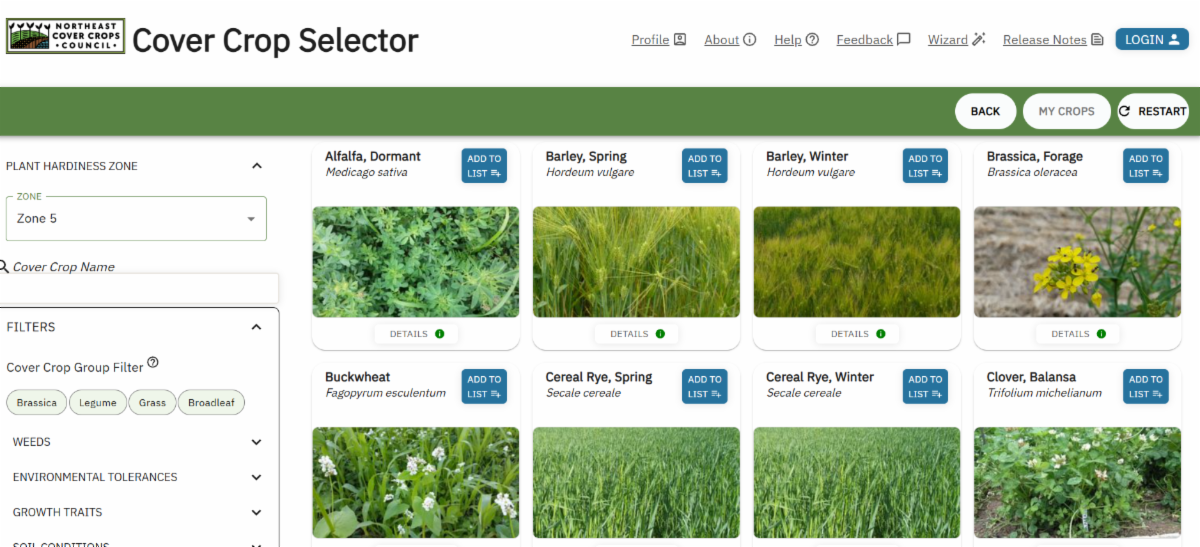
A Cover Crop Selection Tool for Northeast US Farmers
The Northeast Cover Crops Council's free Cover Crop Decision Support Tool can help you identify and compare the best cover crop species for your farm and management goals.
The tool includes information on 42 cover crop species adapted to the Northeast, including planting dates, seeding rates, environmental tolerances, termination methods, and management recommendations. You can also compare species side by side and use the Cover Crop Selector to rank cover crops based on up to three agronomic goals, such as improving soil health, reducing erosion, or suppressing weeds.
Developed by researchers and agricultural experts from across the Northeast, this regionally adapted resource can help you confidently select cover crops or build effective cover crop mixes for your operation.
| | |
Farmworker FAQ Booklet
The Cultivemos Legal Cohort has created a bilingual (Spanish and English) resource that answers legal questions frequently asked by farmworkers. The resource is available online and in print. If you are a farm service organization in the Northeast U.S. region, we can send you free copies of the printed version to distribute. If you are interested, please fill out this form and we will be in touch shortly! We are printing a set amount, so we will close the form when our limit has been reached.
Cultivemos is an inclusive network where diverse farming communities are connected to mental health and stress assistance programs. The FAQ booklet covers questions from worker rights to mental health resources for domestic and workers on H-2A visas. Organizations that receive print copies will receive them free of charge, but will be asked to track how many booklets have been distributed.
If you have any questions you can contact rachel@farmcommons.org.
| | |
Mental Health Resources for Farmers
Farming is a stressful occupation and you are not in this alone!
| | |
Agricultural Mediation Services
What is agricultural mediation? This is a free or low-cost service provided by a trained, impartial person (mediator) who helps participants review their conflicts, identify options, and agree on solutions.
Mediation is a valuable tool for settling disputes in many different areas of farming such as: leases, loans, contracts, estate/property disputes, interpersonal relationships with business partners and staff, debt resolution, and other farm-related issues.
Agricultural mediation can help farmers navigate conflict, protect relationships, and keep decisions moving forward.
If you need support with navigating a conflict relating to your farm business, here are some organizations who offer agricultural mediation services:
Nationwide - Coalition of Agricultural Mediation (CAMP)
New York - NYS Agriculture Mediation Program
Massachusetts (Berkshire County) - Upside413 Dispute Resolution Center
Massachusetts (Western MA) - Collaborative Resolutions Group
Massachusetts (statewide) - UMass Boston Office of Public Collaboration
|
| |
American Farmland Trust Prosperity Partners
Engineering Help Now Available Through AFT’s Prosperity Partners Program
American Farmland Trust’s Prosperity Partners program now includes a full‑service agricultural engineering team, and we’re excited to offer support to farmers who need practical, affordable design help for on‑farm projects—especially those connected to NRCS or grant funding.
We know many producers have good ideas for improving their farms, but the technical details, design work, and paperwork can be a major barrier. AFT’s goal is to make these projects easier by providing farmer‑focused engineering, permitting support, and hands‑on technical assistance that keeps projects moving.
What AFT Can Help With:
Irrigation & Water Systems
- Wells, ponds, pumps, pipelines
- Drip and sprinkler design
- Soil‑moisture monitoring and automation
Drainage & Field Improvements
- Subsurface tile
- Diversions, waterways, French drains
- Wet field management
Farm Access & Infrastructure
- Farm and forest roads
- Stream crossings, bridges, culverts, fords
Farmstead Structures
- Barns, bedded pack, compost and waste storage
- Milkhouse wastewater
- Agrichemical storage and handling
- Structural assessments and repairs
Permitting & Compliance
- Conservation Commission requirements
- Building permits and inspections
- Board of Health items such as well siting
Energy & Solar
- Efficiency upgrades (pumps, VFDs, heat/ventilation)
- Farm‑integrated solar infrastructure
In addition to engineering, Prosperity Partners can also help with:
- Business planning
- Crop production support
- Grant writing and implementation
- Conservation and farm plans
- Organic transition support
- Mapping and spatial analysis
AFT is an official NRCS Technical Service Provider (TSP). All designs follow NRCS conservation practice standards, which helps strengthen funding applications and keeps projects on track from design through reimbursement.
Farmers and service providers can learn more or get in touch here:
https://farmland.org/partners
| | Mass Grown Exchange- A platform serving business to business connections for farmers/food producers operating in Massachusetts.
If you have crops to wholesale, equipment to sell, looking for job postings, the MassGrown Exchange offers free listings to connect farmers, buyers, sellers, and service providers. | | |
MA Farm Energy Program (MFEP)
MDAR’s Massachusetts Farm Energy Program (MFEP) has funds to help farms cover audits, energy efficient projects, and select renewable energy projects.
You will need a technical assessment to file an energy grant application whether with MDAR or USDA. MFEP pays 75% of the technical assessment, first come, first served.
Contact our MFEP now for more information through the Center for EcoTechnology (CET), our partner helping us administer the MFEP: 413-727-3090, info@massfarmenergy.com, or visit www.massfarmenergy.com, submit a Request Form, and we will contact you.
SMART 3.0 Now Accepting Applications
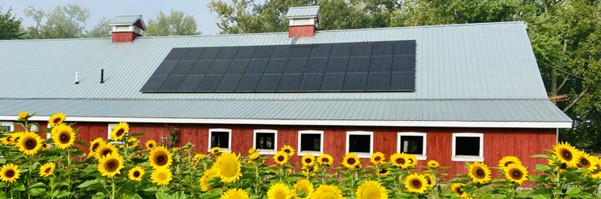
The MA State solar incentive program SMART 3.0 became effective January 1, 2026 and is now accepting applications. SMART (Solar MA Renewable Target) 3.0 was developed and is managed by the MA Department of Energy Resources (DOER) and is a continuation of SMART 1.0 and SMART 2.0 and is operating under the new regulation 225 CMR 28.00. The comprehensive program provides incentives on a kWh production basis for a wide variety of solar projects and includes “adders” to the base incentive rate for a number of specific applications including dual use of land agricultural projects. For more information on the program please see SMART 3.0 Program Details, or contact DOER at doer.smart@mass.gov, 617-626-7369.
| | |
Our Mission:
Berkshire Grown supports and promotes local farms, creates community partnerships that connect people to local food, and works to build an equitable and resilient food system that strengthens local food security.
|
| | | |