|
|
|
|
 |
|
National Breastfeeding Awareness Month
August 1-7 is World Breastfeeding Week and August is National Breastfeeding Awareness month. The following statistics were pulled from Center for Disease Control & Prevention, 2016 Report Card.
- 4 out of 5 (81.1%) mothers breastfed. High breastfeeding initiation rates, or the percentage of infants who start out breastfeeding, show that most mothers in the U.S. want to breastfeed and are trying to do so.
- Over half (51.8%) of mothers were breastfeeding at 6 months.
- Almost one third (30.7%) of mothers were breastfeeding at 12 months.
Source :https://www.cdc.gov/breastfeeding/data/breastfeeding-report-card-2016.html
|
| National Health Center Week August 13-19
The National Health Resources & Service Administration released the following statement in regards to National Health Center Week.
This National Health Center Week will recognize the nearly 1,400 HRSA funded health centers, operating approximately 10,400 delivery sites, across our country. For millions of Americans, community health centers are the key to affordable, high-quality, and patient-centered primary health care. Health centers use a holistic approach to patient care, treating the entire person by integrating behavioral health, oral health and primary care services. Whether it's controlling diabetes, high blood pressure, treating depression or childhood obesity, health centers exceed the national average. Their important work to protect and promote the health of America exemplifies this year's theme: "The Key to Healthier Communities."
|
|
|
|
|
Your ZIP Code Might Be As Important To Health As Your Genetic Code
Author: Kristian Foden-Vencil | NPR - All Things Considered | August 4, 2017
When a receptionist hands out a form to fill out at a doctor's office, the questions are usually about medical issues: What's the visit for? Are you allergic to anything? Up to date on vaccines?
But some health organizations are now asking much more general questions: Do you have trouble paying your bills? Do you feel safe at home? Do you have enough to eat? Research shows these factors can be as important to health as exercise habits or whether you get enough sleep.
Some doctors even think someone's ZIP code is as important to their health as their genetic code.
That's why Shannon McGrath was asked to fill in a "life situation form" this spring when she turned up for her first obstetrics appointment at Kaiser Permanente in Portland, Ore. She was 36 weeks pregnant.
"When I got pregnant, I was homeless," she says. "I didn't have a lot of structure. And so it was hard to make an appointment. I had struggles with child care for my other kids, transportation, financial struggles."
Full Story
|
Chronic Pain Training Plan Now Available on TRAIN

Opioid abuse has increasingly become a serious public health issue over the past few years, with over 12 million people misusing prescription opioids in 2015. Providers' Clinical Support System for Opioid Therapies (PCSS-O) clinical experts, led by Roger Chou and Melissa B. Weimer, who have extensive knowledge in treating chronic pain, have developed a comprehensive core curriculum for primary care providers who want to have in-depth knowledge in this subject area. The curriculum gives up-to-date and evidence-based information on best opioid prescribing practices.
The PCSS-O curriculum, which provides clinicians with a solid base for treating chronic pain, is now on TRAIN as a nationally available training plan. It is the most comprehensive and up-to-date curriculum developed thus far for the treatment of chronic pain.
Funding for this initiative was made possible (in part) by grant no. 5H79TI025595-03 from SAMHSA. The views expressed in written conference materials or publications and by speakers and moderators do not necessarily reflect the official policies of the Department of Health and Human Services; nor does mention of trade names, commercial practices, or organizations imply endorsement by the U.S. Government.
|
|
US Senate passes 'Jessie's Law' to help combat drug overdoses
Author: Erin Beck | Charleston Gazette-Mail | August 3, 2017
A bill that supporters say might have prevented a Charleston woman's overdose death in 2016 has passed the U.S. Senate.
"Jessie's Law," named for Jessica Grubb, permits the federal Department of Health and Human Services to establish guidelines for when health care providers should prominently display a patient's history of opioid addiction in their medical chart - "no different than a penicillin allergy," said Sen. Joe Manchin, D-W.Va., who sponsored the bill.
 |
|
|
Jessica Grubb battled heroin addiction for seven years before dying of an overdose of opioid pain medication in 2016. "Jessie's Law" makes it easier for health care providers to learn of a patient's history of opioid addiction. Credit: Courtesy photo |
Grubb
died in March 2016
after surgery in Michigan for a running injury. She and her parents repeatedly had told doctors that she was in recovery from heroin addiction and shouldn't be given opioids, except under the strictest supervision.
Her discharging doctor never got that message. He wrote her a prescription for 50 oxycodone pills, and she died the night she left the hospital.
"It's just too great a temptation and it's just a thing that never, ever should have been put in front of her," Jessie's father, David Grubb,
said at the time.
"She went home with, in essence, a loaded gun."
Grubb's story gained national attention after her father, a former West Virginia legislator,
told then-President Barack Obama
of her struggle with addiction at an event in Charleston in fall 2015.
|
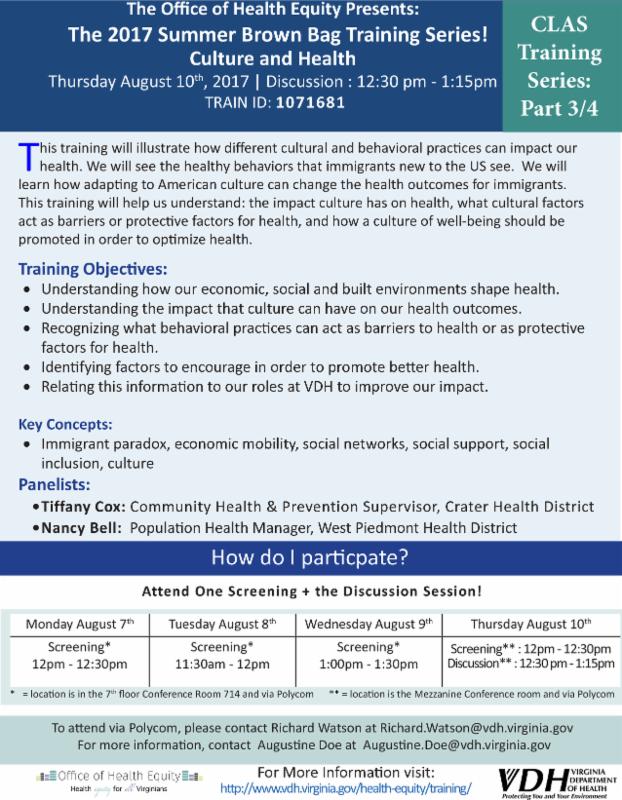
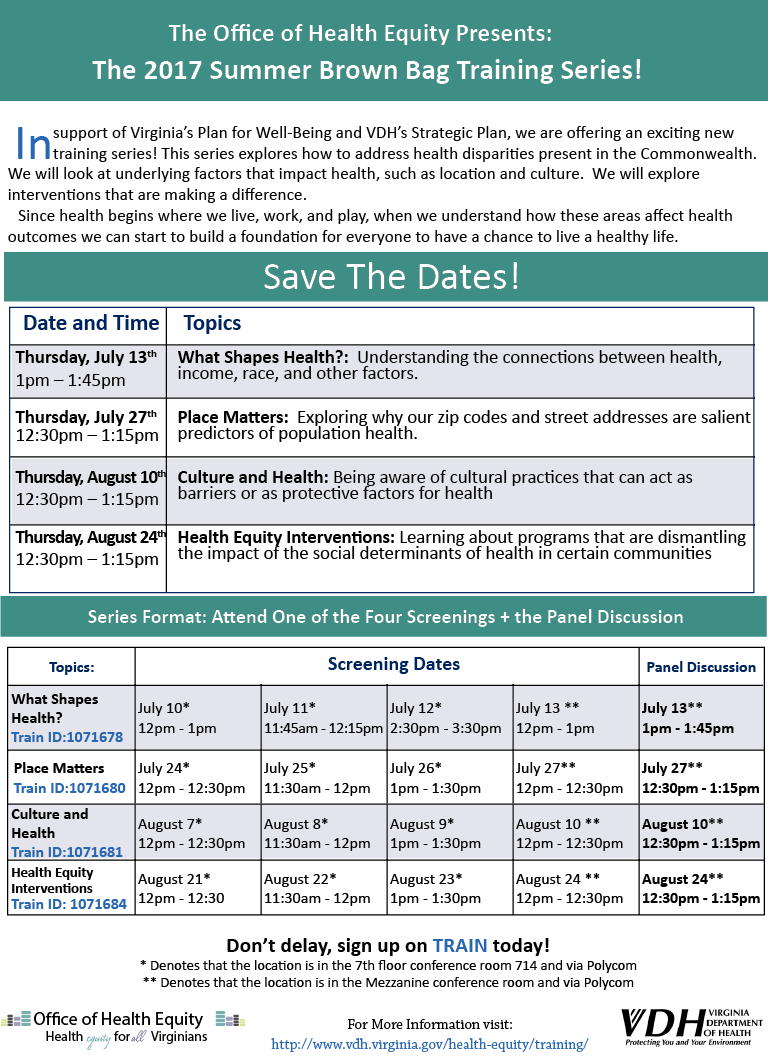
| Download our individual CLAS training flyer
For complete information regarding this series, scroll to the bottom of this email.
|
|
Upcoming Webinars
August 9, 2017 Understanding the Opioid Crisis: What's at the Heart of the Matter?
Sponsored by Substance Abuse and Mental Health Services Administration (SAMHSA) and the Centers For Disease Control and Prevention (CDC)
August 16, 2017 There is Hope: Treatment, Recovery, & Prevention.
Sponsored by Substance Abuse and Mental Health Services Administration (SAMHSA) and the Centers For Disease Control and Prevention (CDC)
August 22, 2017
Learning from Rare Events Infant Mortality Data
Sponsored by National Institute for Children's Health Quality (NICHQ)
August 24, 2017 Promoting Health Equity Through Programs and Policies
Sponsored by The National Partnership for Action to End Health Disparities (NPA)
August 31, 2017 The Role of State Health Leaders in Addressing Neonatal Abstinence Syndrome
Sponsored by National Institute for Children's Health Quality (NICHQ) and The Association of State and Territorial Health Officials (ASTHO)
|
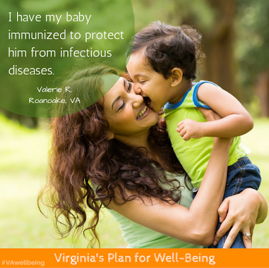
Virginia's Plan For Well-Being
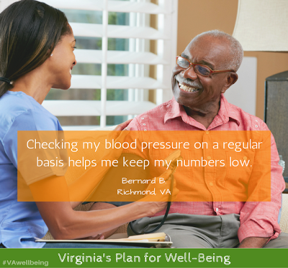
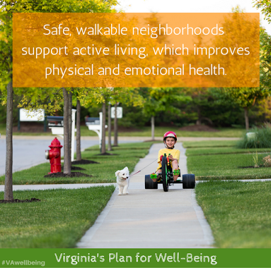
Health begins where Virginians live, work, and play. Virginia's Plan for Well-Being lays out the foundation for giving everyone a chance to live a healthy life. The plan highlights specific goals and strategies on which communities can focus so the state can make measurable health improvement by 2020. Every Virginian deserves the opportunity to be healthy, and you, too, can help make that possible. Join in this effort to assure well-being for all Virginians.
Virginians Live Longer, Healthier Lives
|
|
|
|
|