The Ohio Water Resources Center Newsletter
Issue 4 | Volume 8 | April 2026
| | |
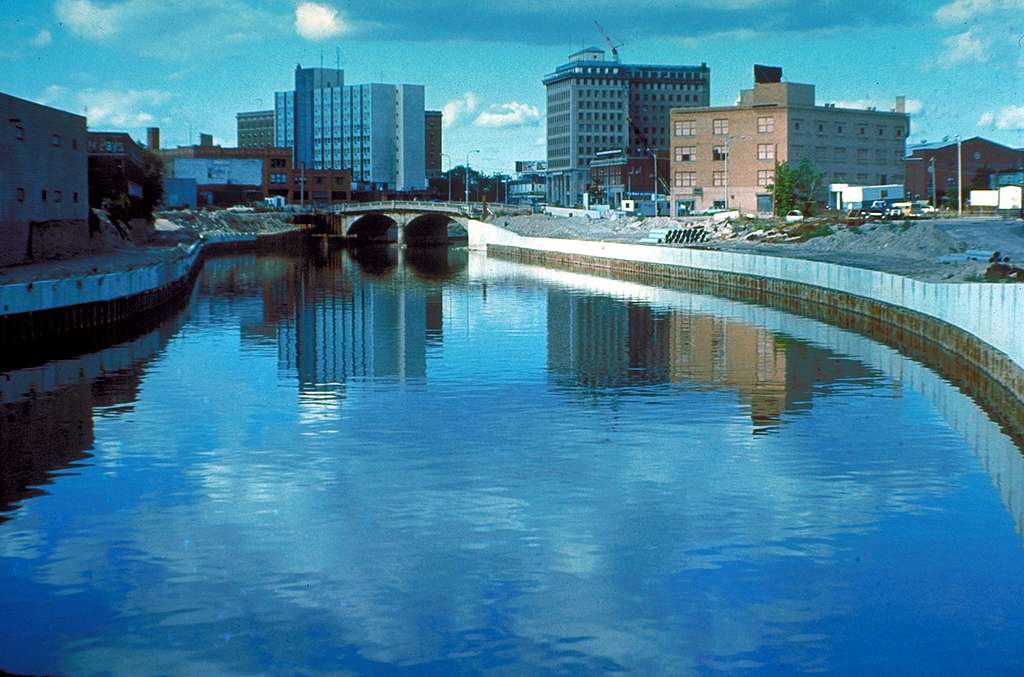
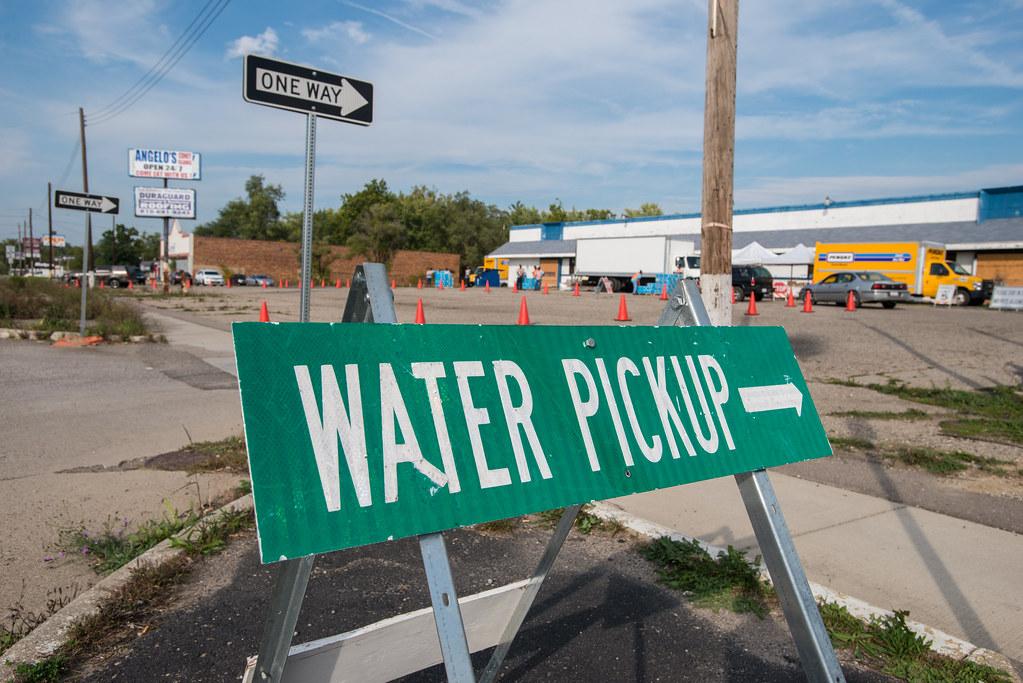
In 2014, officials in Flint, Michigan, made the decision to switch the city’s water source from the Detroit system to the nearby Flint River in order to save money while awaiting the construction of a new pipeline. However, shortly after the transition, residents began reporting strange-smelling, -tasting, and –looking water. As community members began to fall ill, residents — despite being assured by state officials that the water was safe — sought support from Virginia Tech researchers. The resulting study determined that an estimated 100,000 residents had been exposed to elevated lead levels, including roughly 6,000 to 14,000 children. The culprit? Compounding mismanagement and outdated service lines.
Water in the Flint River was more acidic and higher in chloride than that of the Detroit system, making it inherently more corrosive. Additionally, treatment plants did not add orthophosphate, an important anti-corrosive often used to protect pipes in water systems. The city's older, lead-based service lines were exposed to the highly corrosive Flint River water, leading to lead and copper leaching into water supplies.
| |
The situation in Flint prompted the EPA to revise regulations on lead and copper, which went into effect in December of 2024. The rules require water systems to replace all lead and certain galvanized service lines by 2037. The updated regulations also change the way that sampling is conducted, as the EPA determined that using tap sampling and 90th percentile lead levels alone is insufficient to protect public health — a departure from the original 1991 policy. New provisions also lowered the threshold for taking action from 15 µg/L to 10 µg/L of lead and require systems to install or adjust corrosion control as needed.
Flint is one example of the ever-evolving intersection of science and policy. Science is dynamic, and the collective knowledge base is constantly in flux as new ideas and data challenge or support older theories. Ongoing research is critical in yielding new understanding of our systems, as well as supporting science-based policies that protect people and the planet. Regularly updating policy is important to have the best health- and cost-based policies based on state-of-the-art science.
| |
|
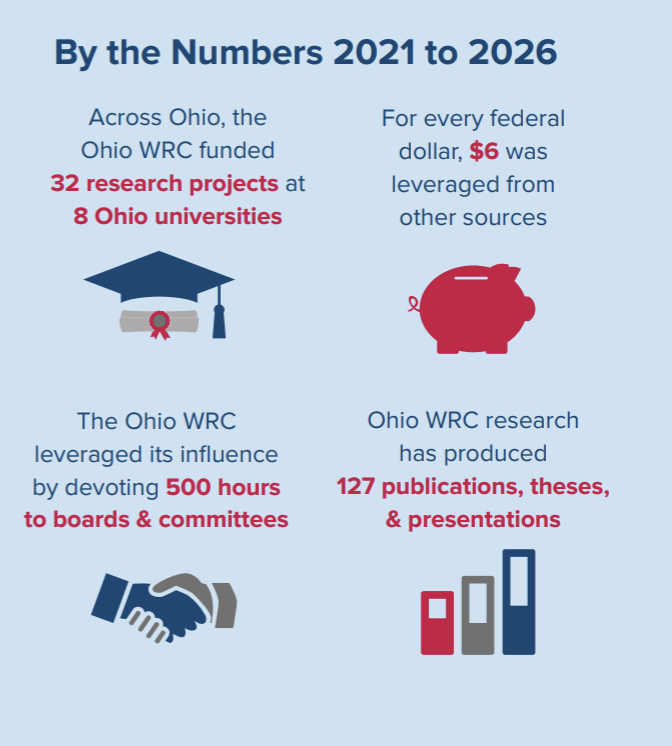
At the beginning of each year, the Ohio WRC takes a moment to reflect on the past five years of activities, initiatives, and fulfilling our goals. As Ohio’s Water Resources Research Institute (WRRI), our mission is to enable and conduct state-relevant water-related research; foster collaboration among academic investigators, governmental bodies and water professionals; train the next generation of water scientists; and educate the public on water resources issues in Ohio.
Since 2021, funded researchers across eight universities have completed projects on pressing issues such as harmful algal blooms, arsenic contamination, and antimicrobial resistance in wastewater. These projects support budding water scientists and create opportunities to engage with public stakeholders, policymakers, water professionals, and other investigators on relevant water resources questions. Additionally, publications and outreach resulting from each project carry the impacts beyond Ohio, sharing solutions to water-related challenges nationally.
As the next cohort of projects begins, we look forward to the great work that investigators, students, and collaborators will produce together.
| | | |
Critical Shifts in U.S. Nutrient Pollution Sources from 1987 to 2017 | |
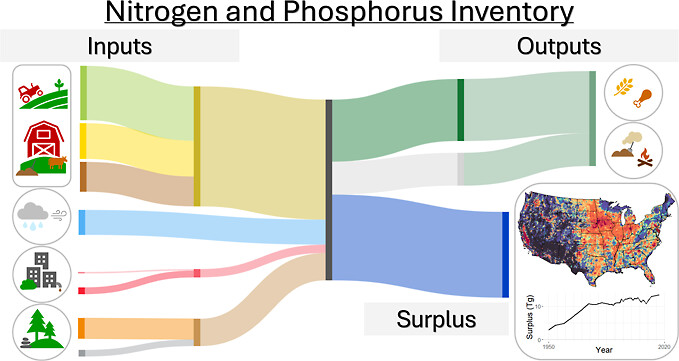
Led by the U.S. EPA, a collaborative group of researchers — including USGS, state environmental quality, and industry scientists — created and published an updated National Nutrient Inventory (NNI) using N and P data from agricultural, urban, atmospheric, and natural inputs and nonhydrologic outputs. USGS researchers provided expertise in USGS water quality datasets, such as P and N from fertilizer and manure. The researchers used a mass balance approach to quantify N and P sources and fluxes across the contiguous U.S. from 1987 to 2017.
In a recently published study, the updated NNI found that the implementation of technologies and management practices to reduce nutrient pollution have been successful in maintaining and even reducing nutrient outputs over the past three decades.
Image: Environ. Sci. Technol., 2025, 59, 51, 27836-27852
| | | |
Ohio EPA: Early stakeholder outreach for WQS beneficial use designations
Beneficial use designations (BUDs) are water quality goals for specific water bodies that define their current and future uses (aquatic life habitats, recreation, water supplies). The Division of Surface Water is seeking input on BUDs for the Maumee, Ashtabula, and Muskingum river drainage basins. More information can be found here. Comments can be submitted here until April 7, 2026.
U.S. EPA: Public input on FCA guidance
The Clean Water Act Financial Capability Assessment (FCA) is non-regulatory guidance used to balance local water bill affordability with wastewater infrastructure improvements for a given community. The guidance provides information on how to assess a community’s financial capability as part of negotiating implementation schedules under both permits and enforcement agreements. The U.S. EPA is seeking input on current issues related to financial capability for communities, particularly for smaller rural water systems. To submit a comment by May 26, 2026, please click here and follow the page’s instructions.
| | |
Ohio EPA Student Scholarships
The Ohio EPA is offering scholarships to be given to undergraduate students enrolled at an Ohio public or private university who can demonstrate their knowledge and commitment to careers in environmental sciences or environmental engineering. Students must be entering their junior or senior year (at least one full year remaining). The scholarship funds cannot be used for housing. For more information and to apply by April 15, please visit the Ohio EPA scholarship website.
Lake Erie Community Grant
The Ohio Lake Erie Commission is offering funding through the Lake Erie Community Grant to support projects that protect and improve environmental issues in the Lake Erie watershed. The grant program is designed to foster healthy, thriving communities by providing resources and support to address local environmental challenges for nonprofits, local governments, and communities within the Lake Erie watershed. For example, funding can support projects that reduce pollution, remove invasive plants in targeted areas, or provide outdoor education. More details can be found here. Proposals are due by April 30, 2026.
| |  | |
MDARD PFAS Research Grant
The Michigan Department of Agriculture and Rural Development (MDARD) is requesting proposals for single- or multi-year projects that will explore PFAS contamination on Michigan agricultural land. For a 1- to 4-year project, MDARD will fund a minimum of $50,000 to a maximum of $400,000. Research questions must clearly relate to State needs and priorities (see here) and any field work that takes place outside of Michigan must include clear justification for its applicability in state. Ohio-based investigators must have a collaborator at a Michigan university. To apply, submit a letter of intent before April 20, 2026. More details can be found here.
H2Ohio: SWCD Conservation Pilot Program
The H2Ohio Soil and Water Conservation District pilot program is designed to fund locally led, water quality-focused projects addressing non-point source pollution. Statewide Soil and Water Conservation Districts (SWCDs) are eligible to apply for up to $250,000 per proposal. Proposals can be submitted until May 1, 2026. Find more details here.
Abstracts requested: 2026 State of the Western Lake Erie Basin Conference
June 22-23, 2026 • Adrian, MI
Michigan's 2026 State of the Western Lake Erie Basin (WLEB) Conference will focus on tri-state (Ohio, Michigan, Indiana) progress, ongoing project updates, and community resilience in reducing nutrient pollution in the Western Basin of Lake Erie. Poster submissions are open here and are due by May 18, 2026.
| | | |
Spring 2026 Careers in Water: Explore Paths in the Water Industry
April 7, 2026 • Virtual
Hosted by the Ohio American Water Works Association Young Professionals Committee, this virtual career panel will include four professionals from various sectors of the water industry: Justin Chaffin, research coordinator at The Ohio State University; Sincerrai Gentry at City of Cincinnati; Lauren Wagner at ms consultants, and Ruth Meinstein at Ohio EPA. Panelists will share their day-to-day work, how they got their start in the water industry, and why they are passionate about the water field. Register here to receive the Zoom link.
Growth, Climate, and Capacity: The Central Ohio Regional Water Study
April 16, 2026 • Virtual
The Ohio Stormwater Association will host a webinar focused on the Central Ohio Regional Water Study, a 15-county-wide evaluation of current and future water use availability. The study evaluates potential future conditions through 2030, 2040, and 2050, considering factors such as population growth and changing temperature and precipitation patterns. This webinar will offer insight into how long-term water supply planning intersects with land development, infrastructure planning, and watershed management. More details and registration can be found here.
Emerging Contaminants in the Environment Conference
April 28-29, 2026 • Champaign, IL (hybrid)
The Emerging Contaminants in the Environment conference, co-hosted by the Illinois Sustainable Technology Center and Illinois-Indiana Sea Grant, will feature the latest in emerging contaminant research, policies, and outreach in soil, water, and air. Registration can be found here and is open until April 13, 2026.
2026 Ohio Stormwater Conference
May 6-8, 2026 • Sandusky, OH
The 19th annual Ohio Stormwater Conference — founded and hosted by Tinker’s Creek Watershed Partners — will be held at the Kalahari Resort and Conference Center. The event is dedicated to advancing knowledge and understanding of comprehensive stormwater and watershed management. Registration and more details can be found here.
River Rally
May 11-14, 2026 • San Antonio, TX
The River Rally, hosted by the River Network, will be celebrating its 26th year of gathering advocates, community leaders, and water professionals together to discuss and share expertise on issues relating to water, climate, and justice. For more information, click here.
Ohio EPA Permitting Conference
May 19, 2026 • Westerville, OH
The Ohio EPA is launching its first permitting conference in May, dedicated to covering key permitting topics for attendees. Sessions will include information on air permitting basics and reporting; hazardous waste permitting vs. notification; NPDES permits and electronic (e-DMR) reporting; new source review (NSR) and Title V permitting; and storm water and wetland permitting requirements. Registration and the agenda can be found here.
| | |
Get in Touch
Email: OhioWRC@osu.edu
Website: https://wrc.osu.edu
Address: 473 Hitchcock Hall
2070 Neil Avenue
Columbus, OH 43210
| | | | | | |