The Ohio Water Resources Center Newsletter

Issue 8 | Volume 5 | August 2023

From Our Directors 

The Ohio Water Resources Center (WRC) is seeking research pre-proposals to address current water resources issues in Ohio. This annual competition for in-state researchers is made possible through the Water Resources Research Institute 104(b) Program. The aim of these grants is to stimulate water-related research relevant to Ohio to the point where a highly competitive external proposal can be developed.


The Ohio WRC will accept any pre-proposal related to Ohio water resources issues but expects to give priority to proposals that address water technology, water resilience and security, and water quality. Projects that also incorporate concepts of water equity — such as identifying causes and impacts of water-related disparities, developing or evaluating tools or strategies to improve water quality or evaluate environmental justice or providing scientific information to benefit underserved communities — are also sought.


The application deadline for Ohio pre-proposals is 11:59 PM, Thursday, September 28, 2023. Pre-proposal decisions and an invitation to submit a full proposal will be announced the week of October 30, 2023. Full proposals will be due December 14, 2023 at 11:59 PM and funding decisions are expected the week of March 13, 2024. Funding is anticipated to begin on September 1, 2024.

Click here for the official request for proposals and detailed submission instructions.


Spotlight


Lithium in Drinking Water Supply

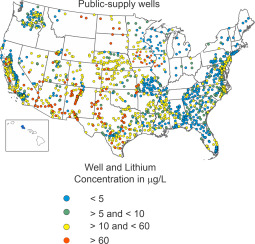
Lithium is a naturally occurring metal in minerals and saline water. Lithium can be found in groundwater, eggs, dairy products, and beverage products. Consumption of lithium can cause adverse health effects, including impaired thyroid and kidney function. Currently, there are no health-based standards set on lithium levels under the Safe Drinking Water Act. However, lithium was added to the EPA's Fifth Unregulated Contaminant Monitoring Rule in 2021 in order to collect data on its presence in drinking water.


The United States Geological Survey (USGS), in collaboration with the EPA, calculated a non-regulatory Health-Based Screening Level (HBSL) for drinking water of 10 parts per billion (ppb) and a second "drinking-water-only" lithium benchmark of 60 ppb when it is assumed that the only source of lithium exposure is from drinking water.


A study conducted by the USGS found that the drinking-water only threshold was exceeded in 45% of public-supply wells and about 37% of U.S. domestic supply wells. The distribution of lithium concentration varied widely by lithology and climate - lithium concentrations were highest in "old" groundwater that recharged the aquifer before 1953 and in arid regions. With increasing lithium battery use and subsequent disposal, comprehensive evaluation of lithium in groundwater is crucial.


USGS Science Highlight


USGS Scientists Develop an Interactive Mapping Tool to Visualize PFAS in Tap Water 

Perfluoroalkyl and polyfluoroalkyl substances (PFAS) are a large group of common, manufactured chemicals in various everyday products that are resistant to heat, oils, stains, grease, and water. Often referred to as “forever chemicals," PFAS linger in peoples’ bodies and the environment instead of degrading over time.


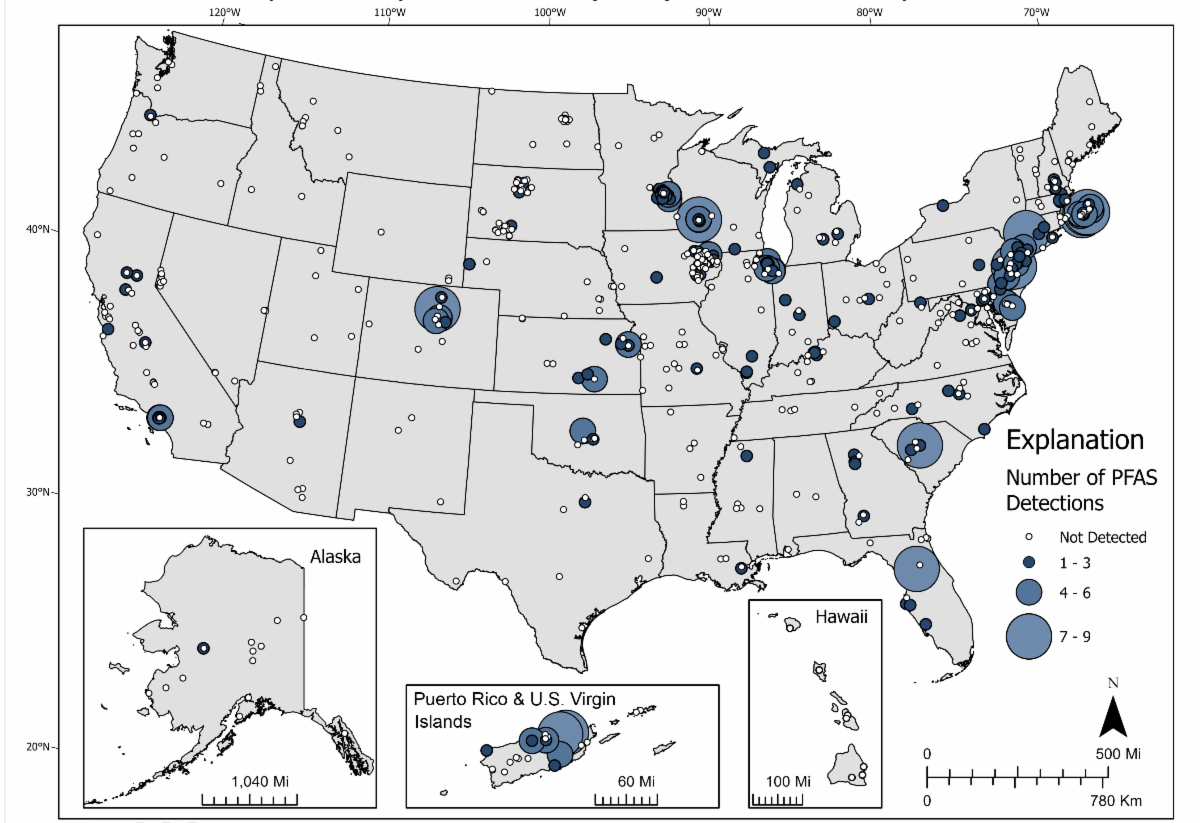
Earlier this month, the U.S. Geological Survey (USGS) released a new interactive dashboard that visualizes PFAS measurements in 716 tap water samples collected at sites across the nation between 2016 and 2021 from private and public supplies. The data was obtained from a USGS study that tested for and compared PFAS in tap water from both private and government-regulated public water supplies on a broad scale throughout the country. The study found that the probability of PFAS not being observed in tap water is about 75% in rural areas and around 25% in urban areas. This data shows the need for further assessments of cumulative health risks of PFAS as a class and in combination with other co-occurring contaminants, particularly in unmonitored private-wells where information is limited or not available.


News Updates


Biden administration water cybersecurity plan temporarily blocked

Via The Hill, July 12, 2023


Judge freezes WOTUS fight until Biden issues new rule

Via E&E News, July 11, 2023


Some cities are digging up water mains and leaving lead pipe in the ground

Via News And Sentinel, July 10, 2023


EPA Releases Draft Supplement to the Risk Evaluation for 1,4-Dioxane

Via EPA, July 7, 2023


Ohio Gov. DeWine asks Biden for major disaster declaration for East Palestine after train derailment

Via CBS News, July 3, 2023

Dayton to combat PFAS with upgrades to water treatment system, lab expansion

Via Dayton Daily, July 11, 2023


High Levels of E. coli prompt water advisories across Ohio

Via 10WBNS, July 14, 2023


DeWine announces additional $135 million for critical water infrastructure projects

Via 13abc, July 21, 2023


EPA Announces New Framework to Prevent Unsafe New PFAS from Entering the Market

Via EPA, July 1, 2023


With new grant, some Ohioans will get direct water access for first time

Via State News, July 31, 2023

Have a news article you'd like us to feature? Email us at OhioWRC@osu.edu!


Opportunities


Request for Proposals: Water Resources Research Institute 104(b) Program

The Ohio Water Resources Center (WRC) is seeking research pre-proposals to address current water resources issues in Ohio. Priority is expected to be given to proposals that address water technology, water resilience and security, and water quality. Click here for more detailed instructions. The deadline to apply is September 28, 2023.


Request for Applications: Effective Programs, Policies, and Decisions to Mitigate Cumulative Health Impacts and Environmental Health Disparities in Underserved Communities 

The U.S. Environmental Protection Agency (EPA) is seeking applications for addressing environmental injustice in underserved communities. The RFA will seek research proposals

to (1) improve health, well-being, and quality of life outcomes by assessing and addressing cumulative impacts resulting from combinations of chemical and non-chemical stressors in underserved communities and investigate how the scientific information can be used to develop effective cumulative impact assessment approaches and/or methods; and (2) investigate how

cumulative impact assessment approaches and/or methods can be used to shape better informed

practical programs, policies, and decisions to eliminate environmental health disparities. The deadline to apply is August 31, 2023.

Request for Applications: National Environmental Youth Advisory Council (NEYAC)

The U.S. Environmental Protection Agency (EPA) is seeking applications to serve on the agency's first-ever national environmental youth advisory council. Register here for an informational webinar that will be held on August 7, 2023 at 12 PM ET. The deadline to apply is August 22, 2023.


Request for Applications: Evaluation of Antimicrobial Resistance

The U.S. Environmental Protection Agency (EPA) is seeking applications to address knowledge gaps in the occurrence, fate and transport, and persistence of antimicrobial resistant organisms and genes found in municipal wastewater effluent and biosolids. More information can be found here. The deadline to apply is August 16, 2023.


Request for Applications: Developing and Demonstrating Nanosensor Technology to Detect, Monitor, and Degrade Pollutants 

The U.S. Environmental Protection Agency (EPA) is seeking applications to develop and demonstrate nanosensor technology with functionalized catalysts that have the potential to detect, monitor and degrade pollutants, specifically PFAS. Register here for an informational webinar on August 14, 2023 2 - 3 pm EDT. The deadline to apply is October 4, 2023.

To find more resources offered by Ohio WRC, please visit: https://wrc.osu.edu/resources

Upcoming Events

Event: Lake Erie Awareness Day

Aug 10, 2023 • Put-in-Bay

Spend Lake Erie Awareness Day touring South Bass Island while learning about Ohio’s greatest water resource and visiting education stations to learn about island history, native plants and animals, the dangers of plastic pollution, and boating safety. Fun giveaways and a great day in nature awaits! Go to all the stations and be entered to win a fabulous island themed prize.


Conference: One Water Technical Conference

Aug 21-24, 2023 • Greater Columbus Convention Center

One Water is a joint effort between the Ohio Water Environment Association and the Ohio Section of the American Water Works Association. We join together to bring both water and wastewater professionals from around the state for training and networking. Registration is open.


Webinar: Phosphorus Cycling in Agricultural Streams in the Maumee River Watershed

Aug 29, 2023 • Virtual

Phosphorus from the Maumee River watershed is the primary driver of harmful algal bloom size in western Lake Erie. In this webinar hosted by Ohio Sea Grant, Stone Lab and the Harmful Algal Bloom Research Initiative, Dr. Jim Hood will be discussing their research on developing a new modeling approach that leverages high-frequency monitoring data to characterize phosphorus cycling in two streams in the Maumee River watershed. Registration is open.


Conference: Understanding Algal Blooms, State of the Science

Sep 6, 2023 • Toledo, OH

This conference will highlight current scientific knowledge related to algal blooms. Topics include community engagement, implementing Best Management Practices, nutrients and processes behind algal blooms, tools for tracking and predicting nutrient levels, and the latest progress from Ohio agencies managing water quality and algal blooms.Registration will be available here.


P3 Electrified Summit: Strategies to modernize energy, water, and other utilities

Sep 21-22, 2023 • San Diego, CA

This summit focuses on the latest solutions, trends and strategies to modernize energy management, utilities, and water infrastructure. The Summit encourages collaborative discussions across government agencies and amongst the private sector regarding the innovations, technologies, challenges, and best practices. Registration is open.


Conference: Duke Energy Student Conference

Fall 2023 • Virtual

This is an event for students interested in 2024 paid internships and coop positions to learn about the innovations in clean energy and work experiences at Duke Energy. To receive updates about this event and Duke Energy's 2024 opportunities, text INTERN2024 to 71729.


Have an event you'd like us to feature? Email us at OhioWRC@osu.edu!

Get in Touch


Email: OhioWRC@osu.edu

Phone: 614-292-2807

Website: https://wrc.osu.edu

Address: 475 Hitchcock Hall 

2070 Neil Avenue

Columbus, OH 43210

Follow us on Twitter

Twitter
wrc.jpg

About Us

Research

Outreach

Publications

Resources