The Ohio Water Resources Center Newsletter
Issue 4 | Volume 12 | December 2022
| |
|
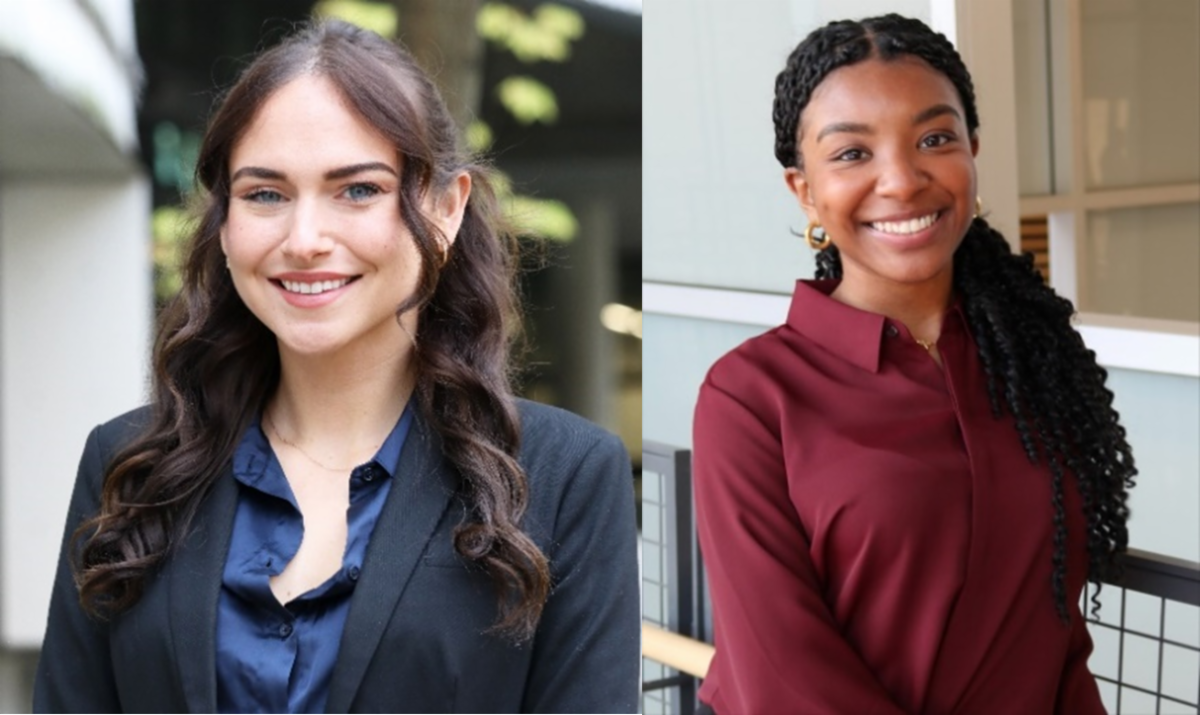
The Ohio Water Resources Center (Ohio WRC) is happy to introduce two new members of our team – Haley Kuhn and Kira Jones.
Haley Kuhn is the Graduate Associate at the Ohio WRC. She is an MS student in the Environmental Science Graduate Program (ESGP) and a PhD student in Civil Engineering at OSU, specializing in environmental engineering. Haley’s research interests include water quality, harmful algal blooms, and innovative water treatment technologies. She is taking the lead on creating the Center's newsletters and managing outreach programs, and is assisting with several other administrative tasks.
Kira Jones is the Student Communication Assistant at the Ohio WRC. She is an undergraduate student at OSU studying environmental policy and public policy analysis. Kira’s background is focused in communications and social media marketing. She is leading our efforts in creating written content for report summaries and for the Ohio WRC website, producing content for Ohio WRC social media, and other creative tasks.
With the help of these amazing students, we are excited to communicate out the great work conducted by our funded researchers and restart outreach activities that were stopped due to the pandemic.
| |
Microorganisms and enzymes driving glyphosate degradation in Lake Erie | |
Dr. Matthew Saxton, Assistant Professor in the Department of Biological Sciences at Miami University, completed an Ohio Water Resources Center funded project via a USGS 104(b) subaward. Glyphosate is the most widely applied herbicide in the world. Glyphosate’s chemical structure includes phosphorous and nitrogen, making the contribution of this chemical to eutrophication of increasing interest. Bacterial biodegradation of glyphosate has been observed in bacterial cell culture and is presumed to occur in nature, but the gene pathways that drive this metabolism in the environment are unclear. This study aimed to understand how microorganisms in water react to glyphosate and similar chemicals running off agricultural fields into downstream bodies of water.
Dr. Saxton’s team added six different herbicides and five different insecticides to water collected from a reservoir in a highly agricultural area to study how the algae and bacteria respond. Results found that while the bacteria and algae responded to individual chemicals, they responded in different ways to herbicides versus insecticides. The team also exposed water collected from Lake Erie to glyphosate and several of its breakdown products to analyze which genes in the bacteria and algae turn on once exposed to these compounds. Complications due to SARS-CoV-2 delayed data acquisition, but with their final data, the research team will be able to determine the gene pathways used to degrade glyphosate in Lake Erie. These results will provide insight on the forms through which glyphosate derived nutrients enters Lake Erie and the likelihood of downstream impacts on harmful algal blooms and hypoxia.
| | | |
USGS WBD standards version 5 now available | |
The U.S. Geological Survey (USGS) released the 5th Edition of the Federal Standards and Procedures for the National Watershed Boundary Dataset (WBD). The Watershed Boundary Dataset defines the spatial extent of surface water drainage to a point, accounting for all land and surface areas. The WBD is a comprehensive, national hydrologic unit dataset. Hydrologic unit boundaries in the WBD are determined by topographic, hydrologic, and other landscape characteristics. This comprehensive document provides guidance and specifications for allocation and designation of the hydrologic units in the WBD.
The 5th edition includes several significant changes, including revisions to figures, the addition of new guidance on development of 14- and 16-digit hydrologic units, updated Line Source and Hydrologic Unit modification domains, and retirement of outdated material. The 5th Edition, and all previous versions of the Federal Standards and Procedures for the National Watershed Boundary Dataset (WBD), can be accessed here.
| | | |
|
Ohio creating, fixing hundreds of wetlands
Via SanduskyRegister, Nov 19, 2022
$250 million overflow tunnel project in Columbus making progress
Via 10WBNS, Vov 13, 2022
United States Drinking Water PFAS Treatment Market Forecast Report 2022-2026
Via YahooNews, Nov 11, 2022
EPA: Major Clean Water Act noncompliance drops over 50%
Via The Hill, Nov 22, 2022
Elyria ordered to pay $250 million by Justice Department to eliminate sewage dumps into Black River
Via WKYC, Nov 9, 2022
| |  |
|
EPA publishes Fifth Drinking Water Contaminant Candidate List
Via WaterWorld, Nov 2, 2022
Ohio Water Development Authority awards low interest loan to Lima for water improvement projects
Via HometownStations, Nov 1, 2022
US EPA broadens its definition of PFAS
Via C&EN, Nov 4, 2022
Wastewater Discharge Violation Leads to $85M Sewer System Upgrade
Via WWD, Nov 2, 2022
Ohio city to have stormwater management in public space
Via Cleveland.com, Nov 30, 2022
| | |
|
Ohio EPA DSW: Draft Rules in Ohio Administrative Code (OAC) Chapter 3745-1
The Ohio EPA Division of Surface Water (DSW) seeks comments on the Agency's draft rules in Ohio Administrative Code (OAC) Chapter 3745-1. The drafted revisions include adding and removing acronym and term definitions, updating the list of analytical methods including the web addresses for available documents, updating names of water bodies, and making the rule language more concise. More information can be found here. Comments are due by 5 p.m., January 6, 2023 to dsw_rulecomments@epa.ohio.gov
Ohio EPA DSW: Early Stakeholder Outreach - two Surface Water rules packages
The Section 401 package includes three existing rules as well as a new rule(s). The federal Clean Water Act requires any applicant for a federal permit or license that may result in a discharge to a navigable water to obtain a water quality certification from Ohio EPA pursuant to Section 401. The Wetland Water Quality Standards package includes four existing rules that outline wetland water quality standards that apply to all wetlands within the state. More information on each package can be found here. Comments are due by 5 p.m., January 18, 2023 to dsw_rulecomments@epa.ohio.gov.
| |
|
Call for Nominations: US EPA 2023 Green Chemistry Challenge Award
The Green Chemistry Challenge Awards promote the environmental and economic benefits of developing and using novel green chemistry. These annual awards recognize chemical technologies that incorporate green chemistry into chemical design, manufacture, and use. More information here. Entries are due by December 9, 2022.
Call for Abstracts: One Water Technical Conference
The OAWWA/OWEA One Water Technical Conference focuses on water and wastewater industries throughout Ohio. Abstracts can be submitted here and the deadline to submit is December 16, 2022.
Call for Abstracts: UCOWR/NIWR Annual Water Resources Conference
The UCOWR/NIWR Annual Water Resources Conference focuses on all water-related topics; including water resource management, water treatment, watershed restoration strategies, and more. Abstracts can be submitted here and the deadline to submit is January 30, 2023.
| | |
|
Competition: US EPA 20th Annual P3 Awards
Applications proposing to take a holistic approach, grounded in research and innovation, to develop and demonstrate solutions to real world challenges are sought for the U.S. EPA the People, Prosperity, and the Planet (P3) Program. More information is available here. The deadline to submit is February 1, 2023.
Scholarship Program: Ohio Section AWWA
The OAWWA will award three Undergraduate scholarships and three Graduate/Continuing Education scholarships to students supporting the water industry. More information is available here. The deadline to apply is February 10, 2023.
Call for Abstracts: Fresh Ideas Competition
The OAWWA invites students and recent graduates involved in drinking-water related research to submit an abstract for the 2023 Fresh Ideas Competition. The instructions and application are available here. The deadline to submit is February 20, 2023.
| | |
|
Webinar: The Value of Lake Erie Beaches
December 7th, 2022 • Virtual
Registration is open for a webinar discussing new research from Ohio Sea Grant, Stone Lab, and the Harmful Algal Bloom Research Initiative. Dr. Brent Sohngen will be discussing the value of Lake Erie beaches to the state’s overall economy, and how that value is affected when water quality issues such as harmful algal blooms or E. coli outbreaks occur.
Webinar: Managing cyanobacteria and cyanotoxins during and after water treatment
December 14th, 2022 • Virtual
Registration is open for the Water Management Association of Ohio (WMAO) luncheon webinar, hosted by the Ohio Water Resources Center (WRC). Dr. Natalie Hull will be discussing her research on the impacts of harmful algal blooms during and after drinking water treatment processes.
Webinar: Harmful Algal Bloom Research Symposium
January 5-6th, 2022 • Virtual
Registration is open for the 3rd Annual Harmful Algal Bloom Research Symposium, hosted by the Algal Bloom Action Team. Topics will focus on the latest harmful algal bloom research, including effective bloom management and the latest technologies being used.
| |
|
Get in Touch
Email: OhioWRC@osu.edu
Phone: 614-292-2807
Website: https://wrc.osu.edu
Address: 475 Hitchcock Hall
2070 Neil Avenue
Columbus, OH 43210
Follow us on Twitter
| | |
| | | |