The Ohio Water Resources Center Newsletter
Issue 2 | Volume 6 | February 2024
| |
|
The National Science Foundation (NSF) recently announced the inaugural Regional Innovation Engines awards and we are happy to report that Great Lakes ReNEW, which includes Ohio State University as a key partner and Ohio Water Resources Center Co-Director John Lenhart as one of the technical leads, is one of the awardees. The project, lead by Current, the Chicago-based water innovation hub, was awarded up to $160 million over 10 years to develop and grow a water-focused innovation engine in the Great Lakes region. The initiative is a collaboration between six Great Lakes states and includes over 50 research
institutions, industry, investors, government and nonprofit organizations and has the goal of identifying and commercializing new ways to recover and reuse water, energy, nutrients, and critical materials from our water.
In addition to spurring research innovation, Great Lakes ReNEW will create economic opportunities for residents in the region, strengthen the domestic supply chain for clean energy technologies, and address water quality and security issues around work. Furthermore, by partnering with workforce development systems, community colleges, and universities, those most affected by joblessness and systemic barriers to equitable participation will have career opportunities. As one of only 10 awardees, ReNEW is the only initiative focused on the water sector and was selected from 188 invited proposals and more than 700 initial submissions.
| |
Oxidative exhaustion: Assessing the time frame for the cessation of acid mine drainage production within impacted watersheds | |
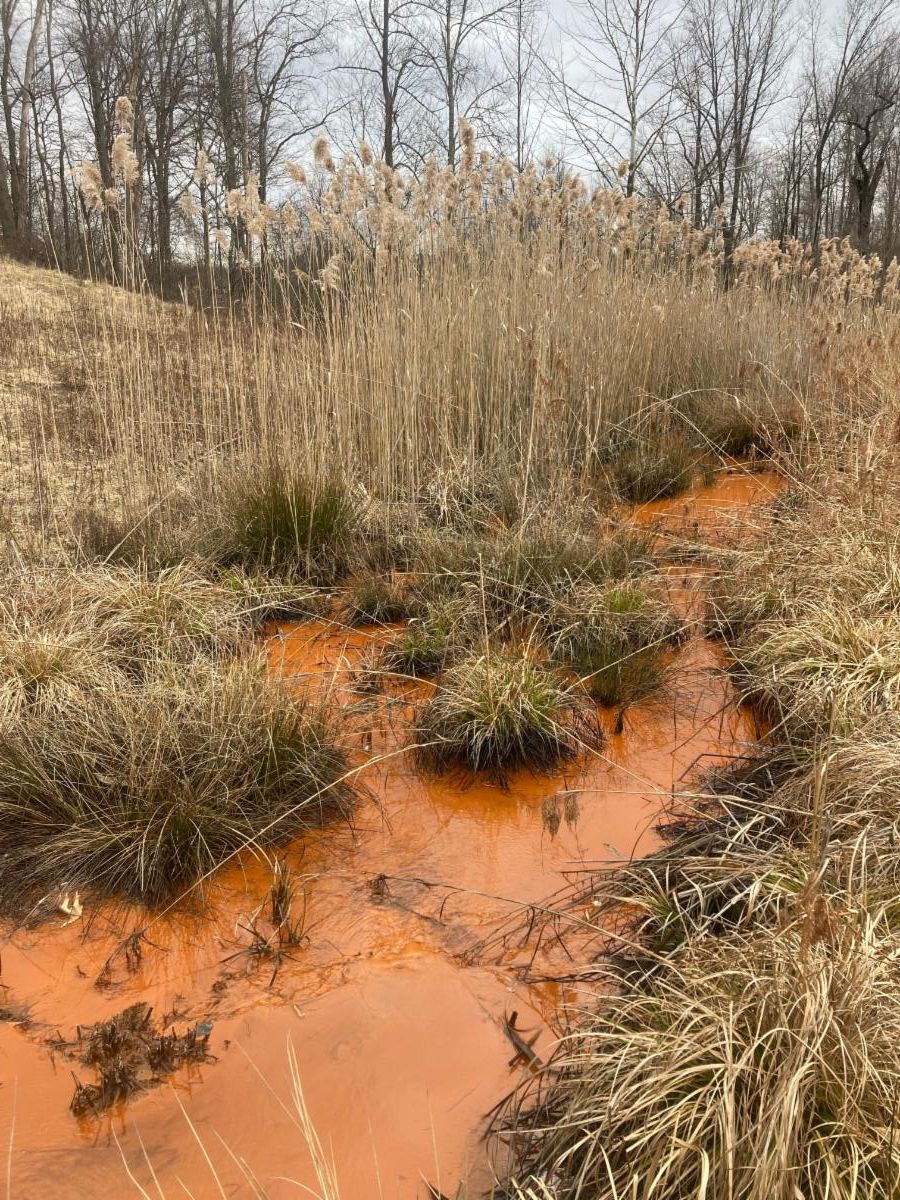
Legacy coal mining operations contaminate water resources across Ohio and Appalachia due to acid mine drainage (AMD). AMD occurs when exposed sulfide minerals in abandoned coal mines and unreclaimed coal refuse piles are exposed to rain and groundwater resulting in acidic, metal-rich fluids that contaminate the local environment. These reactions occur until the oxidation of the sulfide minerals in complete which is called oxidative exhaustion. The time until oxidative exhaustion is not well characterized which has impacts on reclamation projects. The goal of Dr. Singer's project was to provide a time frame for oxidative exhaustion across AMD-impacted watersheds to optimize budget planning.
Dr. Singer and his team measured AMD output and seasonal variability from mine sites and compared the data to historical data to determine the time frame for oxidative exhaustion. The amount of sulfide minerals in coal shales was also determined to understand how much would contribute to future AMD production.
Results showed that discharge at the two sites sampled showed seasonal variability with minimum values in late fall/early winter and maximum values in the early spring which is consistent with precipitation trends. The two mines included in the study estimated oxidative exhaustion to occur in about 30 years. The results by Dr. Singer and his team provide the first timeframe estimates for oxidative exhaustion for two mines in OH. These estimates provide important insight for stakeholders to assess future AMD management.
| | | |
Pesticides are likely impacting invertebrate life essential to our nation's streams | |
The USGS conducted a comprehensive study on the impact of pesticides on aquatic invertebrates in over 400 streams across the United States. Among the five regions studied, researchers found that four pesticides—bifenthrin, chlordane, fipronil, and imidacloprid— affected aquatic invertebrates’ health.
Pesticides are widely used in agricultural and urban settings to treat pests. Still, they can have unintended effects on non-target organisms through direct toxicity or indirect impacts on prey species or habitats. As an indicator of stream health, aquatic invertebrates are already under stress from various environmental factors, such as habitat degradation and changing temperatures. These factors may make stream invertebrates particularly susceptible to pesticide effects.
To assess pesticide exposure, scientists examined water, bed sediment, and invertebrates. The findings note various stressors that make determining the degree of impact on aquatic invertebrates difficult. While the study does not establish causality, it underscores the likelihood of pesticides negatively affecting these ecosystems. The research emphasizes the importance of incorporating pesticide monitoring into stream biomonitoring.
| | | |
|
Latest EPA assessment shows almost no improvement in river and stream nitrogen pollution
Via Associated Press, Jan. 21, 2024
Biden rule could replace hundreds (maybe thousands) of lead home water lines in the Dayton region
Via Dayton Daily News, Jan. 31, 2024
Ohio expanding lead water testing statewide
Via NBC4, Jan. 3, 2024
EPA develops 6PPD-q water testing method for widespread use
Via EPA, Jan. 24, 2024
New research done on Lake Erie reveals frequency of seiche
Via ABC13, Jan. 27, 2024
| |  |
|
Road salt use has doubled in the US and it's polluting water. Here is how Ohio is trying to prevent that
Via WYSO, Jan. 31, 2024
Dayton to spend millions to reduce PFAS in city, county drinking water
Via Dayton Daily News, Jan. 30, 2024
Contamination a concern a year after Ohio derailment
Via The Hill, Feb. 1, 2024
It's water line break season: How thinking ahead can help
Via WTOV9, Jan. 17, 2024
Laundry is a top source of microplastic pollution. Here’s how to clean your clothes more sustainably
Via PBS, Jan. 13, 2024
| | |
|
Ohio EPA: Early Stakeholder Outreach - Ohio NPDES Permit rules (OAC Chapter 3745-33)
The Ohio EPA Division of Surface Water (DSW) is conducting the five-year review of all rules in OAC Chapter 3745-33, with the exception of 3745-33-07 which will be reviewed with the Chapter 3745-02 rule package. For all NPDES rules considered here, it is planned to reduce regulatory restriction language, correct any typos, update any references and definitions as needed, and clarify language to make rules more user-friendly. Additionally, notable changes are being considered for rules 3745-33-03, -08, and -09. Comments are due by 5 p.m., Monday, February 12, 2024 to dsw_rulecomments@epa.ohio.gov. The Fact Sheet can be found here.
Ohio EPA: Early Stakeholder Outreach - Implementation of WQS rules and one NPDES rule (OAC chapter 3745-2 and rule 3745-33-07)
The Ohio EPA Division of Surface Water (DSW) is conducting the five-year review of most of the existing rules in OAC Chapter 3745-2, as well as OAC rule 3745-33-07. General minor changes to the Chapter 2 rules and rule 3745-33-07 include updating references, clarifying language, updating definitions and acronyms, and reducing regulatory restriction language. Additionally, notable changes are being considered for rules 3745-2-04, -05, -10, -11, and 3745-33-07. Please see the Fact Sheet for more information on those specific changes. Comments are due by 5 p.m., Monday, February 19, 2024 to dsw_rulecomments@epa.ohio.gov.
Ohio EPA: Stakeholder Outreach - Permits to Install and Plan Approvals for Water Pollution Control rules (OAC Chapter 3745-42)
A Permit-to-Install (PTI) is required for any installation or modification of wastewater treatment, conveyance, or disposal system. The Ohio EPA Division of Surface Water (DSW) is conducting the five-year review of all ten rules in OAC Chapter 3745-42. For all rules we plan to reduce regulatory restriction language, correct any typos, update any references and definitions as needed, and clarify language to make rules more user-friendly and efficient. Additionally, notable changes are being considered for rules 3745-42-02, -03, -04, and -13. Please see the Fact Sheet for more information on those specific changes. Comments are due by 5 p.m., Thursday, February 29, 2024 to dsw_rulecomments@epa.ohio.gov.
Ohio EPA: Final Filing of Rules - Water Quality Standards, OAC Chapter 3745-1 and 3745-2
The Ohio EPA Division of Surface Water (DSW) has adopted final revisions to four rules in Ohio Administrative Code (OAC) Chapter 3745-1, Water Quality Standards, and added a new rule to Chapter 3745-2, Implementation of Water Quality Standards. The effective date of these rules is April 4, 2024. The final rule can be found here.
| |
|
Request for Applications: Knauss Fellowship 2025
Ohio Sea Grant is accepting fellowship applications for the 2025 Dean John A. Knauss Marine Policy Fellowship which offers a unique experience to graduate students interested in ocean, coastal, and Great Lakes resources and the national policy decisions affecting those resources. Reach out to fussel.20@osu.edu for program eligibility and submission requirements. Ohio Sea Grant asks that all applicants contact the office at least a month prior to the application deadline. Application deadline is February 15, 2024.
Request for Applications: Ohio EPA Drinking Water Grant Opportunities
Ohio EPA has announced three grant opportunities that are available January 8, 2024 through February 23, 2024. Public water systems that meeting the edibility requirements can apply for: asset management program, source water protection strategies grant, and well abandonment grant. For more information and to apply online, please visit Ohio EPA's application portal. Look for the 'PWS Grant' option.
Request for Applications: OAWWA Scholarships
The OAWWA will award 5 undergraduate and 5 graduate/continuing education scholarships for the 2024-2025 academic year. The scholarship award will be paid directly to the recipient's program to be applied to tuition related costs. The instructions and application are available here. The deadline to submit is February 23, 2024.
| | |
|
Request for Applications: Undergraduate Summer Research Fellowship at Stone Lab
Stone Laboratory welcomes college undergraduates to apply for its 2024 Research Experience for Undergraduates (REU) Fellowship Program. Students selected receive a $5,500 stipend and free room and meals for the eight-week fellowship experience at Stone Lab, The Ohio State University’s island campus on Lake Erie. Undergraduates from any U.S. college may apply for this competitive research opportunity. The students chosen will learn how to conduct scientific research in the field alongside top scientists. The fellowship runs from June 3 through July 26, 2024. Applications are due by February 26, 2024.
Request for Applications: Stone Lab Scholarship
High school and college students can now apply for scholarship support to attend classes at Stone Laboratory, The Ohio State University’s island campus on Lake Erie. Stone Lab offers more than 20 college credit courses and workshops each summer on topics ranging from algae identification to ecology. The deadline for college students to apply for scholarships is February 15, 2024.
Call for Abstracts: Fresh Ideas Competition
The OAWWA invites students and recent graduates involved in drinking-water related research to submit an abstract for the 2024 Fresh Ideas Competition. The instructions and application are available here. The deadline to submit is February 16, 2024.
| | |
|
Webinar: The Impact of Plastic on Ecosystems
February 8th, 2024 • Virtual
Hosted by the Tinker's Creek Watershed Partners, Dr. Robert Brand from the Cuyahoga Board of Health will be discussing the impact of plastic on ecosystems and actions that can be taken to reduce plastic waste. Registration is open. For more information or to register, please email Alyssa@tinkerscreek.org.
Webinar: Water Supply Revolving Loan Account Program (WSRLA) Year 2025 Updates and Highlights
February 8, 2024 • Virtual
The WSRLA offers low-interest loan funds for a wide range of public drinking water system needs. The webinar provides an update on activities and priorities that may be new or revised for the upcoming program year including project evaluations for principal forgiveness and readiness-to-proceed. Also, information regarding the project nomination process for planning, design, and/or construction projects seeking funds during the 2025 program cycle will be reviewed. Registration is open.
Webinar: Great Lakes Data Sharing
February 13, 2024 • Virtual
Hosted by Michigan Sea Grant, Ohio Sea Grant and other partners, this webinar will discuss tools that exist to help researchers share their data to improve regional collaboration and knowledge such as GLOS and GLAMR and other databases. Attendees will also get insights into upcoming changes to the National Science Foundation’s RCR and data management requirements.
Virtual Conference: Emerging Contaminants in the Environment Conference
April 24-25, 2024 • Virtual
The conference will feature 15-minute presentations and lightning talk sessions on the latest in emerging contaminant research, policies, and outreach in the soil, water, and air. Registration is open.
| |
|
Get in Touch
Email: OhioWRC@osu.edu
Phone: 614-292-2807
Website: https://wrc.osu.edu
Address: 475 Hitchcock Hall
2070 Neil Avenue
Columbus, OH 43210
Follow us on Twitter
| | |
| | | |