The Ohio Water Resources Center Newsletter
Issue 7 | Volume 8 | July 2026
| | The Fourth Annual Interdisciplinary Water Symposium | | | |
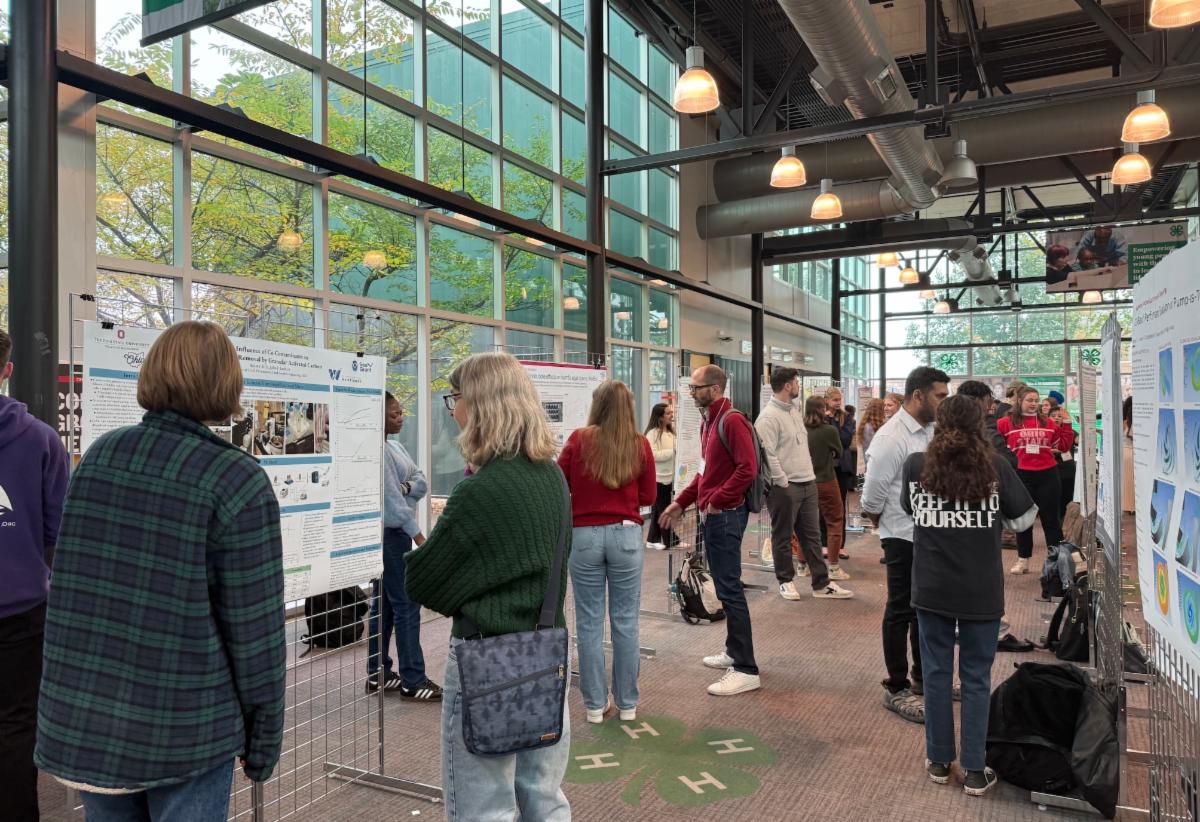
The wait is over: Registration and abstract submission are open for this year's Interdisciplinary Water Research Symposium! Designed for students and by students, this annual event is designed to foster collaboration among those who are working on water-related projects and water stakeholders. The event has grown incredibly in the last three years, and we are happy to announce that — new this year — a limited amount of travel scholarships will be available for students. Please see our website for more details.
We hope you will join us in Columbus on October 28, 2026. Whether you are conducting water-related research, seeking career guidance, or simply interested in the future of water sustainability, this symposium offers valuable opportunities for learning and collaboration.
| | What's in your water? A comparative analysis of micro- and nanoplastics in treated drinking water and bottled water | |
|
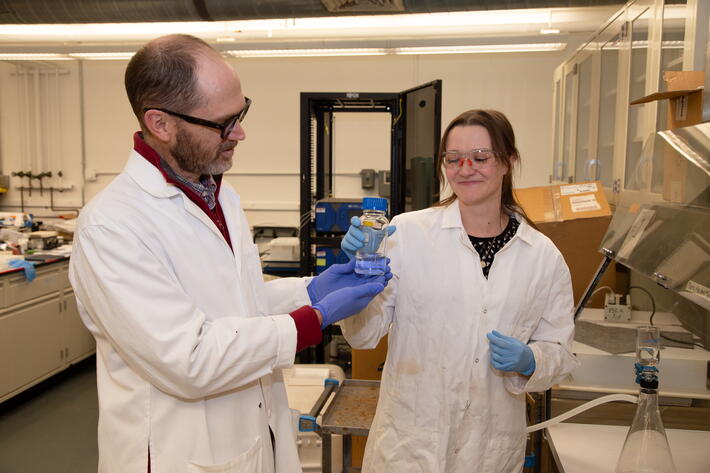
This month we feature research from center co-director John Lenhart and his former student, Megan Jamison Hart, who served as the center’s graduate assistant last year. Alongside their many activities at the center, the two were busy analyzing micro- and nanoplastics (MNP) in treated drinking water and bottled water. Both types of plastics — categorized by their size — have potential associated health risks, but nanoplastic (NP) presence in drinking water is poorly understood. This is partially due to the challenges associated with isolating and analyzing NPs.
Dr. Lenhart and Dr. Jamison Hart developed and validated a method to isolate and determine MNPs using scanning electron microscopy (SEM) and optical photothermal infrared spectroscopy (OPTIR). This method was applied to samples collected from four drinking water treatment plants and six brands of bottled water. The researchers found that bottled water had significantly higher concentrations of MNPs than treated drinking water, particularly for smaller micro- and nanoplastics. Rubber was identified in every sample, indicating that elastomeric MNPs may be more prevalent than previously thought. Altogether, these findings suggest that previous studies may underestimate MNP concentrations by excluding NPs, and that bottled water may have a higher prevalence of MNPs than conventionally treated municipal drinking water.
This research was recently published in Science of the Total Environment and can be read here.
Image Credit: The Ohio State University College of Engineering
| | | |
Clarifying the trophic state concept to advance macroscale freshwater science and management | |
A new perspectives article by USGS researchers discusses potential inconsistencies between the measures used to classify trophic states (TS) — an aquatic ecosystem's characteristic biological productivity — in research studies. The various ways to assess an ecosystem’s TS include Secchi disk depth, nutrients, organic carbon, and chlorophyll, but the proxies measured and resulting classifications of TS can differ widely between ecosystem types and regions. The lack of general consistency fosters confusion and creates conflicting interpretations of what is functional for a given ecosystem.
The article makes a case for more explicit documentation of the TS proxies used in studies to prevent conflicting conclusions about water quality and ecosystem change and increase reproducibility. The authors document different classification schemes and present three case studies for which an improved, standardized understanding of TS would advance freshwater research, management, and interdisciplinary collaboration.
| | | |
Ohio EPA: Interested party review for inorganic chemical monitoring
The Division of Drinking and Ground Waters (DDAGW) is seeking comments on a rule regarding inorganic chemical monitoring. DDAGW reviewed this rule to correct a typo to revert surface water system nitrate monitoring to monthly and added minor language revisions. See the proposed language here. Comments will be accepted via Smart Comment until July 6, 2026.
Ohio EPA: Early stakeholder outreach for emergency loans
The Division of Drinking and Ground Waters is seeking input on a revised rule governing emergency loans for public water systems. The proposed rule can be found here. Comments are due via Smart Comment by July 16, 2026.
Ohio EPA: Interested party review for lead and copper rules
The Division of Drinking and Ground Waters is seeking comments on rules governing lead and copper control, monitoring, and treatment. More details can be found here. Comments must be submitted via Smart Comment by July 16, 2026.
Ohio EPA: Draft 2027 DWAF program management plan
From the Division of Environmental and Financial Assistance, the Draft FY 2027 Drinking Water Assistance Fund (DWAF) Program Management Plan is available for review and comment. The draft proposes how Ohio EPA will distribute funds, administer the DWAF, and prioritize projects during Program Year 2027. There will be two public meetings on July 21, 2026, at 10:30 a.m. and 2 p.m., respectively. The virtual and in-person meetings will be held at the Ohio EPA Central Office, 50 W. Town Street, Suite 700, Conference Room C (Spring), Columbus, Ohio. To attend the hearings online, registration is required. Click here for the morning meeting, and here for the afternoon. Comments can be submitted via Smart Comment until July 21, 2026.
Ohio EPA: Proposal of rules governing plan approval
The Division of Drinking and Ground Waters is seeking input on proposed rules governing plan approval for public water system installation and changes. The proposed rules can be reviewed here. A virtual and in-person public hearing will be held on July 24, 2026, at 10:30 a.m., in the EPA Summer Conference Room at the Lazarus Government Center, 50 West Town Street, Suite 700, Columbus, Ohio 43215. Citizens interested in participating virtually or in-person must register here. Comments can also be submitted via Smart Comment until July 24, 2026.
Ohio EPA: Interested party review for LT2 enhanced surface water treatment
The Division of Drinking and Ground Waters is soliciting comments on amendments to the Long Term 2 Enhanced Surface Water Treatment (LT2) rules. The proposed changes can be found here. Comments are due via Smart Comment by July 24, 2026.
Ohio EPA: Final file of Cuyahoga River drainage basin rule
The Division of Surface Water has adopted final revisions to water quality standards for the Cuyahoga River drainage basin; namely, the basin’s beneficial use designations. The final rule can be found here and will go into effect on September 22, 2026.
| | |
Pre-nominations: WRRSP
The Ohio EPA’s Water Resource Restoration Sponsor Program (WRRSP) is now accepting pre-nomination requests before project proposals open. The WRRSP provides funding for the implementation of projects that specifically target the protection or restoration of high-quality streams and wetlands. Streams targeted for protection must be in attainment of at least the Clean Water Act goal of Warmwater Habitat (WWH) while wetlands must meet category 3 criteria. Similarly, streams must be restored to at least WWH and wetlands to Category 3, respectively. Pre-nomination requests are due by July 15, 2026, and are required to submit a proposal. More details can be found here.
Central Appalachia Habitat Stewardship Program RFP
This program will award grants to restore and sustain healthy forests, grasslands, rivers and streams that provide habitat for diverse native wildlife populations and support local communities across central Appalachia. Applicants are encouraged to use a range of strategies to engage public and private landowners in active stewardship through technical and financial assistance, demonstrations, education and outreach, and other innovative approaches. More information on the program can be found here. Proposals are due by July 16, 2026.
RSF Core Research Grant LOI
The Russell Sage Foundation’s (RSF) core research grants provide up to $200,000 for Ph.D. holders to conduct research projects aligned with RSF's research priorities and special initiatives. RSF will accept letters of inquiry (LOIs) under certain special initiatives: Behavioral Science and Decision Making in Context; Immigration and Immigrant Integration; and Race, Ethnicity and Immigration until July 15, 2026. More information can be found here.
| |  | |
CIG Classic Program
The Conservation Innovation Grants (CIG) program supports the development and adoption of innovative conservation approaches and technologies in conjunction with agricultural production. CIG projects are expected to lead to the transfer of conservation technologies, management systems, and innovative approaches (such as market-based systems) to agricultural producers through the development of technical manuals, guides, and for practical instruction for the private sector. More information can be found here. Applications are due by July 27, 2026.
CIG On-Farm Conservation Innovation Trials
Through On Farm Trials projects, awardees recruit producers and provide them with technical assistance and incentive payments to stimulate the adoption and evaluation of innovative conservation approaches. For 2026, applications will be accepted from eligible entities for projects addressing at least one of the following priorities: irrigation management technologies, new and innovative grazing land management solutions, nutrient management, and soil health demonstration trial. More information can be found here. Applications are due by July 27, 2026.
AWWA 2027 Webinar Program Submissions
The American Water Works Association (AWWA) is accepting webinar proposals through August 20, 2026, for its 2027 program. AWWA program webinars are 90 minutes long with approximately 70 minutes of speaker presentations, allowing time for Q&A at the end. Webinars must be educational in nature and include the presence of a moderator to facilitate speaker introductions and questions. More information, including the submission form, can be found here.
| | | |
From Runoff to Results: Why Stormwater Compliance Matters for Ohio's Future
July 21, 2026 • Virtual
This webinar, presented by the Ohio Stormwater Association, will discuss practical Stormwater Pollution Prevention Plan (SWPPP) implementation for industrial and construction permits. Registration is free for Ohio Stormwater Association-WMAO members and $25 for non-members. Professional Development Hour (PDH) approval is pending from EnviroCert Int'l. See more details — including registration — here.
One Water Technical Conference and Expo
August 17-20, 2026 • Cincinnati, OH
One Water Ohio is a joint effort between Ohio Water Environment Association and the Ohio Section of the American Water Works Association to hold training events for Ohio's water professionals. This year’s four-day conference will take place in Cincinnati. Register here before July 22, 2026, to avoid late fees.
Fourth Annual Interdisciplinary Water Symposium
October 28, 2026 • Columbus, OH
Abstract submission for the annual Interdisciplinary Water Symposium — sponsored by the Ohio Water Resources Center — opened July 1 and will extend until September 18, 2026. Abstracts can be submitted for oral presentations, flash talks, or poster sessions. Registration closes October 5, 2026. For more information, submission details, and this year's target categories, click here.
WMAO Symposium: Water Rich? Ohio's Wealth in Water
November 17-18, 2026 • Dublin, OH
The Water Management Association of Ohio (WMAO) is holding its 55th annual meeting and symposium in the fall, with a focus on new water challenges. This year’s conference will explore the impact of increased water usage and growth on Ohio’s water availability. Abstract submissions for oral presentations are open until July 15, 2026. Student poster abstracts are due by October 16, 2026. Find more information here.
| | |
Get in Touch
Email: OhioWRC@osu.edu
Website: https://wrc.osu.edu
Address: 473 Hitchcock Hall
2070 Neil Avenue
Columbus, OH 43210
| | | | | | |