The Ohio Water Resources Center Newsletter
Issue 7 | Volume 6 | July 2024
| |
|
The Ohio Water Resources Center (Ohio WRC) is the federally authorized and state-designated Water Resources Research Institute for the state of Ohio. Our mission is to enable and conduct state-relevant water-related research; foster collaboration among academic investigators, governmental bodies and water professionals; train the next generation of water scientists; and educate the public on water resources issues in Ohio. With evidence-based scientific information, we form links between water researchers and those who manage and use water.
To achieve these goals, the Ohio WRC has developed and maintains connections with water stakeholders throughout the state. Particularly, we have an advisory board that includes stakeholders from Ohio DNR, the USGS, the Ohio Water Development Authority, the Ohio EPA, the Ohio Department of Agriculture, Ohio Sea Grant, and individuals from The Ohio State University. We engage with our advisory board to stay up to date on the issues that plague Ohio's water resources. Additionally, our advisory board is instrumental in helping us identify research needs for Ohio and pre-proposals that best-fit state needs.
We thank our previous and current advisory board members, who assist us in matching cutting-edge research with needs for the state of Ohio!
| |
Quantifying Induced Infiltration by Municipal Production Wells using Stable Isotopes of Water (𝛿18O and 𝛿2H), Fairfield Ohio.
| |
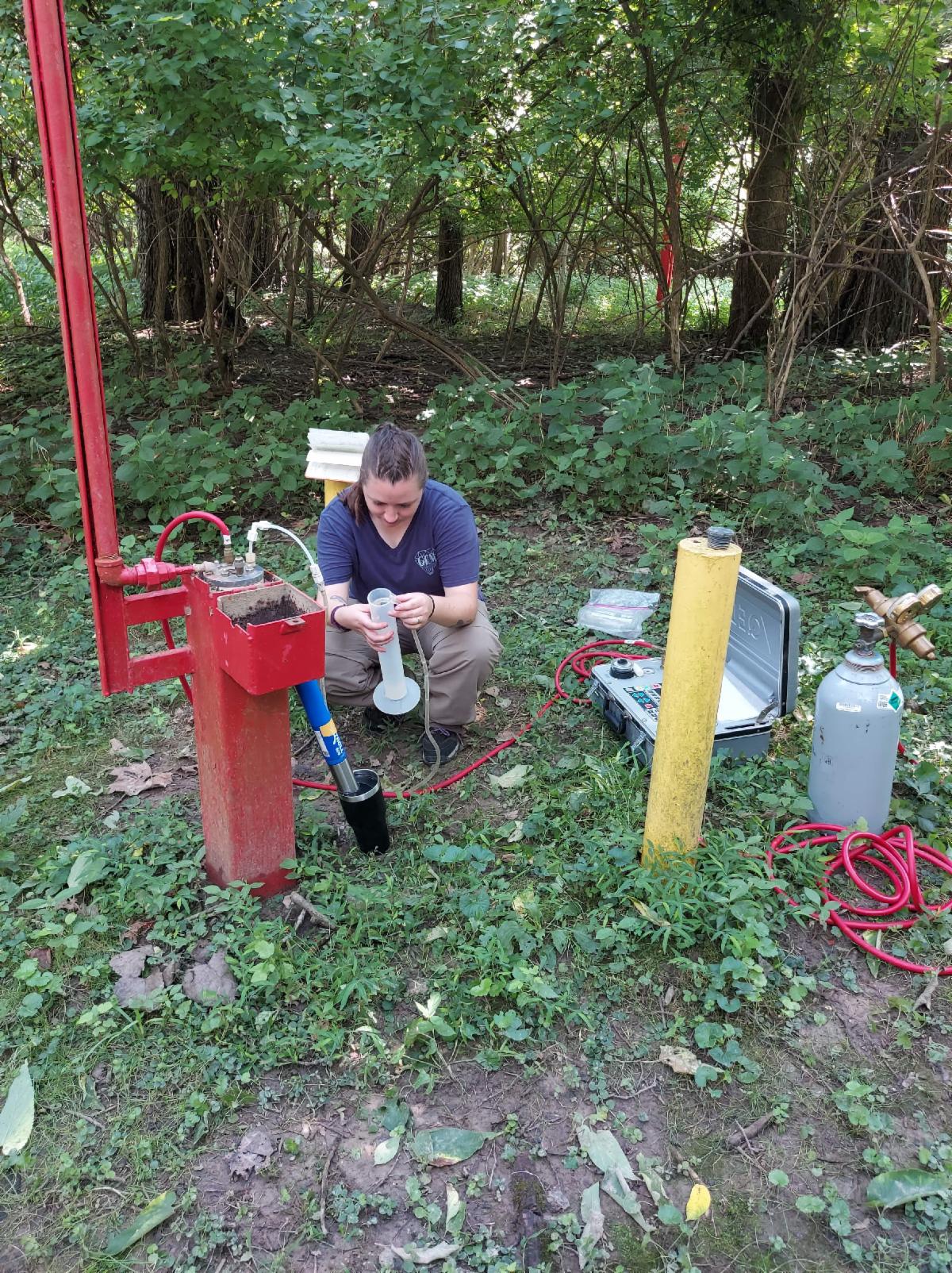
Dr. Jonathan Levy, an associate professor at Miami University, completed an Ohio Water Resources Center funded project via an Ohio Water Development Authority subaward. A common source of groundwater is from wells located in alluvial aquifers that are connected to surface water bodies. The use of these wells induces infiltration of surface water into the aquifer which increases the risk of introducing contamination of the groundwater from the surface water. The goal of Dr. Levy’s study was to quantify induced infiltration using stable isotopes of water, 18O and 2H.
Dr. Levy and his team conducted their study along the Great Miami River in Fairfield, OH. Over one year, the river was sampled bi-weekly from three sites. Each monitoring well included wells that were believed to be both influenced and not influenced by induced infiltration.
The results showed the monitoring wells hypothesized to not be influenced by induced infiltration had the lowest d18O and d2H values. The results from the river water were not as expected because it did not have the highest d18O and d2H values. These unexpected results made further calculations difficult. Despite the unexpected results, Dr. Levy’s research is a first step in refining the isotopic method.
| | | |
USGS led study estimates lithium in groundwater that can be used for drinking water | |
Ongoing research by health organizations has found that low levels of natural lithium in drinking water can lead to positive health outcomes, such as reduced suicide rates and other mental health benefits, but also potential negative effects like autism and thyroid issues. However, data on lithium levels in drinking water and their health impacts are limited.
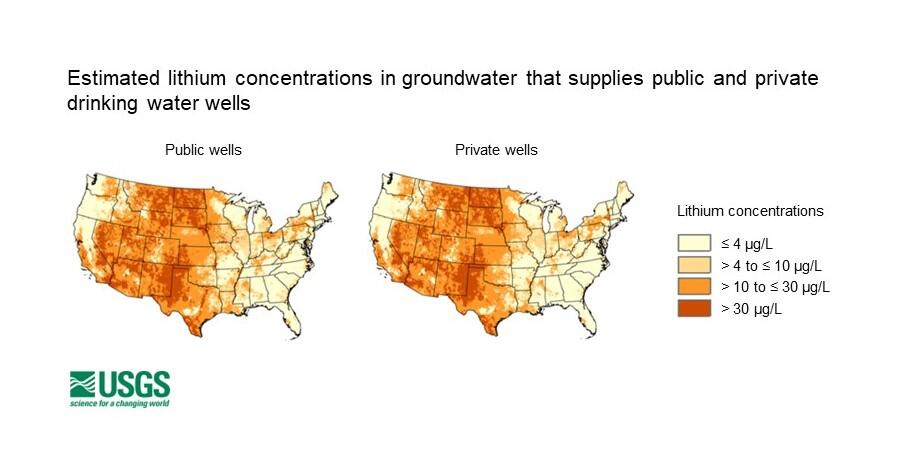
A USGS-led study aims to fill this gap by estimating lithium concentrations in groundwater across the U.S., particularly in the western and southwestern states. The study found that lithium occurs in groundwater at concentrations of 30 micrograms per liter or higher in many areas. A machine learning model was used to estimate these concentrations, considering factors such as well depth, precipitation, soil chemistry, and watershed position.
Lithium in drinking water is not currently regulated in the U.S., though it is on EPA's list of unregulated contaminants to monitor. The USGS and EPA identified 10 micrograms per liter as a health-based screening level, which, while non-regulatory, suggests potential health concerns and can guide future research. The study's findings can assist health researchers, well owners, water utility organizations, and water management agencies in understanding and addressing the impact of lithium exposure on human health.
| | | |
|
Initial cleanup efforts completed, full reassessment of streams underway in East Palestine
Via WFMJ 21, June 7, 2024
East Palestine derailment chemicals reached 16 states
Via The Hill, June 19, 2024
The National Center for Water Quality Research focusing on outreach, education to make a difference
Via WTOL 11, June 21, 2024
EPA, Ohio DNR to perform comprehensive water study in central Ohio
Via Record Herald, June 17, 2024
| |  |
|
Water infrastructure replacements coming
Via Fox 5 WHIZ , June 20, 2024
Text a Lake Erie buoy to get wind, water info
Via The Courier, June 22, 2024
The process of daily water quality monitoring at Cleveland beaches
Via WKYC 3, June 15, 2024
PFAS drinking water limits praised but more regulations sought
Via Bloomberg Law, June 18, 2024
Fire suppressant foam collected and destroyed
Via WFMJ 21, June 7, 2024
| | |
|
Ohio EPA: TMDL Program
Ohio EPA Division of Surface Water (DSW) is soliciting comments on St. Mary's River Draft Loading Analysis Plan and Kopp Creek Dissolved Oxygen Survey Draft Study Plan. The St. Mary's River watershed was surveyed in 2015 and assessed for aquatic life, recreation, and public drinking water supply beneficial uses. The results from this survey were used to develop a loading analysis plan (LAP) for the impaired sites in the watershed. In support of the LAP, Ohio EPA will be conducting a dissolved oxygen survey in the Kopp Creek tributary of the St. Mary's River watershed. The fact sheet for the St. Mary's River LAP and the draft study for the Kopp Creek tributary survey can be found here. Comments for both are due July 15, 2024. Comments can be submitted by email to
EPATMDL@epa.ohio.gov.
Ohio EPA: TMDL Program
Ohio EPA is addressing recreation use impairment in multiple watersheds throughout the state via a single Total Maximum Daily Load (TMDL) report for bacteria. The agency is releasing the loading analysis plan (LAP) for the multi-watershed bacteria TMDL project for review and comment and will accept feedback on any aspect of the plan. The fact sheet for the a fact sheet describing this notice and the draft LAP can be found here. Comments for both are due July 15, 2024. Comments can be submitted by email to
EPATMDL@epa.ohio.gov.
Ohio EPA: Draft 2025 Drinking Water Assistance Fund Program Management Plan
The draft 2025 Drinking Water Assistance Fund (DWAF) Program Management Plan (PMP) is now available for review and comment on the WSRLA program website. The draft PMP will be available for comment until July 22, 2024. Ohio EPA will host two public hearings to receive comments on July 22, 2024, at 10:30 AM and 2:30 PM. The hearings will be hosted online and in-person. To attend either hearing, please register in advance: AM or PM. Written comments may be submitted via e-mail to defamail@epa.ohio.gov. All comments on the Draft PMP must be received by Ohio EPA no later than close of business on Monday, July 22, 2024.
| |
|
Call for abstracts: WMAO 53rd Symposium
Water Management Association of Ohio (WMAO) is hosting their 53rd Annual Meeting and Symposium - Navigating Troubled Waters: Past, Present, and Future from November 19-20, 2024. Full abstract submittal information can be found here. Presentation submission for 20-minute presentations is July 17, 2024 and student poster presentation abstracts are due October 18, 2024.
Request for Proposals: Water Resources Research Institute 104(b) Program
The Ohio Water Resources Center (WRC) will be seeking research pre-proposals to address current water resources issues in Ohio. Priority is expected to be given to proposals that address water technology, water resilience and security, water quality, water reuse and the circular blue economy. Proposals from early career investigators will also be given priority. Detailed information will be available July 8, 2024.
Request for proposals: EPA, Water Reuse
The Ohio EPA is requesting applications for the National Priorities: Occurrence and Implications of De Facto Water Reuse on Drinking Water Supplies grant. The solicitation seeks to address knowledge gaps associated with human risks associated with de facto water reuse and mitigation strategies as well as developing a holistic understanding of the national impact of de facto reuse. Applications are due August 21, 2024.
| | |
|
Request for applications: Water Resource Restoration Sponsor Program (WRRSP)
The goal of the WRRSP is to counter the loss of ecological function and biology diversity that jeopardize the health Ohio's water resources. The WRRSP funds projects that target the protection and restoration of streams and wetlands. To apply, the WRRSP pre-nomination site review request form must be submitted by July 15, 2024. More information and the form can be found here.
Request for proposals: The Water Research Foundation
The RFP has been released for four projects funded through the Research Priority Program. The Water Research Foundation addresses broadly relevant water sector topics, challenges, and opportunities. Open RFPs include advancing the disinfection of wet weather-driven sewer overflows: best practices and case studies; technology and innovation for assessing operability and full closure of high consequence valves; case studies for successful watershed and sewershed monitoring and decision making; and, optimizing sensor networks and advanced sensing techniques for enhanced collection systems management. Utilities interested in participating in the research project can volunteer to serve as test facilities, respond to surveys, provide samples, loan equipment, or share staff expertise. Proposals are due by August 20, 2024 at 3 pm MT. Questions should be directed to the contact within the RFP.
| | |
|
Webinar: Diversity in Water Speaker Series
July 11, 2024 • Virtual
The Diversity in Water Speaker Series invites leaders in Ohio's water industry from diverse backgrounds to discuss their careers, lend us their life lessons, and help lead the discussion on championing diversity within the water industry and in our day-to-day lives. Charles L. Moore, Jr., the Water Maintenance Coordinator of the City of Columbus Department of Utilities, will speak on his career on July 11, 2024 from 5:30-6:30. Register to receive the Zoom link.
Webinar: Freshwater Science - Advancing Stormwater Management at Great Lakes Marinas with Green Infrastructure
July 16, 2024 • Virtual
Hosted by Ohio Sea Grant, Stone Lab and the Harmful Algal Bloom Research Initiative, Dr. Scott Hardy, Sarah Orlando, and Dr. Ryan Winston will discuss their involvement in improving stormwater management at Great Lakes marinas by implementing green infrastructure. Register in advance to attend the webinar.
Conference: 2024 AWRA/UCOWR/NIWR Water Resources Conference
September 30-Octobter 2, 2024 • St. Louis, MO
Hosted by the American Water Resources Association (AWRA), the Universities Council on Water Resources (UCOWR), and the National Institutes for Water Resources (NIWR), the conference will be held in St. Louis, MO focusing on water-related research, management, extension, and education topics. Registration will open soon.
| |
|
Get in Touch
Email: OhioWRC@osu.edu
Website: https://wrc.osu.edu
Address: 475 Hitchcock Hall
2070 Neil Avenue
Columbus, OH 43210
| | |
| | | |