The Ohio Water Resources Center Newsletter
Issue 6 | Volume 5 | June 2023
| |
|
Harmful algal blooms (HABs) are a significant environmental concern that pose risks to both aquatic ecosystems and human health. In recent years, the frequency and severity of HAB events have increased, underscoring the need for effective projections to mitigate their impact. The importance of HAB projections cannot be overstated, as they play a crucial role in monitoring, predicting, and managing these harmful events.
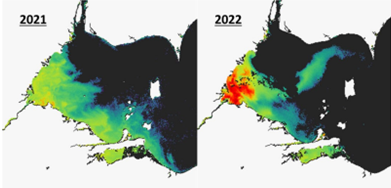
As the upcoming HAB season approaches, there are various resources providing insight on the season’s forecast. One of these resources is a series of Western Lake Erie Harmful Algal Bloom Early Season Projections issued by the National Oceanic and Atmospheric Administration (NOAA). Beginning in May, these projections estimate bloom severity based on measurements of phosphorus loading from the Maumee River along with long-range forecasts and historical records. The early season projections are updated each week with new information until NOAA issues a comprehensive seasonal forecast on June 30th.
Based on observations through May 23rd, NOAA expects a moderate to small bloom, with a severity of 2.5-5.5, on a scale of 0 to 10. A smaller bloom is likely if precipitation remains at or below average for the rest of the loading season. However, larger rain events may produce larger nutrient loads, resulting in a severity closer to 2021 (~6). Interested individuals can subscribe to receive the early season projections via email or view them online.
| |
Annual Central Ohio Children's Water Festival | |
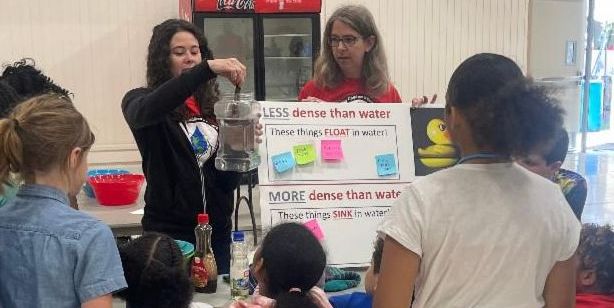
On Tuesday, May 9th, over 600 fifth-grade students from a number of schools across Columbus and Franklin County attended the annual Central Ohio Children's Water Festival at Franklin Park in Columbus, Ohio. The festival promotes environmental awareness of our valuable water resources. The goal is to provide a better understanding of water resources, and the value and importance of water. Hosted by the City of Columbus, the Central Ohio Children's Water Festival happens because of a collaborative volunteer effort from Ohio EPA, City of Columbus, OSU, and local consulting companies.
Throughout the day, students rotated through activities, including interactive displays, hands-on workshops, and fun presentations; learning about the irreplaceable resource of water and its characteristics. The Ohio WRC provided one of the 25-minute workshops introducing attendees to buoyancy and how it relates to density. Students were challenged to determine if items would float or sink based on the principles of buoyancy. Students made origami boats, followed by a friendly competition to determine how many metal washers were needed to sink the paper boats.
| | | |
Salinity and total dissolved solids measurements for natural waters | |
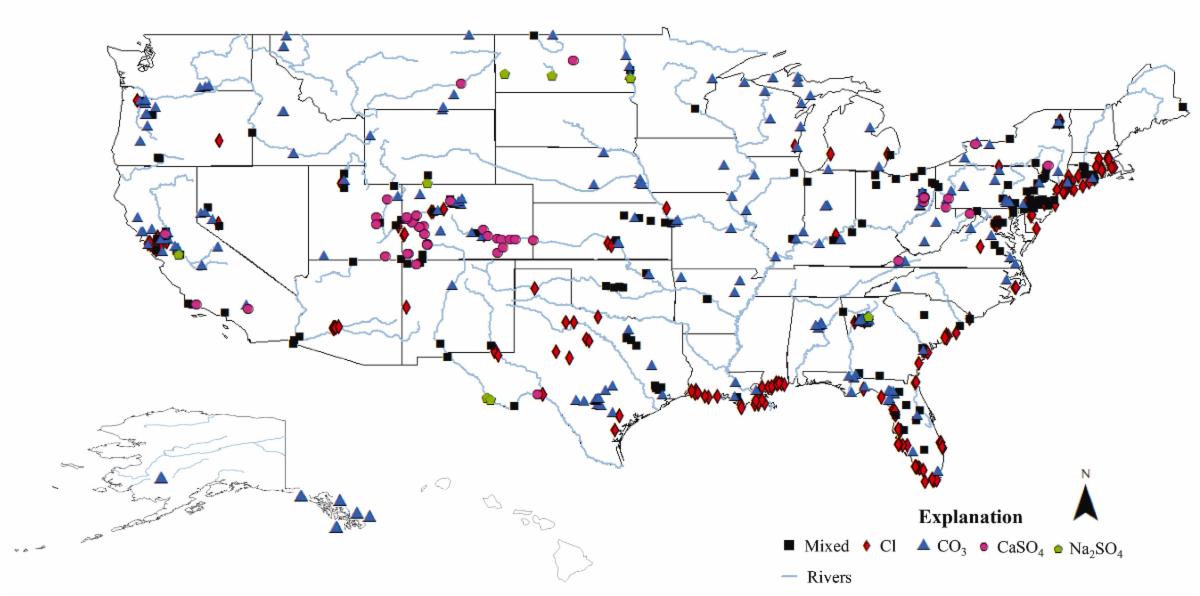
Measurements of salinity or total dissolved solids (TDS) are routinely used to quantify the total concentration of dissolved constituents in water. TDS is defined as the mass of residue passing through a filter remaining after evaporation and subsequent oven drying. Salinity is defined as the mass of dissolved salts in a given mass of solution. These parameters are operationally defined by their analytical methods that are not equivalent for most waters and have inherent differences. This difference presents an issue of misrepresentation of data and incomparable results between studies using differing methods.
This study investigated the potential of several salinity and TDS methods to reliably determine the total concentration of dissolved constituents in surface waters. Several methods to calculate each parameter were compared for 6391 surface water samples. The study concluded that TDS measurements are best suited for studies of evaporites and salinity determined by summing the speciated ion concentrations is the most comprehensive method to represent the concentration of dissolved constituents in natural waters. The sum of speciated concentrations was then used to compare differences between the various methods and develop a new proxy to predict salinity based on specific conductance and major ion water type. This approach is cost effective, rapid, and capable of providing reliable real-time salinity determinations at surface water sites where SC data are available and water type is known.
| | | |
|
EPA continues remediation on EP waterways
Via The Review, May 12, 2023
Local counties meet with EPA in Columbus on water plan
Via WKBN, May 10, 2023
Supreme Court limits federal power over wetlands, boosts property rights over clean water
Via Spectrum News, May 25, 2023
Cleveland expands network of “smart buoys" to monitor Lake Erie water quality
Via Fox, May 26, 2023
Norfolk Southern is on pace to restore East Palestine main line in early June
Via Trains, May 18, 2023
| |  |
|
Court: EPA must regulate perchlorate, contaminant in water
Via AP News, May 9, 2023
Ohio EPA Updating State Water Quality Management Plan
Via Clermont Sun, May 3, 2023
Biden administration proposes water quality standard for tribes
Via The Hill, May 3, 2023
Marietta to explore amount of lead in city water, find solution to remove it
Via Marietta Times, May 28, 2023
Temporary water treatment plant under construction near East Palestine derailment site
Via WMFJ, May 19, 2023
| | |
|
Ohio EPA DSW: Swan Creek, Toussaint River, Western Lake Erie Tributaries, and Lower Maumee River Tributaries Draft Biological and Water Quality Report (2017)
In 2017, the Ohio EPA evaluated watersheds in Swan Creek, Toussaint River, Western Lake Erie Tributaries, and Lower Maumee River Tributaries for aquatic life, recreation, and human health beneficial uses. The draft report can be found here. Comments are due by 5 p.m., June 26, 2023 to EPATMDL@epa.ohio.gov.
| | | |
|
Request for Proposals: Time Critical Water Resource Issues in Ohio
The Ohio Water Resources Center (WRC) is seeking research proposals to address time critical water resources issues in Ohio. This funding mechanism is for proposals having urgency with regard to availability of, or access to data, including quick response research on natural or anthropogenic disasters and similar unanticipated events. Contact Ohio WRC (ohiowrc@osu.edu) to determine if a project may fit into this category prior to submission. Click here for more detailed instructions.
Request for Applications: Evaluation of Antimicrobial Resistance
The U.S. Environmental Protection Agency (EPA) is seeking applications to address knowledge gaps in the occurrence, fate and transport, and persistence of antimicrobial resistant organisms and genes found in municipal wastewater effluent and biosolids. More information can be found here. The deadline to apply is August 16, 2023.
| | |
|
Call for Abstracts: 52nd Annual WMAO Meeting and Symposium
Water Management Association of Ohio (WMAO) 52nd annual meeting and symposium, themed "Water: Our Most Valuable Resource", will be held from November 7-8. For full abstract submittal information, click here. To directly access the online submittal form, click here. Deadline for presentation abstract submission is July 7, 2023.
Call for Abstracts: One Water On Demand
One Water On Demand is seeking abstract submissions for presentations applicable to both water and wastewater audiences. For more information and to submit, click here. Deadline for submission is July 12, 2023.
Request for Proposals: USDA Agriculture Research
The U.S. Department of Agriculture (USDA) released available funding sources for projects focused on Sustainable Agricultural Systems. The deadline to apply is July 13, 2023.
| | |
|
Conference: 2023 UCOWR/NIWR Annual Water Resources Conference
June 13-15, 2023 • Ft. Collins, CO
Registration is open for the 2023 Universities Council on Water Resources (UCOWR) / National Institutes of Water Resources (NIWR) Annual Conference. Discussions will focus on critical water issues facing the western United States, the continent, and globe. Learn more here.
Webinar: Forecast for Harmful Algal Blooms in Lake Erie 2023
June 29, 2023 • Virtual
Registration is open for a live web event for National Oceanic and Atmospheric Administration's (NOAA’s) annual HABs Forecast for western Lake Erie on June 29 from 11 AM to 1 PM, hosted by Stone Laboratory and Ohio Sea Grant. In addition to the official forecast, the event will feature spring nutrient loading and projections along with expert commentary and highlights of recent research efforts and successes.
Webinar: Designing Manufactured Treatment Devices (MTDs) with Maintenance in Mind
July 11, 2023 • Virtual
Registration is open for a Ohio Stormwater Association (OSWA) co-produced webinar on designing manufactured treatment devices with maintenance in mind. Dana Stayer (Hinaman) will present on how to design MTD’s with maintenance in mind, the integration of O&M information into the BMP selection process and the factors that impact MTD maintenance cost.
Webinar: Medicated Streams, Pharmaceuticals Within and Near Treatment Plants in the Lake Erie's Western Basin
July 26, 2023 • Virtual
Registration is open for a webinar hosted by Ohio Sea Grant. Dr. Kevin McCluney will be discussing the variations in locations of emerging contaminants and how establishing these patterns would help managers understand the chemicals’ impacts on the environment, potentially identifying hotspots for treatment.
Conference: One Water Technical Conference
Aug 21-24, 2023 • Greater Columbus Convention Center
One Water is a joint effort between the Ohio Water Environment Association and the Ohio Section of the American Water Works Association. We join together to bring both water and wastewater professionals from around the state for training and networking. Registration is open.
| |
|
Get in Touch
Email: OhioWRC@osu.edu
Phone: 614-292-2807
Website: https://wrc.osu.edu
Address: 475 Hitchcock Hall
2070 Neil Avenue
Columbus, OH 43210
Follow us on Twitter
| | |
| | | |