The Ohio Water Resources Center Newsletter
Issue 6 | Volume 8 | June 2026
| | |
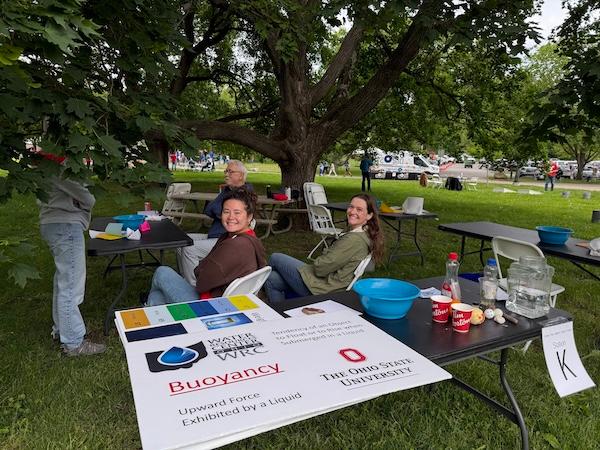
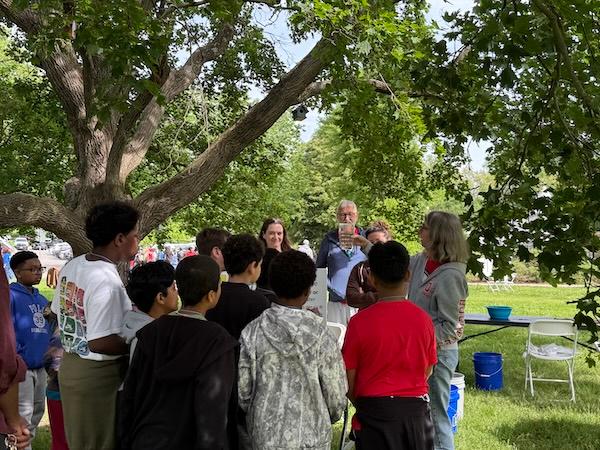
This month, a group of about 350 fifth graders from across Columbus kicked off their summers with a splash. The 16th Annual Children’s Water Festival brought together curious students with local and statewide organizations — including the Ohio Water Resources Center — to learn about water science and conservation through interactive workshops and performances.
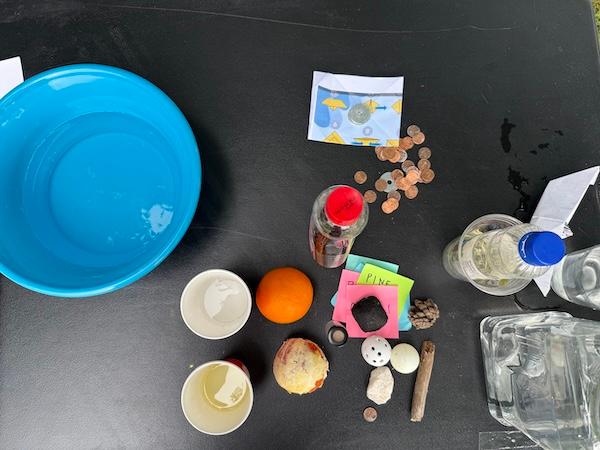
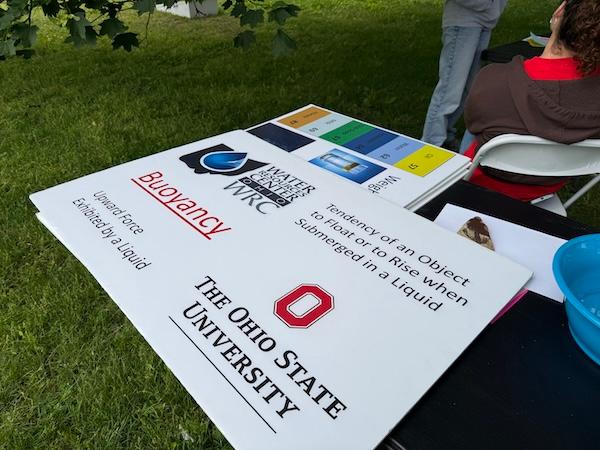
At our station, Ohio WRC staff and co-director Dr. Linda Weavers led a lesson on buoyancy, discussing why some objects float, and others do not. Students then competed to construct the most resilient paper boat, capable of supporting a mixture of pennies and washers. The young scientists walked away with a better understanding of the importance of water and its role in supporting all kinds of life — and boats.
Read more about this year’s activity here.
| | Field observations and numerical simulations to understand the role of PFAS deposition on hydrologic systems | |
|
Andy May, Associate Professor of Civil, Environmental and Geodetic Engineering at Ohio State, leads a multi-year project funded through the Water Resources Research Act Program investigating the atmospheric fate and transport of per- and polyfluoroalkyl substances (PFAS). PFAS are chemicals — historically used in a wide variety of non-stick and stain-resistant products, as well as firefighting foams — that persist in the environment for long periods and are harmful to human and environmental health. Dr. May’s research explores PFAS deposition and aims to inform atmospheric chemical transport models.
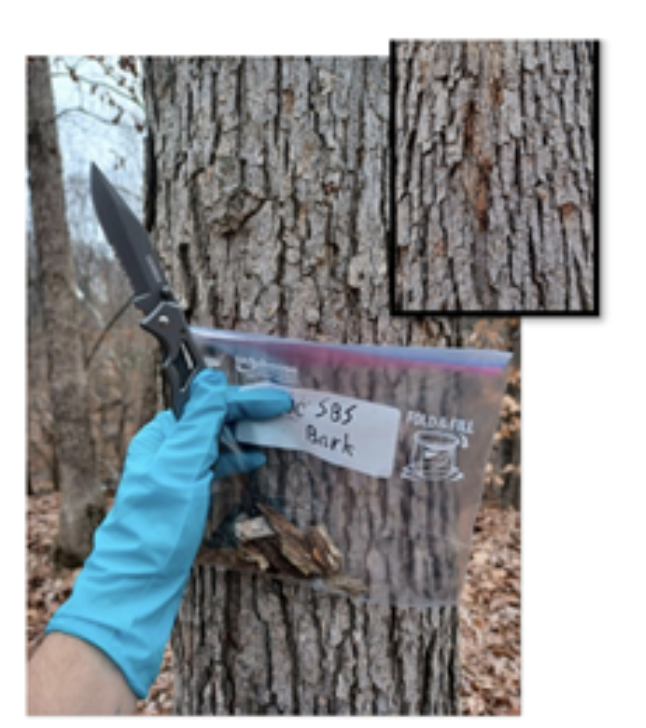
The research team developed a method to sample tree bark near suspected PFAS emission sites and then combined these results to better inform a model that simulates atmospheric PFAS transport from these sites based on wind speed, wind direction, and solar radiation. While the team determined it is possible to use tree bark to monitor atmospheric PFAS, their preliminary findings suggest that tracking the origin of atmospheric PFAS will be difficult, as multiple nearby PFAS sources compound and influence field observations. The research team will be updating their model to include an inventory of known or suspect PFAS air emission sources in proximity to their sampling locations.
Image Credit: Kai Muran.
| | | |
Decadal trends and occurrence of geogenic constituents and mixtures in groundwater across the continental United States | |
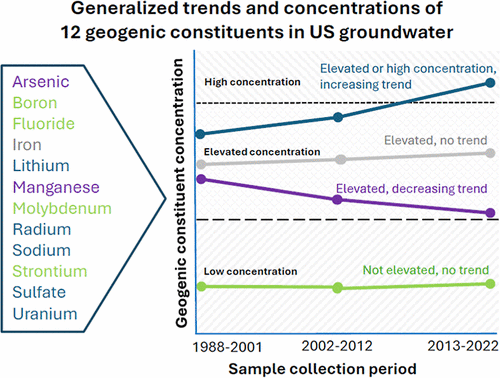
A recently published study by USGS scientists found that elevated concentrations of geogenic contaminants — contaminants released from a geologic source — are widely present in drinking-water aquifers and are somewhat increasing in concentration. These contaminants include elements like lithium, sodium, radium, and uranium, which can harm human health and limit safe water availability.
Using samples from the USGS National Water Quality Network for groundwater monitoring (NWQN-GW) — a series of 89 networks with 20–30 wells per network across the United States — researchers were able to determine the concentrations of geogenic contaminants over three decades. They found that concentrations and trends were influenced by aquifer material geochemistry, constituent geochemistry, groundwater geochemistry, well depth, and land use. For instance, urban and domestic well networks had increasing lithium and sodium trends more often than agricultural networks, while manganese most increased in domestic well networks and uranium more commonly increased in agricultural and urban networks. While the overall contaminant trend was negligible, increasing concentration trends were more common than decreasing trends.
This research is particularly relevant for domestic well users, who are responsible for their own water monitoring. A more complete picture of areas with elevated geogenic contaminants can assist resource managers in determining sites of safe drinking water for communities and families.
| | | |
Ohio EPA: Interested party review for draft 2026 Integrated Report
The Ohio EPA’s draft 2026 Integrated Report indicates the general condition of Ohio’s waters and a prioritized list of waters with impaired beneficial uses and may require Total Maximum Daily Load (TMDL) development to meet water quality standards. The draft is open to public comment until June 7, 2026. Comments can be emailed to EPATMDL@epa.ohio.gov.
Ohio EPA: Early stakeholder outreach for revised coliform rules
The Division of Drinking and Ground Waters is seeking input on revisions to rules governing total coliform. More information on the proposed changes can be found here. Comments can be submitted via Smart Comment by June 8, 2026.
Ohio EPA: Early stakeholder outreach for WQS human health criteria
The Division of Surface Water is considering changes to water quality standards (WQS) related to human health criteria. WQS are state regulations or rules that protect lakes, rivers, streams and other surface water bodies from pollution. More information on the proposed revisions can be found here, and comments can be submitted here until June 11, 2026.
Ohio EPA: File of rules governing secondary MCLs
The Division of Drinking and Ground Waters filed amendments to rules governing secondary maximum contaminant levels (MCLs), which are non-enforceable guidelines for contaminant concentrations in drinking water. An online and in-person hearing will be held at 10:30 a.m. on June 18, 2026, in the EPA Summer Conference Room at the Lazarus Government Center, 50 West Town Street, Suite 700, Columbus, Ohio 43215. Participants must register here. Comments can be submitted via Smart Comment until June 18, 2026.
Ohio EPA: Early stakeholder outreach for contingency plan rules
The Division of Drinking and Ground Waters is seeking input on revisions to the rules governing contingency plans, such as supply chain shortages and cybersecurity incidents. More information can be found here. Comments are due via Smart Comment by June 19, 2026.
| | |
Pre-nominations: WRRSP
The Ohio EPA’s Water Resource Restoration Sponsor Program (WRRSP) is now accepting pre-nomination requests before project proposals open. The WRRSP provides funding for the implementation of projects that specifically target the protection or restoration of high-quality streams and wetlands. Streams targeted for protection must be in attainment of at least the Clean Water Act goal of Warmwater Habitat (WWH) while wetlands must meet category 3 criteria. Similarly, streams must be restored to at least WWH and wetlands to Category 3, respectively. Pre-nomination requests are due by July 15, 2026, and are required to submit a proposal. More details can be found here.
| |  | |
AWWA 2027 Webinar Program Submissions
The American Water Works Association (AWWA) is accepting webinar proposals through August 20, 2026, for its 2027 program. AWWA program webinars are 90 minutes long with approximately 70 minutes of speaker presentations, allowing time for Q&A at the end. Webinars must be educational in nature and include the presence of a moderator to facilitate speaker introductions and questions. More information, including the submission form, can be found here.
| | | |
Webinar: New phosphorus or old phosphorus?
June 17, 2026 • Virtual
The Nature Conservancy will host an online webinar on the importance of managing both fertilizer-derived phosphorus and legacy phosphorus. The presentation will include examples from field and small watershed studies in the Western Lake Erie Basin. Register here.
Water data forum: Water management for data centers
June 30, 2026 • Virtual
Sponsored by the Cleveland Water Alliance, Water Environment Federation, and CUAHSI, this forum will gather industry, government and utility experts to explore the current and future landscape of water and wastewater considerations around the management and operations of data centers. Panelists will examine specific challenges, opportunities, and case studies to define a vision for the future of this area of work. RSVP here.
One Water Technical Conference and Expo
August 17-20, 2026 • Cincinnati, OH
One Water Ohio is a joint effort between Ohio Water Environment Association and the Ohio Section of the American Water Works Association to hold training events for Ohio's water professionals. This year’s four-day conference will take place in Cincinnati. Register here before July 22, 2026, to avoid late fees.
| | |
Get in Touch
Email: OhioWRC@osu.edu
Website: https://wrc.osu.edu
Address: 473 Hitchcock Hall
2070 Neil Avenue
Columbus, OH 43210
| | | | | | |