The Ohio Water Resources Center Newsletter

Issue 4 | Volume 6 | June 2022

From Our Directors

009CF935-B0CF-45AA-9058-50F3DAABEE81_4_5005_c.jpeg

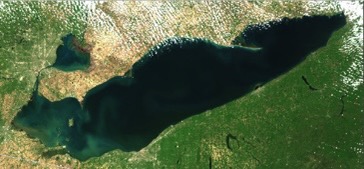
Harmful algal bloom (HAB) season is right around the corner, and there are various resources providing insight on the season’s potential forecast. One of these resources is a series of Western Lake Erie Harmful Algal Bloom Early Season Projections issued by the National Oceanic and Atmospheric Administration (NOAA). Beginning in May, these projections estimate bloom severity based on measurements of phosphorus loading from the Maumee River along with long-range forecasts and historical records. The bloom severity depends on the input of total bioavailable phosphorus (TBP) from the Maumee River during March 1 through July 31. TBP is the sum of dissolved phosphorus and the portion of particulate phosphorus available for HAB development.


The early season projections are updated each week with new information until NOAA issues a comprehensive seasonal forecast on June 30th. Based on observations through May 22, NOAA expects a bloom that is likely less severe—running on a scale of 0 to 10—than 2021 (<6) with a maximum range slightly above 6. A smaller bloom, similar to 2020 (~3), is likely if precipitation for the rest of the spring matches the early season forecast of near average rainfall. However, larger rain events may produce larger TBP loads, resulting in a severity closer to 2021 (~6). Interested individuals can subscribe to receive the early season projections via email or view them online.

Spotlight

Effects of Harmful Algal Blooms on Stress and Immune Function in Freshwater Amphibians and Reptiles

2018OH548B_Refsnider_Jessica Garcia.jpg

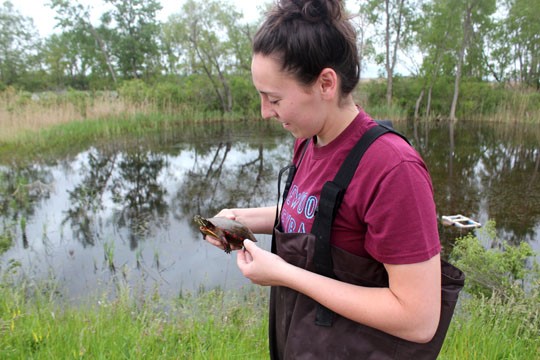
Dr. Jeanine Refsnider from the University of Toledo completed an Ohio Water Resources Center funded project via the 104(b) USGS program. The project aimed to determine whether wildlife health can be used as an early indicator of microcystin pollution by comparing stress levels and immune function in turtles, snakes, and frogs exposed to microcystin from HABs to control, unexposed animals. Field studies consisted of sampling wild songbirds, painted turtles, and northern watersnakes during a HAB event in Grand Lake St. Mary’s and a control site at Ottawa National Wildlife Refuge.


The results found that even when HABs do not cause direct mortality of exposed wildlife that they can act as a physiological stressor across several different taxa, which may lead to other sublethal effects such as organ damage and depressed immune functioning in some groups. Songbirds and snakes from the microcystin exposed site had higher baseline stress levels than unexposed individuals. Microcystin-exposed turtles exhibited depressed immune functioning measured by bactericidal capacity compared to control turtles. Watersnakes exhibited higher physiological stress levels and increased bactericidal capacity when exposed to microcystin. Therefore, the health of aquatic wildlife does appear to be a useful indicator of water quality and of the health of aquatic systems.

USGS Science Highlight

New USGS Maps Show Flood Levels on Lake Ontario's US Shoreline by Lake Level

7AD574FD-8AF0-4BB9-9D7A-9A3D1460E53C.jpeg

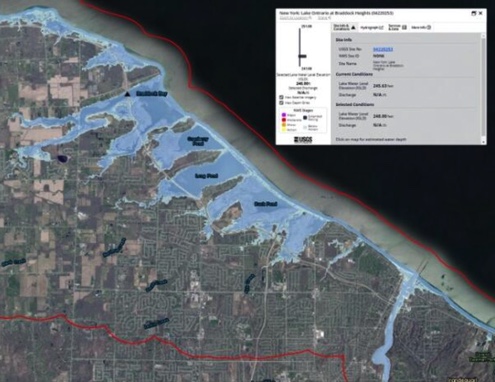
The U.S. Geological Survey has developed new flood inundation maps to provide tools emergency managers and communities along Lake Ontario’s U.S. shoreline can use to visualize potential flooding at different lake levels. Funded by the New York State Department of Environmental Conservation, the maps will inform flood preparation and response. They also may inform decisions on issues ranging from road closures and evacuation areas to post-flood recovery efforts.


The maps cover 321 miles of New York shoreline and depict estimates of the area of inundation and water depth of shoreline flooding based on data collected from eight new USGS lake gauges. The new gauges monitor lake levels in near real time. They are not the only ones on the lake but are the first gauges that produce data reflecting localized conditions affecting water elevation, such as wind speed and direction. The new maps can be accessed through the USGS Flood Inundation Mapper, an online tool that can help assess the potential for flooding at various places across the nation.

News Updates

EPA Adds Five PFAS Chemicals to List of Regional Screening and Removal Management Levels

Via US EPA, May 18, 2022


Ohio EPA Declares Four Mile Creek Watershed Streams in Good Condition

Via The Oxford Observer, May 13, 2022


What the DoD PFAS Incineration Halt Means for Water Professionals

Via Water & Wastes Digest, May 13, 2022 

Governor DeWine Announces H2Ohio Projects in the Ohio River Basin

Via Governor Mike DeWine, May 10, 2022


Ohio Farmers Work to Keep Algae-Causing Nutrients Out of Water

Via The Columbus Dispatch, May 9, 2022


Governor DeWine Awards Lead Line Mapping Grants

Via Governor Mike DeWine, May 6, 2022

Have a news article you'd like us to feature? Email us at OhioWRC@osu.edu!

Policy Update

Ohio EPA DSW: Temporary Wastewater Discharges Permit Renewal


Ohio EPA has issued a final general National Pollutant Discharge Elimination System (NPDES) permit for temporary wastewater discharges in Ohio. The draft renewal permit is available for comment, which must be submitted to the agency by June 15. On June 8, 2022, Ohio EPA will hold a virtual information session and hearing to provide an overview of the Temporary Discharge General Permit renewal.


Ohio EPA DDAGW: Proposed ‘Amend’ Rulemaking Governing Primary Drinking Water Standards Rules


The Ohio EPA Division of Drinking and Ground Waters seeks comments on proposed rulemaking governing Primary Drinking Water Standards. OAC Chapter 3745-81 contains rules critical to the protection of drinking water, including regulations regarding monitoring for disinfectants, MCL’s for organic contaminants, and public notification requirements. Comments are due to the agency by June 20.

Opportunities

Call for Articles: Ohio Section American Water Works Association (AWWA)

In an effort to highlight members' knowledge, experiences, and achievements, Ohio AWWA is accepting technical articles and success stories. The intent is to highlight this content by including it in the 2022 issues of the Ohio Section Newsletter. Send a request to submit with a synopsis of the article to oawwa@assnoffices.com. Deadline for the spring issue is February 8, summer issue is April 22, and the winter issue is October 8. 


Call for Articles: UCOWR Journal of Contemporary Water Research and Education

The Universities Council on Water Resources is interested in publishing research resulting from 104b and 104g grants in the Journal of Contemporary Water Research and Education (JCWRE). JCWRE is published three times per year (April, August & December) and available online at Wiley Online Library. Manuscripts may be submitted at any time, but should be submitted by June 15 for the December issue. More information, including author guidelines, can be found here. 

Call for Abstracts: Virtual ORBCRE Symposium

Youngstown State University is hosting the Ohio River Basin Consortium for Research and Education (ORBCRE) symposium and inviting oral and poster presentations. Topics include, but are not limited to, biological, environmental and water resources research within the Ohio River Basin, Great Lake Region, and beyond. The registration is open, and the abstract is due by August 1. Information about the conference agenda, registration, and abstract submission can be found here.


Call for Proposals: Ohio Department of Higher Education Harmful Algal Bloom Research Initiative

On behalf of the Chancellor of the Ohio Department of Higher Education (ODHE), the Ohio Sea Grant College Program and The University of Toledo are requesting Harmful Algal Bloom Research Initiative (HABRI) pre-proposals for one- to two-year research projects from Ohio colleges and universities. Proposals must be submitted online by June 23 at 5 p.m. ET. More information about guidelines, documents, and form submission can be found here.

To find more resources offered by Ohio WRC, please visit: https://wrc.osu.edu/resources

Upcoming Events

Conference: 2022 UCOWR/NIWR Annual Water Resources Conference

June 14-16, 2022 • Hyatt Regency in Greenville, SC

Registration is now open for the Universities Council on Water Resources and National Institutes of Water Resources Annual Water Resources Conference. The conference has a focus on water resilience to encourage conversations about how watersheds, ecosystems, infrastructure systems, governance structures, and communities can adapt and transform in the face of current and future stressors.


Workshop: Ohio EPA Grant Writing Workshop 2022

June 16, 2022 • Locke Branch Library in Toledo, Ohio

Registration is open for a grant writing workshop hosted by the Ohio EPA. Topics include how to find the right funder, approaching different kinds of grantmakers, avoiding common mistakes applicants make, and developing realistic objectives, activities, and budgets.


Webinar: Forecast for Harmful Algal Blooms in Lake Erie

June 30, 2022 • Virtual

Stone Lab and Ohio Sea Grant will host a live web event for NOAA’s annual HABs Forecast for western Lake Erie. In addition to the official forecast, the event will feature spring nutrient loading and projections along with expert commentary and recent research successes. Registration is open.


Conference: Climate Intersections Conference

July 11-14, 2022 • DECC, Duluth MN

Registration is now open for the North Central Region Water Network’s Climate Intersections Conference. The conference theme is “Taking Care of People, Water, and the Land” and will feature emergent research and key programming that can facilitate solutions for resilient and equitable agricultural systems, communities, and watersheds throughout the North Central Region and beyond.


Conference: One Water Technical Conference

July 25-28, 2022 • Huntington Convention Center in Cleveland, Ohio

One Water is a joint effort between the Ohio Water Environment Association and the Ohio Section of the American Water Works Association. We join together to bring both water and wastewater professionals from around the state for training and networking. Registration is open.

Have an event you'd like us to feature? Email us at OhioWRC@osu.edu!

Get in Touch


Email: OhioWRC@osu.edu

Phone: 614-292-2807

Website: https://wrc.osu.edu

Address: 475 Hitchcock Hall 

2070 Neil Avenue

Columbus, OH 43210

Follow us on Twitter

Twitter
wrc.jpg

About Us

Research

Outreach

Publications

Resources