The Ohio Water Resources Center Newsletter
Issue 11 | Volume 5 | November 2023
| |
|
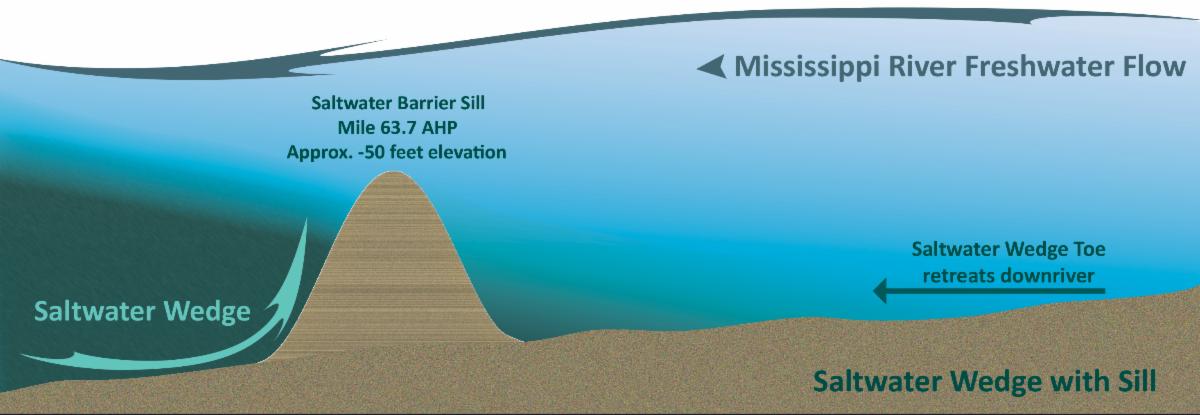
Saltwater intrusion has threatened the water supply of New Orleans and surrounding communities. Due to the severe heat and drought conditions, the water level and current of the Mississippi River, which serves as the primary source of drinking water for the region, have significantly decreased. This reduction has allowed the seawater to intrude farther upstream into the river.
While predictions by the U.S. Army Corps of Engineers indicate the intrusion of seawater has slowed, the water supply of some communities has already been exposed to salt. To mitigate exposure to unsafe salty water, communities have had to create contingency plans including building costly pipelines, transporting water from upriver, or accessing desalination technologies. On September 27, 2023, the White House declared an emergency in Louisiana which enables federal funding for mitigation efforts.
Sand sills were constructed by the U.S Army Corps of Engineers in 1988, 1999, 2012, and 2022 to mitigate similar seawater intrusions. Seawater is more dense than fresh water so seawater will remain at the constructed sills until seawater reaches the top of the barrier. Not only is increased salt in water supplies a health issue, it can also damage an already aging infrastructure.
| |
Evaluating Current and Future Drinking Water Affordability in Ohio | |
Dr. Daniel Gingerich, a professor at The Ohio State University, completed an Ohio Water Resources Center funded project via a 104(B) subaward. Drinking water systems are facing existing and new stressors which impact the affordability of drinking water. Per- and polyfluoroalkyl substances (PFAS), an emerging contaminant, are man-made chemicals that drinking water systems are currently facing. These contaminants have a significant impact on drinking water quality, fish and animal habitat, human health, and ecosystem services in Ohio. For several PFAS, the EPA has proposed National Primary Drinking Water Regulations (NPDWR). This study aimed to assess the affordability of water at the household and system-level if PFAS regulations are implemented as proposed.
Dr. Gingerich and his team assessed water affordability using census-tract level economic data from more than 200 community water systems in Ohio. EPA methods and tools were used to assess water affordability amid the proposed PFAS regulations. Results showed that smaller community water systems may have difficulties complying with upcoming PFAS regulations.
Dr. Gingerich’s research will aid in determining if systems will find difficulty complying with future PFAS regulations at a system level. These results are important for the US EPA, utilities, and state primacy agencies because PFAS regulations are imminent and will impact water affordability.
| | | |
Integrated Water Resources Assessment | |
The USGS Water Resources Mission Area is producing Integrated Water Availability Assessments to estimate past, present, and future water supply and demand. Overall, the assessments will aid in management as imbalances occur between water supply and demand.
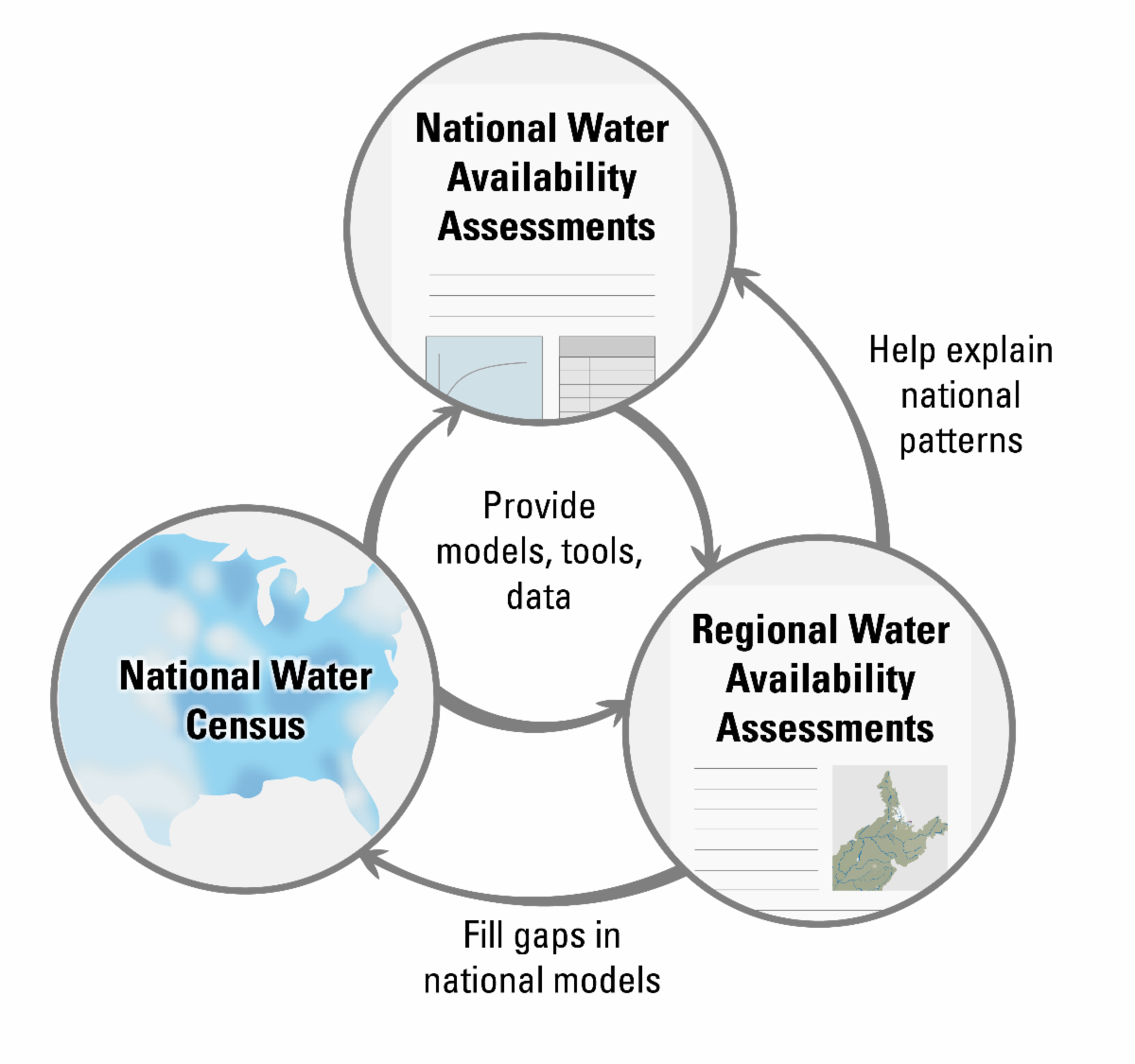
As a part of the water availability assessments, three products will be generated: the National Water Census, National Water Availability Assessment, and Regional Availability Assessment. The National Water Census will provide information about water quantity, water quality, and the use of surface and groundwater. The National Water Availability Assessments will be produced on a five-year cycle due to the large scope of data. Information about the synthesis and interpretation of water availability in the past, present, and future will be included in the National Water Availability Assessments. Regional Water Availability Assessments will be performed at medium-sized watersheds that are representative of regions throughout the United States. Data will be collected to understand the major drivers of water availability.
Each one of three products will aid in generating the other products. The foundational models for the National Water Census will be used for the National Water Availability Assessments. The Regional Water Availability Assessment will supplement the foundational models improving future National Water Census and aid in explanation for patterns found in the National Water Availability Assessments. The outcomes from the Integrated Water Availability performed by the USGS will be crucial to understanding water resources in the past, present, and future.
| | | |
|
Ohio EPA DSW: Prenotice of Biocriteria rules package OAC chapters 3745-1 and 3745-2
The Ohio EPA Division of Surface Water (DSW) is requesting input regarding the following comments received during Ohio EPA’s Water Quality Standards Triennial Review. The Agency received comments supporting the categorization of Little and Big Darby Creeks as Outstanding National Resource Waters in Table 5-7 of rule OAC 3745-1-05, in lieu of the current categorization of Outstanding State Waters due to exceptional ecological values. At this time, Ohio EPA is soliciting input on this suggestion. Comments are due by November 17, 2023 at 5 p.m. to dsw_rulecomments@epa.ohio.gov.
| |
|
Call for Abstracts: 52nd Annual WMAO Meeting and Symposium
Water Management Association of Ohio (WMAO) 52nd annual meeting and symposium, themed "Water: Our Most Valuable Resource", will be held from November 7-8. The deadline for abstract submission for the student poster competition is November 3, 2023.
Request for Applications: Treatment Technology Demonstrations Using Practical and Affordable Manganese Treatment for Small Drinking Water System
The U.S. Environmental Protection Agency (EPA) is seeking research to evaluate the effectiveness of common manganese treatment technologies in small drinking water systems. Small utilities find Mn treatment challenging due to the complexities of the treatment process, costs, and aging infrastructure. Applicants should address both treatment and cost and capacity. Applicants are asked to evaluate performance and sustainability of Mn treatment technologies over time and the economic viability of Mn treatment technologies over time. Applications are due November 15, 2023.
Call for Abstracts: One Water Technical Conference
The OAWWA/OWEA One Water Technical Conference focuses on water and wastewater industries throughout Ohio. Abstracts can be submitted here and the deadline to submit is December 15, 2023.
| |  |
|
Request for Applications: EPA's Drinking Water System Infrastructure Resilience and Sustainability Grant Program
The U.S. Environmental Protection Agency (EPA) is soliciting applications from eligible entities for projects in underserved communities to increase drinking water system resilience to natural hazards. The deadline to apply is November 6, 2023.
Call for Abstracts: Emerging Contaminants in the Environment Conference
The call for abstracts is open for 2023 Emerging Contaminants in the Environment Conference (ECEC23). Topics include per-and polyfluoroalkyl substances (PFASs), pharmaceuticals and personal care products (PPCPs), plastic debris and microplastics, algal toxins, agricultural chemicals, and other emerging contaminants. The deadline to submit is November 16, 2023. More information is available here.
Request for Applications: Ohio Department of Higher Education Harmful Algal Bloom Research Initiative
The Ohio Sea Grant College Program and the University of Toledo are requesting Harmful Algal Bloom Research Initiative (HABRI) pre-proposals for one- to two-year research projects from Ohio colleges and universities. Proposals should aid in the management of efforts of state agencies and support H2Ohio Initiative. Pre-proposals are due November 9, 2023.
| | |
|
Symposium: Interdisciplinary Water Symposium
Nov 3, 2023 • Scott Hall
The First Annual Interdisciplinary Water Research Symposium, “Diving into water research across OSU – An interdisciplinary symposium”, is an event organized by students, for students, with the aim of fostering collaboration and knowledge exchange in the field of water resources. Abstract submission for student poster presentations and lightening talks can be found here.
Webinar: Freshwater Science: Testing Waters and Fish for Pharmaceuticals and PFAS Contamination On-site
Nov 29, 2023 • Virtual
During this webinar, hosted by Ohio Sea Grant, Stone Lab, and the Harmful Algal Bloom Research Initiative, Dr. Emanuela Gionfriddo of the University of Toledo will be discussing their research developing microextraction protocols that will provide a fast, reliable screening and quantitative approach for the analysis of pharmaceutical and PFAS in fish and environmental waters. Registration is open.
| |
|
Get in Touch
Email: OhioWRC@osu.edu
Phone: 614-292-2807
Website: https://wrc.osu.edu
Address: 475 Hitchcock Hall
2070 Neil Avenue
Columbus, OH 43210
Follow us on Twitter
| | |
| | | |