The Ohio Water Resources Center Newsletter
Issue 11 | Volume 6 | November 2024
| |
|
This October, the Ohio Water Resources Center and the Sustainability Institute hosted the Great Lakes ReNEW research consortium and industrial consortium joint workshop at The Ohio State University. The workshop showcased the power of partnerships between academia and industry. From “smart and connected” work in Lake Erie to the role of the Scioto and Olentangy Rivers providing water that drives economic development in Columbus, the workshop highlighted the importance of Ohio’s leadership in water.
Great Lakes ReNEW, includes Ohio State University as a key partner and Ohio Water Resources Center Co-Director John Lenhart as one of the technical leads. Great Lakes ReNEW is a new water-focused Regional Innovation Engine funded by the U.S. National Science Foundation. The initiative will fund efforts to identify novel approaches, materials, and processes to recover clean water, nutrients and materials for clean energy technologies from wastewater. ReNEW will also support the development of a regional infrastructure to support workforce development and education programs at the K-12, community colleges, trades and unions, and university levels with the goal to build an equitable and inclusive water-sector job-creation ecosystem that spans the entire Midwest.
| |
Decision-tool to prioritize water line repair to combat water inequity | |
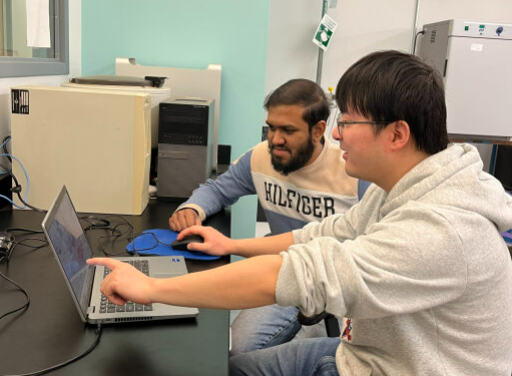
Drs. Yalin Dong and Teresa Cutright from the University of Akron recently completed an Ohio Water Resources Center project via a United States Geological Survey104(b) subaward. Working with the City of Akron Water Supply Bureau, the research team created a tool to predict pipe breaks and correlate those breaks with socioeconomic factors.
Using data from the city of Akron to train the machine learning model, the research team estimated the probability of pipe failures and highlight vulnerable areas. The system was able to identify 600 pipelines at varying levels of risk. This data was combined with socioeconomic information to create an overall analysis of water equity, which can provide decision-makers with a tool to help plan investments. The researchers, and the city of Akron, want to make sure that customers across the complete socioeconomic spectrum are getting the same amount of preventative maintenance.
| | | |
Millions in the U.S. may rely on groundwater contaminated with PFAS for drinking water supplies | |
Per- and poly-fluoroalkyl substances (PFAS) are a class of chemicals with a wide range of uses due to their non-stick and water-resistant properties. PFAS are commonly called “forever chemicals” because they do not break down in the environment. Because of their widespread presence in water supplies and growing knowledge of toxicity, the EPA has established maximum contaminant levels, for six PFAS in drinking water. The EPA regulates public water supplies, but those with private wells are responsible for maintenance and testing.
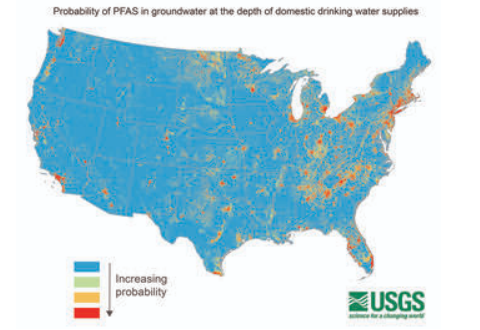
Using 1,238 groundwater samples to create a predictive model, recent research from the USGS found between 71 to 95 million people in the Lower 48 states may rely on groundwater that contains detectable levels of PFAS in their drinking water supplies. The model was made to prioritize areas for future sampling to help ensure people aren’t unknowingly drinking contaminated water. This work identified Michigan, Florida, North Carolina, Pennsylvania, New York, and Ohio as having the largest populations relying on private wells utilizing potentially contaminated groundwater.
The machine learning model was developed to identify which geographic areas have a higher likelihood for contamination. That information was combined with existing USGS research on the number of people in a given area who rely on groundwater for drinking water to establish population estimates. This research provides a broad outlook for the Lower 48 states and presents state-level estimates.
| | | |
Ohio EPA: Adoption of Amended Rule Language (OAC) Chapter 3745-81
The Division of Drinking and Ground Waters (DDAGW) has adopted the amended rules in Ohio Administrative Code (OAC) chapter 3745-81. Chapter 3745-81 of the Ohio Administrative Code covers primary drinking water standards, including requirements for monitoring, reporting, and recordkeeping. Public water systems must monitor tap water for lead and copper, as well as source water at each entry point to the distribution system. The amended rules will be effective as of Thursday, October 31, 2024.
Ohio EPA: Adoption of Amended Rule Language (OAC) Chapter 3745-7
The Division of Drinking and Ground Waters (DDAGW) has adopted the amended rules in Ohio Administrative Code (OAC) chapter 3745-7. Chapter 3745-7 of the Ohio Administrative Code covers the certification of operators for public water systems and wastewater treatment works. There are multiple classifications for professional operators, including public water system and treatment works operators. The amended rules will be effective as of Thursday, October 7, 2024.
| |
|
Call for Abstracts: Ohio Stormwater Conference
The 18th annual Ohio Stormwater Conference hosted by the Tinker’s Creek Watershed Partners and the Ohio Stormwater Association is calling for abstracts. The conference is dedicated to advancing the knowledge and understanding of stormwater management. The conference will provide updates on environmental issues, new technologies, regulatory information and pollution prevention. The conference will take place on May 8th and 9th, 2025. Abstracts are due November 20, 2024.
| |  |
|
Request for Proposals: H2Ohio Methods to Identify High Phosphorus Loss Sites Research Grant
H2Ohio's Phosphorus Removal Structures Program, is seeking proposals for projects that focus on identifying the measurable site parameters most indicative of dissolved phosphorus losses from Ohio cropland, specifically in the Western Lake Erie Basin. This investment in research will aid ODA in identifying high phosphorus losses from agricultural sites, and recommend processes to identify sites suited for removal structures. Proposals are due December 31, 2024. Proposals are due December 31, 2024.
| | |
|
Conference: 2024 Water Management Association of Ohio Conference
November 19-20, 2024 • Columbus, Ohio
The Water Management Association of Ohio is hosting its annual fall conference. This
year they are celebrating the 75th anniversary of the Ohio Department of Natural Resources and the 50th anniversary of the Safe Drinking Water Act. This Years conference is also focusing on navigating troubled waters in the past, present and future.
Register here
Webinar: Spatial Ecology of Small Mouth Bass in Lake Erie
November 21, 2024 • Virtual
The Freshwater Science Speaker Series, hosted by Ohio Sea Grant, has Zak Slagle of the Ohio Department of Natural Resources Division of Wildlife talking about how he is using acoustic telemetry for this Ohio Sea Grant research project to study how much smallmouth bass move, when they move, what habitats they prefer, and if angler-caught fish have higher movement rates than “unselected” fish.
Register to receive the Zoom link
| |
|
Get in Touch
Email: OhioWRC@osu.edu
Website: https://wrc.osu.edu
Address: 473 Hitchcock Hall
2070 Neil Avenue
Columbus, OH 43210
| | |
| | | |