The Ohio Water Resources Center Newsletter
Issue 10 | Volume 8 | October 2026
| | |
On October 18, 1972, bipartisan majorities in Congress overrode a presidential veto to enact new, landmark legislation: the Clean Water Act. Fifty-four years later, the act’s fingerprints can be seen on major water quality and restoration achievements nationally. The Cuyahoga River — whose flammability partially prompted the act’s passage — and Lake Erie — nicknamed the “dead lake” in the 1960s due to mass algal blooms — have experienced dramatic improvements and organizations are now working to reintroduce sensitive species in their waters.
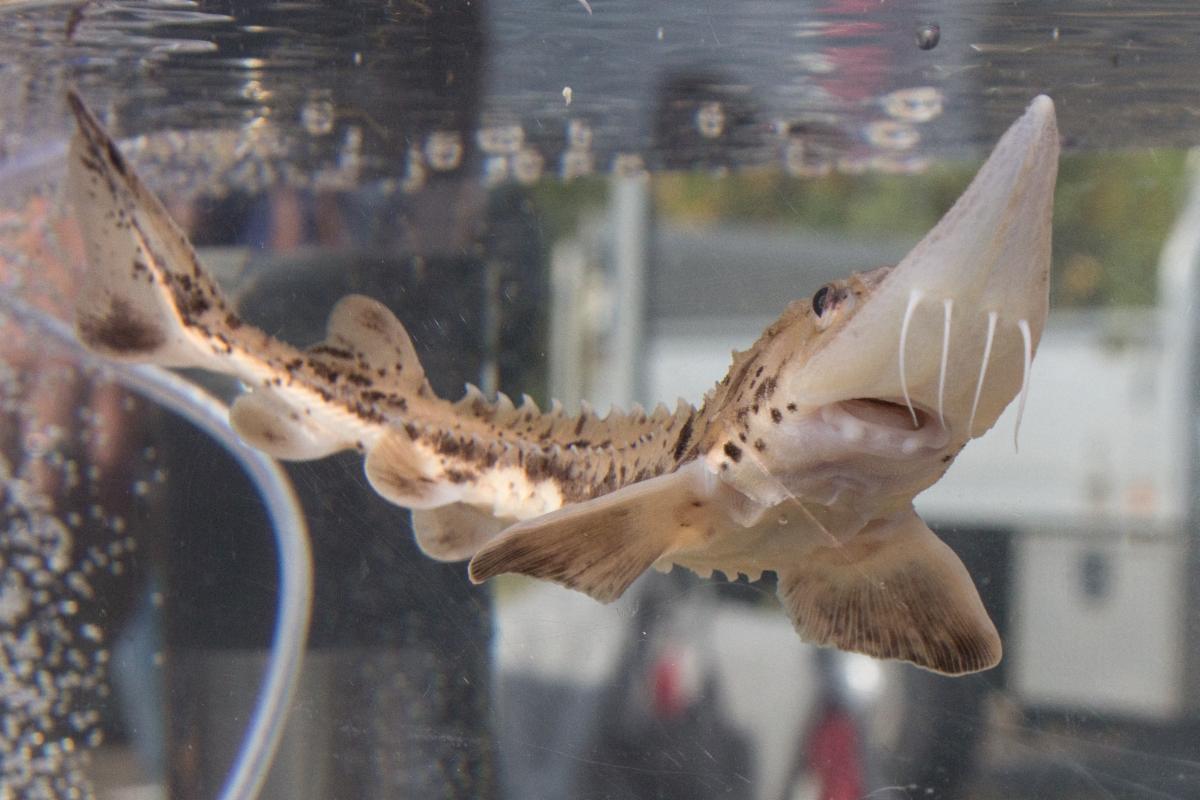
Led by the Ohio Department of Natural Resources (ODNR) Division of Wildlife, in partnership with the University of Toledo and the U.S. Fish and Wildlife Service, thousands of juvenile lake sturgeon have been released into Ohio waters since 2018. The now-state-endangered fish were once abundant in Lake Erie and the Ohio River, but overfishing, dam construction, and habitat degradation reduced their populations to less than 1% of historic levels in the mid-19th century. Lake sturgeon are the largest and longest-lived fish in the Great Lakes, living up to 150 years and reaching up to 6-8 feet in length. However, these characteristics make them vulnerable to external pressures.
“With a long-lived, sensitive species like lake sturgeon, we know that they act like a canary in the mine,” said Eric Weimer, fishery biologist supervisor at the ODNR Division of Wildlife’s Sandusky Research Station. “If water quality and habitat start to decrease, we're going to see it first and foremost with them.”
Over the years, an increased awareness and stewardship of water resources — backed by the Clean Water Act and similar legislation — has paved the way for the return of the sturgeon, as well as other Great Lakes species.
“As we have worked over the last 50 years to improve water quality, to work on habitat, and to improve these impacted areas, we know that not only will that work benefit lake sturgeon reintroduction, but it will also benefit all of our native species as well,” Weimer said.
Continue reading this story here.
Image credit: ODNR
| | Special Announcement: 2026 USGS 104g RFP now open | | The rapid expansion of data centers and other water intensive industries that rely on public supply systems has outpaced the availability of accurate, transparent, and timely information about their water use. Existing datasets often contain gaps, inconsistencies, and uncertainties that limit the ability of communities, utilities, and policymakers to make informed decisions. As public concern grows and water resource pressures intensify, there is a critical need for improved methodologies — potentially leveraging artificial intelligence and machine learning capabilities — that can more reliably characterize industrial water withdrawals, cooling demands, and local impacts. This Notice of Funding Opportunity seeks to address these challenges by advancing observational and analytical approaches capable of reducing uncertainty and strengthening confidence in publicly available information. Please see our website for more details. | |
|
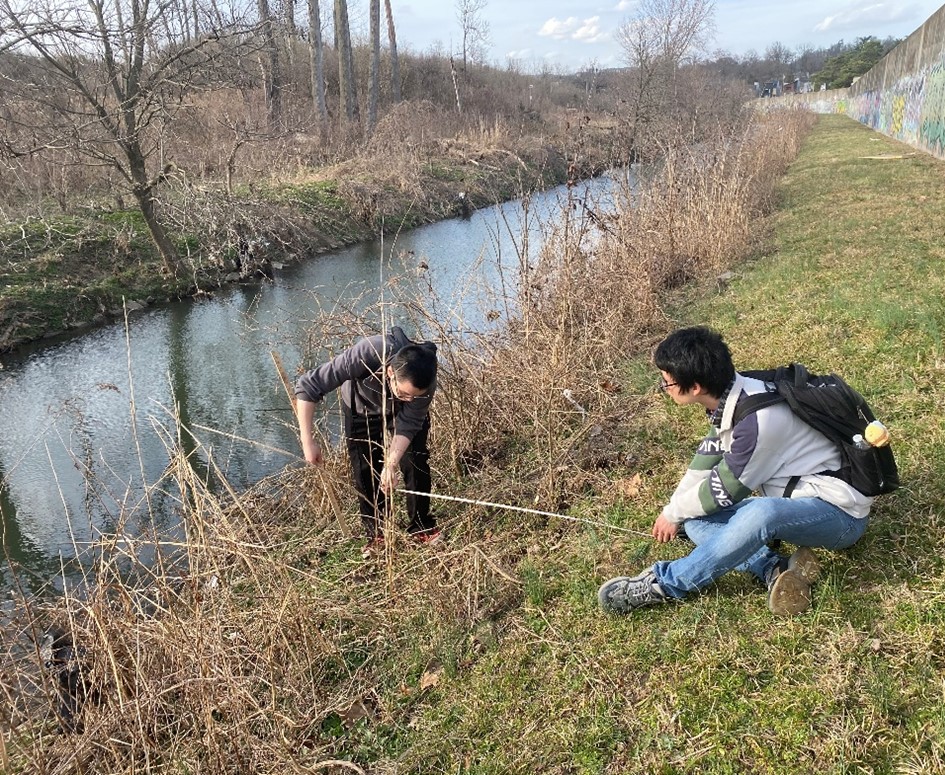
At the University of Cincinnati, PI Lei Wang — an associate professor of civil engineering — and students recently developed a framework to evaluate the stability of earthen levees. Levees are critical flood protection infrastructure built along waterways that consist primarily of earthen masses to retain water and secure landslide areas against flood events. While widely distributed along Ohio waterways such as the Ohio River, the Miami River, and Lake Erie, most of these structures are aging and currently operating beyond their design life. As flooding events are expected to increase in Ohio, levee stability is critical in protecting communities.
The researchers created a simulation framework to test how different soil compositions handle rising water and established a new design standard to ensure levees perform reliably during extreme storms. They also built a deep learning-based framework to expedite safety calculations. This new framework bridges the gap between static geotechnical safety and dynamic flood hazards, ensuring levees do not simply meet a baseline safety factor, but rather actively withstand extreme, fluctuating flood pressures cost-effectively.
Read more about this project on our interactive project map.
| | | |
|
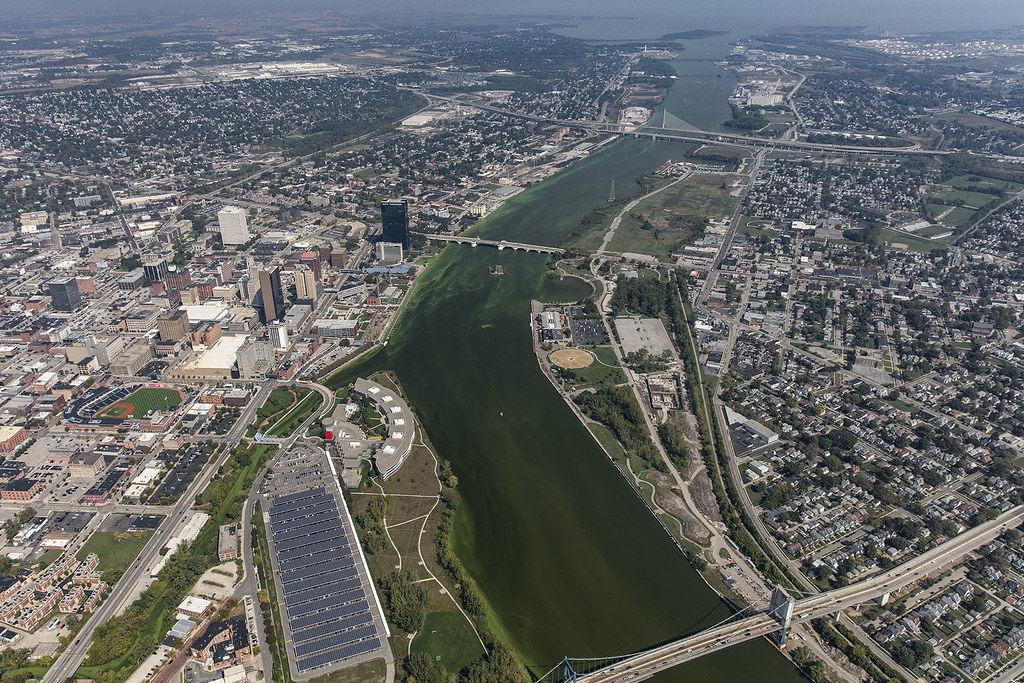
A recent review of 50 years of harmful algal bloom (HAB) modeling synthesized results from 162 studies on over 80 rivers worldwide. The authors found most research centered on large, nutrient‑rich, flow‑altered rivers, with South Korea, Europe, the United States, and China contributing most of the work. The authors found that data-driven (AI) methods have expanded over time with the rise of better computing and monitoring, although process-based models still accounted for 59% of the modeling approaches.
Inconsistent units and taxonomic resolution hindered comparisons between models, but, across all models, nutrients, light availability, streamflow, algal physiological processes, and water temperature emerged as key predictors. The authors identified persistent modeling challenges, including underrepresentation of benthic habitats, neglect of side-channel and backwater influences, insufficient documentation of river features, and weak linkages between modeled endpoints and potential harms.
| | | |
Ohio EPA: Supplemental comment period for the Draft 2026 Integrated Report
The Integrated Report indicates the general condition of Ohio’s waters and includes a prioritized list of waters with impaired beneficial uses. A supplemental comment period on the draft — due to incomplete materials in the previous comment window — will be open until October 12, 2026. The Ohio EPA will only accept comments on the full list of waters and their priority rankings. Comments can be submitted via email to EPATMDL@epa.ohio.gov.
Ohio EPA: Interested party review for water quality trading rules
The Ohio EPA is soliciting comments on rules governing water quality trading — a voluntary program that allows a National Pollutant Discharge Elimination System (NPDES) permit holder (point source) to meet its regulatory obligations by using pollutant reductions generated by another wastewater point source or non-point source. The proposed rules can be found here. Comments can be submitted via Smart Comment until October 16, 2026.
Ohio EPA: Early stakeholder outreach for plan approval rules
The Division of Drinking and Ground Waters is seeking input on rules governing drinking water source protection plans and certification(s). Comments can be submitted via Smart Comment until October 29, 2026.
Ohio EPA: Consumer confidence report rules
The Division of Drinking and Ground Waters has proposed rules regarding consumer confidence reports. There will be an in-person and virtual public meeting at 10:30 a.m. on October 30, 2026, at the EPA Summer Conference Room at the Lazarus Government Center, 50 West Town Street, Suite 700, Columbus, Ohio 43215. Participants must register here. Comments can be submitted via Smart Comment until October 30, 2026.
| | |
Call for abstracts: 2027 Emerging Contaminants in the Environment Conference
April 20-21, 2027 • Virtual
The 2027 Emerging Contaminants in the Environment Conference (ECEC) will feature presentations on the latest in emerging contaminant research, policy, and outreach in the soil, water, air, and built/human environments. Please note that this year’s conference will be virtual; in the future, ECEC will be entirely virtual in odd number years (e.g., 2027, 2029, 2031, etc.) and in person only in Champaign, IL, in the even years. Abstract submissions are open until December 1, 2026. Applications for undergraduate student scholarships are due by March 17, 2027. See more details here.
| |  | |
Call for abstracts: 2027 Ohio Stormwater Conference
May 5-7, 2027 • Sandusky, OH
The 2027 Ohio Stormwater Conference will be celebrating its 20th iteration this spring. Presented by Tinker’s Creek Watershed Partners and the Ohio Stormwater Association, this conference welcomes engineers, regulators, consultants, municipal officials, watershed professionals, and vendors showcasing stormwater industry technologies and services. Abstract submissions are open until October 23, 2026, and can be found here. Click here for more event details.
| | | |
WMAO 55th Annual Meeting & Conference: Water Rich? Ohio's Wealth in Water
November 17-18, 2026 • Dublin, OH
The Water Management Association of Ohio (WMAO) is holding its 55th annual meeting and conference in the fall, with a focus on new water challenges. This year’s conference will explore the impact of increased water usage and growth on Ohio’s water availability. Student poster abstracts are due by October 16, 2026. Find more information here.
AGU26 Hydrology Session H077
December 7-11, 2026 • San Francisco, CA
This session of the American Geophysical Union’s annual meeting will address heavily stressed aquifers under agricultural, human, and energy demands. It aims to bring together studies that investigate the processes, patterns, and impacts of groundwater depletion across aquifers globally. See more information here.
| | |
Get in Touch
Email: OhioWRC@osu.edu
Website: https://wrc.osu.edu
Address: 473 Hitchcock Hall
2070 Neil Avenue
Columbus, OH 43210
| | | | | | |