The Ohio Water Resources Center Newsletter
Issue 4 | Volume 10 | October 2022
| |
|
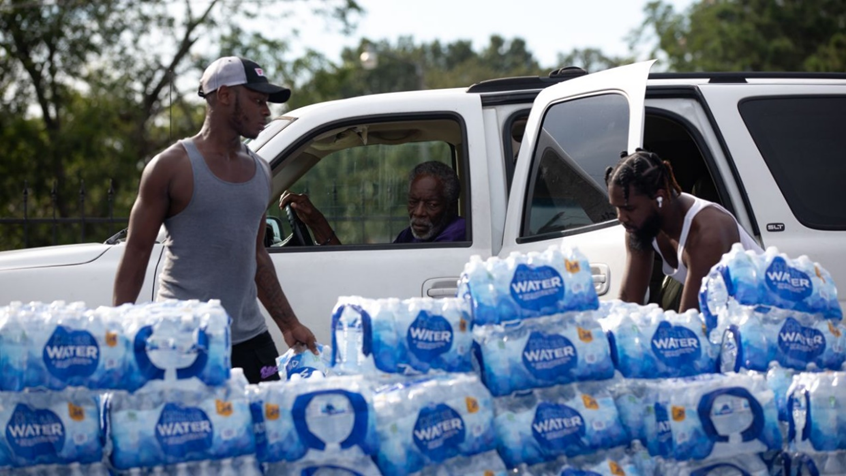
For more than 40 days, many of the 170,000 residents in Jackson, Mississippi were left without potable water to drink. Jackson had already been under a state health department boil-water notice when torrential rain fell in August, flooding the Pearl River and exacerbating shortcomings of the treatment system.
The issues with Jackson's water system have come under scrutiny from state and federal officials for years and though the boil-water advisory has been lifted, the crisis in the city of Jackson isn't over. Mayor Chokwe Antar Lumumba is seeking state and federal help, as repairs to the city's water system are estimated to cost billions of dollars that the city doesn’t have. This crisis highlights the socioeconomic obstacles that many low income communities face. Necessary infrastructure maintenance is often deferred due to costs, and funding to make the long-term investments needed for system modernization often requires federal or state assistance.
This chronic underinvestment in the predominantly Black city's water infrastructure is an example of the environmental racism affecting other communities of color as well. With historic flooding and record droughts stressing water systems across the country, the intensifying threats to aging infrastructure in vulnerable communities need to be addressed. A 2020 study estimates that $2.2 trillion needs to be invested over the next two decades to address the nation's infrastructure shortfalls.
To learn more about the challenges of building and maintaining the costly infrastructure needed to deliver clean water, watch the "And Water For All" documentary.
| |
Tracing Nitrate Sources and Processes with a Combined Isotope Approach at Grand Lake St. Marys Watershed | |
Dr. Zalalem Bedaso from the University of Dayton completed an Ohio Water Resources Center funded project via the Ohio Water Development Authority subaward. This study aimed to identify and quantify the relative contributions of anthropogenic sources of nitrate—including organic and inorganic fertilizers, human wastes, and urban runoff— in the Grand Lake St. Marys (GLSM) watershed.
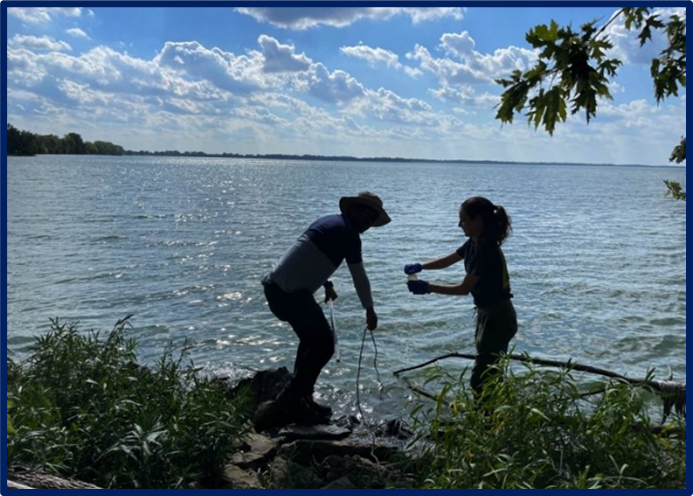
The Grand Lake St. Marys watershed is one of the most nutrient impacted lakes in Ohio. This overabundance of nutrients, such as nitrogen, contributes to harmful algae blooms that disrupt access to drinking water and recreation. Dr. Bedaso’s team used stable isotopes of nitrogen, oxygen and boron to identify sources of nitrate contaminants in the aquatic system and quantify relative contributions from multiple sources. The project involved targeted water and sediment sample collection, as well as isotope lab analysis.
Dr. Bedaso’s results indicate that the primary source of nitrate during the sampling period in the GLSM watershed is manure, which contributed ~77-100% of all nitrate sources in the watershed. These results demonstrate the potential use of the multi-isotope approach to determine nutrient sources and nitrogen transformation processes in the GLSM watershed, providing a regional baseline for nitrate contaminant source tracing and fostering further studies to improve nutrient management decisions and public health policy related to nitrate sources in the Grand Lake St. Marys watershed.
| | | |
USGS Works with Partners in 15 Cities to Improve Urban Waterways | |
The U.S. Geological Survey (USGS) and the Urban Waters Federal Partnership (UWFP) announced that nearly $4 million is being invested to improve water systems and help reconstruct degraded urban riverscapes into cleaner and safer environments. The funds will benefit 22 urban waters projects critical for citizen health and safety, recreation, and economic development in 15 cities.
The 15 sites where the projects are located are part of the Urban Waters Federal Partnership, a coalition of 15 federal agencies working to restore urban waters and the lands that surround them, helping to address economic, public health and environmental priorities. The work includes partnerships with local, state and federal agencies, businesses, nonprofits and philanthropic groups to clean up pollution; spur redevelopment of abandoned properties; promote new businesses; and provide parks and access for boating, swimming, fishing and community gatherings.
For more information and a full list of projects, click here.
| | | |
|
Ohio EPA DDAGW: Proposed Amendments to Four Water Quality Standards (WQS) Rules
The Ohio EPA Division of Drinking and Ground Waters (DDAGW) seeks comments on proposed amendments to four Water Quality Standards (WQS) rules in Ohio Administrative Code Chapter 3745-1. This rulemaking includes the WQS Beneficial Use Designation rules for Hocking river, Little Beaver creek, and Little Miami river, and the Chagrin river drainage basins. There will be a virtual and an in-person public hearing on the rules on October 11, 2022. Registration is available here. Written comments may be submitted via e-mail to ddagw_rulecomments@epa.ohio.gov. All comments must be sent no later than close of business on October 11, 2022.
| |
|
Call for Articles: Ohio Section American Water Works Association (AWWA)
In an effort to highlight members' knowledge, experiences, and achievements, Ohio AWWA is accepting technical articles and success stories. The intent is to highlight this content by including it in the 2022 issues of the Ohio Section Newsletter. Send a request to submit with a synopsis of the article to oawwa@assnoffices.com. Deadline for the winter issue is October 8, 2022.
Call for Abstracts: Emerging Contaminants in the Environment Conference
The Illinois Sustainable Technology Center and Illinois-Indiana Sea Grant are hosting the 2023 Emerging Contaminants in the Environment Conference (ECEC23) and inviting oral and poster presentations. Topics include a variety of emerging contaminant topics such as per-and polyfluoroalkyl substances (PFASs), pharmaceuticals and personal care products (PPCPs), plastic debris and microplastics, algal toxins, agricultural chemicals, and other emerging contaminants. The deadline to submit is November 14, 2022. More information is available here.
Post-doc Opportunity: Colloidal Phosphorous in Western Lake Erie
Drs. Hood and Lenhart at Ohio State are looking for a Postdoctoral Scholar with expertise in aquatic biogeochemistry and spectroscopy to work on a multi-investigator study investigating the sources, fate and transformation of colloidal phosphorous in western Lake Erie and the surrounding watershed. The deadline to apply is October 23, 2022. More information is available here.
| |  |
|
Call for Papers: MDPI Journal of Water Special Issue
The Multidisciplinary Digital Publishing Institute (MDPI) is inviting paper contributions to the Special Issue of the Journal of Water titled “Green Water-Infrastructure Systems: Advances in Research and Technology.” Potential submissions include original research papers, overviews, technology innovations, case studies and articles on topics such as the potential impacts of green water-infrastructure systems, water conservation and more. The submission deadline is February 28, 2023. More information is available here.
Post-Doc Opportunity: USGS Integrated Water Prediction
There are four Mendenhall research fellowship opportunities within the Integrated Water Prediction Program of the Water Mission Area of the U.S. Geological Survey. The research topics include: Advancing co-design of models and data networks, advancing representation of groundwater surface water interaction in regional and national hydrologic models, advancing hydroclimate science for water availability, and integrated water availability modeling. The closing date for applications is November 1, 2022. Information on application requirements is available here.
Post-Doc Opportunity: The Evaluation of Nitrogen Management Outreach and Extension in California
The University of California, Davis (UCD) Center for Environmental Policy and Behavior (CEPB) seeks a post-doctoral scholar to provide leadership a large-scale extension, education, and outreach project on agricultural nitrogen management in California’s Central Valley. More information is available here.
| | |
|
Workshop: Ohio EPA Grant Writing Workshop
October 6, 2022 • Zanesville, OH
Registration is open for a grant writing workshop hosted by the Ohio EPA. Topics include how to find the right funder, approaching different kinds of grant makers, avoiding common mistakes applicants make and developing realistic objectives, activities and budgets.
Workshop: Community-Centered Approaches for Food Systems Transformation
October 13 - 14, 2022 • Columbus, OH
Registration is open for a food sovereignty workshop hosted by the Middle East Studies Center, Global Water Institute, and University Libraries. The workshop will focus on the cultural contexts of local food systems and cross-cultural, community-partnered fieldwork.
WestFest: Ohio State University’s West Campus Science and Sustainability Festival
October 15, 2022 • Columbus, OH
WestFest is an annual public engagement event highlighting STEM research, sustainability initiatives and outreach programs. More information is available here.
Workshop: OWEA/OSWA Watershed Workshop
October 27, 2022 • Dublin, OH
Registration is open for a watershed workshop hosted by OWEA and OSWA. The workshop will focus on regulatory updates, flood mitigation, watershed restoration, and current projects surrounding Ohio watersheds.
| |
|
Get in Touch
Email: OhioWRC@osu.edu
Phone: 614-292-2807
Website: https://wrc.osu.edu
Address: 475 Hitchcock Hall
2070 Neil Avenue
Columbus, OH 43210
Follow us on Twitter
| | |
| | | |