Ohio Water Resources Center Newsletter |
|
As climate change continues to impact the planet in profound ways, extreme weather events are becoming increasingly common. These extreme weather events can have serious consequences on the quality of water sources that directly impact drinking water and ecosystem services.
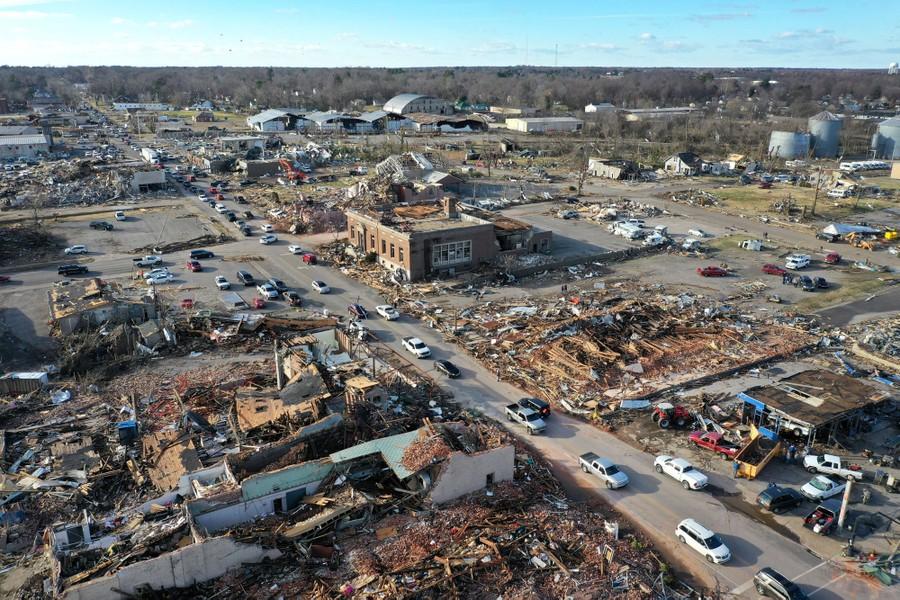
Furthermore, the damage caused during these weather events is costly. According to Davenport (2021), precipitation changes from precipitation extremes have contributed to 36% ($73 billion) of the 1988-to-2017 cumulative US flood damages. Climate models show that anthropogenic climate change has increased the likelihood of heavy precipitation associated with these costs. According to research conducted by the Great Lakes Integrated Sciences Assessments Center, in the Great Lakes region we can expect precipitation to change seasonally. This means more precipitation in the winter and more droughts in the summer. Precipitation in the summer is predicted to be in the form of storm events that could cause heavy flooding. These changes along with others present risks in the Lake Erie area to public health, infrastructure, and tourism. All of these risks can have significant economic impacts. The effect on human life is also significant. In Kentucky, shown in the image on the top right, destruction caused by tornados left residents without access to safe drinking water. In the town of Mayfield, Kentucky there was no running water, the water tower itself was destroyed, and the wastewater management system was crippled. It is critical that new infrastructure being designed and implemented can combat the impacts of increased extreme weather events. As a scientific community, it is incumbent upon us to be prepared to face these new and ongoing challenges that will arise due to climate change.
|
|
Via The Associated Press, December 2, 2021
Via The Wall Street Journal, December 3, 2021
Via Times Reporter, December 7, 2021
Via The Office of Gov. Mike DeWine, December 7, 2021
Via Water Environment Federation, December 20, 2021
Via E&E News, December 20, 2021
Via USGS, December 22, 2021
Via Lexology, December 27, 2021
|
|
Have a news article you'd like us to feature in our Newsletter? Email us at OhioWRC@osu.edu!
|
|
Request for Applications (RFA): National Estuarine Research Reserve Science Collaborative
|
|
The National Estuarine Research Reserve (NERR) Science Collaborative is pleased to announce the Request for Science Transfer Proposals. This grant program supports the co-development and application of relevant and usable knowledge to address critical coastal management issues identified by the NERR System to improve the long-term stewardship of the nation’s estuaries. Proposals are due February 24, 2022. |
|
Request for Applications (RFA): DOE Earth System Modeling Development and Analysis
|
|
RFA for 1) Earth System Model Development (ESMD) and 2) Regional and Global Model Analysis (RGMA). Pre-applications are due January 5, 2022. For more information visit here. |
|
Request for Applications (RFA): US EPA Life-Cycle Analysis to Support Cost-Effective Enhanced Aquifer Recharge
|
|
The U.S. EPA is seeking applications proposing research to develop cost-benefit tools to support the use of Enhanced Aquifer Recharge (EAR) as a viable, safe, and cost-effective water management strategy. For information on eligibility, project specifications, or how to apply, visit here. Applications are due January 13, 2022. |
|
Request for Applications (RFA): US EPA Water Quality Benefits |
|
The U.S EPA is seeking applications for research that will address how measurable attributes of water quality improvements can be valued, either directly or through indicators. Applications are due January 26, 2022. For more information visit here. |
|
Accepting Proposals: CIGLR 2022 Partner Programs |
|
CIGLR is accepting proposals from Regional Consortium Partners for a suite of programs that aim to build collaborative partnerships through career development opportunities, visionary science, and impactful outreach. Please visit the full program announcements for descriptions, eligibility, and application information. |
|
Post-doctoral Research Associate Positions: University of Arizona Water Resources Center |
|
The University of Arizona WRRC will be hiring two post-doctoral research associates into 24-month positions beginning in early 2022. The first position is with the Water RAPIDS (Research and Planning Innovations for Dryland Systems) program. The second position will contribute to multiple WRRC programs, particularly Diversifying Voices in Water Resources (DViWR) and activities related to the WRRC’s outreach to, and engagement in, Arizona’s rural and Tribal communities. |
|
Research Associate Position: Tennessee Water Resources Center
|
|
Research Associate III position open at the Tennessee Water Resources Research Center. Doctoral level position. Job application and further information can be found here. |
|
UCOWR Journal of Contemporary Water Research and Education |
|
The Universities Council on Water Resources is interested in publishing research resulting from 104b and 104g grants in the Journal of Contemporary Water Research and Education (JCWRE). JCWRE is published three times per year (April, August & December) and is available on Wiley Online Library. Manuscripts may be submitted at any time, but should be submitted by February 15 to be considered for the August issue and June 15 for the December issue. More information about JCWRE, including author guidelines, can be found here.
|
|
Call for Abstracts: Emerging Contaminants in the Environment Conference |
|
April 27-28, 2022 • I Hotel and Conference Center in Champaign, IL & Virtual
|
|
Call for Abstracts: One Water Technical Conference |
|
July 25-28, 2022 • Huntington Convention Center in Cleveland, OH
OAWWA and OWEA are excited to announce that the Call for Abstracts for the 2022 One Water Technical Conference has now opened. The deadline to submit is January 15, 2022. |
|
Call for Abstracts: UCOWR/NIWR Annual Water Resources Conference |
|
June 14-16, 2022 • Hyatt Regency in Greenville, SC
Universities Council on Water Resources and National Institutes of Water Resources are inviting you to submit your abstracts with special focus on Water Resilience, to encourage conversations about how watersheds, ecosystems, infrastructure systems, governance structures, and communities can adapt and transform in the face of current and future stressors. Abstracts due January 24, 2022.
|
|
Virtual Harmful Algal Bloom Symposium |
|
January 6-7, 2022 • Virtual
The Algal Bloom Action Team is a collaboration of water professionals, researchers, and educators from twelve states in the North Central Region of the US. This symposium will feature emergent harmful algal bloom (HAB) research and provide a venue for moderated discussions regarding HAB research, outreach, and how information dissemination can be improved. Visit here to register.
|
|
Webinar: UCOWR Roundtable Discussion "Forever Pollutants: Knowledge Gaps, Risks, and Solutions" |
|
January 26, 2022 • Virtual
Universities Council on Water Resources (UCOWR) presents a roundtable discussion centered on "Forever Pollutants: Knowledge Gaps, Risks, and Solutions". This discussion will be facilitated by Nathan Howell from West Texas A&M University's Department of Environmental Engineering. For more information on future sessions and on how to register please visit here.
|
|
Conference: P3 Water Summit |
|
April 7-8, 2022 • San Diego, California
The P3 Water Summit is an opportunity to learn, discuss and share evolving concepts and state-of-the-art techniques in delivering water partnerships. The annual program focuses on drinking water, green infrastructure, wastewater, sanitation, stormwater, resiliency and more. Visit here to register. |
|
Have an event you'd like us to feature in our Newsletter? Email us at OhioWRC@osu.edu!
|
|
Ohio EPA DSW: Maumee Watershed Nutrient TMDL Project |
|
The Maumee Watershed Nutrient Total Maximum Daily Load (TMDL) Project has a goal to reduce harmful algal blooms in order to remove drinking water and recreational impairments to the Lake Erie Shoreline, Open Water and Islands of the Western Basin. Starting in December, Ohio EPA will begin holding monthly webinars to provide updates on the TMDL project development leading up to the release of the draft Preliminary Modeling Results by the end of March 2022. Here is December's webinar.
|
|
Ohio EPA DDGAW: 2022 Revised Drinking Water Monitoring Schedules |
|
The 2022 monitoring schedules will be mailed next week to all public water systems and have also been posted on the Ohio EPA website. A list of laboratories certified to analyze public drinking water samples is located here. |
|
Ohio EPA DSW: Rocky River Draft Loading Analysis Plan |
|
The Rocky River watershed was surveyed in 2014-2015 and assessed for aquatic life and recreation beneficial uses. The results from this survey were used to develop a loading analysis plan for the impaired sites in this watershed. The Rocky River Draft Loading Analysis Plan is available for review and comment, comments are due January 17, 2022. |
|
Email: OhioWRC@osu.edu
Phone: 614-292-2807
Website: https://wrc.osu.edu/
Address: 475 Hitchcock Hall
2070 Neil Avenue
Columbus, OH 43210
|
|
|
|
|
|
|
|