|
As American clockmaking entered the industrial age, exceptional craftsmanship remained the province of individual makers whose skills defied easy classification. Among them was John W. Scott, a clockmaker of uncommon ability whose work reflected both the precision of the artisan and the ingenuity of the inventor. His career unfolded during a period when mass production was reshaping the trade, yet excellence still depended on the hands and judgment of remarkable craftsmen.
Born in Toronto, Canada, Scott was the son of James Scott, an English immigrant from Yorkshire whose journey to America became part family legend, part frontier history. After settling briefly in New York City, James is said to have walked with his three children to Cadiz, Ohio, in 1819, carrying his youngest daughter for much of the journey. There he established Harrison County's first watch and clock shop, introducing a level of mechanical craftsmanship to what was then the western edge of the young republic. A tall clock signed "Cadiz" survives as quiet testimony to his work.
John almost certainly learned his trade beside his father. By the early 1840s, he had relocated to New Lisbon, today's Lisbon, Ohio, where he established his own workshop before later returning to Cadiz under the firm name J. W. Scott & Son.
But to describe Scott simply as a clockmaker would scarcely do him justice. Like many nineteenth-century mechanics, he possessed an insatiable curiosity. He built watches and clocks, manufactured musical instruments, including the unusual melophean, a keyboard instrument operated by foot-powered bellows, worked as a tanner, practiced dentistry, and pursued invention with equal enthusiasm. In an era before specialization, Scott embodied the American artisan whose livelihood depended as much on ingenuity as on skill.
The regulator offered here was almost certainly the finest instrument in his workshop.
A regulator was more than a clock. It served as the standard against which every other clock and watch was adjusted. Customers entrusted their treasured timepieces to it. Every repair, every new movement, every finished watch ultimately answered to the steady beat of the shop regulator. Accuracy was not merely desirable; it was the foundation of a clockmaker's reputation.
Scott built this movement accordingly.
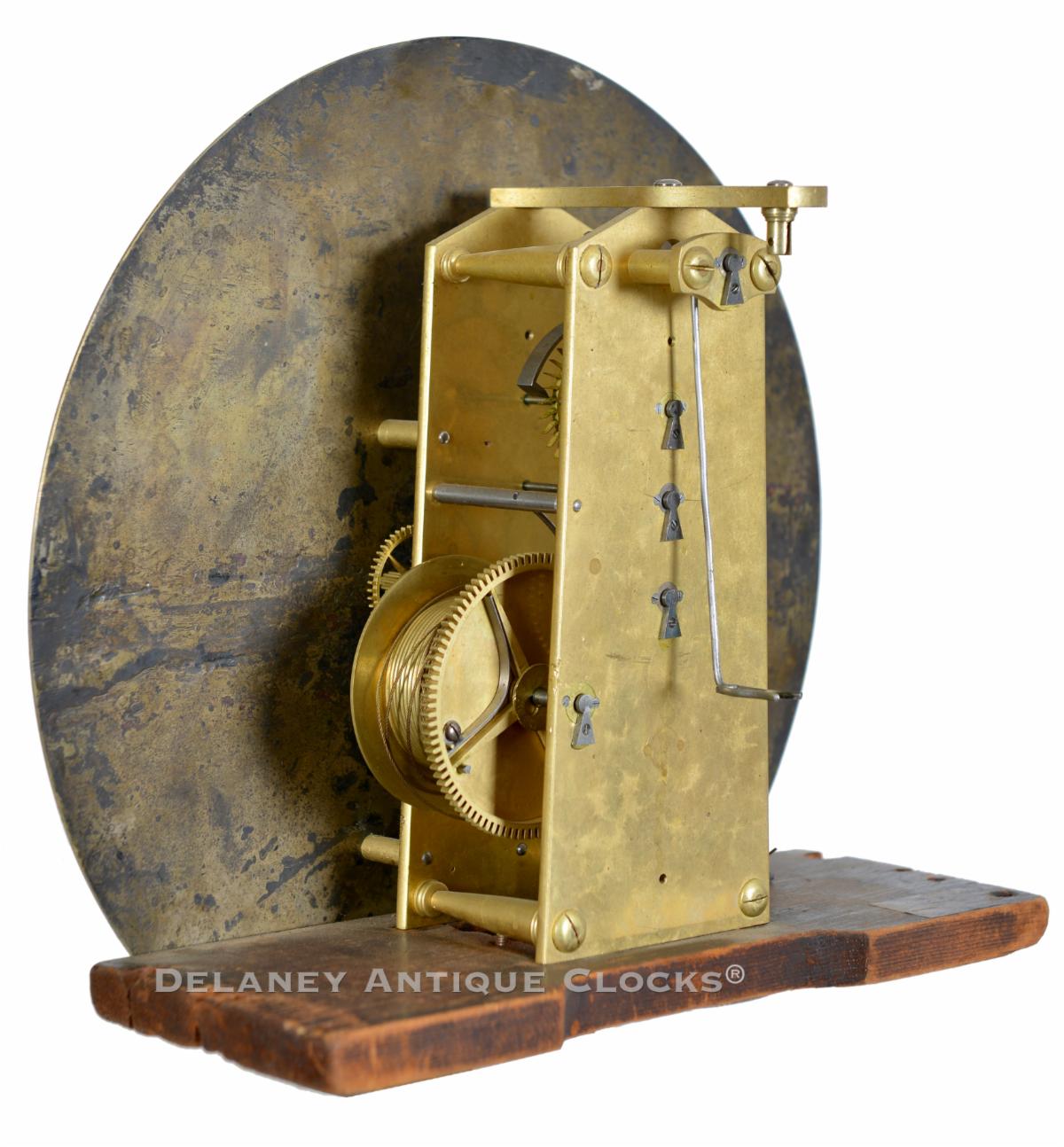
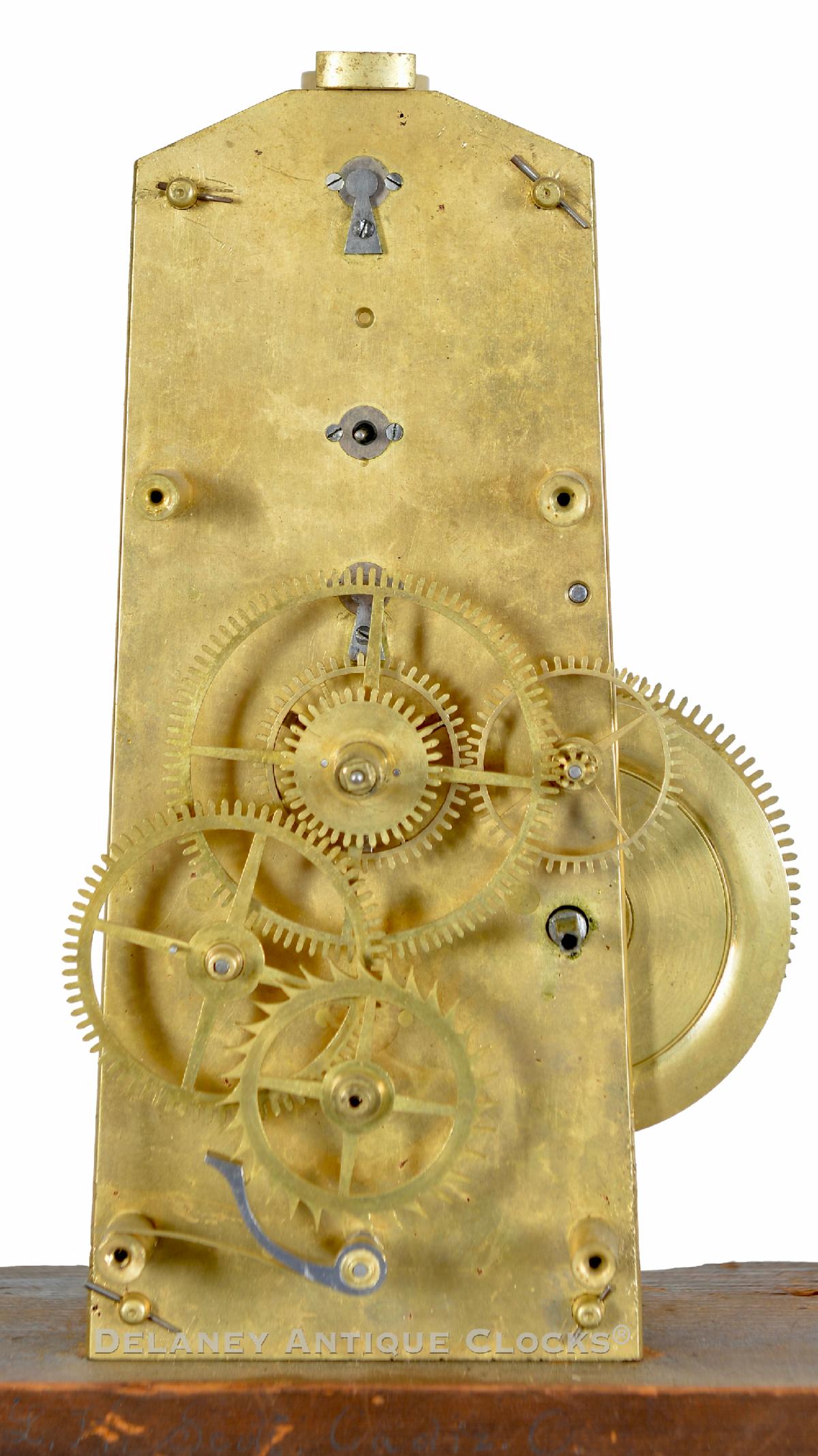
Every element reflects an uncompromising pursuit of precision. The heavy brass plates are carefully finished and joined by elegantly turned pillars. The wheelwork is exceptionally refined, requiring only about two pounds of driving weight to keep the clock running. Bronze bushings protected by steel dust caps reduce wear and preserve lubrication, while a going barrel fitted with retaining power allows the movement to continue driving the train during winding, a sophisticated feature absent from most American tall clocks of the period.
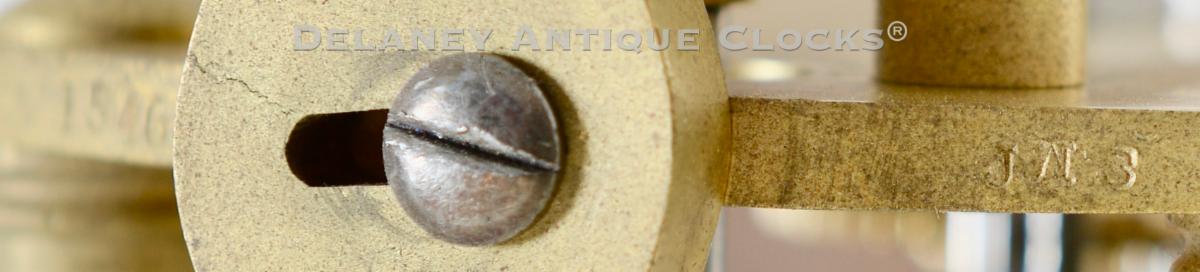
The top of the back plate bears Scott's die-stamped initials, "JWS," together with the number 1546. Rather than a serial number, it may record the date of completion: January 5, 1846. If so, it places the clock squarely within Scott's productive years in New Lisbon.
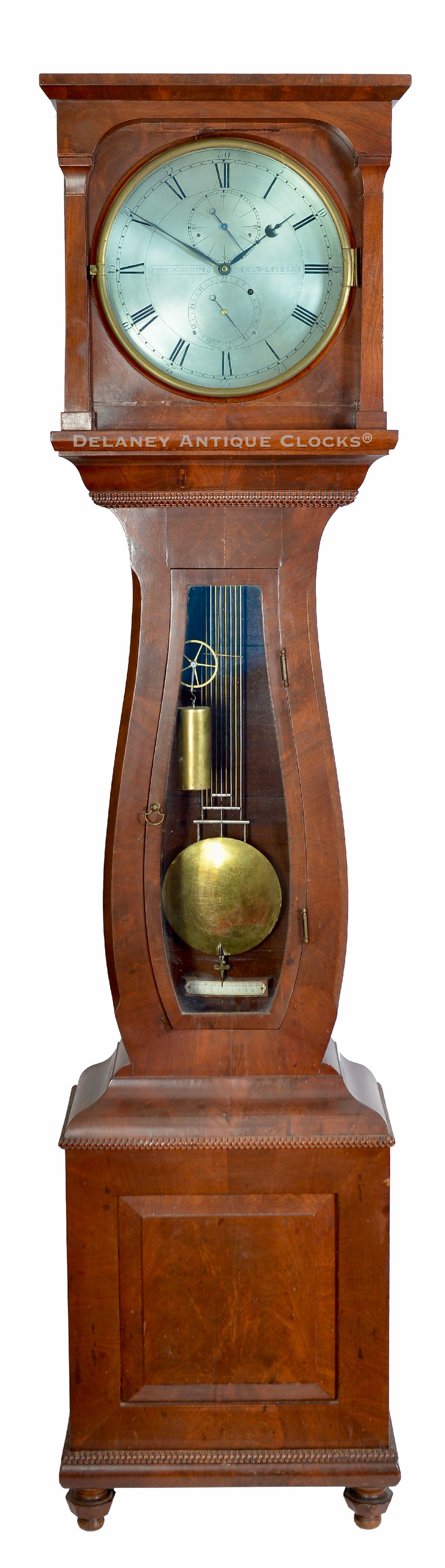
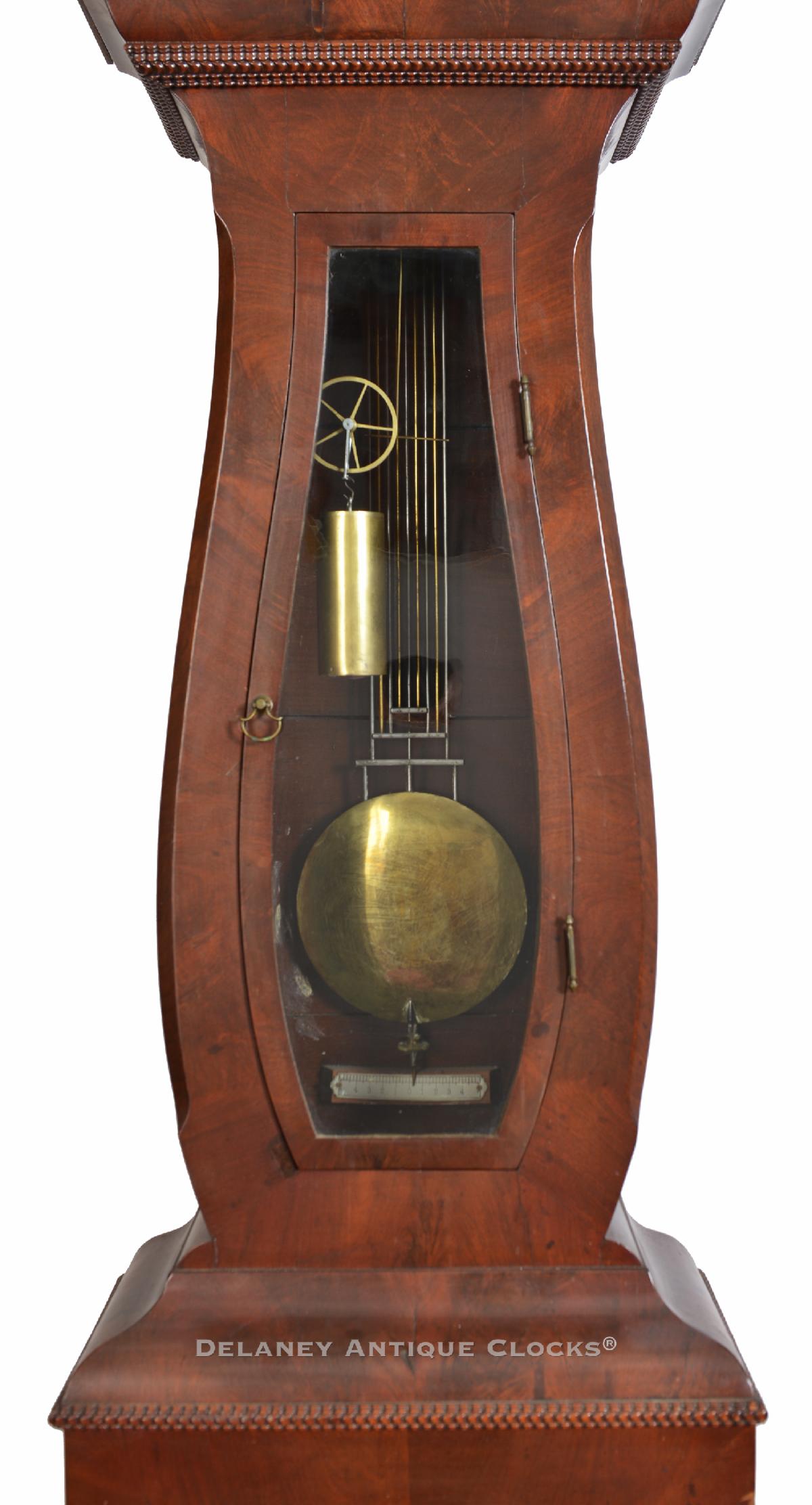
Its precision was further enhanced through some of the greatest innovations in horology. The movement employs the deadbeat escapement developed by George Graham, eliminating the slight recoil found in ordinary escapements and allowing the gear train to stop cleanly with every beat of the pendulum. The pendulum itself follows the celebrated gridiron design invented by John Harrison, combining alternating brass and steel rods to compensate for seasonal temperature changes. The result is a remarkably stable rate, precisely the quality demanded of a regulator responsible for setting every other clock in the shop.
Curiously, the movement shares numerous construction details with several known regulators signed by Christopher Harber Strieby, suggesting an intriguing but unresolved relationship between the two makers. Yet Scott's die-stamped initials leave little doubt about the authorship of this movement, making it one of the strongest documented examples of his work.
The case is every bit as ambitious as the mechanism it houses.
Veneered in richly figured mahogany, it possesses a quiet architectural confidence. Dramatic crotch mahogany enlivens the broad surfaces, while deep ripple moldings articulate the transitions between base, waist, and hood. The gracefully tapered waist, resembling a harp or a droplet of water, draws the eye upward toward a restrained hood framed by applied columns beneath a flat cornice. Rather than competing with the movement, the cabinet celebrates it.
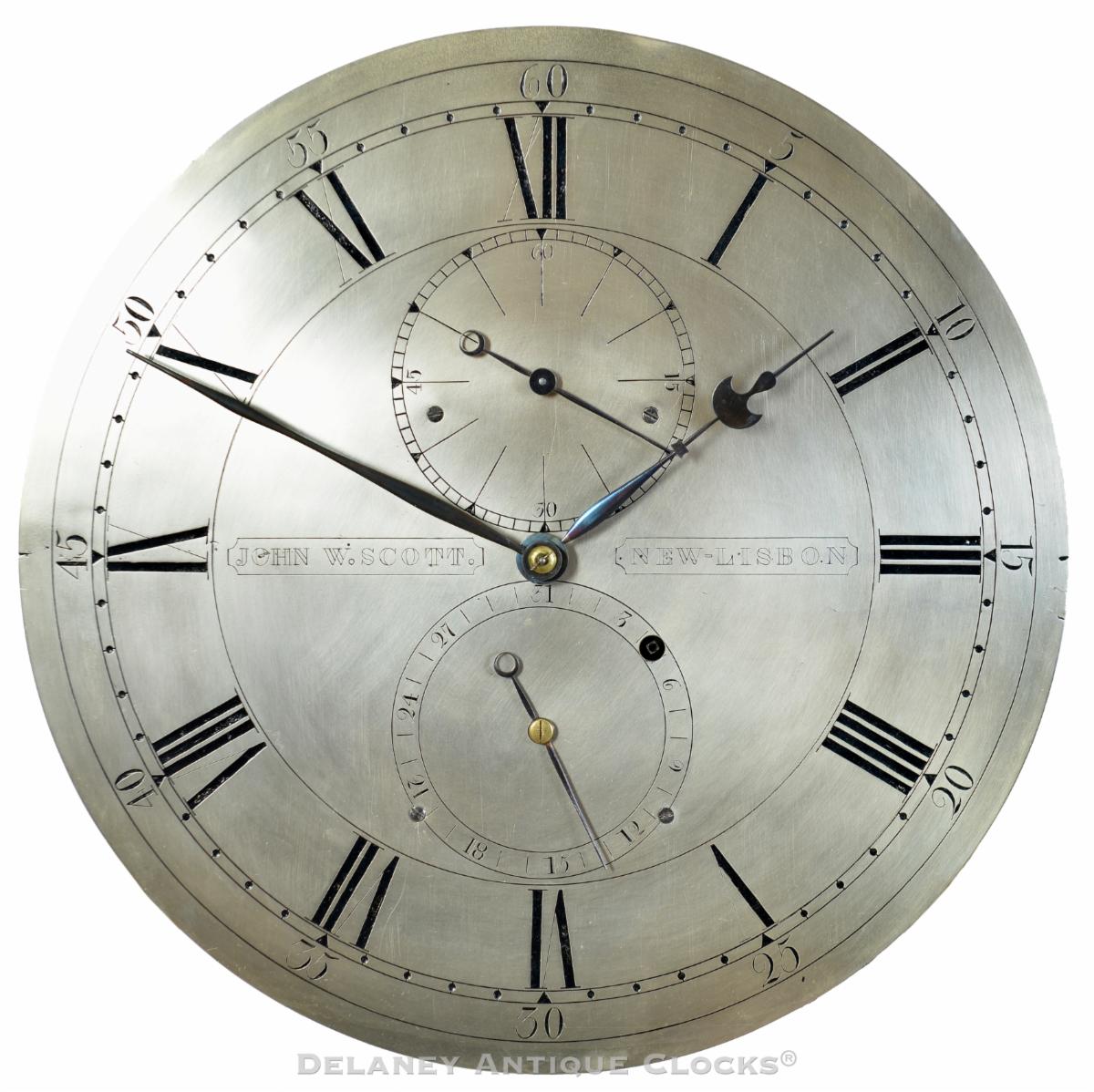
Behind the glazed brass bezel lies a finely engraved silvered dial signed "John W. Scott" and "New Lisbon." Subsidiary dials display the running seconds and calendar date, while four delicately blued steel hands provide a visual elegance equal to the movement's mechanical sophistication.
Standing nearly seven feet tall, this regulator represents far more than an exceptional nineteenth-century clock. It is the surviving work of a craftsman whose life mirrored the optimism and inventiveness of early America, a period when a single individual could be a clockmaker, musician, inventor, dentist, and entrepreneur all at once. Built to measure time, it remains a testament to the remarkable breadth of skill that flourished in the nation's workshops.
Height 6' 10 1/2" Width 19 3/4", Depth 10 1/2"
Inventory 226090
|