|
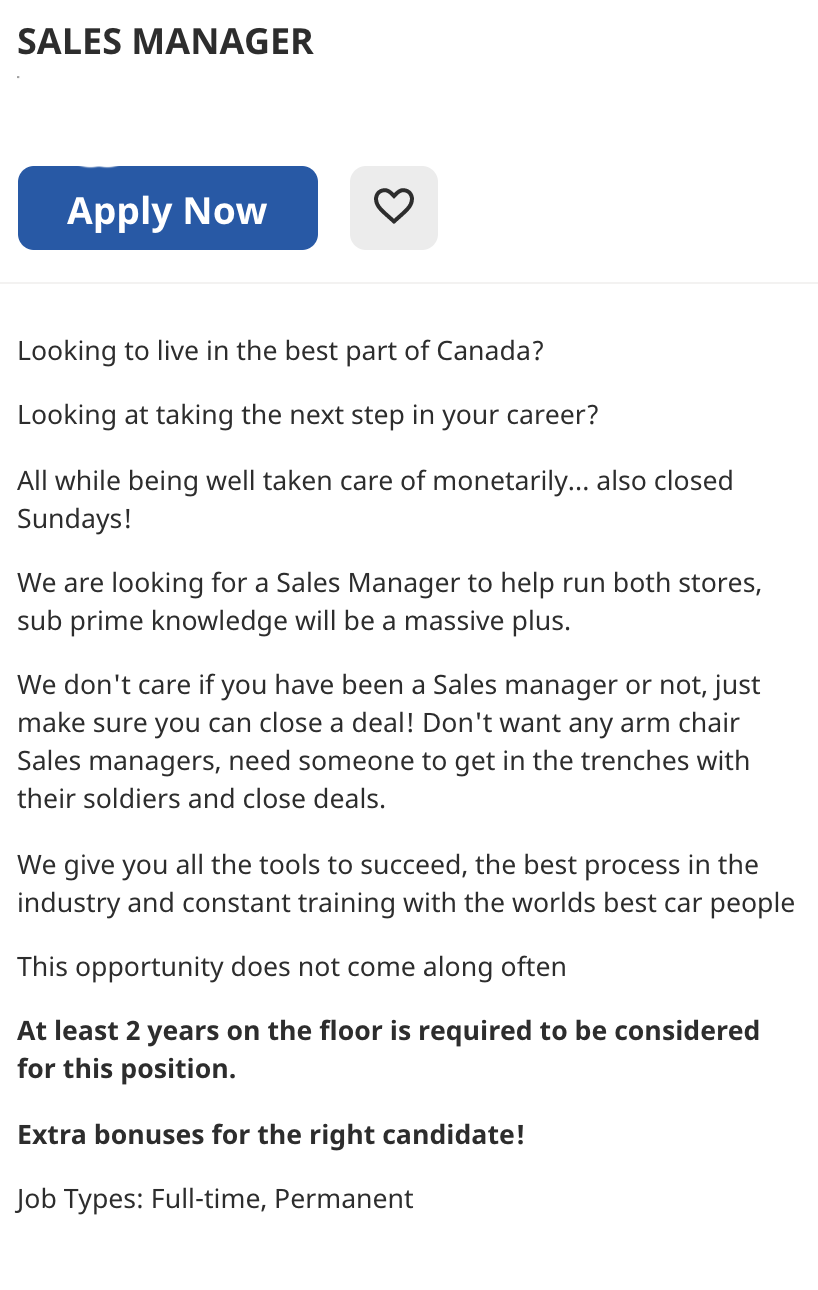
One of my wife’s well-meaning friends sent me this job posting the other day - she knew my contract with Porsche was up at the end of the summer and thought that I might be interested. This was for somebody to run the showrooms of a Kia and Chrysler dealership in BC, but it could have been anywhere. Even with the promise of healthy compensation my first reaction was, ‘Ugh’.
I write about Hyundai/Kia quite a bit, and they are shaping themselves up to be one of the major players in the new EV paradigm. Their E-GMP platform is state-of-the-art with 800V electrics, bi-directional charging, as well as multiple battery sizes and two or four wheel drive. There is the Hyundai Ionic 5, the Kia EV6, and there will be Genesis version as well. Hyundai bought into Rimac with Porsche, and currently owns 12%. Rimac is working on some ‘N’ versions for their cars (Hyundai’s version of a AMG/M Series). They are really putting a serious effort into their cars, and I’m certain they will take a major slice of the EV market.
But what is buying one going to be like? The EV demographic at the moment contains a high percentage of physicians and academics. At least half are female. All are smart. Probably none are going to want to deal with the guy this dealership hires!
The job ad isn’t asking for the smartest person, the most experienced person, the most educated person, the person with the best track record for customer satisfaction or skill at handling problems - and education doesn’t even come up. They are looking for the ‘closer’. The most aggressive person. The one who wants to be ‘in the trenches with his soldiers’. What customer wants to be on the receiving end of that?
It takes about 2 minutes to buy a Tesla on your phone. About the same time as walking out of the Kia dealership and into your car - and that’s exactly what will happen.
The salesperson/sales manager hard-close dealership sales model is old and will disappear for the simple reason that the vast majority of customers hate it. Every EV start up, and many of the legacy automakers, are now selling their EV’s on line. For volume cars, most of the people that I talk to know exactly what they want and would rather buy the car without going to a car dealer or talking to a salesperson. Most of the time it is a cumbersome, error-filled (never in your favour) and frustrating process.
It is better with the luxury dealers. There are often long-time employees (though fewer every year) who are given stable jobs and give good service. Most are well trained. Many have the authority to write their own deals without the intervention of a closing manager. Often the Dealer-Principal is on-site and approachable. The cars are generally more complicated and can be confusing to order. There is a legitimate benefit to establishing a relationship with a helpful salesperson who can give good information and advice. When trust can be built, the service can be excellent.
I recall one elderly-and very rich-lady telling me the story of getting her new car. She had been driving her Mercedes Station Wagon for something like 15 years and she was perfectly happy with it. But it started to give some trouble and stranded her. She picked up the phone, called a Dealer she knew, and said indignantly, “Oh, just get me a new car!”. A new Volvo was delivered to her house the next day.
That kind of personal service doesn’t translate well to on-line sales. There are lots of high-end customers who just want to come in and sign the paperwork and hand over a cheque and expect the dealer to handle everything for them. Many will run out of patience pretty quick if asked to sit in front of the computer and navigate an elaborate on-line purchase. A Telsa has maybe ten things you need to choose to order a car, a Porsche probably has over one hundred, and you don’t get a friendly “are you sure you want to do that” when you make a resale-killing mistake.
I think the question that manufacturers and dealers have to ask themselves is whether their salespeople add any value to the process - as the customer sees it. My admittedly unscientific polling suggests that most often they don’t. If that’s the case then move the process on-line. Spend a portion of the money you save on commissions on better on-line photos, videos, and instructional tutorials. The dealership will still need ‘presenters’ and staff to organize test drives and appraise trade-ins, but these positions need not be commission-based.
Remember, Tesla took their sales model from Apple - now its hard to find a commission salesperson when you shop for electronics. It can’t be a coincidence that two companies with the highest market capitalization use similar sales models. If you don’t think this can apply to used cars, take a look at what CARVANA has accomplished.
For manufacturers committed to on-line sales, it probably makes sense to adopt some sort of ‘concierge’ service to cater to people who are more comfortable talking to a (helpful) person rather than typing on a computer. On-line sales, especially for major purchases, don’t suit everybody and this is mainly a function of age: younger people are more comfortable buying on-line.
For the dealers that want to invest in a high quality sales process that a customer would actually want to sit through, remember that the customer wants to be helped, not pressured. If you do a good job, they will usually buy the car. Being helpful in the first place will yield a higher closing ratio than doing a poor job and then harassing the customer after they leave. Sounds obvious, but my own recent tour of Calgary dealerships looking for an EV revealed dismal product knowledge and basic incompetence. I had one guy tell me I really didn’t want a Golf E because the resale was so poor. I said, “OK fine, I’ll look for a used one then”. I didn’t come in the store to get in an argument...
The worst high-pressure sales floors happen when the manufacturer is chasing volume and ships the dealers too many cars- especially when there are multiple dealers in a certain market. If the dealer gets the right type of cars, and the right quantity of them for their market, they can relax a little bit - sales will happen organically. If they get overloaded with the wrong cars, that’s when everybody gets desperate and the whole sales process goes to hell. The incentives come out, and the pressure increases, particularly when the cars aren’t competitive. The desperation to ‘close’ anybody who walks in the door intensifies as you don’t want the customers going home and reading the reviews. The dealers then look at the ‘sub-prime’ market - selling high interest car loans to people with bad credit - as a way to shift the inventory. This is not the environment to launch your new premium EV.
Dealer inventories are at extremely low levels right now due to a computer chip shortage and other supply chain issues caused by the Pandemic. This is an opportunity for a ‘re-set’ for dealers and manufactures to re-assess volume targets and inventory levels. Everybody has a lot of work to do if they are to change the public perception that buying a car is painful and frustrating. It should be fun.
|