50 Years in Connecticut: From YMCA Intern to Co-Founder of Two Companies and an Active Community Leader | Paddi LeShane, Co-Founder & CEO | | | | I came to Connecticut as a college senior, thinking I’d be here for just a year. My internship at the Middletown YMCA was supposed to be a pit stop. Instead, it became the launch pad for a career—and a life—that has kept me in Connecticut for 50 years. | | |
I was recruited from my alma mater, Springfield College, to serve as the adviser to the YMCA’s new youth leadership program. As an urban development major with plans to become a city planner, I was eager to get started. One of the group’s members, future UConn basketball star Corny Thompson, was already known across town as a basketball standout, but he was also a student in need of direction. Corny would wander into the YMCA gym whenever the high school was closed, joining men’s pick-up games or shooting hoops with friends.
One day, I had to clear the gym because of ongoing construction. The teens were not happy. That night, as I walked out to my car, I was stunned to discover it missing — until the security team and I found my yellow VW Type 3 fastback carefully “parked” on the upper patio outside the swimming pool entrance. In the distance, we heard laughter and the sound of sneakers sprinting away.
It was my first lesson in leadership: speak softly and carry a big stick. The boys were banned from pick-up basketball for two weeks, and the men who usually played insisted the young scamps leave me handwritten apologies. From then on, we became friends.
What I remember most, though, isn’t the prank. It was the way Corny grew into leadership: mentoring younger kids, organizing fundraisers, and proving that discipline on the court could translate into discipline in life. Watching him, I realized that leadership is built through small, steady acts of showing up. That lesson has guided me ever since.
At the same time, Connecticut itself was teaching me lessons. Just before I arrived, Ella Grasso became the first woman in the U.S. elected governor in her own right. The Blizzard of ’78 reminded us that crises reveal character. A few years later, a bridge located in the heart of traffic-ridden Greenwich collapsed and created Connecticut’s worst nightmare, filled with sadness for the lives that were lost and the communities that were now hosting the hundreds of thousands of cars and trucks once found on I-95, the busiest interstate highway between Boston and NYC. Around that time, the medical community identified Lyme Disease—a discovery that put our state on the map in another unexpected way.
My career evolved alongside the state’s story. In 1983, together with Patrick Sullivan—who later became my husband—we co-founded a government relations firm to help businesses and organizations navigate state and local decision-making. In 1988, we launched a second venture — a strategic communications firm serving regional and statewide organizations. By then, Connecticut was on the national stage in ways both inspiring and heartbreaking. Senator Joe Lieberman became the first Jewish American on a major-party presidential ticket. The Cheshire home invasion and the Sandy Hook tragedy forced us to confront questions of justice and safety. Superstorm Sandy exposed vulnerabilities in our infrastructure, as did the infamous Halloween snowstorm of 2011. Each of these moments underscored the need for communications rooted in honesty and empathy when the stakes are highest.
In the early 1990s, when Governor Lowell Weicker introduced the income tax, every business in Connecticut had to rethink its bottom line. Foxwoods and Mohegan Sun came into being and reshaped the economy. And the rise — and eventual resignation — of Governor John Rowland underscored the importance of public trust. Our job was to help clients interpret these shifts and act with clarity and transparency.
The decades since have brought more change: among them, GE’s relocation of its headquarters from Fairfield to out of state, the COVID-19 pandemic, and the ongoing challenge of keeping Connecticut competitive for the next generation of businesses and workers.
Through it all, one constant has remained: Connecticut reinvents itself. That resilience—and the opportunities it created—is why I stayed.
Fifty years after walking into the Middletown YMCA, I see a clear path. Invest in people. Believe in their potential. Build bridges between policy, business, and community. That young man’s leadership journey in Middletown mirrors what I’ve witnessed across Connecticut: talent, discipline, and heart, all waiting to be harnessed.
I’m proud to have co-led two respected companies that help organizations navigate complexity and raise their voices. But more than that, I’m proud to call Connecticut home—a place that has shaped me as much as I’ve tried to shape it.
As Connecticut looks ahead to its next chapter, I’m convinced the same principles still matter: clarity, trust, and leadership rooted in action. That’s the lesson I learned from Corny, from the YMCA, from my early jobs, and from five decades of living and working in this state.
I can’t help but wonder what new events will unfold—and how they will shape the next generation of Connecticut leaders, just as this state has shaped me.
| | Meet the Media: Q&A with Jim Altman, Fox 61 | | Dan Tapper, Senior Director | | |
Jim Altman has been with Fox 61 since 2005 and, in those 20-years, has become synonymous with award-winning television journalism. A 54-time Emmy Award winner as well as the recipient of the prestigious national Edward R. Murrow Award for newswriting, Jim has become one of Connecticut’s most recognized and respected television journalists. He is also noted for lending his time and talent to a number of charitable organizations and events in Connecticut, including Hartford’s Camp Courant, the Hometown Foundation, the Muscular Dystrophy Association, and the Parkinson’s Foundation.
You’ve become a very familiar and well-known television journalist in our market for 20+ years. While you’re not from Connecticut, you’ve chosen to stay here and build your career. What caused you to stay?
| | | |
It’s a great question, because when I got here nearly 21 years ago, I figured I’d stay for one three-year contract and move on. As I became entrenched in my community and my contact list became more fortified, I realized that Central Connecticut was a great place to be. Our station was allowing me to cover topics that I found interesting to report on and, from a living perspective, the fit was right. Geographically, the Greater Hartford area is close to where a lot of my family is – New York City and Washington, DC.
You have become very popular for finding unique stories and creating more long-form features, and viewers have always responded well. What about stories like these that appeal to you and your viewers?
I think coming from the world of newsmagazines – I spent nearly a decade at ABC News 20/20 as an associate producer – is what has given me the foundation to report on stories that might have added layers and texture. I’ve also found that Connecticut has a good story around every corner – once you make connections, more people want to share their stories.
Is there one story in particular that has stood out to you, that you truly enjoyed doing because it was unique and you knew would be meaningful for viewers?
So many – too many to single out. I particularly love to report on the tales of the perennial underdogs. In recent years there have been a lot of examples, but my tag team partner, Fox 61 photographer Sean McKeever, and I found a story about a 90-year-old golfer named John Casolo. John was getting out once or twice a week with his friends to hit the links. As if swinging the clubs as a 90-year-old great-grandfather wasn’t enough, John happened to be completely blind. It always helps when the story subject is full of personality, and John couldn’t have been more telegenic and effervescent.
Among the other stories I’ve been energized by has been coverage of the Connecticut SWAT Challenge. We covered it in its very first year, 2005, when it was a small-time backwater event. The most rewarding part of covering this topic year after year was watching the steady growth and evolution of the SWAT Challenge, which now brings in teams from across North America. The event today is as much about camaraderie as it is about the high-tension competition.
You have also become a very familiar presence with a number of charitable events, lending your talents as an event host and emcee. Why is this so important to you?
I think this largely comes down to how I was brought up. My father was a children’s surgeon and dedicated his life to making sure families were made whole again, making sure kids were cured of what ailments they were fighting. While I wasn’t exactly headed down the medical path, I did want to make sure I used the platform I’ve been given to try and better the community around me and help to amplify their messages. You certainly don’t want me to perform surgery on you – but a live auction for a charity? I can do that!
Finally, media is obviously changing – newsrooms are getting smaller, reporters are being tasked with having to cover more to make up for smaller staffs while social media platforms have had an increased presence. What has this done to your role as a television journalist and how have you managed to thrive despite the added challenge?
Our business is rapidly changing, but what business isn’t? At the heart of this, the one thing that hopefully remains constant is the need for good content. How that content is consumed is changing – that’s fine. Good content can be effective on a 75-inch 4k TV, but it can still work well on your phone screen. We are experiencing a new approach to covering news, but the current management at Fox 61 still encourages me to continue to cover the types of content that I have for the past 20 years. Watch it on your TV, your iPhone, or your Apple Watch – we just want it to resonate, to compel, and, whenever possible, to inspire.
| | Tips and Tricks: Now you’re talking! So be sure not to trip on your tongue with misused words and phrases | | |
Brian Flaherty, Executive Vice President
“You keep using that word. I do not think it means what you think it means."
- Inigo Montoya -
| | | | |
Nothing can instantly undermine a presentation or speech as devastatingly as a misused word or phrase. You could be the world’s foremost authority on a topic, have an audience in front of you, whether in a conference room, a shop floor, or a Rotary Club lunch, and undermine yourself instantly by tripping on your tongue by saying “for all intensive purposes.”
We work with our clients to hone their best messages and coach them to deliver them with confidence, often in a public setting or a radio, TV, or print interview. Here are some of the most cringe worthy examples that I’ve heard of misused words and phrases—any of which, once heard, is impossible for many in your audience to forget.
| | |
Misused phrase vs. Correct phrase
“For all intensive purposes.” vs. “For all intents and purposes.”
“I was taken back.” (Really, back where?) vs. “I was taken aback.” (Surprised.)
“Averse circumstances.” (Averse means against.) vs. “Adverse circumstances.” (Tough sledding.)
“Flush out.” (What hunters do to scare birds into the open.) vs. “Flesh out.” (As in, build out a plan or idea.)
“Irregardless.” (No need for the double negative.) vs. “Regardless.” (That’s it!)
“The situation was fraught.” (Fraught with what? It means filled with.) vs. “Fraught with peril.” (Stick the landing with a bang!)
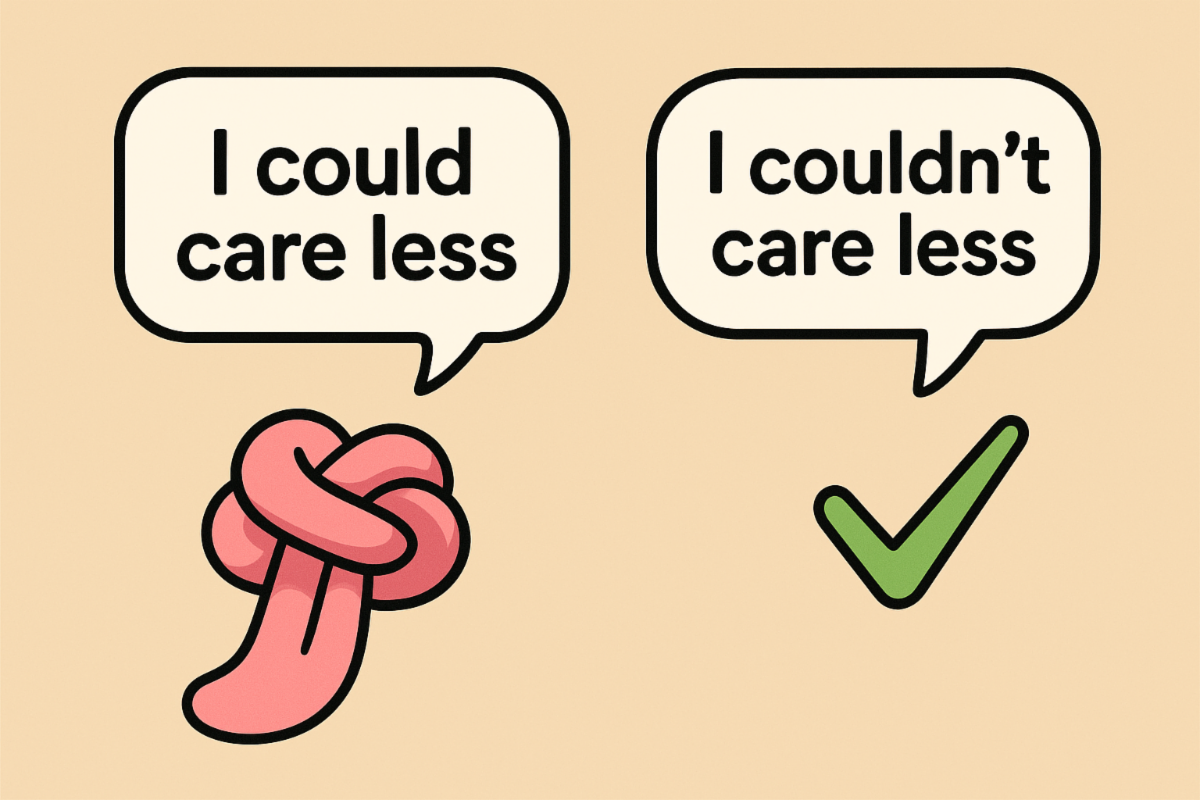
“I could care less.” (So, you actually care more?) vs. “I couldn’t care less.” (Much stronger.)
The best way to avoid malapropisms like these is also the same way to Carnegie Hall: practice, practice, practice. Master your material by talking it through out loud. Silently flipping through your slides or speech notes may help you remember what you have to say, but reading and remembering are not speaking.
Walk it through. Talk it through. The second or third time, you’ll find that you’re able to hit a natural cadence and flow. You’ll likely re-arrange a point or two, you’ll be better on transitions, and hearing yourself will help you find a confident, crisp tone. That way, should you decide to turn a phrase or two, you’ll be more likely to root out the ones that could trip you up!
| | Case In Point: VRSim's Digital Newsletter Reimagined | | Randi Sussman, Public Relations Associate | | |
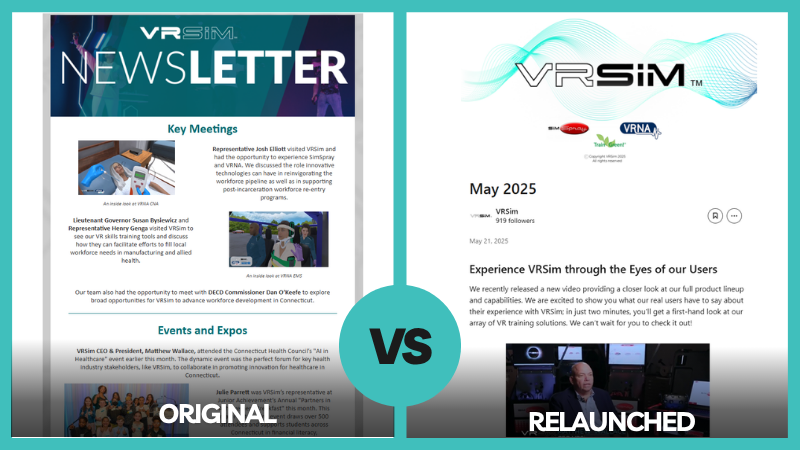
In 2023, VRSim, a provider of virtual reality simulation, asked Sullivan & LeShane Public Relations (SLPR) to help launch a digital newsletter. We were excited to jump in and collaborate closely with their marketing team to develop and share content through Constant Contact.
However, after eleven editions, the newsletter wasn’t making the impact we had hoped. It did not fail, but it didn’t meet all our expectations. We weren’t able to grow our email list. Therefore, we ended the newsletter to reassess the situation.
In May 2025, VRSim and SLPR relaunched the newsletter on LinkedIn, a platform we chose to leverage VRSim’s existing professional network and increase visibility and engagement.
This second attempt, guided by a careful focus on driving engagement, clicks, and comments, proved successful. Subscribers grew from 142 in May to 249 in August — a 75% increase in just four months. Engagement clicks remained steady, and the newsletter consistently outperformed industry averages for both click-through and email open rates. As a team, we couldn’t be more proud of the success of this platform, and we are energized to keep building on this momentum.
This is a great example of how the right platform, paired with the right strategy, can turn a good idea into lasting impact.
| | |
Sullivan & LeShane Public Relations, Inc. | (860) 560-0001 | www.ctpr.com | | | | | |