When Speaking Out Works—and When It Backfires | |
Paddi LeShane, Co-Founder & CEO
In today's hyperconnected world, more and more CEOs are stepping out from behind the boardroom table to speak directly on social, employee, and environmental issues. This wave of CEO activism reflects a growing public expectation that business leaders play a role in shaping society—not just managing their companies.
| | |
Support among Gen Z is even stronger. Surveys show that 89% expect CEOs to lead on employee issues, 82% on climate issues, and 81% on combating discrimination. For many younger consumers and employees, corporate engagement is no longer viewed as optional—it is expected.
But while the opportunity is real, so is the risk.
What the Research Tells Us
Studies from the European Corporate Governance Institute suggest that a CEO's activist stance can influence stock prices by signaling a company's values, culture, and long-term direction. Other academic research has found a positive relationship between CEO activism and investor behavior, reflecting a growing expectation that leaders take positions on issues that affect their stakeholders.
Customer response, however, is far less predictable. Research from Harvard Business School and Cornell University shows that activism aligned with customer beliefs can increase purchase intent and brand loyalty. Yet when positions become polarizing, those gains can quickly disappear—or even reverse.
The lesson is straightforward: authenticity and alignment matter.
When a public stance reflects a company's mission, culture, and long-standing values, it can strengthen trust and reinforce brand identity. When it appears opportunistic, reactive, or disconnected from the organization's actions, it can damage credibility and invite scrutiny.
When It Works: Tim Cook and Apple
A frequently cited example is Apple CEO Tim Cook's opposition to Indiana's Religious Freedom Restoration Act (RFRA), a law that critics argued could permit discrimination against LGBTQ individuals.
Cook's position was notable not only because he spoke out, but because it aligned with Apple's established commitment to inclusion and diversity. Research later found that support for the legislation dropped significantly when respondents learned of Cook's opposition, demonstrating that corporate leaders can influence public opinion much like elected officials.
Equally important, Apple's reputation remained strong. Purchase intent increased among supporters of same-sex marriage, while there was little measurable downside among those who disagreed.
Why did it work?
Authenticity — The position reflected both Cook's personal convictions and Apple's corporate values.
Consistency — Apple's support for LGBTQ rights was already well established.
Credibility — The company's actions matched its public statements.
A Few Practical Guidelines
For CEOs considering whether to engage publicly, communications professionals generally focus on several best practices:
- Align positions with your company's mission and values.
- Speak from conviction, supported by facts and transparency.
- Make engagement part of your brand purpose, not a publicity strategy.
- Consider the interests of employees, customers, investors, and partners.
- Balance tone and timing carefully—inform and inspire rather than provoke.
- Remain consistent over time; credibility is built through sustained commitment, not one-time statements.
In an era when audiences—especially younger ones—expect organizations to stand for something, silence can speak as loudly as words. Speaking out without preparation can create unnecessary risk, but avoiding important conversations altogether may leave a company disconnected from the people it serves.
The most effective leaders approach engagement as a discipline. They listen first, weigh the risks and rewards, and act with consistency and authenticity. Whether choosing to speak out or exercise restraint, staying attuned to key stakeholders is no longer optional.
Values are not what we say they are. Values are what we do when it matters.
| | Meet the Media: Q&A with Melissa Sheketoff of WICC 600 AM/95.9 FM | | |
Dan Tapper, Senior Director
Melissa Sheketoff is the host and executive producer of Melissa in the Morning on WICC 600AM / 95.9FM. She has worked with Connoisseur Media since 2018, providing news for both WICC and WEBE 108. Prior to radio, she was a television reporter and anchor beginning in 2012. In its inaugural awards year, the Connecticut Broadcasters Association named Melissa in the Morning Best Radio Talk Show in 2024. She has also earned Connecticut and New York Press Club Awards and received a New York Emmy nomination for her reporting.
What made you want to go into a career in radio in the first place?
| | | |
I grew up with a younger brother on the autism spectrum. So often in childhood, he felt misunderstood and without a voice. I was that sibling who wasn’t afraid to stand up to bullies or face consequences for advocating for him. I realized as I got older, that’s a passion and skill I wanted to hone in on professionally. It led me to journalism. As a news talk show host, I have the ability to have in-depth conversations getting to the core of issues; asking questions that come from people who feel like they are not heard or need more support. It drives me to create the content I do for my show every day.
Radio news has changed considerably over the past two decades, but as your show on WICC indicates, there is still a strong need for it among people in the community. What do you see as the most important aspects of local radio?
A big reason why I left the television industry was that I could see the shift becoming less local-driven with more focus on national content and opinion-related topics. Local radio is providing that town hall update most people don’t know about, but desperately need to know about. Local and live radio is providing real conversations in real time, not recorded, which is true and coming from the mouths of our politicians and local leaders. Local radio is one of the only outlets left that holds the hands of listeners each day and addresses what matters to them. Local radio keeps people connected to the community and keeps our feet grounded in reality. It’s easy to watch national news, listen to syndicated podcasts, or watch TikTok videos and feel like you’re “in the know.” But you are not. Local radio is your neighbor, your colleague, your classmate, your friend, your community partner. You can’t find that in most other media outlets.
How has social media and the digital world impacted your role in radio?
Social media has definitely made the job of accurate journalism harder. For every video posted online, we have to triple-check if the source is credible and the information is accurate. And that’s only half the battle…then you need to convince the audience that what they are reading or seeing may not be true, and the importance of doing research. The digital world has a lot of positives to it. But I fear a big gap in education today involves digital literacy. We don’t check sources, we don’t have open minds to all sides of a story, and we don’t know how to identify something as fact or opinion. That’s a problem! It’s a problem beyond even a radio host; as a society, we need to recognize this and start doing better with taking in information from the digital world and acting appropriately to it.
What are the favorite kinds of interviews you like to conduct? What do you find most enjoyable about your job?
Honestly, I love doing interviews that spark change. One of my biggest claims to fame on WICC was my coverage of Success Village in Bridgeport and Stratford. For those who don’t know, that’s a massive housing complex that was experiencing no hot water and heat for a long time. There were also management and financial issues we uncovered as I dug into the story more. My favorite interviews in the two years I’ve covered it were live on-air moments that are authentic and truthful for the audience. An interviewee admitting something, getting caught in a lie or discovering something in real time. Those conversations led to major changes for the complex. I love moments like that, not because of ratings, but because I know I did my job effectively and it helped 2,000+ people who were being ignored for too long.
Finally, a public relations question. What are the kinds of story/interview pitches that work best for you? What advice would you give public relations professionals looking to pitch you an idea?
I care about local. You tell me what about your pitch impacts the average Connecticut resident. I’m not a gimmicky show. I love perspectives on topics that matter to my listeners. I love connecting my listeners with organizations or experts who can shed light on topics that matter. Think about what you talk to your family and friends about…what matters to you? That’s how you should frame a pitch to a news talk radio host. If you’re an attorney who has covered cases of government money theft across the country, but you can provide expertise about a case happening in Connecticut impacting taxpayers, pitch me THAT! Don’t pitch all your accolades as a law firm and why people should hire you. Become an expert and share knowledge with listeners. It’s a better interview; it builds trust and ultimately may even land you more clients, too. But my biggest focus is my listeners' needs; I’m not really here to please anyone else’s agendas.
| | Tips and Tricks: Right Story. Right Outlet. Right Audience. | | Brian Flaherty, Executive Vice President | | |
Some lessons you learn by accident.
When I was a press secretary in the state Senate eons ago, a colleague once sent the same press release to the Associated Press, the Hartford Courant, and a weekly paper in his senator’s district. The AP ignored it: too narrow. The Courant buried it: too remote. The weekly paper put it on the front page.
By making that mistake, he accidentally did something right. He found exactly who needed to read the story.
Connecticut's media landscape rewards precision. Each outlet has a different reader or listener. And that reader matters as much as the outlet itself.
| | | | The Hartford Courant, the nation’s oldest continuously published newspaper, has a marquee statewide profile and a focus on Hartford and surrounding towns. The Connecticut Mirror and CT News Junkie are what legislators, advocates, policymakers, and political insiders are scrolling on their phones. The Hearst Connecticut Media newspapers reach audiences from lower Fairfield County to Waterbury, New Haven, Middletown, and beyond. They are the largest collection of dailies in the state, with a strong online and weekly presence. Meanwhile, the Hartford Business Journal (HBJ) is the go-to source for Connecticut business news, tracking industry trends, leadership changes, and economic developments. HBJ has expanded its coverage into Fairfield County and hosts numerous events throughout the year that bring together leading business professionals, creating a valuable opportunity for networking and visibility. | | |
CT Public and WNPR reach thoughtful, civically engaged listeners across the state, and WTIC AM’s “Brian & Company” morning drive-time show is jam-packed with newsmakers looking to access its self-named “50,000-watt flamethrower” signal.
Here's a test we give our clients: Who actually needs to hear this story? If the answer is the business community, pitch the HBJ. If the answer is legislators and policy advocates, that's the Courant, CT Mirror, News Junkie, and Hearst. And if the answer is the people who show up at planning and zoning meetings and town council hearings—the neighbors who will actually live with the outcome of your proposed development project—pitch a local paper, and don’t overlook the Patch. That's their front page, and it's the one they read.
Know your audience first. The right outlet will follow.
| | Case in Point: The Cows Came Home — and So Did the Funding | | |
Randi Sussman, Senior Manager, Integrated Communications
At the beginning of 2026, the Connecticut Dairy Farmers approached Sullivan & LeShane Public Relations (SLPR) to complement their legislative advocacy efforts with a strategic public relations campaign. Connecticut's dairy industry has experienced a more than 25% decline in just seven years, falling from 108 operating dairy farms to fewer than 80 today. Farmers have been facing significant challenges, including volatile milk pricing, rising input costs, and growing economic uncertainty.
Sometimes, public relations is not just about the messaging, but the people behind it. Connecticut dairy farmers had a compelling story to tell—from the impact on food banks and farmers' markets across the state to preserving Connecticut's rural landscape, supporting agricultural education and youth programs, and sustaining traditions like 4-H and agricultural fairs. Their willingness to share their experiences helped people better understand what was at stake, not only for the dairy industry but for Connecticut agriculture as a whole.
Drawing on our experience supporting organizations navigating public policy issues, our team worked closely with the Connecticut Dairy Farmers and their lobbying team to develop key messages and raise awareness of the challenges facing the industry. We connected farmers with media outlets across the state, providing opportunities for them to share firsthand how these pressures were affecting their businesses, families, and communities.
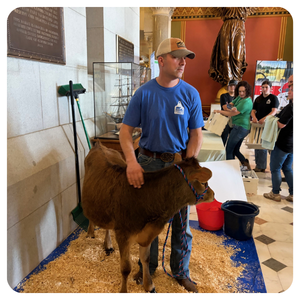
| | The farmers' willingness to speak openly about their experiences played a critical role in the campaign's success. Throughout the legislative session, which ran from February through early May, SLPR secured more than a dozen prominent media placements and responded to ongoing interview requests that helped keep the issue in front of legislators, state agencies, and the Governor's Office. At the same time, the lobbying team organized a “Dairy Day” at the Capitol, complete with a live calf that attracted hundreds of visitors to displays highlighting the challenges facing Connecticut dairy farms and the consequences of continued farm closures. The event generated significant attention from lawmakers, the public, and the media, helping maintain momentum around the issue. | | | |
The farmers' willingness to speak openly about their experiences played a critical role in the campaign's success. Throughout the legislative session, which ran from February through early May, SLPR secured more than a dozen prominent media placements and responded to ongoing interview requests that helped keep the issue in front of legislators, state agencies, and the Governor's Office. At the same time, the lobbying team organized a “Dairy Day” at the Capitol, complete with a live calf that attracted hundreds of visitors to displays highlighting the challenges facing Connecticut dairy farms and the consequences of continued farm closures. The event generated significant attention from lawmakers, the public, and the media, helping maintain momentum around the issue.
Working alongside the organization's legislative efforts, this sustained media coverage helped shine a spotlight on the challenges facing Connecticut dairy farmers and build support for action. In May, Governor Ned Lamont announced a plan to provide $22.5 million in aid to Connecticut dairy farmers, offering much-needed relief as farmers continue to navigate tariff impacts, federally regulated milk pricing, and rising operating costs.
Take a look at some of the media coverage that helped Connecticut dairy farmers tell their story and raise awareness of the challenges facing the industry:
| | |
Sullivan & LeShane Public Relations, Inc. | (860) 560-0001 | www.ctpr.com | | | | | |