|
The UWM Research Foundation has announced the latest recipients of its Bridge Grant Program, which provides vital early-stage funding to help UWM-affiliated startups move promising technologies closer to market. This year’s awardees are tackling ambitious challenges: from safer menopause treatments and lightweight drone components, to robotic arms that restore independence for wheelchair users and a cancer therapy that targets tumors with precision. Supported by the WEDC Capital Catalyst Program and generous contributions from Dennis and Susan Webb and Christina and Karl Fiasca, these grants help advance high-potential research into real-world solutions.
Estrigenix Therapeutics is developing innovative treatments for menopause symptoms—hot flashes, memory loss, and bone decline—without the cancer and stroke risks of traditional hormone therapies. Their lead compounds target an estrogen receptor to deliver safer relief. With Bridge grant funding, Estrigenix will generate essential data on bone density and blood clotting to meet investor requirements and move toward FDA approval. The company plans to license its technology following early clinical trials.
Intelligent Composites is improving drone engine performance with ultra-light, high-strength aluminum composites. Their cylinder liners—just one-third the weight of iron—boost fuel efficiency, reduce emissions, and extend range. Following successful testing and strong industry interest, the company is now developing advanced liners for hybrid engines. With Bridge grant support, they will accelerate testing and secure production contracts to meet growing demand for U.S.-sourced drone components.
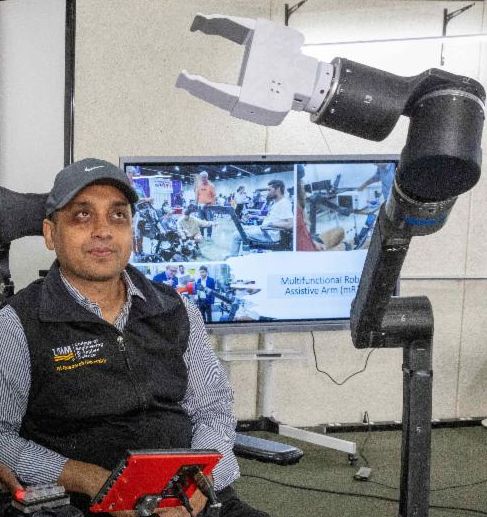
RoboHeal Innovations is helping powered wheelchair users regain independence with its robotic assistive arm (mR2A), designed to support daily tasks like eating and opening doors. Developed at UWM’s BioRobotics Lab, the mR2A uses intuitive controls such as eye-gaze and chin joysticks. Bridge grant funding will support go-to-market planning, distributor partnerships, and regulatory strategy—positioning the company for future investment and commercialization.
SynXT Therapeutics is developing a novel cancer therapy that combines ROS-activated prodrugs with high-dose vitamin C to selectively destroy cancer cells while sparing healthy tissue. In preclinical models of triple-negative breast cancer, the approach has shown complete tumor regression. With Bridge grant support, SynXT will generate pivotal safety and efficacy data in advanced animal models and continue advancing a low-toxicity alternative to chemotherapy.
|