On the Move | Q4 | October 2, 2025 | | On the Move: Your Quarterly Transportation News & Updates in Northern Colorado | | |
In This Issue:
- Updates from the North Front Range MPO
- Building Our Region's Future—Together
- 2026 Freight Northern Colorado (FNC) Plan Updates
- 2025 Summer Outreach Summary
- Budgeting for Your Commute
- 2025 Coordinated Plan Update
- Updates from our Partner Agencies
- RAQC: Air Quality Updates in the Region
- NHTSA: October is National Pedestrian Safety Month, Drivers Urged to Protect Pedestrians
- CDOT: Choose a Sober Ride Every Time
- GoNoCo34 TMO: Become a TMO Member
- Get Involved!
Read on for the latest transportation updates in the North Front Range.
| | North Front Range MPO Updates | | Building Our Region's Future—Together | | |
Dear North Front Range Community,
I’m honored and excited to introduce myself as the new Executive Director of the North Front Range Metropolitan Planning Organization (NFRMPO).
As someone who has dedicated my career to transportation planning and community development, I’m deeply passionate about the role our region plays in shaping a stronger, more connected future—not just for ourselves, but for the generations that follow. The North Front Range is a dynamic and rapidly growing area, and I believe that through thoughtful planning and strong partnerships, we can create communities that are not only functional and resilient, but truly livable for everyone.
The work of the NFRMPO is about more than roads, buses, and bike paths—it’s about regional vision. It’s about asking: What kind of communities do we want to leave behind for our children and grandchildren? And then doing the hard, collaborative work to make that vision a reality.
I am committed to listening, learning, and leading with transparency and intention. I look forward to working alongside our member communities, state and federal partners, and all of you—residents, business owners, advocates, and future thinkers—who care deeply about where we’re headed.
Together, we can plan for a future that reflects our shared values: sustainability, equity, innovation, and connection. I welcome your ideas, your insights, and your partnership as we move forward.
Thank you for the warm welcome. I’m thrilled to be part of this region and this mission.
With gratitude,
Elizabeth Relford
NFRMPO Executive Director
| | 2026 Freight Northern Colorado (FNC) Plan Updates | | |
The NFRMPO is currently working on a new version of the Freight Northern Colorado Plan (FNC), anticipated to be adopted in Spring 2026. This Plan will guide the improvement of freight movement across the North Front Range. Freight movement includes trucks, delivery vehicles, rail, aviation, pipelines, and commercial micromobility. While the NFRMPO, its member agencies, and other planning partners have conducted various projects and corridor-specific studies and reports, FNC will provide a holistic view of the freight industry and positions the region to pursue funds for a variety of freight-benefiting projects.
The 2026 Freight Northern Colorado Public Survey is still open through the end of the year! Make your voice heard on freight transportation planning in the region. A freight stakeholder survey will be sent to respective parties soon. You can explore more freight information and resources at nfrmpo.org/freight.
| | 2025 Summer Outreach Summary | | |
Between April and September, NFRMPO and RideNoCo staff attended 12 events and co-hosted six Bike to Work Day Stations around the region. During the events, MPO staff interacted with 1,648 community members across 11 communities and discussed transit, air quality, bike and pedestrian trails, mobility options, and transportation safety. These discussions allowed NFRMPO staff to learn about transportation needs and concerns in the region, and community members to learn something new about transportation in Northern Colorado.
For more information about the NFRMPO’s public outreach, check out the 2022 Public Involvement Plan or the NFRMPO Public Involvement webpage. To see when and where the NFRMPO staff will be, including community events and public meetings, check out the NFRMPO Calendar.
| | Budgeting for Your Commute | | |
One of the important factors in considering your commuting options is cost. And while it’s easy to add up your fuel costs in each week or month this, unfortunately, doesn’t encompass all that should be included. So, this quarter, we’re going to jump into some math—seems fitting as school is back in session.
According to an Argonne National Lab report, for the first five years of owning a vehicle, maintenance and repairs should be established at .101 per mile. Using that as a baseline, let’s assume a Ft. Collins to Denver commute five days a week at 114 miles round trip. This breaks down to $11.51 per day, $57.57 per week, or $230.28 per month.
That’s $230.28 per month and we’ve not added the cost of fuel yet. So, let’s do that.
According to the U.S. Department of Energy, a 2025 Toyota Corolla gets 41 mpg, highway driving. That would be 2.78 gallons on our assumed round trip. At $2.73 per gallon, that’s $7.58 per day, $37.95 per week, or $151.79 per month.
So, combining maintenance, repairs, and fuel we have a monthly commute cost of $382.07.
This is assuming you’re never taking the express lane and your parking is free downtown. There are various other factors unaccounted for here as well, but I’m just seeking a simple and innocuous dollar amount.
Commuting alone: $382.07 that can vary based on vehicles and fuel costs.
The VanGo™ monthly fare for Ft. Collins to Denver: $246 fixed (inclusive of fuel, repairs, maintenance, insurance, a guaranteed ride home in case of emergencies, shared driving so you’re not driving every day, and use of the HOV 3+ lanes fee free with 3+ riders).
Commuting with VanGo™, using simple math, equates to a savings of $136.07 per month, or $1632.84 a year. Money saved which can be used for more enjoyable things than your commute.
So, what are you waiting for? Find a route today at VanGo™ Vanpools.
Sincerely,
Shane Armstrong , CAFM
Operations & Fleet Manager
| | 2025 Coordinated Plan Update | | |
The Coordinated Plan is updated every four years, incorporating input from the public, stakeholders, the Mobility Committees, and the Planning Council. For additional context, the Coordinated Plan is a requirement for projects receiving Federal Transit Administration 5310 funds that serve older adults, individuals with disabilities, and low-income individuals.
The Coordinated Plan emphasizes mobility for older adults, individuals with disabilities, low-income adults, and underserved communities. It considers mobility from all its aspects, aiming to take a comprehensive approach and support providers, advocates, and stakeholders to improve at every level.
The public involvement and survey for the 2025 Coordinated Plan concluded at the end of August 2025. The NRMPO received approximately 17 survey responses, participated in over 30 outreach events, and delivered 34 presentations to various Committees, Boards, Councils, Commissions, and stakeholders across the region. The image above displays a Joint Northern Colorado Mobility Committee and Boulder Mobility and Access Coalition meeting, featuring a presentation by Mobility Planner Aaron Hull on the 2025 Coordinated Plan and RideNoCo.
The NFRMPO engaged in many productive discussions about mobility in the region through various public outreach efforts. The NFRMPO received valuable feedback on service gaps and suggestions for addressing them from these outreach efforts. Some of the feedback is summarized below:
Common Service Gaps:
- New developments needing transportation support
- Improved connections between communities and the region
- Enhanced support in rural areas
- Assistance with last-minute transportation needs
- Support for temporarily disabled individuals
- Increased awareness and outreach
- More affordable transportation
Suggested Solutions:
- Creating a volunteer pooling program to connect better those needing help and those willing to assist
- Developing a volunteer medical chaperone program for temporarily disabled individuals
- Establishing an emergency fund to provide support when needed at the last minute
- Expanding current services to fill gaps, such as in rural areas, new developments, and offering weekend or late-night services
The feedback received during outreach efforts will be incorporated into the 2025 Coordinated Plan. This plan is currently under review by the NFRMPO Staff, the Mobility Committees, stakeholders, and service providers before it is presented to and reviewed by the NFRMPO’s Planning Council in November.
If you have any comments, questions, or want to discuss the 2025 Coordinated Plan, please contact the Mobility Planner at the NFRMPO, Aaron Hull, at ahull@nfrmpo.org or (970) 672-0677.
| | RAQC: Air Quality Updates in the Region | | |
New Study to Better Understand Causes of Ozone in the Region
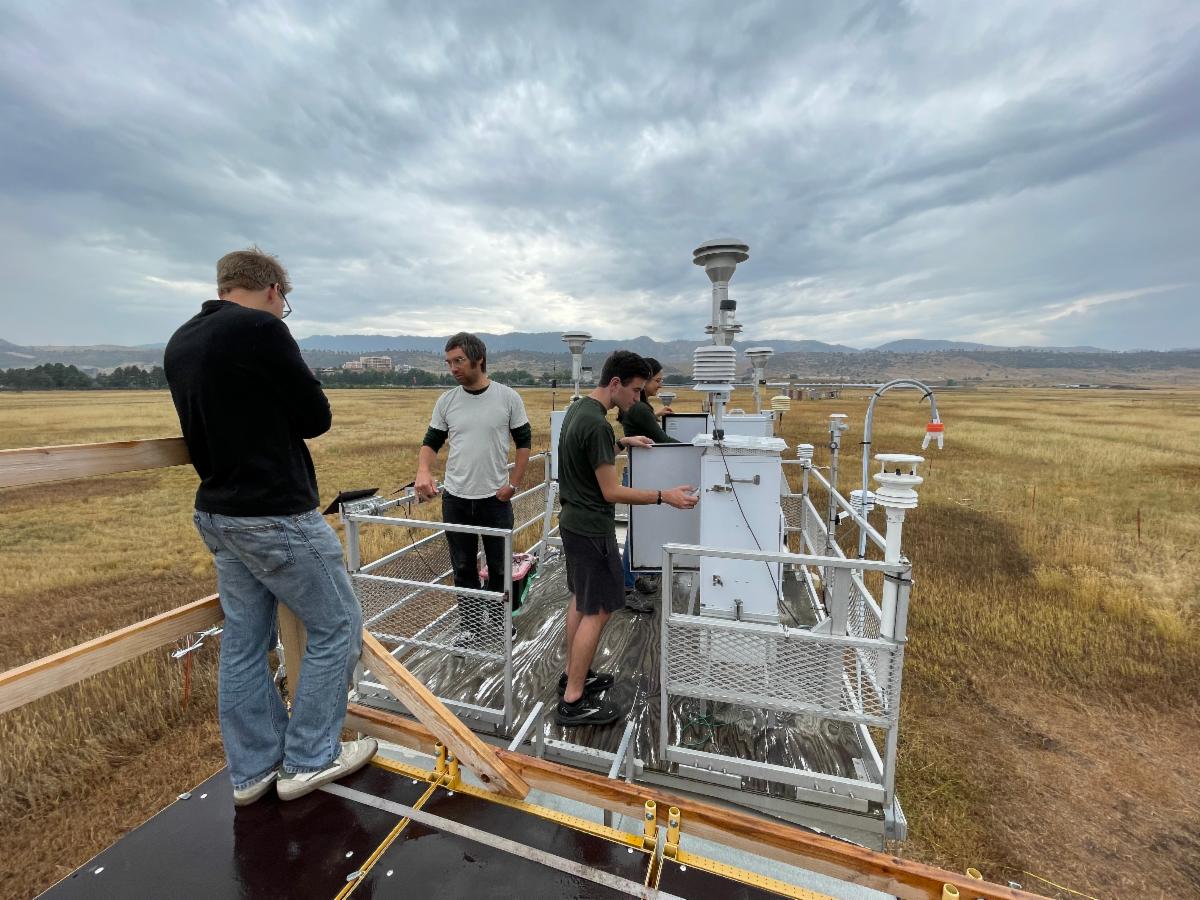
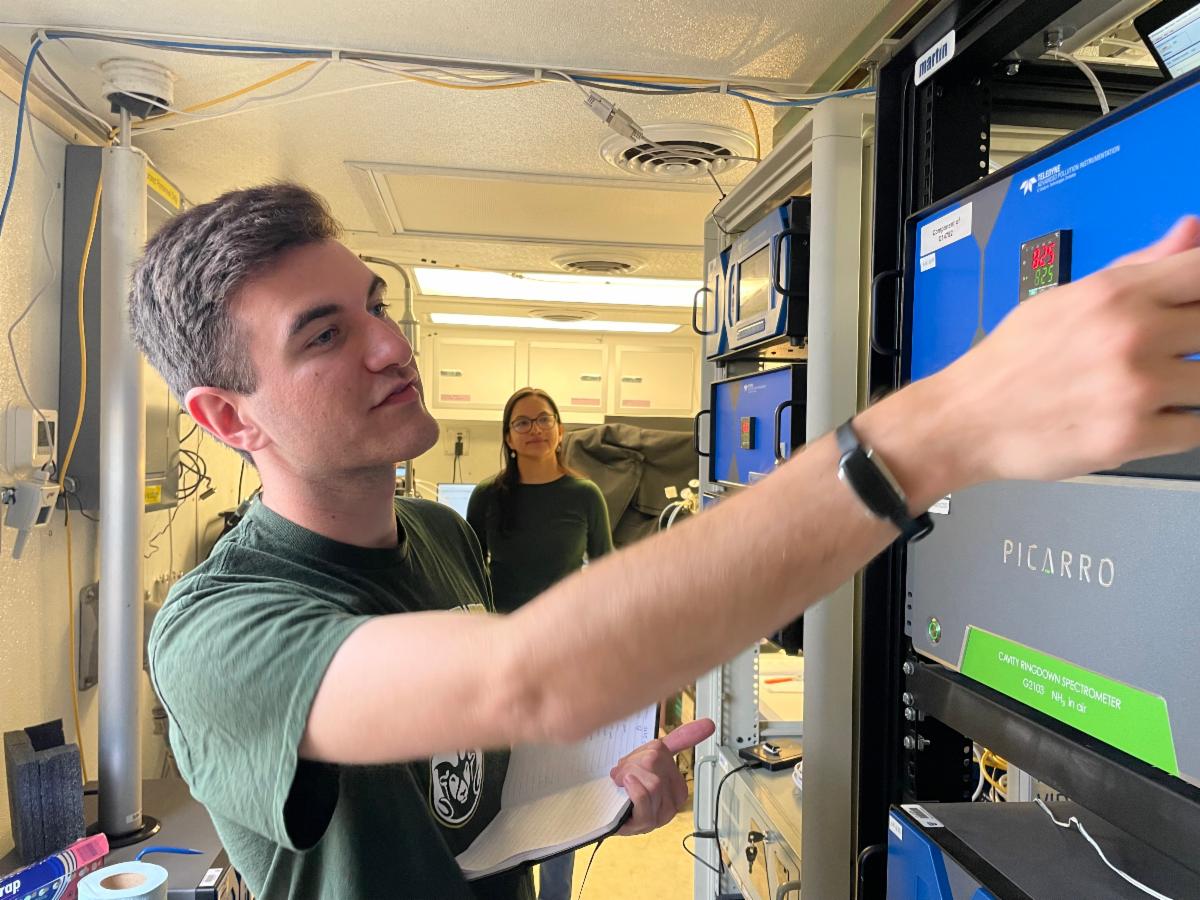
To support air quality planning in our region to achieve the ozone air quality health standards, the state’s Air Quality Enterprise awarded funds for a comprehensive scientific field study. The Regional Air Quality Council (RAQC), Colorado State University’s Atmospheric Sciences Department and the Colorado Air Pollution Control Division’s Technical Services Program partnered with a major air quality field study during Summer 2025. The atmospheric data will then be analyzed and modeled in 2026-27 to improve understanding of ozone formation and source contributions for future air quality planning.
New Grant to Expand Programs Across the Nonattainment Region
This summer, Colorado’s Nonattainment Area Air Pollution Mitigation Enterprise (NAAPME) board approved an application from the Regional Air Quality Council (RAQC) to the Community Clean Transportation Assistance Grant Funding Program. Being awarded this grant provides the opportunity for RAQC to expand the Clean Air Auto Repair, Engines Off, Accessible Bikes for Community, and Simple Steps. Better Air. programs throughout the full nine-county ozone nonattainment region. We look forward to working with our partners in the North Front Range on these efforts and serving our communities with this additional funding in 2026 and beyond!
‘Blueprint’ Process for Air Pollution Strategies Continues
RAQC is developing a proposed strategic framework for air pollution control strategy options for the next five years to achieve cleaner air and comply with ozone air quality health standards. The RAQC’s Control Strategy Blueprint page has detailed information about the entire Blueprint process, including supporting documents for proposed strategies, stakeholder outreach efforts, and previous versions of the Blueprint and strategy exploration.
During the Blueprint development process, RAQC convenes conversations with stakeholders from industry, local government, environmental advocacy groups, and interested citizens about a variety of air pollution control strategies to help bring the region’s air quality into compliance with Environmental Protection Agency standards for ground-level ozone. The October board, Control Strategy Committee, and Indirect Sources Work Group meetings are opportunities to provide input. Go to the RAQC calendar for dates and more information.
| | NHTSA: October is National Pedestrian Safety Month, Drivers Urged to Protect Pedestrians | | |
October is National Pedestrian Safety Month, and the U.S. Department of Transportation’s National Highway Traffic Safety Administration (NHTSA) is urging drivers to slow down and be alert for pedestrians.
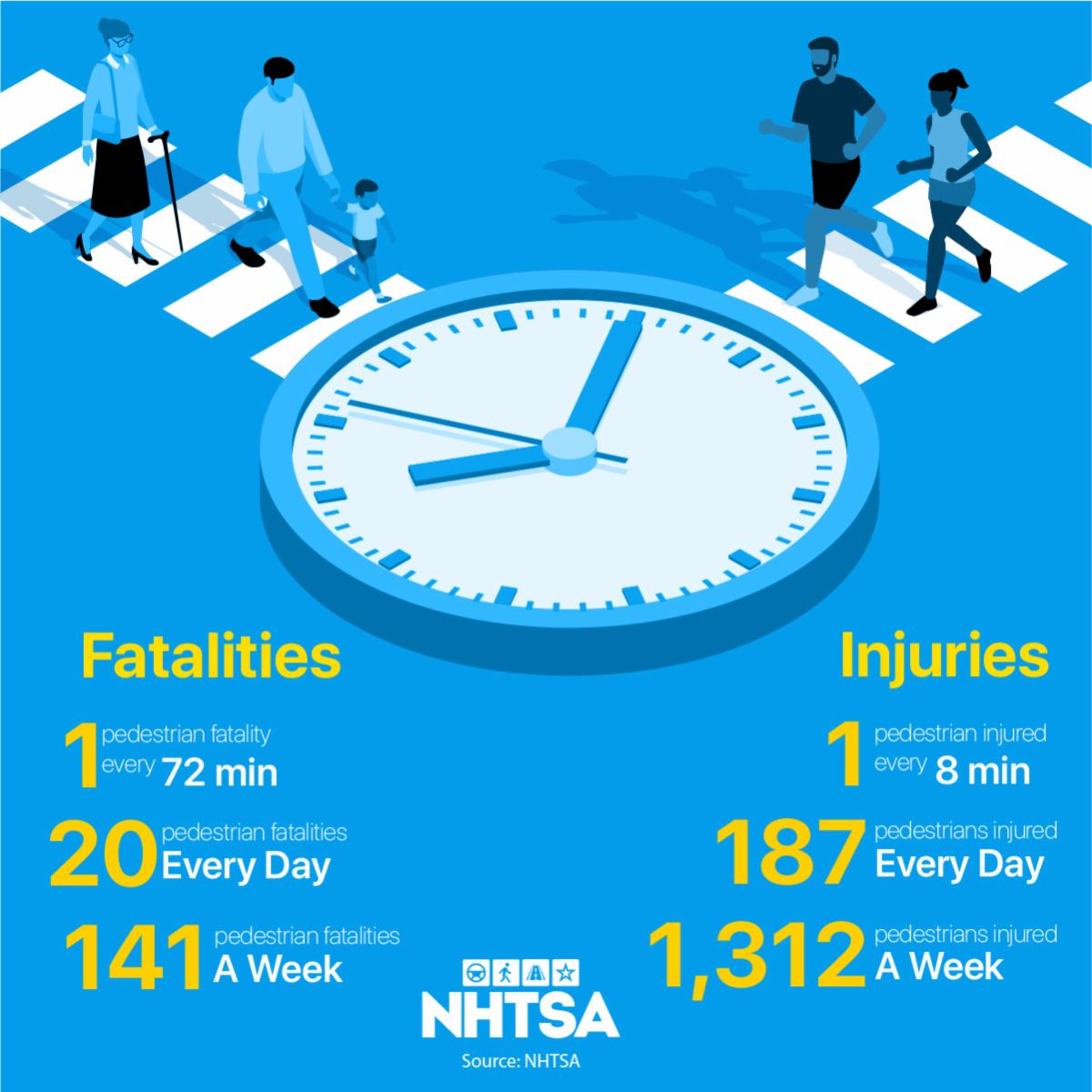
On average, in the United States a pedestrian dies every 72 minutes and one is injured every 8 minutes in traffic crashes. There were an estimated 68,244 pedestrians injured in 2023 and 7,314 pedestrians were killed — a 4% decrease from 2022. But pedestrian fatalities still remain high in the United States — they accounted for 18% of all traffic fatalities in 2023. This highlights a critical safety issue that impacts everyone.
| | |
Pedestrian Safety in the NFRMPO Region
In Northern Colorado, we want to ensure that our pedestrians are safe on the sidewalks and crossing the street. Anywhere that people walk they should be able to do so without fear or stress. We urge drivers to take the time to look out for pedestrians, slow down, and incorporate pedestrian awareness into their driving routines.
At some point during the day, everyone is a pedestrian. Pedestrians accounted for 19% of all fatal crashes in the NFRMPO region in 2023. NHTSA offers these driving tips to keep everyone safe:
- Use extra caution when driving in hard-to-see conditions — 89% of pedestrian fatalities in 2023 in the NFRMPO region occurred in the dark.
- Follow the speed limit, especially around people on the street, around schools, and in neighborhoods where children are present.
- Drive sober — alcohol or other drug use was suspected in 11% of all fatal pedestrian crashes in 2023 in the NFRMPO region.
- Always stop for pedestrians in crosswalks.
- Look out for pedestrians everywhere and minimize blind spots.
- Never pass vehicles stopped at a crosswalk. There may be people crossing where drivers can’t see.
October is especially timely as more pedestrians will be out towards the end of the month for Halloween. Drivers should be aware that on Halloween evening, there will likely be more pedestrians on the roads and in unexpected places. Families will be trick-or-treating with children who may be unaware of surrounding traffic and quickly dart into the street.
For more information about pedestrian safety, please visit NHTSA.gov/Pedestrian.
| | CDOT: Choose a Sober Ride Every Time | | |
In Colorado, 1 in 3 traffic crashes involves an impaired driver. Just last year, 214 people lost their lives in impaired-related crashes across the state. Driving under the influence of alcohol, cannabis, drugs or a combination of these substances is dangerous and always illegal.
Each year, CDOT’s The Heat Is On campaign supports Colorado State Patrol and local law enforcement agencies to hold 15 high visibility enforcement periods centered on national holidays and large public events. In an effort to remove impaired drivers from Colorado roads, enforcement can include sobriety checkpoints, saturation patrols, additional law enforcement on duty and more.
Impaired driving is always preventable. If you plan to drink or consume drugs, getting behind the wheel should never be part of the equation. CDOT offers the following tips to help all motorists plan ahead and avoid impaired driving:
- Leave your car keys at home.
- Use ride-hailing services, such as Lyft or Uber.
- Designate a sober driver.
- Call a friend or family member to pick you up.
- If you are hosting a party or gathering, consider:
- Collecting your guests’ car keys upon arrival or encourage them to designate a sober driver or use a rideshare service, taxi or public transportation.
- Calling a friend or family member for a guest if they have been drinking or offer them a place to stay if a sober ride home is unavailable.
- Stop serving alcohol at least two hours before the party is over. Provide plenty of food and non-alcoholic drink options.
- Be persistent if a guest is intoxicated and planning to drive home. Explain that you care about their safety and cannot let them get behind the wheel.
A DUI costs you more than a night in jail. Impaired driving can take away your time, money, driving privileges and more. According to NoDUIColorado.org, first-time DUI offenders rack up an average cost of $13,530 and a minimum of 170 hours of their time dealing with the consequences in addition to any criminal fines. These costs can include:
- Increased auto insurance: $3,600
- Ignition interlock service: $2,172
- Alcohol/drug treatment & education: $1,000
- Defense attorney: $3,650
- Arrest, court & legal fees: $2,300
- Department of Revenue & DMV fees: $773
If you are arrested for DUI, you must provide a breath or blood test. While drivers over the age of 21 can refuse a roadside breathalyzer test, a DUI arrest can still be made if a police officer observes signs of impairment in your behavior, speech or appearance. Refusing a breath or blood test can have worse consequences than failing it. To learn more about Colorado’s Expressed Consent law, click here.
The bottom line: impaired driving isn’t worth it and there’s never an excuse to do it. Driving under the influence changes and takes lives. More information about The Heat Is On campaign can be found at HeatIsOnColorado.com. Learn more about CDOT’s dedication to keeping Colorado roads safe, including impaired driving enforcement objectives, arrest data and safety information at codot.gov/safety.
| | GoNoCo34 TMO: Become a TMO Member | | |
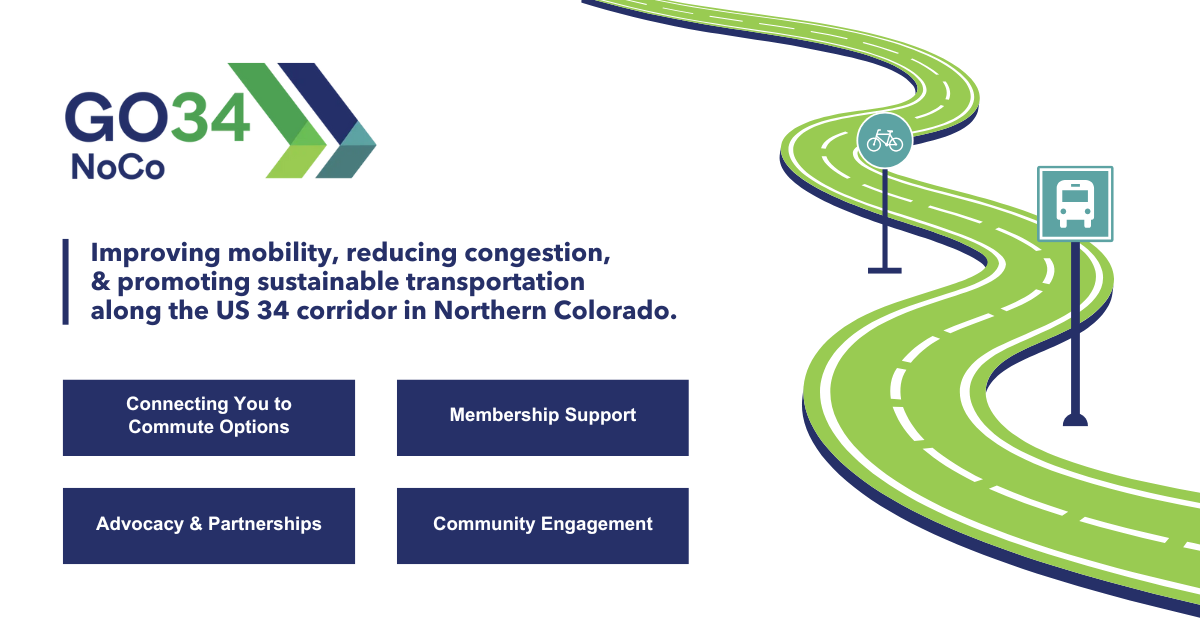
The GoNoCo34 Transportation Management Organization (TMO) collaborates with businesses, public agencies, and communities along the US 34 corridor in Northern Colorado to create innovative solutions for the region’s growing transportation needs. To improve mobility, reduce congestion, and promote sustainable transportation options, GoNoCo34 provides resources and tools to reduce single-occupancy vehicle trips, enhance transportation choices, and improve air quality.
Join the movement for sustainable transportation in Northern Colorado and become a member of GoNoCo34! Learn more about membership benefits here.
| | Upcoming Events, Public Comment Opportunities, Office Closures, and Meetings | | | | |