On the Move | Q2 | April 7, 2026 | | On the Move: Your Quarterly Transportation News & Updates in Northern Colorado | | |
In This Issue:
Updates from the North Front Range MPO
- Winter Bike to Work Day Recap
- Active Transportation Plan (ATP) Public Comment is Open
- Intermountain West 2026 Ozone Exchange
-
VanGo™: We Are All in This
- Spring Knowledge Break: Transportation-Focused Session
- 2026 Bike to Work Day and the "Summer Moves" Challenge
- Performance Report for the 2023 Congestion Management Process
Updates from our Partner Agencies
- FRPR: Front Range Passenger Rail Community Q&A in Loveland
- CDOT: Speeding Enforcement for I-25 North Construction Zone
- CDOT: Tolling on I-25 Express Lanes between Berthoud and Fort Collins has Begun
- RAQC: Updates in Northern Colorado
- GoNoCo34 TMO: Become a TMO Member
Get Involved!
Read on for the latest transportation updates in the North Front Range.
| | North Front Range MPO Updates | | Winter Bike to Work Day Recap | | |
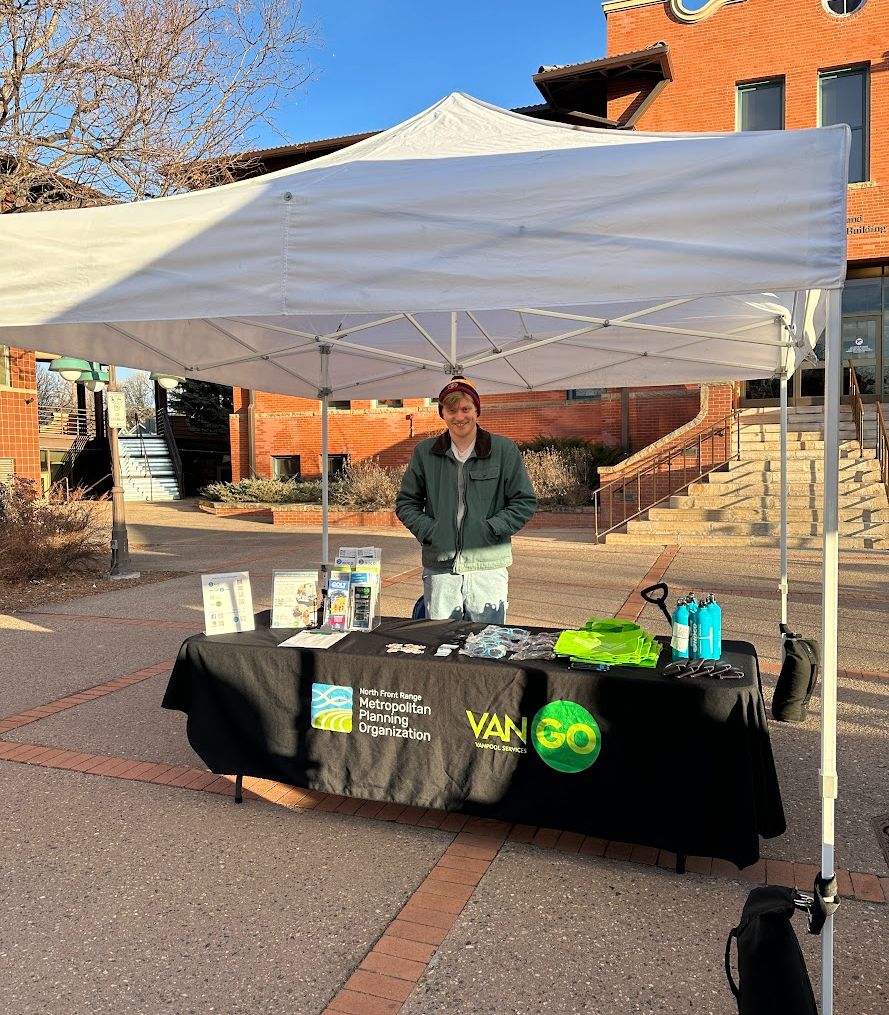
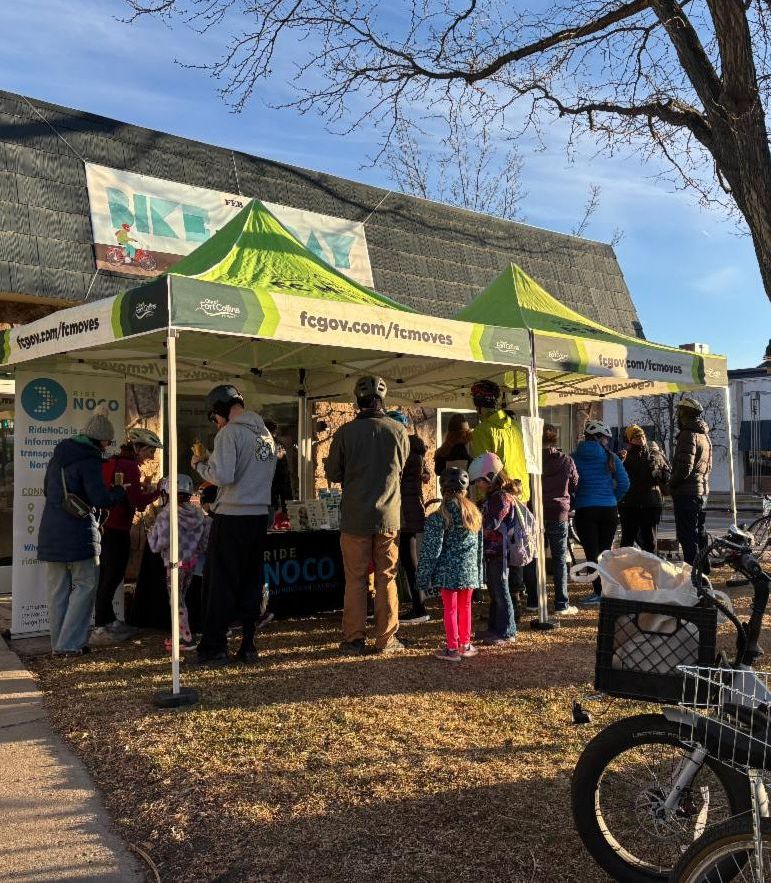
Winter Bike to Work (or Anywhere!) Day was Friday, February 13, 2026. NFRMPO staff co-hosted two stations this year across the region:
- Fort Collins at the corner of Mountain Ave and Mason St;
- And Civic Center Plaza in Loveland!
The two stations combined had 209 visitors and Staff had great conversations with residents of the communities about transportation options, safety, mobility, and trail access. In both communities, Staff encouraged cyclists and walkers to take the NFRMPO’s 2026 Public Involvement Plan survey.
Keep an eye out for information on the summer version of Bike to Work Day happening on Wednesday, June 24, 2026.
| | Active Transportation Plan (ATP) Public Comment is Open | | |
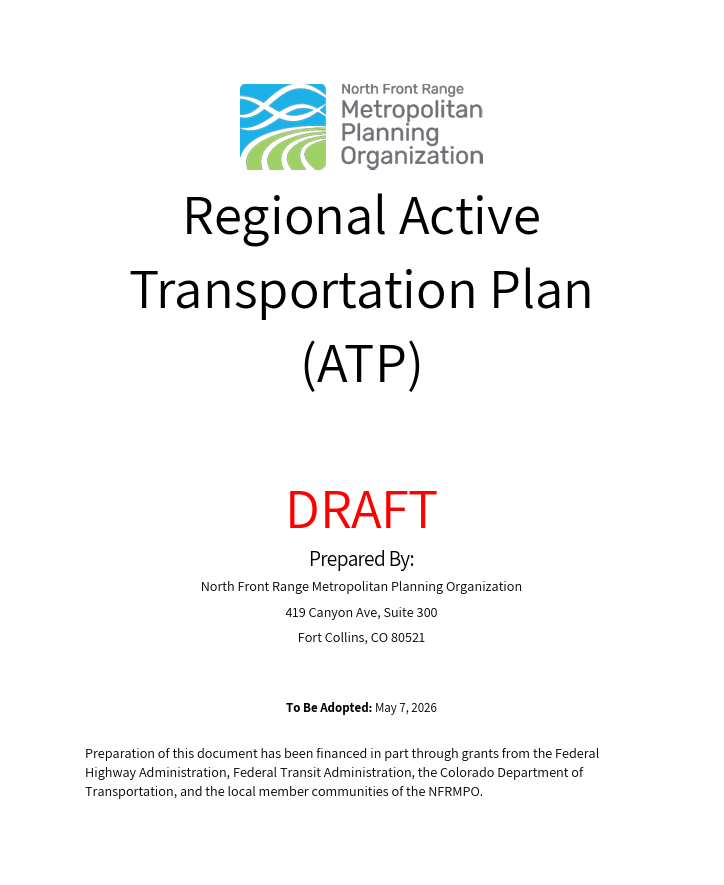
Every four years, the NFRMPO updates the Regional Active Transportation Plan (ATP). The ATP is an update to the shared regional vision for active (bicycle and pedestrian) transportation. The Plan provides extensive guidance and serves as a toolkit for consistent active transportation planning across Northern Colorado Communities. The ATP identifies various strategies and action steps to improve active transportation across the region and position NFRMPO communities to better pursue other funding opportunities. The ATP was released for 31-day public comment on March 20 and is open through April 20. The Draft ATP can be found here or on the NFRMPO’s Public Comment page. The Plan is expected to be adopted in May.
Comments on the Plan can be submitted online or can be emailed to Jerome Rouser, Transportation Planner II, at jrouser@nfrmpo.org.
| | Intermountain West 2026 Ozone Exchange | | |
In Fall 2026, the NFRMPO is jointly hosting a two to three day conference with the Pikes Peak Area Council of Governments (PPACG) on ozone science and attainment challenges specific to Intermountain West (IMW) states.
Why do we need this exchange?
Ozone levels in the IMW are no longer responding to state initiatives reducing human-made pollutant emissions that contribute to ozone production.
Ozone is not directly emitted into the atmosphere, rather it is chemically created by combining nitrogen oxides (NOx) and volatile organic compounds (VOCs) in the presence of sunlight. NOx and VOC are called ozone precursors. In areas where the ozone monitors show exceedance of the National Ambient Air Quality Standards (NAAQS) for ozone, local air quality agencies must reduce ozone levels by reducing these ozone precursors.
However, in IMW nonattainment areas contributions from high background levels, natural sources, wildfires and related mitigation activities, international sources, and more appear to unduly influence whether these areas can attain or come into attainment of the NAAQS. These sources of ozone precursors and ozone are not within any one state’s authority to control.
A regional ozone conference was last held in 2016, hosted by the US Environmental Protection Agency (EPA). Given the pressing need for understanding the ozone attainment challenges in the IMW states, this conference provides a regional venue in which to broadly share research findings and collectively discuss solutions.
What are the goals for this exchange?
- Share information among air quality agencies, metropolitan planning organizations, academic researchers, industry, local governments, community groups, and members of the public;
- Educate on the EPA’s State Implementation Plan process and Clean Air Act requirements and provisions;
- Recognize and prioritize unique regional challenges and considerations faced in the IMW states;
- And discuss near-term and longer-term solutions and communication planning.
How can I receive updates as we get closer to the conference?
To learn more, visit the NFRMPO’s Intermountain West 2026 Ozone Exchange website and keep an eye on the NFRMPO’s social media and LinkedIn pages.
| | VanGo™: We Are All in This | | |
It’s not just about helping commuters. It’s about helping Colorado.
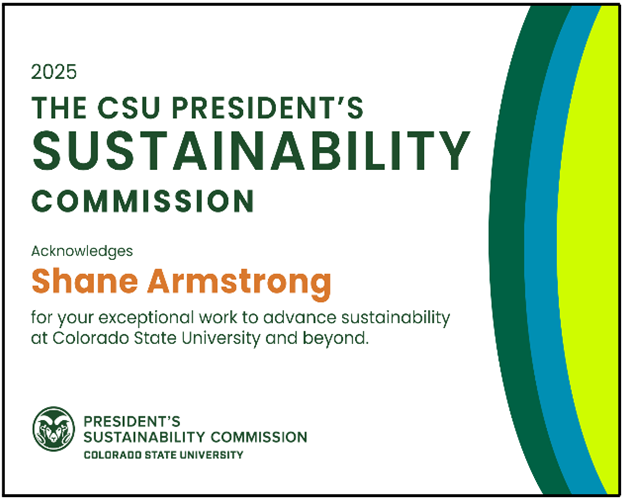
Sometimes we get so involved in our daily job that we miss the impact. I stumbled on the pictured acknowledgement from last year and it hit me; while, yes, the part of the VanGo™ program that most see are our vans safely transporting commuters to and from work, what many do not see is our commitment to cleaner air and improving sustainability, our commitment to something bigger, something that impacts all of us.
Every VanGo™ hybrid van going down the road carries the potential of removing six vehicles from our increasingly overcrowded roadways. That’s six vehicles removed from a daily commute, reducing congestion, making our participants and other commuters drive faster and easier. Six vehicles that don’t require a parking spot. Six commuters who will arrive at work happier and less stressed. These are results we can see. Results that have an impact every day.
But what about what we can’t, or don’t, see? Six less vehicles contributing greenhouse gases to our Colorado skies. Six less vehicles consuming fossil fuels. Six less vehicles contributing to everyday noise. Six less vehicles contributing to the wear and tear of infrastructure. And six commuters, per van, who are building a community, connecting with others through a shared experience.
We are all in this together, Colorado. Things we can’t or don’t see do make an impact.
Shane Armstrong , CAFM
Operations & Fleet Manager
| | Spring Knowledge Break: Transportation-Focused Session | | |
Ever wonder how our transportation is keeping up with a growing Northern Colorado? Take a Knowledge Break! Dive into regional transit, discover how we connect NoCo, and see the strides we're taking to improve our community.
Join the North Front Range Metropolitan Planning Organization (NFRMPO) on April 9th, 2026 for a "Knowledge Break" in partnership with Climate Smart Future Ready of Larimer County for an overview of transportation in Northern Colorado and what regional mobility looks like in the North Front Range today.
This Knowledge Break is designed to help you understand how we move around our region and how you can help shape what comes next. We’re lucky to have so many ways to get around, and the NFRMPO will be diving into current issues and plans for congestion, safety, and our region's growing needs.
Your input matters. We invite you to learn more, ask questions, and help us plan a safer, smoother future for our community.
When: Thursday, April 9 | 12:00 PM – 1:00 PM
Where: 200 W Oak St, Fort Collins (or join via Zoom!)
Cost: Free!
Come curious, leave inspired! Register on Eventbrite.
| | 2026 Bike to Work Day and the "Summer Moves" Challenge | |
While the North Front Range and Colorado get excited to celebrate Bike Month every June, the main event is Bike Wherever Day on June 24th, when people leave their cars at home and bike wherever they go. This annual free event attracts tens of thousands of Colorado drivers who celebrate by swapping car rides for bike rides. Participating helps improve air quality, reduce greenhouse gas emissions, and ease traffic congestion. Plus, it’s fun!
The NFRMPO and local municipalities, including Fort Collins, Loveland, Greeley, Timnath, and Windsor, will all participate this year! More details will be shared online through our social media, a new webpage about Bike Wherever Day, and a future special Bike Wherever Day newsletter. So, mark your calendars and stay tuned for more information!
| |
Additionally, mark your calendars from June 1 to June 30, 2026, for the “Summer Moves” Regional Challenge in Northern Colorado! This June, the NFRMPO will host the “Summer Moves” Regional Challenge using the MyWayToGo platform.
The “Summer Moves” Regional Challenge aims to improve air quality by encouraging commuters to skip solo drives and choose sustainable transportation options such as transit, biking, walking, vanpooling, and carpooling, coinciding with the 2026 Bike Wherever Day on June 24.
The NFRMPO is partnering with MyWayToGo to help you track your rides and enter for prizes. Sign up and practice tracking your trips at MyWayToGo.
More details about the “Summer Moves” Regional Challenge will be shared on our social media and on a new webpage dedicated to the event.
| Performance Report for the 2023 Congestion Management Process | | |
In December 2025, a Performance Report for the 2023 Congestion Management Process (CMP) was completed by NFRMPO staff to identify effective strategies for congestion management in the region. This performance report supplements the 2023 CMP by monitoring the implemented congestion strategies in terms of the CMP’s performance measures. The purpose of the performance report is to identify effective strategies for congestion management to enable the region to strategically improve system performance. This report fulfills the federal requirement for a periodic assessment of the effectiveness of implemented congestion strategies.
The report demonstrates the region is improving in five of nine performance measures as seen in the table below. This performance report also identifies the implemented and programmed projects funded through the NFRMPO that include one or more congestion management strategies in their project scope.
| | | CMP Performance Measure | Baseline Value (2023 CMP) | Current Value (2025 Performance Report) | Performance Measure Status | | Travel Time Index (TTI) - Percent Congested | 0.6% | 1.0% | Worsening | | Vehicle Miles Traveled (VMT) per Capita | 21.6 | 20.2 | Improving | | Travel Time Reliability (TTR) - Percent Unreliable | 1.1% | 3.7% | Worsening | | Truck Travel Time Reliability (TTTR) - Percent Unreliable | 52.1% | 7.8% | Improving | | Total Number of Crashes | 7,564 | 8,888 | Worsening | | Transit Ridership per Capita | 5.3 | 7.7 | Improving | | Percent of Non-Single Occupancy Vehicle (SOV) Commute Trips | 25.0% | 29.5% | Improving | | Percent of Devices Connected by Fiber on RSCs | 87.0% | 84.3% | Worsening | | Peak Hour Excessive Delay on NHS in Fort Collins Urban Area | 3.4 | 2.9 | Improving | | | To learn more about the Congestion Management Process and the CMP performance measures, visit the NFRMPO’s CMP webpage or reach out to Mykayla Graalum, Transportation Planner I, at mgraalum@nfrmpo.org. | | FRPR: Front Range Passenger Rail Community Q&A in Loveland | | |
Your voice matters in the future of transportation in Loveland.
Join the Front Range Passenger Rail District on Thursday, April 16th at 5:30 p.m. for a Community Q&A.
These meetings are designed primarily as listening sessions — opportunities to learn more, ask questions, and share your input. District leaders want to hear directly from residents, business owners, and community stakeholders as planning advances.
When: Thursday, April 16, 2026 from 5:30 to 7:00 p.m.
Where: Pulliam Community Building - 545 Cleveland Ave, Loveland, CO 80537
Cost: Free!
| | CDOT: Speeding Enforcement for I-25 North Construction Zone | | |
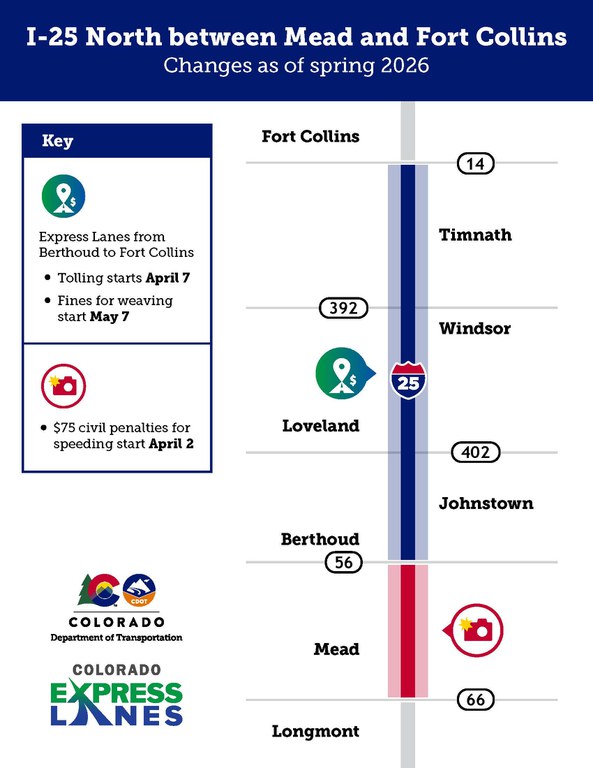
The Colorado Speed Enforcement Program began issuing $75 civil penalties on April 2, 2026 to drivers who exceed the posted speed limit in the I-25 North Express Lanes work zone between Mead and Berthoud.
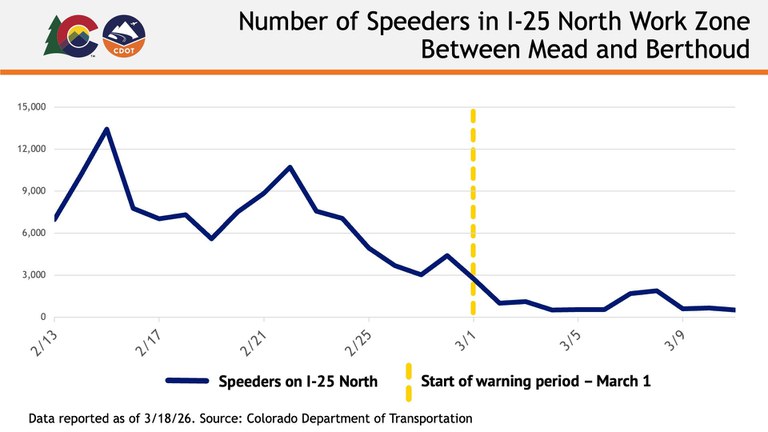
During the warning period, which began March 1, 2026 and ended April 1, 2026, drivers who exceeded the posted speed limit will receive mailed warning notices instead of fines. The program has issued 4,154 warnings to date, and, since the start of the warning period, excessive speeds in the corridor have dropped by 90%.
| |
The I-25 North corridor marks the second active enforcement area of the Colorado Speed Enforcement Program, which uses camera technology to reduce speeding in high-risk corridors, such as work zones. The goal is to reduce speed-related crashes and improve safety for drivers, roadway workers, law enforcement and other vulnerable road users.
“The goal isn’t to punish drivers; it’s to prevent crashes before they happen,” said CDOT’s Chief Engineer Keith Stefanik. “Speeding continues to be a contributing factor to crashes and fatalities in Colorado. Safer speeds save lives — it’s that simple.”
Preliminary data shows that there were nine work zone fatalities in 2025, marking a 70% decrease since 2024 (30). Additionally, work zone crashes in Colorado caused 558 injuries in 2025, a nearly 8% decrease from 2024 (602). Despite the known risks, 70% of Coloradans admitted to speeding on main and local highways, according to a 2025 CDOT survey.
The Colorado Speed Enforcement Program was authorized by state law in 2023. The program first launched in July 2025 on Colorado Highway 119 between Boulder and Longmont (the Diagonal Highway), where excessive speeding has declined by more than 80% since civil penalties began.
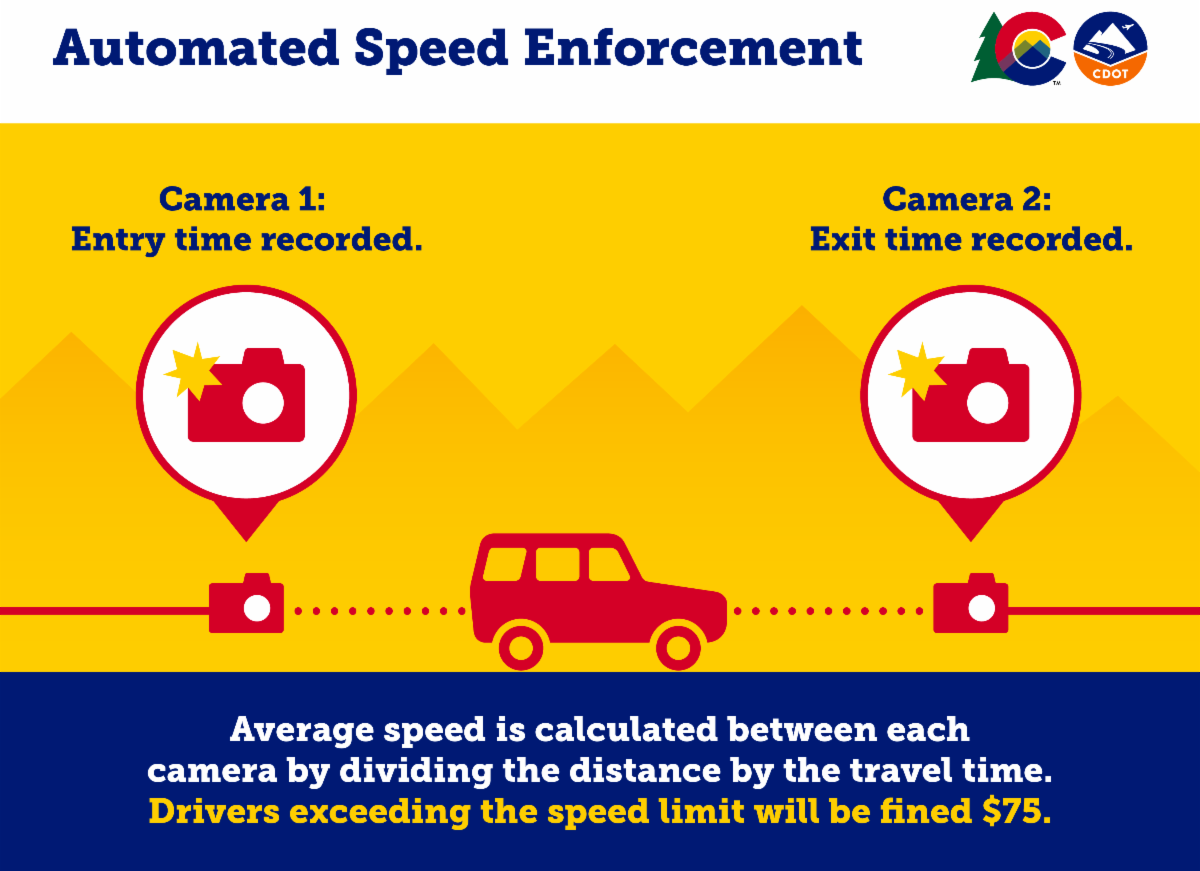
In the I-25 North work zone, eight speed cameras were installed in late January between Mead and Berthoud, where crews are constructing new Express Lanes in both directions. The system measures a vehicle’s average speed between two points. The presence of speed cameras is clearly marked by signage at least 300 feet in advance.
| |
Drivers who exceed the posted speed limit will receive a $75 civil penalty mailed to the registered owner of the vehicle. Drivers will have 45 days to pay the $75 fine or appeal the notice.
Revenue collected from the penalties will be used primarily to fund the Colorado Speed Enforcement Program. Any excess funds will be allocated to the Vulnerable Road User Protection Fund, which provides infrastructure improvements that protect vulnerable road users.
According to the Federal Highway Administration, the use of point-to-point speed cameras has been shown to reduce roadway injuries and fatalities by 20% to 37%.
For more information about the Colorado Speed Enforcement Program, visit CDOT's speed enforcement webpage.
| | CDOT: Tolling on I-25 Express Lanes between Berthoud and Fort Collins has Begun | | |
Tolling on the 14-mile I-25 Express Lanes between Berthoud and Fort Collins starts today, April 7, 2026.
Drivers who have an ExpressToll pass can expect to pay between $1 to $4.75 per Express Lane segment, depending on the segment, direction and time of day. For example, a driver using all three segments — northbound or southbound — from 11 p.m. to 6 a.m., when toll rates are lowest, would pay a minimum of $3 for the whole trip, while a driver using all three segments from 6 p.m. to 7 p.m. and traveling northbound would see the highest trip price at $12.20. Drivers without an ExpressToll pass would pay more.
Overhead signs will display the current toll price. The price shown when entering the Express Lanes is the price ExpressToll account holders will pay.
Also beginning today, April 7, 2026, drivers on this corridor will receive a warning for entering or exiting the Express Lanes outside designated areas, a violation of Express Lanes rules. Enforcement will begin with a 30-day grace period, during which warnings will be mailed to the vehicle's registered address. Starting May 7, 2026, the warning period will end, and violators will receive fines known as “civil penalties” if they are weaving over solid lines.
“Express Lanes aren’t just about saving time for the drivers who choose to use them,” said Tim Hoover, deputy director of communications for the Colorado Department of Transportation. “They’re designed to help manage congestion across the entire corridor. When traffic moves safely in and out of the Express Lanes, it reduces pressure on the regular, untolled lanes, which benefits all drivers — whether they pay a toll or not.”
Drivers who don’t have an ExpressToll pass can still use the Express Lanes but will pay a higher toll rate. In those cases, a bill will be mailed to the registered vehicle owner using license plate billing. ExpressToll account holders pay an average of 40% less compared to drivers who use license plate billing. Drivers can visit expresstoll.com to open an account, order a sticker pass or get a switchable HOV3+ transponder. The switchable HOV3+ transponder functions as a regular ExpressToll pass when not set to HOV3+ mode.
The same ExpressToll passes — including sticker passes and switchable HOV3+ transponders — used on Express Lanes along US 36, I-25, C-470 and I-70, as well as E-470 and the Northwest Parkway, will also work on the I-25 North Express Lanes.
The Express Lanes are free to motorcyclists, commercial transit vehicles and cars with three or more passengers that are using a switchable HOV3+ transponder. For a quick refresher on how to enter and exit the Express Lanes legally, check out the Express Lanes Safety and Toll Enforcement Program diagrams and video.
As a reminder, if an emergency vehicle with flashing lights and siren is behind you while you are in the Express Lane, you are legally allowed to cross over solid lines to your right to exit the lane when it is safe to do so. However, you cannot then re-enter the Express Lane over the solid lines. You must wait until the next designated entrance.
| | RAQC: Updates in Northern Colorado | | |
Smoke Impacts on Ozone
The Regional Air Quality Council (RAQC) is launching an update to its Smoke IMpact Assessment System (SIMAS), which analyzes the effect of wildfire smoke on ground-level ozone at official monitoring sites on the Front Range. The SIMAS update adds another level of probability that smoke had an impact on the daily ozone readings at a given site, giving air quality planners a more refined tool for understanding what the EPA calls "exceptional events" that should not count against the federal ozone standard for the region. Learn more at raqc.org/aq-analysis-and-data.
Upcoming Expansion of Northern Programs
The RAQC is preparing an expansion of the Clean Air Auto Repair, Engines Off, Accessible Bikes for Community, and Simple Steps. Better Air. programs throughout the full nine-county ozone nonattainment region this year after receiving a grant through the Community Clean Transportation Assistance Grant Funding Program. We look forward to working with our partners in the North Front Range on these programs in the coming months!
| | GoNoCo34 TMO: Become a TMO Member | | |
The GoNoCo34 Transportation Management Organization (TMO) collaborates with businesses, public agencies, and communities along the US 34 corridor in Northern Colorado to create innovative solutions for the region’s growing transportation needs. To improve mobility, reduce congestion, and promote sustainable transportation options, GoNoCo34 provides resources and tools to reduce single-occupancy vehicle trips, enhance transportation choices, and improve air quality.
Join the movement for sustainable transportation in Northern Colorado and become a member of GoNoCo34!
| | Upcoming Events, Public Comment Opportunities, Office Closures, and Meetings | | See what's happening at the North Front Range MPO and join us virtually or in-person at one of our upcoming events or meetings. | | | | |