|
Friends: It becomes ever more difficult to find some good news with which to start these updates. While the Narcissist-in-Chief focuses on his triumphal arch, ballroom, reflecting pool, and name on the Kennedy Center, the rest of the world is falling apart. The Russians and Ukranians are killing civilians right and left; Israel has told trump and his Peace Board to pound sand over their Gaza plan; Iran controls the Strait of Hormuz which was open before this needless war; the Treasury is buying bonds in a panic as long term inflation is beginning to be priced in; the National Debt has reached $4 trillion; another January 6th pardoned felon has once again been arrested for creating a riot; and we're now treating Canada as an enemy. On the other hand, perhaps there is some hope. One of trump's picks broke the MAGA rulebook by admitting she didn't know doodle about national security and several candidates the Narcissist-in-Chief backed have lost. When Jared Kushner, the Chief-son-in-law-negotiator meets with the Democratic Minority Leader to discuss post November election plans, you might begin to believe that the craziness has peaked and is beginning to ebb. May it be so!
Faced with the state of the world, I was struggling to find some reading to elevate my mood when I recalled a suggestion made by Richard, one of my college roommates. He thought it might be interesting to read books published 100 years ago, and when I followed his advice last October, I was delighted to read Woolf's "Mrs. Dalloway", Kafka's "The Trial", Fitzgerald's "The Great Gatsby", and Willa Cather's "The Professor's House", all published in 1925. The books published in1926 proved to be just as rewarding. Several of my favorite writers had their literary debuts that year. Faulkner ("A Soldier's Pay"), Hemingway ("Torrents of Spring" and "The Sun Also Rises"), Nabokov ("Mary"), and Langston Hughes ("The Weary Blues") all burst upon the scene in 1926 with their first books, a literary bonanza. Add to that new works by Willa Cather, Ford Maddox Ford, Sinclair Lewis, Kafka, Agatha Christie, B. Traven, A.A. Milne, and Sean O'Casey, and one can almost forget trump and his Cabinet of seven dwarves.
Beyond the quirky conceptual art project of reading 100 year old books, where's the value in doing so? On the one hand, it provided a window into a fascinating period in history. The world in 1926 was less than a decade from the end of WWI and the Russian Revolution. While Europe remained in shock, America was celebrating. Prohibition was in effect though widely ignored, and flappers, industrial titans, and a booming stock market made for a bouyant atmosphere. The Harlem Renaissance featuring Black music, art, and writing was underway and the 'lost generation' expats in Paris were drinking cheap wine, traveling to Spain for the bulls, and writing. There was the first public demonstration of TV and the first liquid fuel rocket launch. Queen Elizabeth II, Marilyn Monroe, and Fidel Castro were born that year, and Rudolph Valentino, Harry Houdini, Claude Monet, Annie Oakley, and Rainer Maria Rilke all shuffled off this mortal coil in 1926.
A second reason for reading the books of a century ago is that it provides some basis for judging what has become a classic versus what has justifiably faded with time. There are as many definitions of what comprises a classic as there are literary crtiics, but my favorite one was penned by M.H. Abrams as follows:“Agreement among diverse humanists as to the importance and value of a work at any one time, and still more, the survival value of a work—general agreement as to its importance and value over an extended period of time—serves as a sound way to distinguish the better from the worse and to identity which work is a classic. The consensus that emerges when an imaginative work is viewed from a diversity of critical perspectives and through a diversity of sensibilities—and especially a consensus that emerges despite radical cultural changes over many centuries—is a reliable index to the fact that the work is central in its human concerns, broad in its imaginative appeal, and rich in its inherent aesthetic and other values.” Abrams was a literary critic who was the founding editor of the "Norton Anthology of English Literature", and I would only add to his observations that a classic also must be readable. "The Sun Also Rises" meets all of these criteria. Ford Maddox Ford's "Parades End" and William Faulkner's "The Soldier's Pay" on the other hand, proved to be unreadable, and I abandoned them after a few miserable pages.
And now to climb back into my time machine and review the books from 1926 that I read in August, 2026.:
- On the Razzle, Tom Stoppard
- The Sun Also Rises, Ernest Hemingway
- The Torrents of Spring, Ernest Hemingway
- My Mortal Enemy, Willa Cather
- Mary, Vladimir Nabokov
- Arrowsmith, Sinclair Lewis
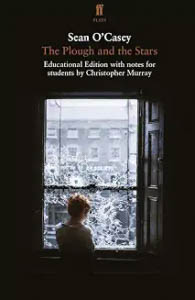
- The Plough and the Stars, Sean O'Casey
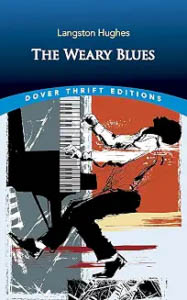
- The Weary Blues, Langston Hughes
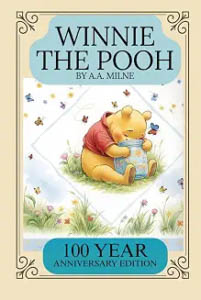
- Winnie-the-Pooh, A.A. Milne
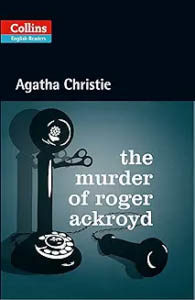
- The Murder of Roger Ackroyd, Agatha Christie
- The Castle, Franz Kafka
- The Death Ship, B. Traven
| |
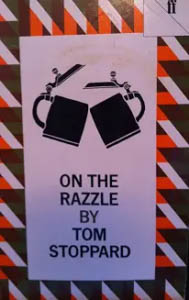
Before diving into 1926, I continued with my project of reading one of Tom Stoppard's plays from each decade in which he worked, and "On the Razzle" was the one from the 1980's. It read as if it were the illegitimate offspring of Groucho Marx and the Three Stooges as farce piled up double entendres, confused identities, puns, malapropisms, spoonerisms and more in this adaptation of a 19th C. Viennese play. There had been an earlier adaptation of that play by Thornton Wilder that became the source of the Broadway hit "Hello Dolly", but Stoppard chose farce over romance, and he had me laughing out loud. Hard to imagine that the same man wrote this play as well as "Leopoldstadt". I look forward to re-reading his 1990's play "Arcadia" which we saw last year in London.
Ernest Hemingway has always been a fascinating character for me. Born in Oak Park, Illinois in 1899 and a fellow alumnus of Oak Park River Forest High School, he was a dashing figure as well as a Nobel Prize winning author. Whether fishing off his beloved Cuba, surviving a plane crash while on safari in Africa, or living the life of the poor, struggling author in Paris, the four times married Hem was larger than life. Sadly, that proved to be the case for him as well for he committed suicide in 1961 beset by depression, alcoholism, and failing health. His first two books were published in 1926 by Scribners with the support of his editor, Max Perkins (see "Max Perkins: Editor of Genius", a wonderful biography by Scott Berg.), and the two books could not be more different.
| |
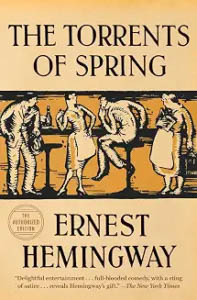
"The Torrents of Spring" is a parody of a novel by Sherwood Anderson. Hemingway respected Anderson whose "Winesburg, Ohio" remains a classic today but he disliked his "Dark Laugher" so much that he lampooned it with this book length parody. It's the story of two men working in a pump factory in Michigan. The over-the-top use of adjectives and adverbs and the weird plot turns make it evident from the first paragraph that this is a satire. Though the book has occasionally been taken seriously, in general, "Torrents" has been relatively ignored and dismissed and is seldom cited today.
| |
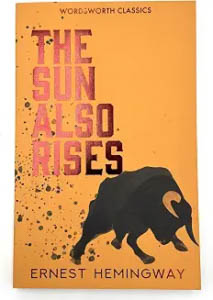
In contrast, "The Sun Also Rises" is considered one of Hemingway's best novels and the prime example of the new style that he brought to 20th C literature. Spare, direct, brief sentences stripped of adjectives and adverbs are evident from the first page and serve to move the action along swiftly. I was, however, deeply troubled by the anti-semitic content that begins in the very first paragraph when we are introduced to Robert Cohen, a Princeton grad who is the butt of derogatory language throughout the book including 'kike'. That aside, the story of Jake Barnes, Lady Brett Ashley, and the young Spanish matador that unfolds from Paris to Pamplona is a gripping tale and a deep dive into the 'lost generation' that lived through WWI. It's hard to believe that this extraordinary novel was a debut written by a 27 year old living in Paris, and it's worth re-reading especially if you last encountered it in high school.
| |
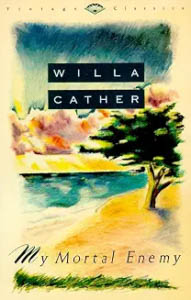
Willa Cather was a pioneering woman author whose oeuvre includes the outstanding novels "Death Comes for the Archbishop", "My Antonia", and "O, Pioneers". "My Mortal Enemy" and while interesting did not measure up to these other books. The story of the young Myra Henshawe who eloped against the wishes of her uncle, leaving behind the wealth she would have inherited only to regret it on her deathbed, is a quiet one. Like "The Professor's House, it's the story of a life regretted. Though written with skill and tenderness, it failed to engage me. Its most powerful sentence is its final one in which Myra, dying in poverty, whispers into the stillness of the night, "Why must I die like this, alone with my mortal enemy?"
|
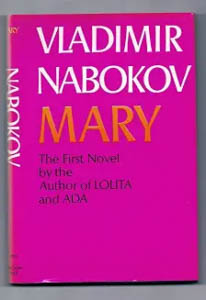
| |  | On the other hand, Vladimir Nabokov's first book, "Mary" presaged his incredible body of later work. Written in Russian when the 27 year old author was living in exile in Berlin, the book wasn't translated into English until 1970. It's the story of Ganin who, like the Nabokov, has fled Bolshevik Russia for Berlin. It's 1923 and he's living in a run-down pension with five other exiled Russians one of whom is about to be joined by his wife, the eponymous Mary, after a four year separation. Ganin realizes that Mary is the young girl he was in love with in the Russian countryside when he was 16, and excitedly anticipates her arrival. The themes of memory, time, a lost past, and a mundane and empty present that Nabokov will write about for the next 50 years in his superb biography "Speak, Memory" and in his powerful novels "Lolita", "Pale Fire", and "Ada" are all there, and it was fascinating to see this earliest manifestation of great talent. I have all of Nabokov's books on my shelves in Cambridge and look forward to re-reading some of them soon. The lack of a Nobel Prize in Literature for this giant figure remains one of the great injustices of the literary world.
|
| | | Sinclair Lewis won the Pulitzer Prize in 1926 for his novel, "Arrowsmith". It's the story of Martin Arrowsmith whom we first meet as a young boy reading a medical book in Doc Vickerson's office in Elk Falls, Winnemac, the fictitious amalgamation of Wisconsin, Michigan, and Minnesota. We follow Arrowsmith through medical school at the U of Winnemac (its model being the U. of Michigan Medical School, my alma mater), residency in Zenith Hospital, practice in Wheatsylvania, North Dakota, a stint as GP and public health officer in Nautilus, Iowa, work as a pathologist at a private surgery clinic in Chicago, time as a scientist at an institute in New York, a wrenching experience fighting the bubonic plague on St. Hubert in the Carribean, and finally working on science in the remote Vermont woods with his friend Terry. It's an exhausting and often melodramatic tromp through 540 pages in as different a style from Hemingway's tersely focused sentences as one can imagine, but it's also a damn good tale An interesting side story involves another alumnus of the U. of Michigan, Paul de Kruif who obtained a PhD there in bacteriology. Lewis knew little of science and medicine when he undertook "Arrowsmith" so he brought de Kruif on board to provide the details involved in Arrowsmith's quest. Their deal promised co-authorship and a 50/50 share of the royalties, but Lewis reneged on this plan after the book's success. While they eventually reached an agreement on the royalties, de Kruif's name is nowhere to be found on the cover or acknowledgments. He did ultimately benefit from the experience, however, going on to write several best selling books of his own that popularized science and medicine for the layperson. His "Microbe Hunters" was a best seller. How Lewis received a Nobel while Nabokov didn't is bewildering.
|
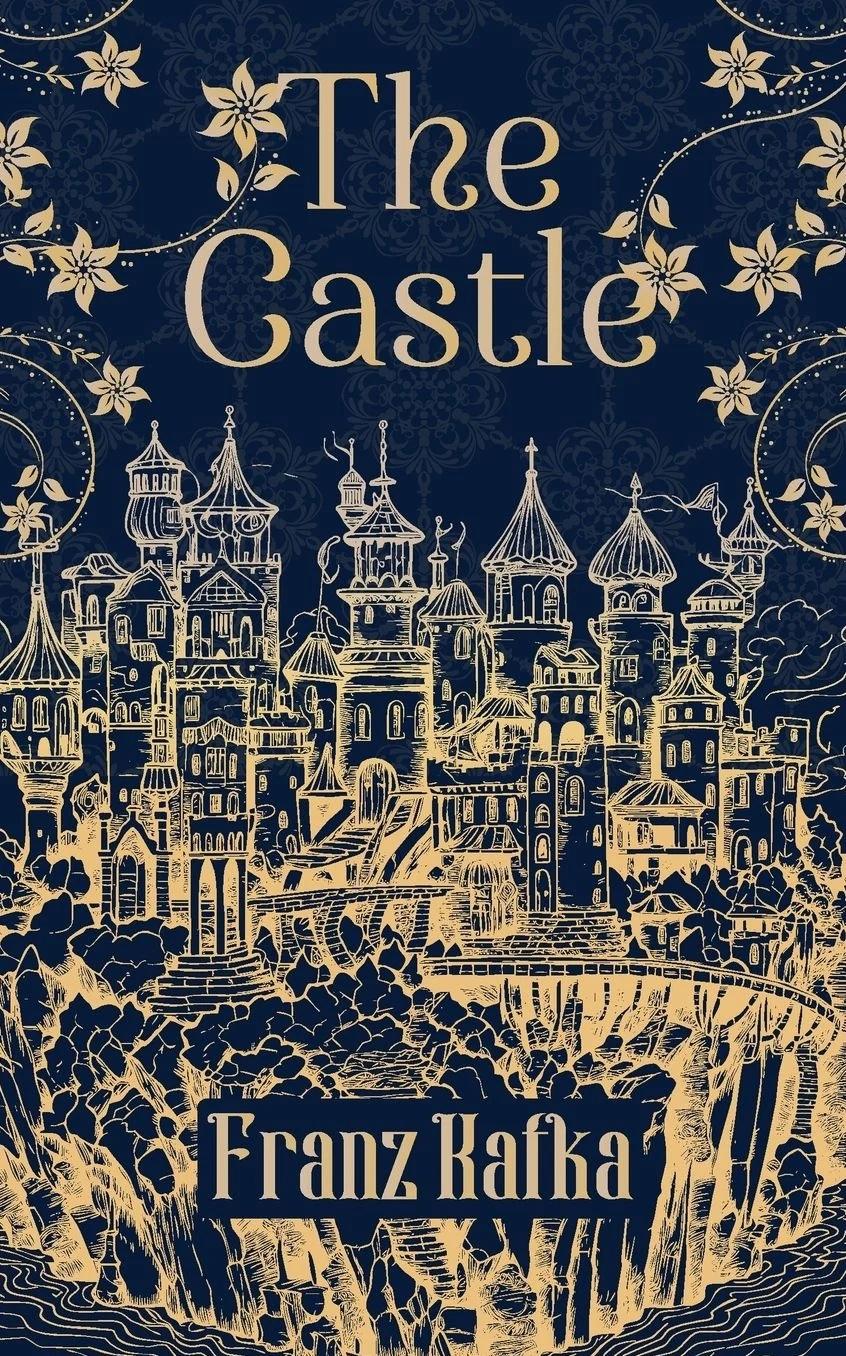
| | | Two other novels that I haven't completed warrant a departure from my usual practice of only including books in my Book Journal that I have finished. I am still working my way through these densely written, but profoundly interesting novels. "The Castle" was Franz Kafka's final work, and it was incomplete when he died in 1924. Like "The Trial" and "Metamorphosis", it's a surreal tale about alienation, aloneness, and the stultifying impact of the bureaucratic state. The main character, K, is summoned to a remote village to work as a land surveryor for The Count who lives in the castle that overlooks the village. K is endlessly shuffled from one minor functionary to another never gaining actual entry into the Castle or meeting the Count or Kammen, his secretary. Poor K never does get an answer to why he has been hired, by whom, and for what. Kafka's friend, Max Brod, whom he directed to burn his manuscripts and letters, disregarded Kafka's wishes, finished writing the book, and published it posthumously.
| |
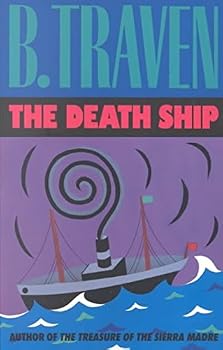
The other unfinished book is "The Death Ship" by B. Traven who is best known for his novel "The Treasure of Sierra Madre" written in 1927 and made into a cult film starring Humphrey Bogart which won three Academy Awards in 1949. Traven is almost certainly an alias and little is known about his real name and place and date of birth. The main character of the novel is Gerard Gales, a sailor who, having lost his documents, virtually forfeits his identity, the right to normal life and a home country and, consequently, is forced to work as a stoker's helper in extremely difficult conditions on board a "death ship", which sails on suspicious voyages around the European and African coasts. The novel is an accusation of the greed of capitalist employers and a bureaucracy of officials who deport Gales from the countries where he seeks refuge.
| |
The rest of the 1926 books include the genres of theater, poetry, mysteries, and children's books. Sean O'Casey's play, "The Plough and the Stars" caused a riot when it was first performed at the Abbey Theater in Dublin in 1926. It's the story of a group of working class Irish living in a tenement in Dublin in 1916 as they prepare to engage the British in the Easter Rebellion. The charwoman, the fruit peddlar, the carpenter, the butcher, and others take up arms under the starry flag of the Irish Citizen Army in a doomed fight against their colonial oppressors. The book provides a powerful background for Ireland's Troubles that followed. Strongly dramatic, the play has lost none of its impact. I imagine that seeing it on stage would be an overwhelming experience. It continues to be performed today with a recent run by the National Theater.
| |
Langston Hughes is considered the leading light of the Harlem Renaissance. A poet, playwright, novelist, and activist, he turned away from the Black middle class's attempts at assimilation and extolled the Black's 'low life' arts of jazz, dance, and poetry. His poem "I, too, sing America" is his most famous and is the final poem in "The Weary Blues", his first published book. The poems reflect his engagement with the often grim reality of being Black in America in the early 20th C. Weary is the feeling that comes through repeatedly but always accompanied by the joy found in music and dance. His volume in the Library of America series speaks to his increasing recognition. This book is a fine introduction to his work.
|
| | | Agatha Christie remains one of the most popular writers of all time with her 66 mystery novels and 14 collections of short stories continuing to sell 50 years after her death. It's estimated that her novel "And Then There Were None" has sold 10 milion copies, and her play, "The Mousetrap" had its 30,000th performance in London's West End in 2025. We saw it there in 1971! "The Murder of Roger Ackroyd" is the classic British closed door mystery and was chosen by the Crime Writers of America as #12 on its list of the 100 best mysteries. Its final scene when Hercule Poirot confronts the potential suspects before identifying the surprise perpetrator is a treat. On this, my second reading in the last few years, I was, however, a bit bored. It turns out that for a mystery to be effective, one has to really care about the characters and what happens to them. I didn't, and this ennui was shared by Edmund Wilson, the critic, when he wrote a 'New Yorker' piece in 1945 entitled "Who Cares Who Murdered Roger Ackroyd". I'd have to agree with him.
|
| | | And that takes us to Winnie the Pooh, A.A. Milne's wonderful book that he wrote to entertain his son. Milne was a graduate of Cambridge, an assistant editor at "Punch", and a successful playwright and novelist when he decided to write a series of stories to entertain his four year old son, Christopher Robin. Featuring Edward Bear, nicknamed Winnie after a bear at the London Zoo, Milne introduced his son's other stuffed animals Piglet, Eeyore, Owl, Rabbit, Kanga, and Roo to the reading public. The stories were a hit, but Milne chafed as his other literary accomplishments faded from view and he became identified solely with the cute little bear. The 100th anniversary of the book has been celebrated by Disney who bought the rights to it in 2001 for $350 million, not a bad investment for a franchise that is second only to Mickey Mouse in profits. The BBC's "Big Read" poll ranked "Winnie the Pooh" #7 on their list of readers' favorite novels. Sadly, Milne and his wife became estranged from their son who resented their thrusting him into the public eye. I enjoyed the charming, endearing dialogue between this bear and his friends, but the Milne/Christopher Robin story is ultimately a sad one.
And finally, under the heading of Errata, two alert and erudite readers identified errors in last month's update. Peter, poet, playwright, and critic, noted that it was the Irish writer and author of 'Waiting for Godot', Samuel Beckett and not the beheaded 12th C cleric, Thomas Becket who said "You must go on; I can't go on; I'll go on". And, Richard, retired law professor and lunch partner, noted that reports of Calvin Trillin's death were vastly exaggerated. My apologies to Calvin, and my thanks to Peter and Richard.
The Poetry Tree on the Charles features four poems by Langston Hughes from his first volume "The Weary Blues". A "Collected Poems" was published in 1994 containing all 868 poems written by this iconic Harlem Renaissance poet. I've chosen to feature these four from his initial volume.
- I, too, Langston Hughes
- The Negro Speaks of Rivers, Langston Hughes
- The Weary Blues, Langston Hughes
- Mother to Son, Langston Hughes
We're in the Berkshires this weekend to celebrate the 80th birthdays of dear friends, and a visit to The Mount, Edith Wharton's stunning home and grounds provided this quotation which referred perfectly to my dear wife and editor: "Each time you happen to me, all over again."
| |