|
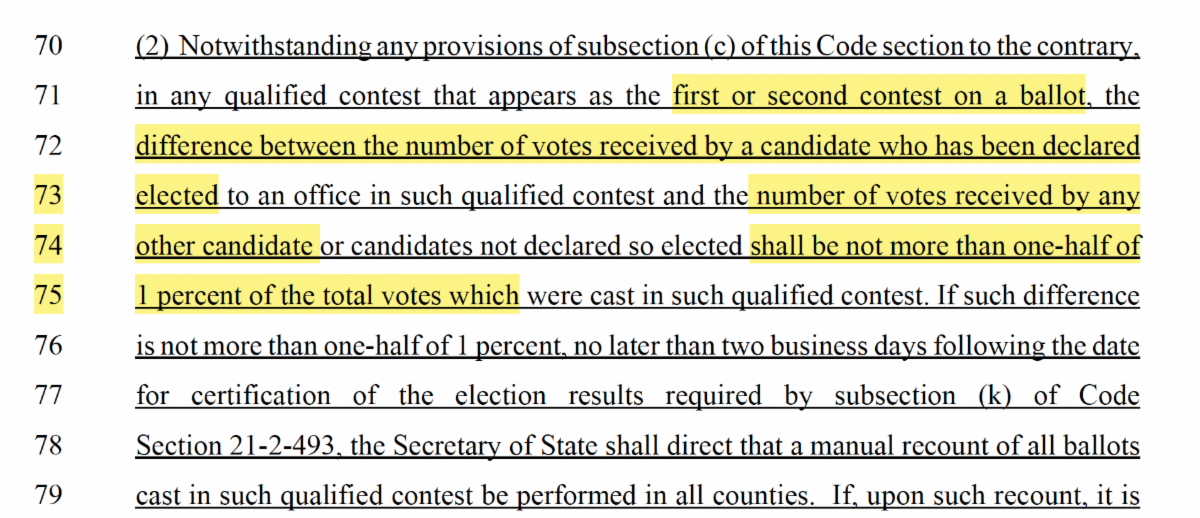
Under the bill’s literal wording, certain statewide candidates may win—but not by very much.
Even after the Democrats called the attention to the drafting error on the Senate floor, Senator Burns, the bill sponsor, stubbornly insisted that there was no error. The Democrats decided to vote for it anyway, along with all the other major problems in the bill.
While the drafting error will almost certainly be corrected in a future legislative session, it serves as a cautionary example of what happens when complicated election legislation is drafted, negotiated, generally behind closed doors, and passed at breakneck speed, with the public and Democrats not permitted to see bill drafts until moments before votes were taken.
The Recount Red Herring
Drafting error aside, after days of nonsensical uninformed endless infighting about manual recounts, the legislature’s great recount reform amounts to this: if a statewide candidate loses by less than one-half of one percent and forgets, or declines to ask for a recount, the state will recount anyway.
That is the practical effect of the provision that consumed so much legislative attention. In fact, its practical effect is laughably small. How many statewide candidates who lose a race by less than ½% are going to forego their free recount option? Was this worth days of legislative time and escalating acrimony?
Georgia law has long provided for recounts (hand recounts) in two circumstances:
1. Close-Margin Recounts
A candidate may request a recount when the difference between the top two candidates is one-half of one percent (0.5%) or less of the total votes cast in that contest.
2. Discretionary Recounts
Election officials may also conduct a recount when substantial questions, anomalies, or potential errors suggest that further review is warranted. This authority is rarely exercised.
Hand Recounts Required Since 2019
Since Georgia adopted the Dominion ballot-marking-device system in 2019, state law has required recounts to be conducted manually. Many of the legislators debating the bill’s requirements to hand recount certain races appeared unaware of this fact. (They were arguing against long standing law, apparently unaware of the law.)
Part of the confusion may stem from State Election Board rules (conflicting with law) adopted years ago under then-Secretary of State Brian Raffensperger’s chairmanship. Those rules created confusion by instructing using machines for recounts, even though it was acknowledged at the time his demand for machine recounts conflicted with Georgia’s statutory recount requirements, which of course control, making the SEB rules inapplicable.
Georgia’s manual recount requirement is not unusual. Manual recounting of very close races is the proper manner of resolving close contests. Election experts, the National Academies of Sciences, and even the State's experts in the Curling litigation, confirm the need for manual review for such recount purposes, as has long been embedded in Georgia law.
Democrats led the charge in trashing such recounts, despite the science and the current law, and with no basis, insisted that machine recounts should be used. It was a huge uniformed mess of a “debate.” It is obvious that in a very close margin race, you want to be certain that the machine got it exactly right. You don’t do that by sending the ballots back through the same (possibly erroneously programmed machine.)
As a result, many of the criticisms and outrage directed at “manual recounts” during debate were actually uninformed criticisms of existing Georgia law rather than changes made by this bill.
What Recount Law Changed?
Prior to passage of 3EX, all close-margin recounts occurred only if a candidate requested one.
The candidate paid no fee, but the candidate had to make an affirmative request. Losing candidates always do, of course.
The new bill changes that rule for certain statewide state offices. If one of those races falls within the 0.5% recount threshold, a recount becomes mandatory rather than optional.
Notably, this change does not apply to federal races.
In other words, the legislature spent days acrimoniously creating a provision that addresses the highly unlikely circumstance in which a losing candidate for statewide office forgets to, or declines to ask for a recount!
A Wasteful Result
Ironically, the bill’s new audit provisions may create situations in which election officials conduct a risk-limiting audit and then conduct a full recount of the same race only days later.
That means election officials could end up manually reviewing the same contest twice through separate processes.
Meanwhile, legislators continue to exempt their own legislative races from being audited! That should tell you something.
Bottom Line
After hours of acrimony and baseless claims made on both sides, the recount controversy ultimately boils down to a simple change:
For a limited category of statewide races, if a candidate entitled to a recount fails to request one, the recount will occur automatically.
While the recount provision is far from the most consequential part of the bill, recounts consumed an extraordinary amount of floor speeches (not debate) and little of substance was discussed or in the committees. Instead of addressing the major public-policy questions raised by the bill, we got lengthy diatribes over a provision that affect only a narrow set of unlikely circumstances. And far more urgent policy matters are left festering, such as the “QR Code” issue, which was not resolved, despite the press reports to the contrary.
Stay tuned for more in the series where we will explain:
1) why the QR code ban “deadline” was not resolved (despite inaccurate claims that it was.)
2) how the bill created conflicting laws about the next voting system
3) why the new voting system contract is wired to give one single vendor the contract.
Georgians should hold their lawmakers accountable for the increasing mess they are creating with their continued reckless handling of the electors’ votes.
👉🏼Sign up here to be sure you are on our Special Session Voting System Explainer List.
❓ If you have questions about this Explainer, feel free to post them here.
|