Community & Economic Development Manager's Notes: | |
All funding opportunities in this newsletter are federal grants. Kerr-Tar Regional Council of Governments is committed to vetting funding for member governments throughout the region. If you have a project that does align with the opportunities listed here, please reach out to our office so that we may provide technical assistance in supporting project development.
Thank you for all you do for the Kerr-Tar region,
Desiree Brooks
| | Midsize and Large Drinking Water System Infrastructure Resilience and Sustainability Program | |
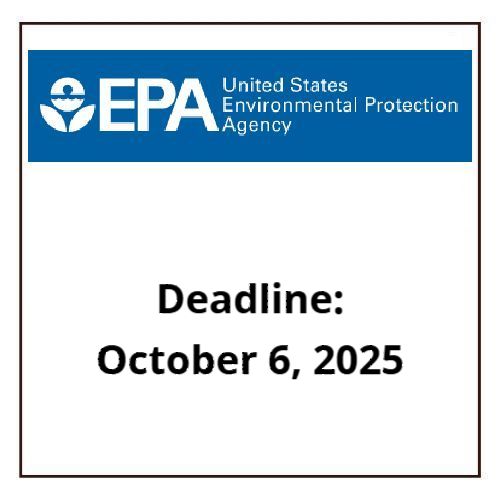
This grant program assists medium and large size public water systems with protecting drinking water sources from natural hazards, extreme weather events, and cybersecurity threats.
Eligible applicants for this grant program include public water systems that serve a population of 10,000 people or more. Projects or programs that may be funded through this opportunity are those which aim to increase the resilience of a water system to natural hazards, extreme weather events, or reduce cybersecurity threats.
A midsize community is identified in Section 1459F(f)(2) of the SDWA as one that has a population of equal to or greater than 10,000 individuals and fewer than 100,000 individuals, and a large community is identified as one that has a population equal to or greater than 100,000 individuals. NOFO
Award: $1,187,500 - $2,375,000
Match: 10% of Project Cost
| | OJJDP FY25 Internet Crimes Against Children Data System Enhancements | |
This NOFO will support the maintenance and enhancement of the Internet Crimes Against Children Data System (IDS), which assists credentialed law enforcement investigators in quickly and securely accessing information involving the online exploitation of children. Specific enhancements will focus on work reduction, deconfliction and deduplication of casework, and improving CyberTip management. Training and technical assistance will be provided to the ICAC task forces and their federal law enforcement partners on using the system. Eligible Applicants include Special district governments,
Nonprofits that do not have a 501(c)(3) status with the IRS (other than institutions of higher education,) Public and State controlled institutions of higher education, City or township governments, Native American tribal governments (Federally recognized), County governments, For profit organizations other than small businesses, State governments, Private institutions of higher education, Native American tribal organizations (other than Federally recognized tribal governments), Nonprofits having a 501(c)(3) status with the IRS (other than institutions of higher education,) and units of local governments.
Award: $900,000
Match: None
| | Promotion of the Humanities Research | |
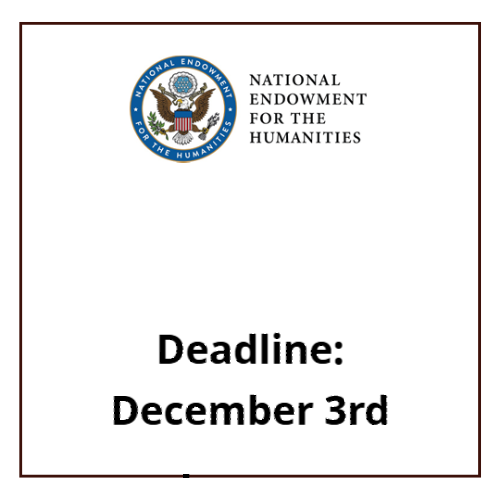
The National Endowment for the Humanities (NEH) Division of Research Programs is accepting applications for the Scholarly Editions and Translations program. This program supports collaborative teams who are editing, annotating, and translating foundational humanities texts that are vital to generating new scholarship but are inaccessible or only available in inadequate editions or translations. NOFO
Award: $1 - $450,000
- Planning: Up to $65,000
- Implementation: Up to $100,000 per year in outright funds, plus an additional $50,000 in matching funds, for a maximum of $150,000 per year and a maximum of $450,000 per award.
Match: None
| |
Region 4- Environmental Justice Thriving Communities Grantmaking Program (EJ TCGM) | |
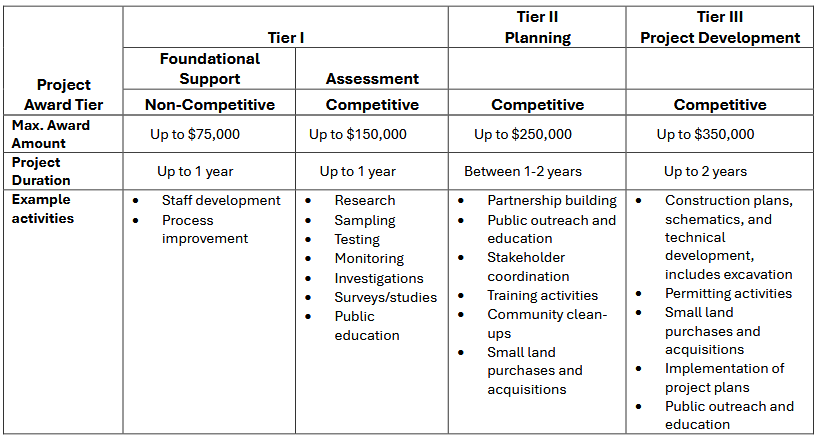
The EPA has selected Research Triangle Institute to serve as a pass-through entity for the Environmental Justice Thriving Communities Grantmaking Program (EJ TCGM) to address environmental justice and public health issues in underserved communities. They will provide subgrants to community-based nonprofits and other eligible subrecipients for assessment, planning, and project development activities. They will alleviate much of the burden that the federal grants process places on small, resource-constrained community-based organizations supporting underserved communities and marginalized populations.
Frequently Asked Questions: FAQ
Dates to Submit for Funding:
- April 30, 2025
- July 31, 2025
- October 31, 2025 (Last date for 2-year projects)
- January 31, 2026
- April 30, 2026
- July 31, 2026
- October 31, 2026 (Last date for 1-year projects)
- January 31, 2027
- April 30, 2027 (Last date for 6-month projects)
Match: No
Program Fact Sheet: One-pager
| | Water & Waste Disposal Loan & Grant Program | | |
The Water & Waste Disposal Loan & Grant Program provides funding for clean and reliable drinking water systems, sanitary sewage disposal, sanitary solid waste disposal, and storm water drainage to households and businesses in eligible rural areas.
Who may apply?
This program assists qualified applicants who are not otherwise able to obtain commercial credit on reasonable terms. Eligible applicants include:
What is an eligible area?
Areas that may be served include:
What kinds of funding are available?
- Long-term, low-interest loans
- If funds are available, a grant may be combined with a loan if necessary to keep user costs reasonable.
How may the funds be used?
Funds may be used to finance the acquisition, construction or improvement of:
- Drinking water sourcing, treatment, storage and distribution
- Sewer collection, transmission, treatment and disposal
- Solid waste collection, disposal and closure
- Storm water collection, transmission and disposal
In some cases, funding may also be available for related activities such as:
- Legal and engineering fees
- Land acquisition, water and land rights, permits and equipment
- Start-up operations and maintenance
- Interest incurred during construction
- Purchase of facilities to improve service or prevent loss of service
- Other costs determined to be necessary for completion of the project
-
See 7 CFR Part 1780.7 and 1780.9 for a complete list
| |
Agriculture Innovation Center Program
| |
Through the AIC program, RBCS makes grants to Centers that provide Producer Services to Agricultural Producers seeking to develop and market Value-Added Agricultural Products.
Matching Funds Requirement:
Matching Funds are required for at least one-third of the total project budget. For example, if the total project budget is $1,500,000, matching funds must be at least $500,000. Matching funds may be provided in cash by the applicant or a third party or in-kind by a third party. They must be available for use during the period of performance, and they must be used for allowable expenses.
How may funds be used?
Grant and matching funds may be used to operate an agriculture innovation center, and to provide the following services to agricultural producers:
- Business development services, such as feasibility studies and business plans..
- Market development services, such as marketing plans, branding, and customer identification.
- Organizational assistance, such as legal and technical advisory services related to the development, expansion, or operation of a business.
- Financial advisory services related to the development, expansion, or operation of a business, such as assistance with obtaining credit for operating costs, training on using financial management software, and guidance on use of cash flow.
- Process development services, such as engineering services, scale production assessments, and systems development.
- Product development, such as idea generation, concept testing, feasibility and cost analysis, product taste-testing, demographic and other types of consumer analysis, production analysis, recipe development, evaluation of packaging and labeling options, and brand development for a value-added agricultural product.
- Value chain coordination, or directly working with an agricultural producer to connect that producer to a distribution system, processing facility, or commercial kitchen.
- Grants to agricultural producers for the above services, where the individual award does not exceed $5,000.
| |
Community Facilities Direct Loan & Grant Program in North Carolina
| | |
This program provides funding for the development of essential community facilities in rural areas. Eligible projects must deliver critical services that support the orderly development of local communities and cannot be private, commercial, or business-related. Funding may be used to construct, expand, or improve facilities such as healthcare centers, public safety buildings, schools, and other essential infrastructure. Eligible applicants include public bodies, community-based nonprofit corporations, and federally recognized tribes. The program is available in rural areas, including cities, villages, townships, and tribal lands with populations of 20,000 or fewer, as determined by the latest U.S. Census data.
How may funds be used?
Funds can be used to purchase, construct, and / or improve essential community facilities, purchase equipment and pay related project expenses.
Examples of essential community facilities include:
- Health care facilities such as hospitals, medical clinics, dental clinics, nursing homes or assisted living facilities
- Public facilities such as town halls, courthouses, airport hangars or street improvements
- Community support services such as child care centers, community centers, fairgrounds or transitional housing
- Public safety services such as fire departments, police stations, prisons, police vehicles, fire trucks, public works vehicles or equipment
- Educational services such as museums, libraries or private schools
- Utility services such as telemedicine or distance learning equipment
- Local food systems such as community gardens, food pantries, community kitchens, food banks, food hubs or greenhouses
| | | | |