Basin and Range Watch
Defending the Desert
December 11th, 2021
|
|
Oppose the Rough Hat Clark County Solar Project!
Sample Letter to Send Below
|
|
Candela Renewables, LLC has applied to the Bureau of Land Management (BLM) Las Vegas Field Office for a right-of-way for the construction and operation of the Rough Hat Clark County Solar Project, a photovoltaic solar power project including a battery storage facility on BLM-managed public land designated as a solar variance area in Clark County. The Rough Hat Clark County Solar Project includes up to a 400 MW alternating current solar photovoltaic power generating facility with energy storage on approximately 2,400 acres (3.75 square miles) of BLM-managed public land located in the Pahrump Valley in Clark County immediately adjacent to the county line, southeast of the Town of Pahrump and approximately 38 miles west of Las Vegas. The Rough Hat Clark County Solar Project would cover the desert habitat with photovoltaic panels. The electricity would be delivered to a proposed onsite substation, where it would then be transferred to the BLM-approved Trout Canyon Substation via a new 230 kV gen-tie transmission line and export all energy to California. The BLM has already approved the Yellow Pine Solar Project with grave impacts to the desert tortoise and has plans to sacrifice a total of 18,000 acres (nearly 30 square miles) for 5 solar projects in this part of of the Mojave Desert.
|
|
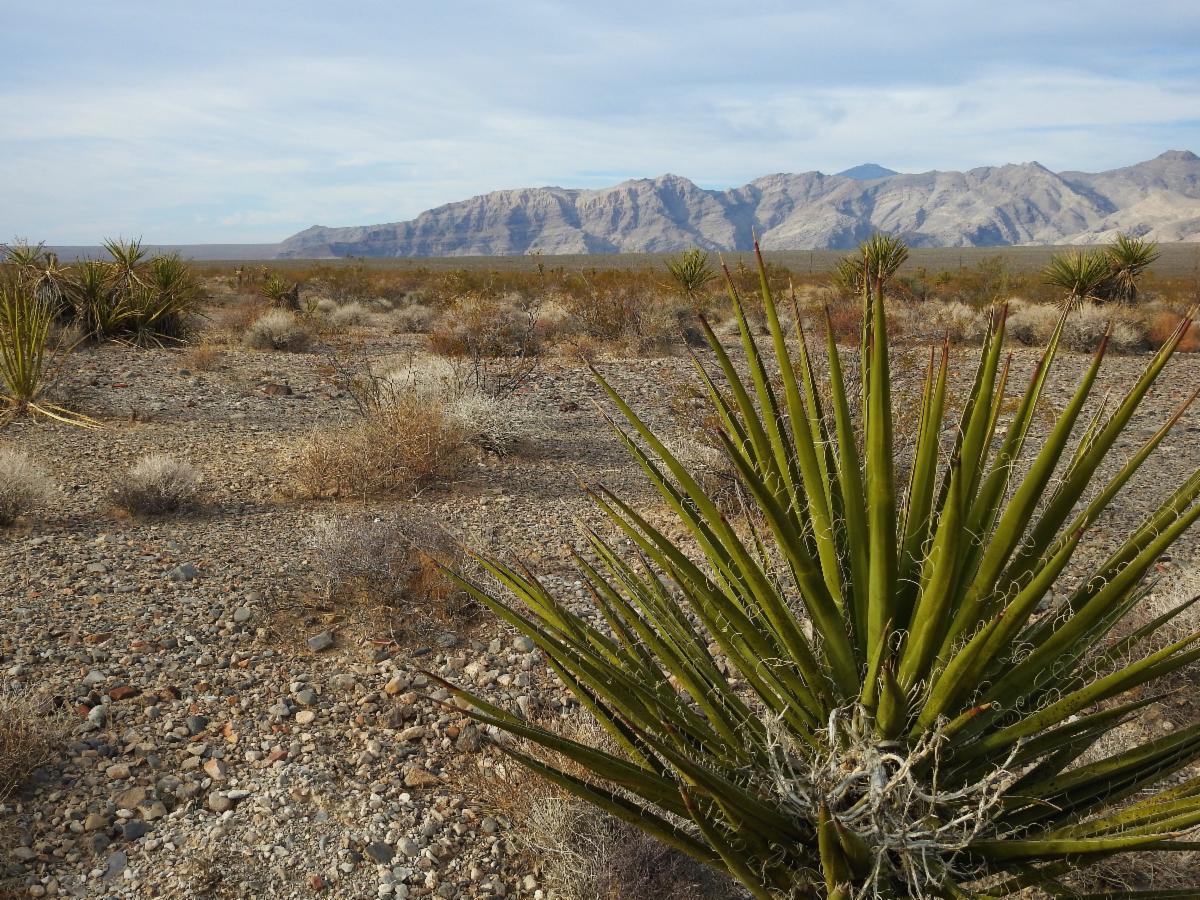
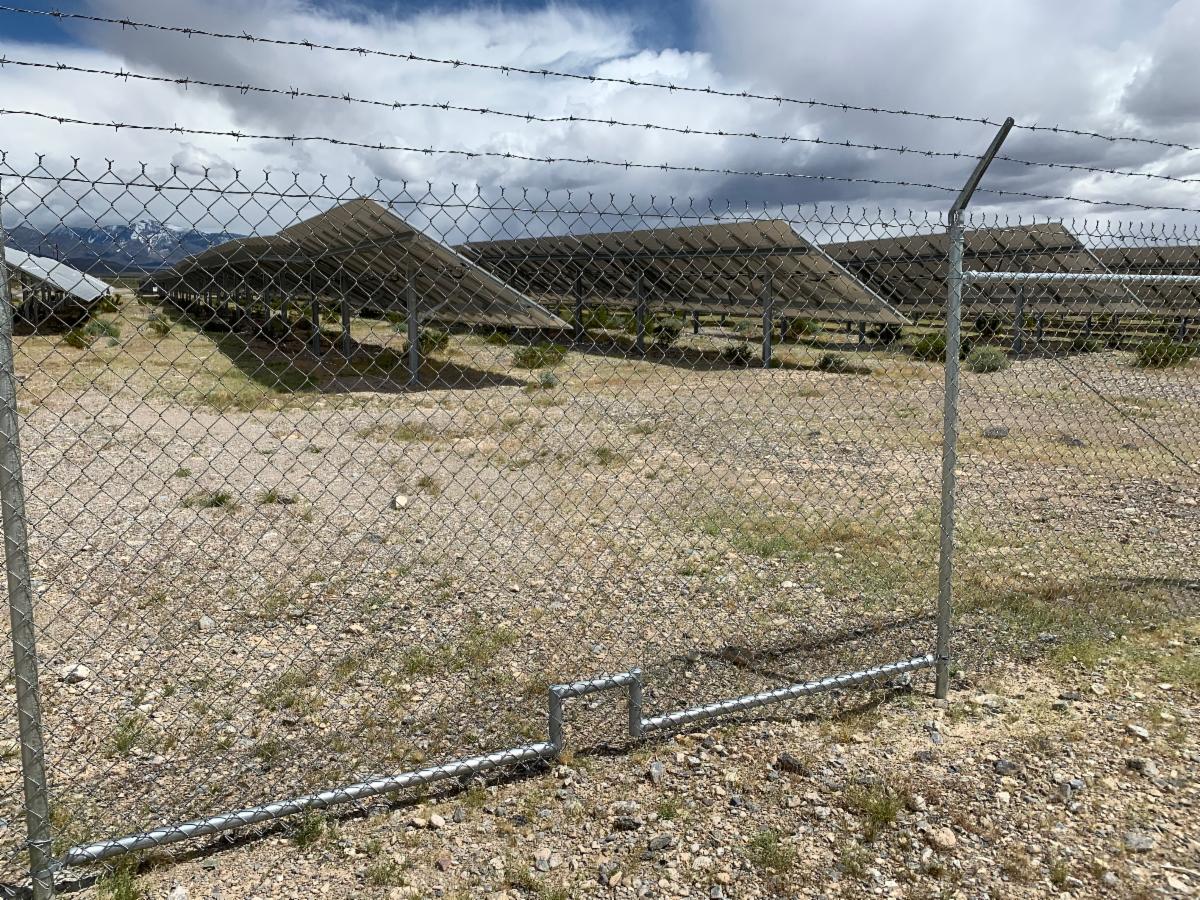
^ Before and After? The photo on the left is part of the 2,400 acre Rough Hat Clark County Solar proposed project site. The photo on the right is the construction phase of the 4,000 acre Blythe Solar Project near Blythe, California in 2015.
|
|
Degrading Desert Tortoise Habitat on Public Lands
The proposed Rough Hat Clark County Solar Project is located in the Eastern Mojave Recovery Unit for the federally threatened Desert tortoise (Gopherus agassizii) . Even with adequate monitoring and vegetation mowing, the development and operation will likely kill, injure and displace several individual desert tortoises.
Candela Renewables surveyed two of their proposed sites Rough Hat Clark and Rough Hat Nye on over 5,000 acres and consulting biologists observed 80 live adult tortoises and 854 desert tortoise burrows. Even the most experienced desert tortoise biologists end up missing a significant number of hatchlings and juveniles. The surveys took place for 12 days in May of 2021 which has been a record-breaking drought year. The company's consulting biologists have claimed their surveys were conducted with a 95 percent confidence interval, but the BLM agency biologists said these surveys were conducted with only a 64 percent confidence interval due to unfavorable conditions.
|
|
All tortoises would be excavated from their burrows and translocated to the Stump Spring Translocation Area across the Tecopa Road, and the Trout Canyon Translocation Area. Recently, the translocation for the adjacent, approved Yellow Pine Solar Project resulted in the predation of 30 of the moved tortoises by badgers which are not common desert tortoise predators. This could very well be because they moved the tortoises during a record- breaking drought year and the badgers were desperate for food. Common problems that result from translocation of desert tortoises include:
-
Predation - Savvy predators like coyotes will often keep track of recently moved, disoriented desert tortoises, and they have reduced tortoise numbers on certain translocation projects. A bigger problem on drought years. Ravens also search out newly-moved tortoises.
-
Overheating (Hyperthermia) - Translocated tortoises often become disoriented and will seek out their former homes. In many cases, tortoises overheat doing this. They have been observed pacing recently built fences searching for former burrows and water sources. Tortoises are ectothermic (cold-blooded) and do not internally regulate their body temperature that well.
-
Lack of Reproductive Success - A recent Smithsonian study found that translocated male desert tortoises are not reproducing.
Has the desert tortoise population on the Rough Hat Clark Solar site been undercounted?
The BLM issued a "High Priority" status for the Rough Hat Clark Solar Project in August 2021. The report claims that the density of desert tortoises is 3.04 per square miles and it is basing the number on surveys that took place over 30 years ago. The recently approved 3,000 acre Yellow Pine Solar Project ended up moving 139 desert tortoises off of the site. But they only predicted that they would find 53 adult desert tortoises. Before the desert tortoise clearance happened starting in April of 2021, BLM predicted that only 3.04 desert tortoises per square mile would be found on the Yellow Pine site, but the numbers were higher.
The Rough Hat Clark site is even higher in elevation than Yellow Pine containing some Joshua trees. This would also indicate a higher desert tortoise density.
Clearly the BLM should require Candela Renewables to go back to the drawing board and start brand new tortoise surveys.
The desert tortoise is now included in the global list of the top 50 turtle and tortoise species at greatest risk of extinction.
According to tortoise biologists: "Prevailing declines in the abundance of adults overall and in four of the five recovery units indicate the need for more aggressive implementation of recovery actions and more critical evaluation of the suite of future activities and projects in tortoise habitat that may exacerbate ongoing population declines. G. agassizii is now included in the list of the top 50 turtle and tortoise species at greatest risk." (from Allison, L. J. and A. M. Mcluckie. 2018. Population Trends in Mojave Desert Tortoises (Gopherus agassizii). Herpetological Conservation and Biology 13(2):433–452.)
Crushing Desert Ecosystems
Candela promises to mow desert vegetation to 18 inches on the entire 2,400 acres. They will use large mulchers not unlike these GT-25XP Heavy Duty Mulchers. No vegetation would be allowed to regrow over 24 inches. While this reduces impact from traditional methods, it is essentially allowing vehicles far more heavy than any recreational off highway vehicle to crush this habitat. All life left on this site, from biological soil crusts to kangaroo rats to Mojave yucca, will be crushed and shredded. Any animals not crushed will most likely be deafened by the noise. Mojave yuccas generally do not survive this kind of development. and the bulk of vegetation regrowth is invasive weeds.
|
|
*The GT-25XP Heavey Duty Mulcher |
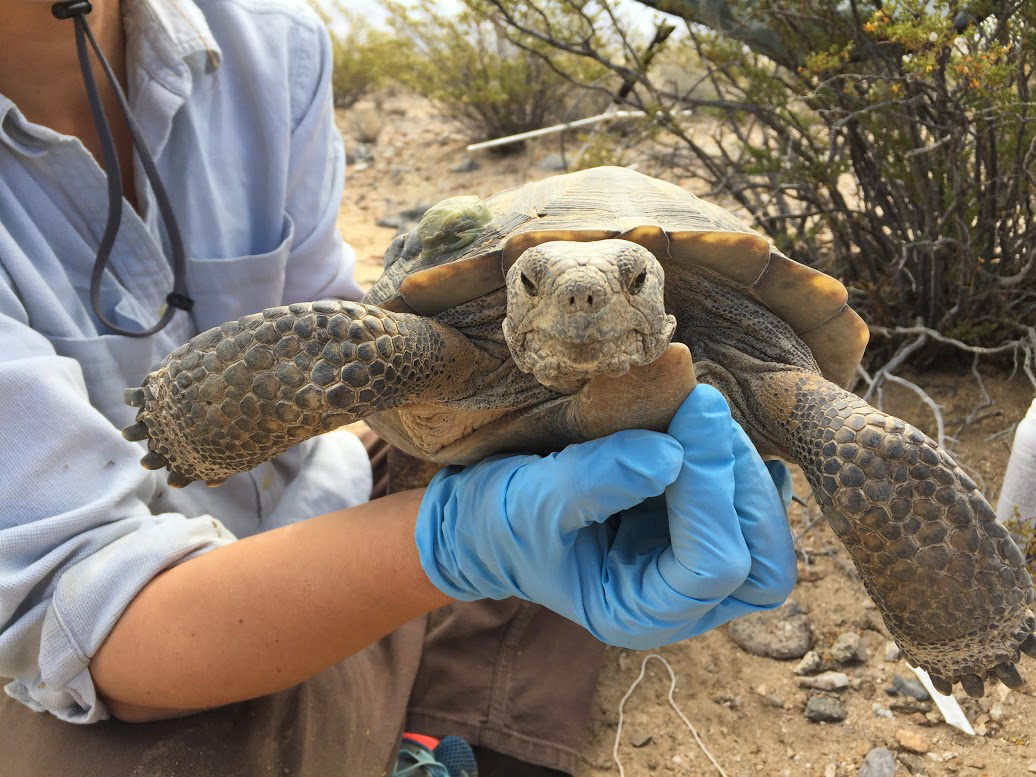
^Desert tortoise biologist moving and checking a desert tortoise |
|
^Invasive annual grass revegetating a Solar Project near Pahrump, Nevada |
^Desert Tortoise (Gopherus agassizii)
|
|
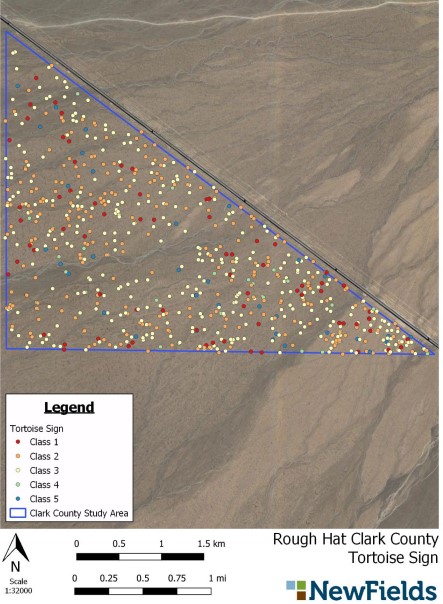
^Map of live tortoises found on the Rough Hat Clark Solar project site |
|
Loss of Wildlife and Rare Plants |
|
The proposed project would be developed on a diverse and undisturbed Mojave Desert habitat. The vegetation is characterized by creosote and white bursage mixed with mid-elevation Mojave Desert plants. The site supports a host of species such as burrowing owls, kit foxes, kangaroo rats, big galletta grass, fluff grass, Desert iguana, Parish club cholla, Mojave yucca, Joshua tree, California kingsnake, Pahrump buckwheat, American badger, western banded gecko, and beavertail cactus to name just a few.
|
|
^Parish's club-cholla (Grusonia parishii)
|
^Biological soil crusts are undisturbed on the project site |
^Mojave aster (Xylorhiza tortifolia)
|
^Desert tarantula (Aphonopelma chalcodes)
|
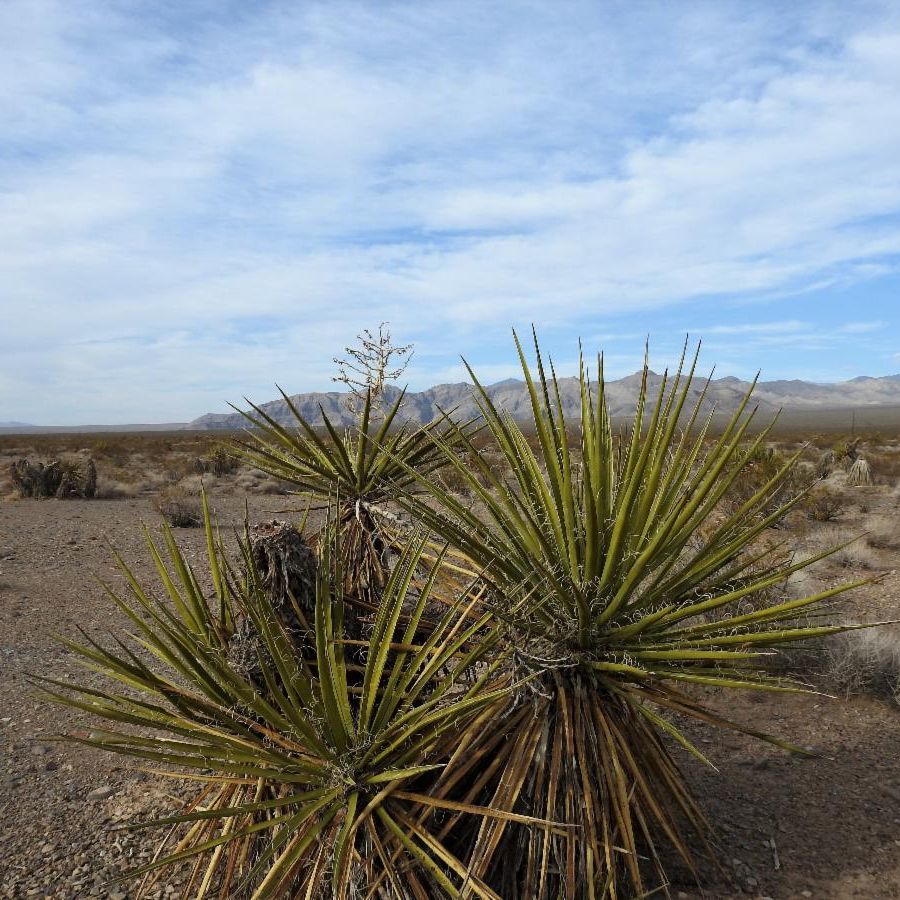
Mojave yuccas (Yucca schidigera) can live to be over 500 years old and provide habitat, shelter and food for multiple species. Nearly 70,000 will be destroyed for the Rough Hat Clark Solar Project
|
|
^Mojave Desert Sidewinder (Crotalus cerastes)
|
American Badger (Taxidea taxus)
|
^American kestral (Falco sparverius)
|
^Desert Iguana (Dipsosaurus dorsalus)
|
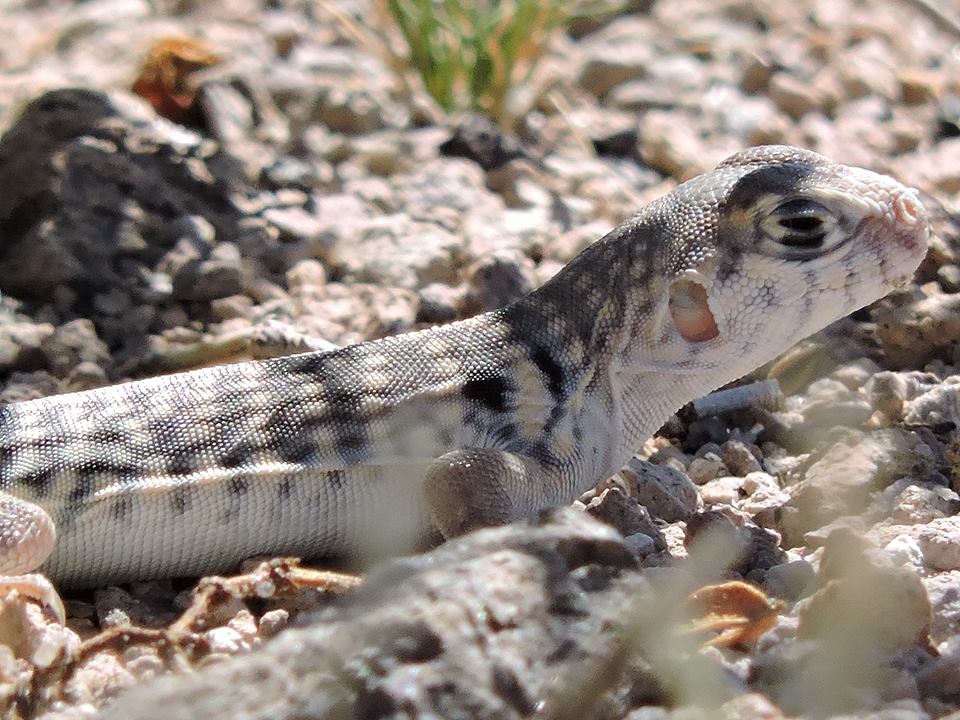
^Great Basin collared lizard (Crotaphytus bicinctores)
|
|
|
|
Large numbers of bird mortalities have been detected on utility-scale solar projects, and many scientists believe that they are creating a polarized glare or lake effect that causes birds and insects to be deceived and collide with solar panels or simply dehydrate after landing. The avian impacts are not fully understood, but everyone seems to agree that this problem was underestimated during the initial boom to fast-track big solar on both public and private lands in the Southwestern US.
Data gathered from seven solar projects in the southern California desert and arid grassland habitats from 2012 through April 2016 show that 183 bird species have been killed at solar projects, a number that rises with new information. 3,545 individual birds were reported dead at solar projects.
The Rough Hat Clark Solar Project would be built within 6 miles of Stump Spring and 30 miles from the Amargosa River and has the potential to attract birds.
|
|
The Old Spanish Trail was in use between 1829 and 1848. Spain searched for a trade route between New Mexico and California in the 1700s. Traders with mule caravans stopped here as early as 1829, using the area as a link from the abundantly watered flowing springs of Las Vegas -- "The Meadows."
Congress designated the area as part of the Old Spanish Trail in 2002. Several segments in Nevada are listed in the National Register of Historic Places.
The Trail was based on a prior Native American route.
The trail goes through the Pahrump Valley and developing 5 massive solar industrial projects in the area will destroy the historic character of the region.
|
|
Impacts to Visual Resources
A 3.7-square-mile development (right) would be visible for great distances. The visual contrasts would be visible from over 25 miles away. Covering that much land with solar panels would completely change the entire landscape. The project would be visible from Mt Charleston, Highway 160, California wilderness areas such as the Kingston Range and the Nopah Range and will create a very unnatural change to the landscape.
|
^Public BLM road closed off for the Palen Solar Project, California |
|
^Above is the Silver State South Solar Project near Primm, Nevada. |
|
With all of the new construction projects happening in the Las Vegas region, renewable energy can be utilized on rooftops and above parking lots. The US Department of Energy says, “The number of U.S. households with rooftop solar is rapidly growing. The amount of grid-connected solar is expected to double in just two years. With this large number of PV homes in the U.S. and a continuing robust market for additional PV installations, an ever-increasing number of PV homes will likely be sold or refinanced.” Building the remote Rough Hat Clark Solar Project will require cooling of the batteries on site and they may use air conditioning to do so. How efficient is this?
|
|
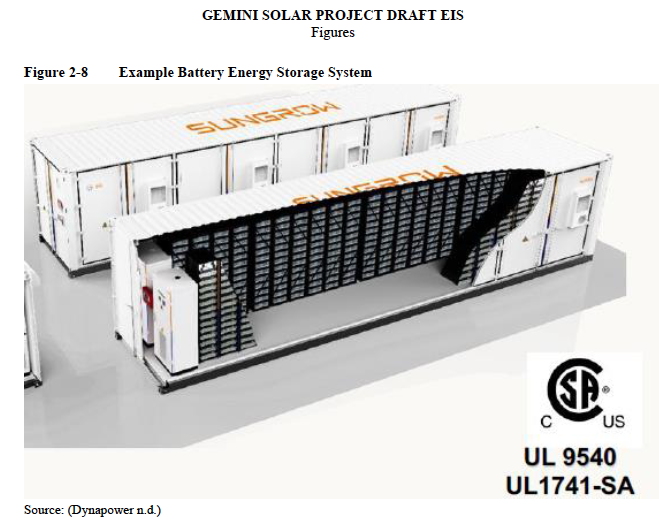
Rough Hat Clark Solar will have an on-site battery storage facility which will have to be cooled with air conditioning in the summer. The batteries will most likely need to be cooled during hot summer nights when the sun is not shining. This will require a "parasitic load" off the existing power grid to run these air-conditioning units, to cool the battery banks in the hot desert. Is this the most efficient way to store energy - in batteries? |
|
Dust control in hot, arid climates is very problematic. The removal of established vegetation, biological soil crusts and centuries old desert pavement creates opportunities for dust to be airborne every time the wind blows. Not only does fugitive dust create problems for visual and biological resources, it creates issues for public health as well. In 2013, 28 workers were sent home with valley fever during the construction of the Topaz Solar Project in California. The above photo shows out of control dust from the Sunshine Valley Solar Project, Amargosa Valley, Nevada construction - 2019
|
|
Sample Letter to Send to BLM |
|
The BLM will be accepting comments on the Variance Process for the Rough Hat Clark County Solar Project until December 22nd, 2021.
Comments can be sent to: BLM_NV_SND_EnergyProjects@blm.gov or mailed to at BLM Southern Nevada District Office, Attn: Rough Hat Clark County Solar Project Variance, 4701 N. Torrey Pines Drive, Las Vegas, NV 89130.
Below is a sample letter you can copy and send to BLM. Please personalize the message to give them a diverse selection of comments. Your own ideas will make a difference to them when considering comments.
"Please use the Variance Process to reject the application for the Rough Hat Clark County Solar Project.
Approval of the project would result in the removal of over 69,000 old growth Mojave yuccas and cacti which are not known to return after being bulldozed. Many of the plants are hundreds of years old and provide habitat and food to the wildlife of the area.
The project site is located in important desert tortoise habitat. Candela did their desert tortoise survey in May of 2021 - a record breaking drought year - not optimal conditions for tortoise surveys. When desert tortoises were moved off the Yellow Pine Site in May, 2021 just to the south of the Rough Hat Clark site, nearly 3 times more tortoises than predicted were found and 30 of the 139 moved were killed by hungry badgers in drought conditions . Please do not allow a repeat of the recent desert tortoise disaster that took place on the Yellow Pine Solar site. Please require Candela Renewables to conduct new tortoise surveys.
The project site contains old biological soil crusts and desert pavement that is about 100,000 years old. Removal of the desert surface will result in uncontrollable fugitive dust. This will impact public health in nearby Pahrump, Nevada.
The project site contains hundreds of rare Parish Club Cholla, scattered Joshua trees, kit fox, desert iguana, burrowing owl, coyote and several other species. Millions of living organisms would be killed in the construction of the project.
Solar projects can mimic lakes and will often kill a number of bird species. The project would be in the vacinity of Stump Spring and the Amargosa River which attract several birds.
The project would be located near the Old Spanish National Historic Trail. Developing 5 large solar industrial projects in the area will destroy the historic character of the region.
The project will cut off access to 3.75 square miles of public land and be visible from recreation trails, Highway 160, Mt. Charleston, the Kingston Range Wilderness in California and the South Nopah Range Wilderness also in California.
The project application recieved a High Priority status becuse BLM claimed it has low conflicts. But the BLM can change that status and cancel the review of this project based on new information. The higher than predicted population of desert tortoises on the Yellow Pine Solar site to the south could be the information used to cancel the review of this application.
To preserve diverse Mojave Desert Habitat on public lands and the quality of life in Pahrump, Nevada, BLM should reject the application for the Rough Hat Clark Solar Project."
|
|
Basin & Range Watch
PO Box 70, Beatty
NV 89003
|
|
|
|
|
|
|
|