GO! Bulletin

2026 DD Legislative Advocacy GO! Day

Standing Up for Disability Justice and Students with IDD

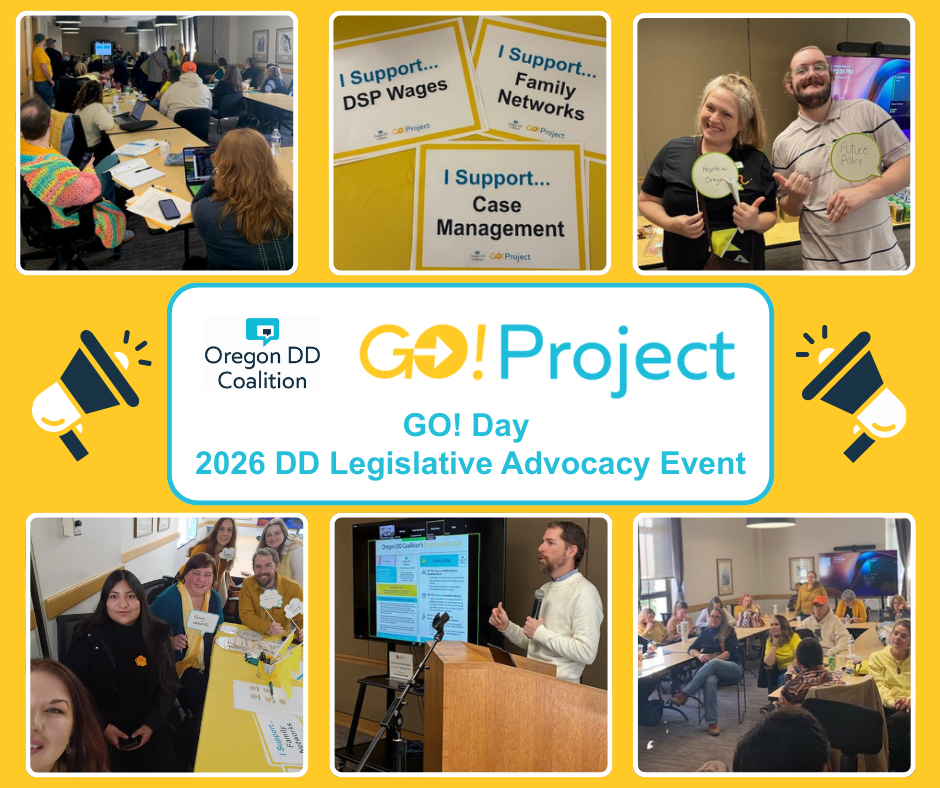
On February 12th, members of the IDD community flooded the State Capitol in big numbers. Nearly 80 advocates, professionals, and supports of those with IDD collected at the State Library of Oregon. They spent the day discussing key legislative priorities, learning about advocacy, and putting those lessons to use testifying and meeting with legislators in the Capitol Building.


Community members shared concerns about key priorities for the IDD community including:


  • Fully funding Case Management, DSP Wages, and peer-driven Self-Advocacy and Family Networks.
  • Avoiding budget reductions that will have detrimental impacts on the IDD service system including proposed eliminations of the Parental Income Disregard, eligibility for individuals with Autism Spectrum Disorder “Level 1”, and delays to provider rate increases that support programs and DSP wages.
  • Public policies including the DD Coalition’s opposition to a Home and Community Based Services Workforce Standards Board (SB 1505), opposition to the removal of children with IDD from classrooms (SB 1572), and support for more wheelchair-accessible housing (SB 1576A).


Advocates Speak Up to Protect Students with IDD from Classroom Exclusion

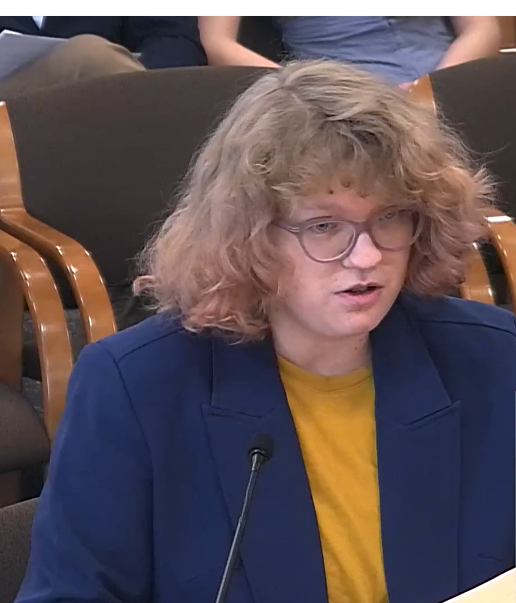
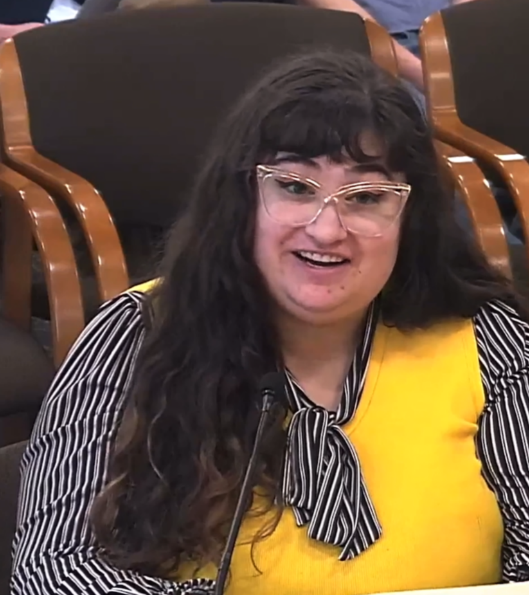
Self-Advocates Emily Williams and Carolina Meyner testify in opposition to Senate Bill 1572.


Some youth advocates with the Transition to Adulthood Council and members of the DD Coalition started their day in the Capitol Building. There, the Senate Committee on Education convened to discuss Senate Bill 1572—a bill devised by Senator Christine Drazan, a candidate for Oregon governor—targeting students with behavioral issues in the classroom. 


What this bill would do:


  • Require each of Oregon’s nearly 200 school districts to develop policies that permit teachers to exclude from the classroom any student who “disrupts” or “repeatedly interferes” in the classroom. 
  • Create reading proficiency standards that require retention of third grade students who do not achieve those standards.


Why this is an issue:


IDD advocates testified that the vagueness and breadth of those standards around disruptions and repeated interference most certainly will result in the exclusion of students with disabilities for behaviors that are a part of their disability.


Under SB 1572, a student can only return to the classroom after a “Placement Review Committee” reviews the case and makes a decision, a process that could take weeks or even months.


What Advocates Had to Say


Committee Chair Senator Fredericks made sure to hear from advocates with disabilities who had lived experience around those issues. 


Emily Williams: "I was one of those kids"


Advocate Emily Williams from Salem testified about the impact this bill would have on students with IDD:


“I oppose this bill because I was one of those kids. I am an autistic adult who had trouble in school due to my disabilities. I still received the education and learning opportunities I needed to thrive and be successful. Because I got that chance, I now have a full-time job and will soon be living on my own. If this bill was passed when I was still a student, I wouldn’t have gotten the opportunities to learn and graduate alongside my peers. I would not be the person you see standing before you today without my education.”


Carolina Meyner: "I see the potential for great harm"


Fellow advocate Maria (“Carolina”) Meyner—a person with disabilities studying accounting and who has experience working with children with disabilities—also testified in opposition to SB 1572. In her testimony, Carolina said,


“Safety and respect are important fundamentals for all students, educators, and people to thrive. I see the potential for great harm to occur [under SB 1572], especially to students with disabilities and their families. There are students with different conditions that might be considered ‘disruptive.’ These students should not be punished or excluded from learning on this basis. I fear for the student with Tourette’s, who blurts out a cuss word unintentionally and is sent to the office. I fear for the autistic student whose auditory stim causes them to miss three days of class and homework. I fear for any student who feels ostracized and isolated from peers on the basis of a condition they did not choose.”


Christy Reese: "We must invest in what we know works"


In closing, Christy Reese—Executive Director of FACT Oregon and an Executive Committee Member of the Oregon DD Coalition—offered real solutions:


“We want safer classrooms, stronger learning outcomes, and we must invest in what we know works, which is evidence-based interventions, staff training, mental and behavioral health supports, and partnerships with families and communities.”


Celebration and a Victory


Carolina and Emily returned to a roomful of self-advocates and peers at the State Library of Oregon, and after hearing about their testimony, the room erupted in cheers. By the end of the day, the GO! Team learned that SB 1572 is dead. After the day’s events, Carolina shared that, as much as she loves math and accounting, she may have discovered a new future using her incredible talents as a disability advocacy. The IDD community couldn’t agree more!


Thank you to all who made this an extraordinary day!

DD Coalition 2026 Short Session:

Key Issues to Watch


The Oregon DD Coalition currently is watching these issues closely:


  • Preserving eligibility for Long Term Services and Support for children with IDD.
  • Stabilizing provider rates that support DSP wages.
  • Stopping the creation of an unrepresentative HCBS Workforce Standards Board.
  • Increasing the supply of accessible housing across the state.
  • Maintaining strong abuse prevention laws for children under care.

Policy Updates


Here is an update on some of the policy issues that the DD Coalition is tracking.


Testify Today on Generating Revenue by Disconnecting from Federal Tax Code


On February 16th, the Oregon Senate passed SB 1507A that proposes a partial disconnect from the federal tax code. The bill is now in the House for consideration. In its current form, the proposed bill would raise $310 million, which would provide the legislature more resources to plug the hole in the budget created by federal House Resolution 1 (July 2025). SB 1507A would help protect funding for critical services like human services, education, childcare, and healthcare for children, seniors, low-income families, and people with IDD. 


The House Committee on Revenue is holding a public hearing today, February 18th, at 3 PM in Hearing Room A at which it will be receiving testimony on the bill. The DD Coalition urges you to submit testimony in support. The agenda for the public hearing and links to register for testimony or submit written testimony can be found HERE.


HCBS Workforce Standards Board (SB 1505)


Senate Bill 1505 is a committee bill put forward by the Senate Committee on Rules, which is chaired by Senator Kayse Jama. It would create a Home and Community Based Services (HCBS) Workforce Standards Board. 


The DD Coalition has provided both oral testimony and written testimony in opposition to the bill, as did several other individual members of the Coalition. There is no Work Session currently scheduled for the bill. We encourage you to contact Committee members directly who are listed HERE to voice your opposition to the bill.


The IDD Community opposes this bill because:


  1. It will lead to loss of individual choice for people with IDD.
  2. It cannot adequately represent the interests of either persons with IDD or the workforce that supports them.
  3. It gives sweeping authority to an unelected Board.
  4. The administrative costs are too great.


Accessible Housing (SB 1576A)


A proposal to improve accessible housing sponsored by Senator Deb Patterson had a work session on Tuesday, February 10th at 3 PM. The Senate Committee on Housing and Development voted it out of committee with a “do pass” recommendation. It is scheduled for its third reading in the Senate Chamber on Wednesday, February 18th.


The Committee also voted to adopt an amendment to the bill that removes provisions related to expanding the number of wheelchair-accessible units in private housing. As amended, the bill now focuses primarily on state-subsidized housing. It will require all housing developments that receive state funds to comply with federal accessibility standards, including 5% of units being wheelchair accessible and/or 2% of units being accessible for those with deafness or blindness. It also gives the Building Codes Division the authority to exceed federal fair housing standards related to accessibility. 


The DD Coalition voted to support the bill and will continue to support it as amended.


Health Care Omnibus Bill (HB 4040A)


The House Committee on Health Care voted to move its large health-care related omnibus bill out of Committee with a “do pass” recommendation on Thursday, February 12th. It has now been referred to the Joint Committee on Ways and Means.


The DD Coalition provided written testimony in opposition to the concept around “Paying Parents as Personal Support Workers” and testified previously against that provision in a pre-session informational hearing. The Housing Committee on Health Care did adopt an amendment to remove a confusing requirement around “pay parity” that required paid parent PSWs to be paid at the same rate as Direct Support Professionals (DSPs).   


Members of Ways and Means will have to decide whether it should take a chance on a concept the cost of which “is indeterminate but may be significant.” They do know that updating ODHS’ express payment and reporting system to add PSW as an option to pay parents has a one-time cost of $247,845. That cost also includes unrelated updates to the psylocibin information system, which are not accounted for separately in the “Fiscal Impact” statement.


As noted above, the DD Coalition has previously shared concerns about:


  • Less training and accountability
  • Reduced choice and self-determination for children
  • Challenges when children transition to adulthood
  • Difficulty moving to outside providers if caregiving becomes the family’s main income


Taking on the role of a paid provider in addition to the role of parent is tricky. New challenges arise from developmental stage to developmental stage. The DD Coalition believes that CEN providers and kids with IDD alike benefit from the supervision and support structure of an agency provider.


Assistive Technology Right to Repair


Another proposal that would have removed prior authorization requirements for electronic wheelchair and other “complex rehabilitation technology” repairs up to $1,500 for Medicaid recipients has sadly been taken out of the bill.


Workplace Disability Discrimination (HB 4093A)


A proposal sponsored by Representative Travis Nelson that would address physical work requirements in job descriptions and reasonable accommodation in the workplace had a work session on Wednesday, February 11th. The House Committee on Labor and Workforce Development voted it out of the Committee, and it has been referred to the Joint Committee on Ways and Means.


Before voting it out of the Committee, legislators adopted an amendment that made several key changes to the bill wording. Wording that said that physical job requirements cannot be used to "screen out" job applicants with disabilities has been amended to remove the phrase “screen out.” However, it still requires that a physical job requirement must be tied to an essential function of the job. 


Also, whereas previous wording permitted employees to have a union representative or legal representative with them during discussions concerning reasonable accommodations, that wording has been changed to “support person.” Those support persons are also only permitted to join the discussion if they do not “disrupt or inhibit” it. 


Based on the discussion during the public hearing held on February 2nd, the intent behind the wording change is to limit support to only social workers and other support people, and to exclude union representatives and attorneys. That does undermine the ability of employees to have proper technical assistance during sensitive discussions around reasonable accommodation.


Abuse Prevention (HB 4059A)


Despite opposition testimony from the DD Coalition, the House Committee on Early Childhood and Human Services voted to pass House Bill 4059 out of committee with a “do pass” recommendation. It has been referred to the House Committee on Rules


The DD Coalition’s objections to the bill are in response to an outpouring of opposition from other members of the IDD community with concerns that the modified definition of “threatened harm” and heightened evidentiary standard of “preponderance of the evidence” puts children with IDD at greater risk of abuse.

🚨 ODHS Budget Reduction Options🚨


Join us in asking the Oregon Legislature not to remove eligibility for Long Term Services and Supports (LTSS) and to follow through on promised provider rate increases. Oregon legislators are considering budget cuts that could take away Medicaid LTSS for thousands of children with IDD and delay DSP wage increases.


What You Can Do Now


The Joint Committee on Ways and Means is finalizing budget recommendations.


👉 Contact Members of the Committee and your legislators today and ask them to:


  • Keep the Parental Income Disregard
  • Protect LTSS eligibility for children diagnosed with ASD “Level 1”
  • Not delay or eliminate provider rate increases that support DSP wages

Advocacy Tools


Want to follow bills during the session?


Watch this video to learn how to:

  • Track legislation
  • Sign up for email alerts
  • Stay informed as bills move

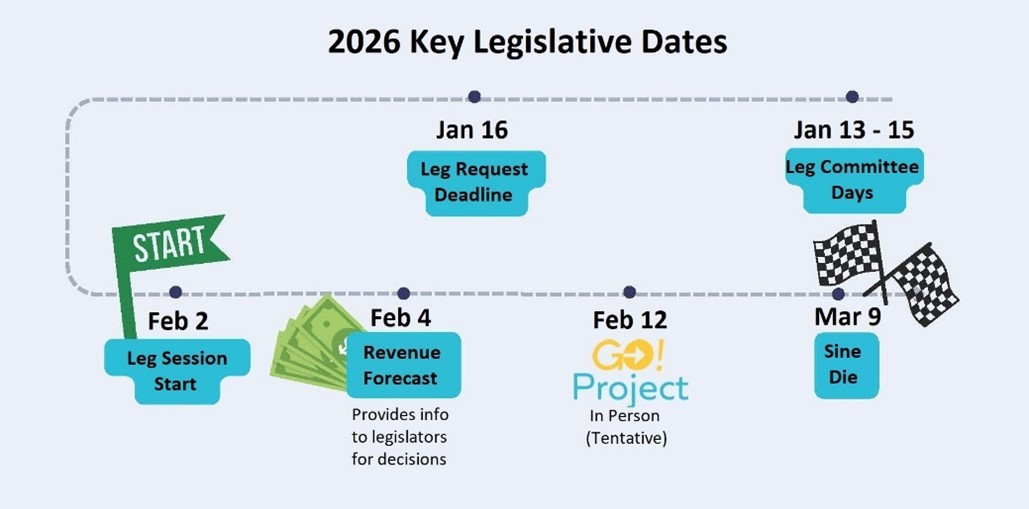
Session Roadmap

About the Oregon DD Coalition

The Oregon DD Coalition advocates for DD services with and for people with intellectual and developmental disabilities, their families, and support organizations across Oregon.


We worth together to influence DD services, systems, and laws so people with IDD have better opportunities across the state.


Interested in signing up for the GO! Bulletin or
becoming a member of the Oregon DD Coalition?

 1775 32nd Place, Suite F, Salem OR 97301

 admin@orddcoalition.orgwww.orddcoalition.org

CONNECT WITH US
Facebook  Instagram