|
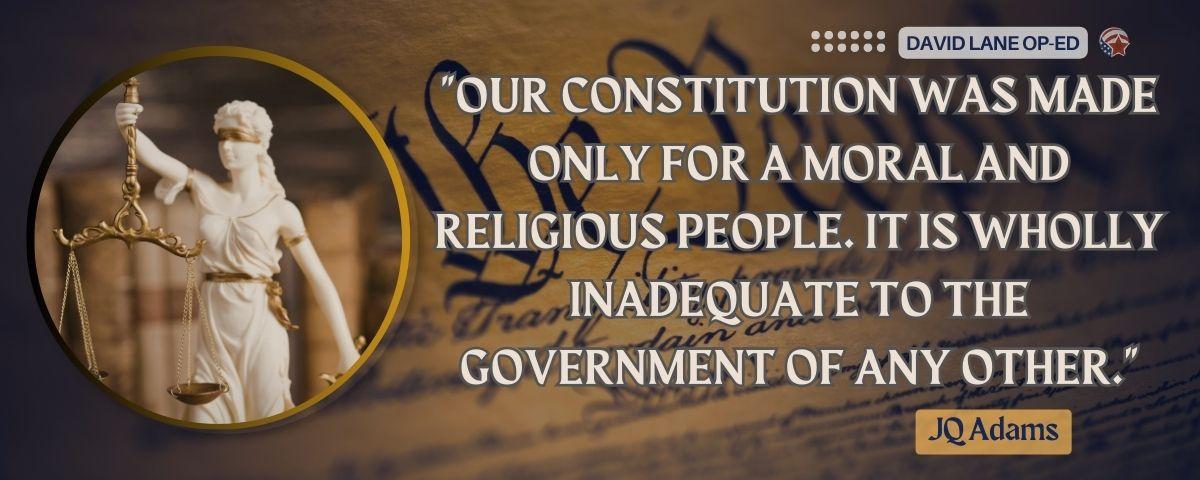
John Adams warned in 1798 that the Constitution “was made only for a moral and religious people. It is wholly inadequate to the government of any other.” His words today read less like historical reflection and more like present indictment. The American system was never sustained by parchment alone. It depended not merely on written rules, but on virtue in the people.
Yet having steadily abandoned the Biblical moral culture the Founders cultivated through the seventeenth and eighteenth centuries, modern believers increasingly think like secular man—embracing his philosophies, absorbing his assumptions, and often unconsciously mirroring his way of life.
The deeper crisis in contemporary America is not merely partisan imbalance. It is the erosion—and near forfeiture—of the moral framework that once undergirded a constitutional structure carefully designed to distribute power among branches and levels of government, preventing its concentration in any single hand.
The contemporary cultural crisis is less structural and more moral.
For early Americans, the Constitution they framed assumed a Judeo-Christian worldview: self-restraint, truthfulness in public life, equal application of the law, and respect for institutional limits. They shared a moral vocabulary rooted in a Biblical fixed point—an objective standard by which all conduct, public and private, was judged.
The Founders did not design a system capable of surviving persistent bad faith, selective enforcement, or tribal loyalty elevated above principle. The constitutional order—then as now—depends not merely on procedure, but on virtue. Virtue is the indispensable condition of freedom.
As Os Guinness has framed it in his “golden triangle of freedom”: freedom requires virtue, virtue requires faith, and faith requires freedom—each sustaining the other.
When prosecutorial discretion appears partisan, when corporate power openly aligns with political factions, when media narratives function as ideological weapons, and when legal processes are perceived as instruments of advantage rather than vehicles of impartial justice, the constitutional machinery strains under pressures it was never meant to bear.
A free society functions only when its citizens restrain their lust for power at any cost, honor contracts, tell the whole truth under oath, respect property, and accept honest and legitimate electoral outcomes.
For the Constitution is “wholly inadequate” for an immoral people. It assumes truth-telling. It assumes oaths are binding—that a man’s word is his bond. It assumes impartial justice, not lawfare deployed as a weapon of faction.
The Founders did not fear disagreement; they feared corruption of character. They understood that liberty cannot survive when appetite overwhelms restraint, when ambition eclipses conscience, and when power becomes an end in itself rather than a trust held under law.
And when justice is selectively applied—when one standard governs allies and another governs adversaries—the moral foundation of the nation begins to crack.
Which brings us to last week’s Wall Street Journal report on Susan Rice—the former U.S. Ambassador to the United Nations, National Security Advisor under President Obama, and senior architect of Democratic policy under President Biden.
Speaking to corporate America, she issued what sounded less like counsel and more like a warning:
“Whether you’re a law firm, whether you’re a university, whether you’re a media entity, whether you’re a big corporation, whether you’re Big Tech,” she said, “you need to play a long game, not this short game that has been so detrimental.”
The implication was unmistakable: when Democrats return to power, there will be consequences—signaling to corporate leaders that political alignment may determine future treatment. She made that explicit. There will be no “forgive or forget” for those institutions that, from her judgment, “bent the knee” to Donald J. Trump.1
That is not the language of reconciliation. It is the language of retribution.
To compound the concern, the Obama and Biden years were not widely perceived by many Evangelicals and pro-life Catholics as an era of impartial justice. To them, it often felt like a season of selective enforcement.
The unrest in Ferguson, Missouri unfolded under a federal posture critics viewed as politically calibrated. IRS official Lois Lerner acknowledged that conservative and Christian organizations had been subjected to heightened scrutiny, then invoked the Fifth Amendment before Congress. No criminal charges followed. For many Christians, that episode was not an isolated misstep—it was emblematic of deeper asymmetry.
And herein lies the danger.
When political leaders signal that institutions will be rewarded or punished based on perceived loyalty, the line between governance and coercion blurs. Law ceases to be a neutral standard and becomes an instrument of faction. Prosecutorial discretion becomes leverage. Regulation becomes a warning shot.
The Founders understood that ambition is natural. What they feared was ambition unrestrained by virtue.
When threats replace persuasion, when political rivalry becomes moral vendetta, when “accountability” becomes indistinguishable from retaliation, the republic drifts from ordered liberty toward something far less stable.
The question is no longer partisan.
The question is whether we still believe justice is blind—or whether we are content for it to wear party colors.
Thankfully, Gideons and Rahabs have begun to stand.
David Lane
American Renewal Project
1.https://www.youtube.com/watch?v=SZql8uCboYY
|