|
Meet Army & Army National Guard Veteran
Recipient #73:
FIRST SERGEANT AARON SCHNEIDER
of Cecil, Wisconsin
====
For more than 25 years, nearly his entire adult life, Aaron Schneider’s life was built around duty. Duty to his Country. Duty to his State. Duty to the mission. Duty to his soldiers. And duty to his family. Inspired by his Army Air Corps grandfather, Aaron enlisted in the Army National Guard in 1998 as a junior in high school; and despite his mother’s reluctance to sign, she would become his biggest life supporter. He graduated, turned 18 while in boot camp, and retired after what would become a long and distinguished military career in 2024. To say Aaron had a strong sense of responsibility and service would be an understatement; as would it be to say those years of dedication came with significant sacrifice and personal cost.
Born and raised in Cecil, Wisconsin, Aaron enjoyed time with his family, ran track and cross-country, and wrestled in school. His grades were decent, but an all-too familiar note from his teachers read, “If only he tried a little more he could be…”. Aaron would eventually do just that, just not in school, as he had long set his sights on service to our Country. His first years in the Army National Guard were quiet: he worked full time at a local boat manufacturer, drilled once a month and hung with the wrong crowd. At his mother’s urging, Aaron realized his need for life direction and transitioned to Army Active Duty in 2000. He joined the 3RD Infantry Division at Fort Stewart, Georgia as a Cannon Fire-Direction Controller and, within weeks of arriving, was sent to Kosovo for six months on a peace-keeping mission between Serbia and Albania. While there, and far from home, the horrific events of 9/11 played out on American soil. Their base immediately locked down, they worked heightened entry checkpoints and base security, and their minds went to thoughts of looming war.
Life moved fast for Aaron after returning to Georgia in late 2001. He met an Army Cook on base and within a year were married and expecting their first child. During this time Aaron learned he would deploy to Kuwait; and after his departure date was suddenly moved up, it was of immense relief his baby girl chose to arrive two days before he left. It would mark the beginning of a pattern many military families know too well: moments of joy mixed with sacrifice, milestones missed or cut short, moves that upend routines and support circles, and a life shaped by the needs of the mission and dedication to our nation.
In early 2003, Aaron landed in Kuwait for two months to acclimate and prepare for a yet unknown mission. After winning the "Battalion Soldier of the Year Award” with standout shooting and physical fitness scores, Aaron’s prize was to become the Battalion Commander’s driver: a highly coveted position and promotion enhancer. It was the only thing he knew for sure he would be doing. As weeks rolled by, he watched more than 16,000 troops, his entire Division included, and over 5,000 vehicles amass…and speculation grew. On the evening of March 19, 2003 the General’s address informed the troops that we would invade Iraq the very next day. There would be no communications home nor locations shared. And during the darkness of early morning hours, jets began bombing the area’s route in, vehicles filled with soldiers, munitions and supplies lined up, and Abrams tanks rolled through the border’s berm to enter Iraq. War had begun.
Although their run to Baghdad only took about 26 days, it would leave a lasting impression of both awe and horror that would stay with Aaron to this day. Their massive convoy moved town to town destroying barriers, securing a presence where necessary and engaging in small arms fire as resistance grew along the way. They slept in their vehicles, ate Meal Ready-to-Eat (MRE’s) field rations, and went without any semblance of comfort, hygiene, or privacy. In fact, they wore their same chemical protective suits the entire 26 days.
As the Battalion Commander’s driver, which he describes as both a blessing and curse, Aaron was able to experience many things in war others did not. He was privy to leadership behavior and strategic conversation as he drove his Commander up and down the convoy. He watched the many arms of a highly orchestrated invasion unfold and drove through the destruction created to mixed reactions of those gathered along the way. As they entered Baghdad, he watched Air Force jets obliterate, and capture, their International Airport. He observed our Infantry take over palaces and civic complexes for our operational use. He escorted journalists through opulent palaces that overlooked its struggling people. And after posing for a photo in Saddam’s bathroom made of gold, Aaron landed on the cover of USA Today–alerting his parents that he was still alive. Once our presence in Baghdad was securely established, Aaron stayed in those palaces for the next month, supported leadership meetings and watched new forces arrive as we solidified our occupation. His role also meant that he was required to go anytime bad things happened; and he was powerless to do much besides drive and watch scenes unfold.
At all hours of the day, Aaron drove his Battalion Commander to sites of crisis, destruction, and casualties. He literally had a front seat view to our invasion; and war’s haunting images still move through his mind 23 years later, as do the emotions created along the way. With paper maps still a necessity, unforgiving terrain and limited communications, the convoy endured strategic challenges. Along their drive they faced unnerving delays, vehicles took wrong turns and got disoriented, cargo and equipment were lost, and ambushes resulted in both the loss of soldiers and their capture at enemy hands. On the day he will never forget, Aaron was two vehicles behind his Battery Commander’s Humvee when he saw an RPG directly strike his vehicle. It killed the Commander instantly and ejected the critically injured driver, whom Aaron was close with. Responding later that day to an overturned vehicle in a canal, Aaron helplessly watched three lifeless soldiers pulled from the wreckage. Driving through bombed-out areas day after day displayed numerous bodies across the land, yet required the desensitized soldier move the mission forward. The sights, smells, sounds and emotions he repeatedly took in would accumulate in his mind and patiently wait to reappear as PTSD and Survivor’s Guilt later in life.
Their mission complete, Aaron’s Division returned to Kuwait for a month, with nothing to do but wait to go home, and think. It was a rough transition that created segregation, anger and resentment…all of which added to Aaron’s brewing inner turmoil. In June, 2003, he was back at Ft. Stewart, timidly reconnecting with his wife and introducing himself to his daughter he’d barely met. To focus on base with expected strength, Aaron repressed all he’d gone through; and with his enlistment up, changed jobs for the fresh start he desperately needed. While transitioning, the couple learned they would welcome a second child; and unable to delay his transfer, Aaron left his family to move to Fort Gordon, GA, and begin 52 weeks of Satellite Controller training. He threw himself into his role’s new demands; and after four months apart, his wife voluntarily separated from the Army due to her pregnancy and joined Aaron in time to welcome their second daughter.
In 2005, his training complete, Aaron was given orders for three years in Okinawa, Japan; a move whose domino effect would disrupt his family’s life direction. He left his family once more; and two months after securing a home, his three ladies joined him…beginning a struggle of loneliness and isolation for his wife. After taking the girls to the states for a family reunion, she chose not to come back, leaving Aaron alone. Further complicating the matter, she re-enlisted in the Army, stationed in Texas and was almost immediately ordered to Iraq for two years. Aaron scrambled to retrieve his two daughters and bring them to Japan where he single-handedly raised them while working on base full time. Life became increasingly stressful for him and it surfaced in heightened anxiety, debilitating panic attacks, and emotional struggles as his PTSD broke through. He began counseling overseas; and as his contract wound down, he chose to separate from service to bring his girls home to Wisconsin.
The strain of service in a marriage, and on a family, is a hard one that the roughly 7% of our nation’s Veterans can personally comprehend; and a reality that less than 1% of our nation’s families currently face. Aaron’s marriage, one further impacted by the hardships of two enlisted parents with dual deployments, coupled with physical and psychological tolls, was almost destined to fail. They chose to divorce in 2006; however, their alternating times out of the country extended that process out over the next several years, but eventually built a sympathetic relationship that focused on their daughters.
Aaron returned to Wisconsin in 2008 and hesitantly stepped into civilian life as a single father. When his wife returned from Iraq and wanted her daughters back, Aaron understood and agreed. Without parental responsibilities and no clear direction forward, Aaron questioned his purpose and emotions; and he began drinking to soften his struggle. When he learned his local Guard Unit would be deploying to Iraq soon, with little thought otherwise, Aaron simply rejoined and volunteered for the chance to deploy. He wanted to do something more in war and was willing to take whatever artillery position they had: Cannon Crewmember.
In 2009, three months after reenlisting, the Guardsman was at Camp Cropper, a large U.S. operated internment facility outside Baghdad’s International Airport. As the war wound down, there was no longer a need for artillery; and so Aaron was assigned to detainee operations to fulfill the changing demands of war. As we consolidated facilities in Iraq, he conducted intake interviews to gather intelligence, process and separate inmates based on their connections, religious sects and extremism while awaiting release or transfer. Six months into his year’s assignment, Aaron learned his active-duty wife would deploy again and his girls needed him.
Aaron was released from his deployment early to assume care for his daughters; and this time, home in Wisconsin, he had the support of family. He also had several friends in the area who rode; and looking for personal release and connection, Aaron took to motorcycling in 2010. He immediately loved the adrenaline it provided, the clarity his mind found and the brotherhood he regained. He would own three different bikes in the course of his next eight years as riding became an integral part of who he was and his healthiest way to cope with his demons.
Despite the benefits gained from riding, the following years proved difficult for Aaron as he struggled directionally and with symptoms he wasn’t ready to address. He bounced around jobs, worked summers at Doc’s Harley-Davidson, and even tried a short stint in college. His girls shuffled between parents until 2015 when they asked to stay in Wisconsin: a request Aaron was thrilled to honor. Amongst these years and moves, Aaron took to drinking and gambling to cope with his growing depression and PTSD symptoms. His nights were challenged by sleep deprivation and turbulent dreams while his days lent themselves to anxiety and panic attacks. Transitional adjustments impacted his mood, and left him irritable and unreliable; and his impulsive, risky behaviors and dark thoughts further weighed him down. Aaron did his best to do what was right, but his struggles took a toll on employment, relationships and his finances. Still unwilling to seek help, he pushed through to make ends meet; but happiness grew harder to find.
In 2018, Aaron learned he would again become a father; and while the news was a surprise to him and his girlfriend, it would be the moment that redirected his life, and likely saved it. Needing stable work, he landed the job he still has today with Northeast Asphalt. It opened the door to the International Union of Operating Engineers (IUOE) Local 139’s Apprentice Training program and he gained a career skill set that made him a proud Operating Engineer. Needing a more responsible path forward, Aaron worked to curb his drinking, be more of a presence and sold his Harley to free up money and time for his new daughter.
Over the years Aaron had grown to love his part-time role in the Guard: he took on additional training, advanced in rank, and volunteered for every deployment he could, though not accepted. He became a Field Artillery Instructor at Wisconsin’s Fort McCoy and eventually accomplished his goal of becoming a First Sergeant and leading a Battery at Two Rivers Army National Guard. Time is a precious gift; and with his three daughters all nearby, Aaron decided to focus his time on his family–a commodity he lacked with his eldest two, and a loss that still crushes his heart today. In June, 2024, at age 42, he retired from the military after 25 years of dedicated service. And that very same year, Aaron finally decided to finally seek help from the VA and the Green Bay Vet Center for his depression, PTSD and addictive behaviors.
He’s proud of his life accomplishments, the dedication to service and now to his healing efforts. He spends his free time with his girls, supporting their lives and interests, and hanging with friends. As he saves to buy his first house, he knows buying the Harley he sorely misses is not within his financial means…but it is within ours. Hogs For Heroes admired the strength and devotion Aaron showed to Country and Family, but more importantly to addressing his mental health needs. We believed providing Aaron with our therapeutic tool, healing release, and the chance to join a Veterans riding group for supportive camaraderie would support his hard journey forward.
Aaron had no idea who we were until we introduced ourselves and our plan to change his life…and then we watched his shocked face contort with emotion and disbelief. As we talked about bikes, he knew he wanted a touring bike this time…he just didn’t know if he was a Street Glide or a Road Glide guy these days, but he knew he loved the color black. A test ride honed in his search: sitting on the showroom floor of Vandervest Harley-Davidson in Green Bay was a sleek, blacked-out and brand new 2026 Street Glide. It was the one his heart wanted and our friends at VVHD super-stretched to put this deserving Veteran back on the road with that sweet ride.
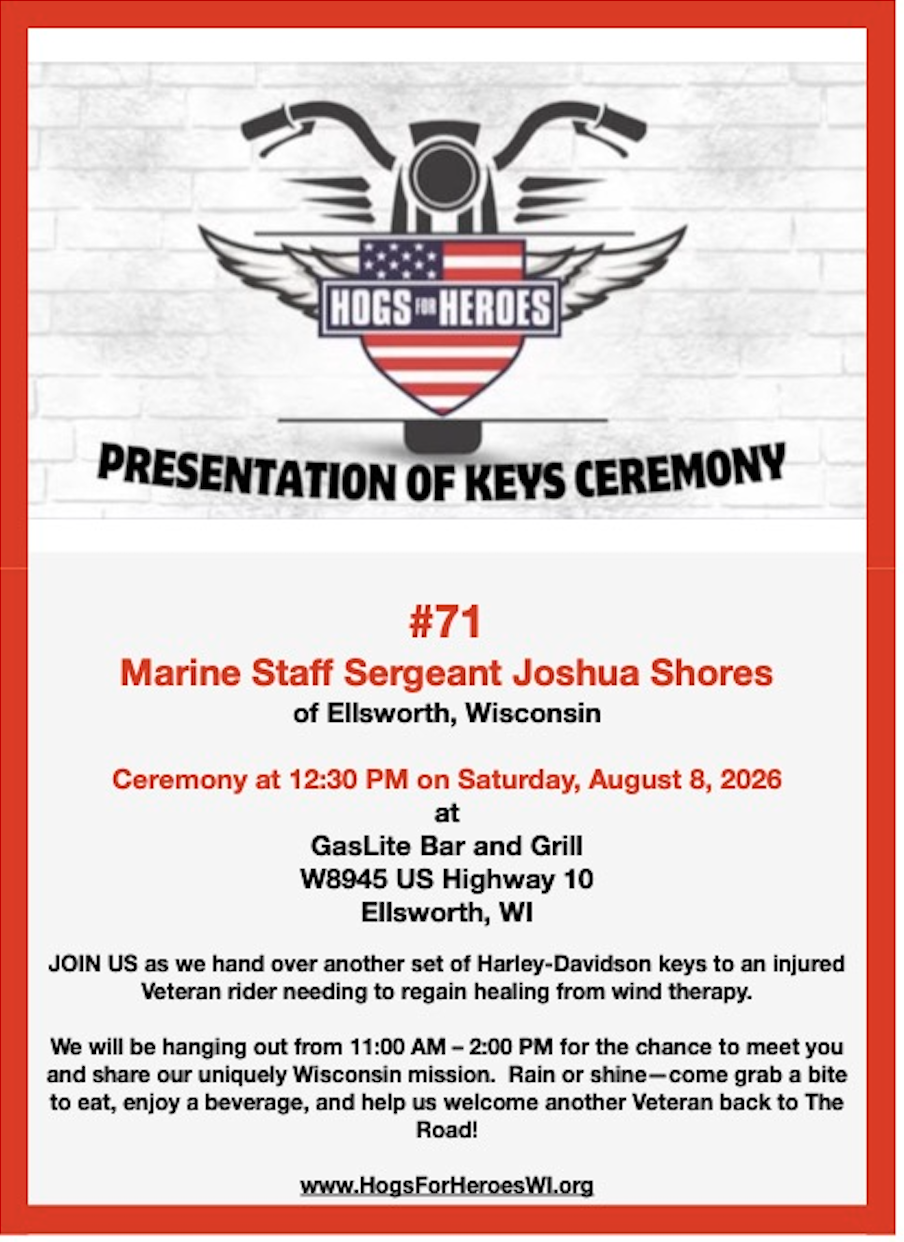
Despite our small nonprofit’s goal of gifting one bike a year, Aaron will be our 73rd Veteran & Harley pairing since handing over our first set of keys in 2016. His bike is the last of twelve that we will present in 2026, and he will receive it alongside Veteran Recipient #72 as we wrap up our 2026 season.
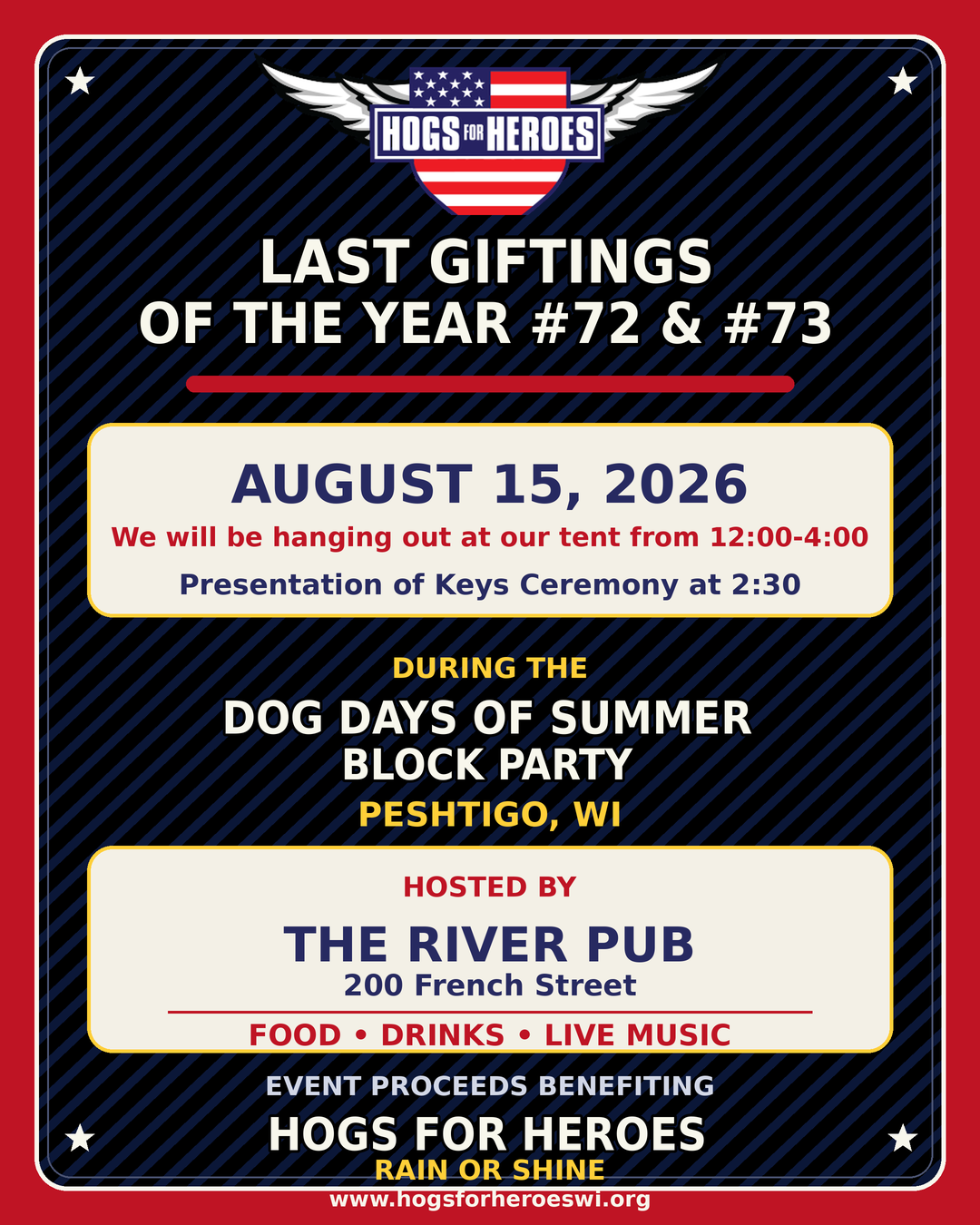
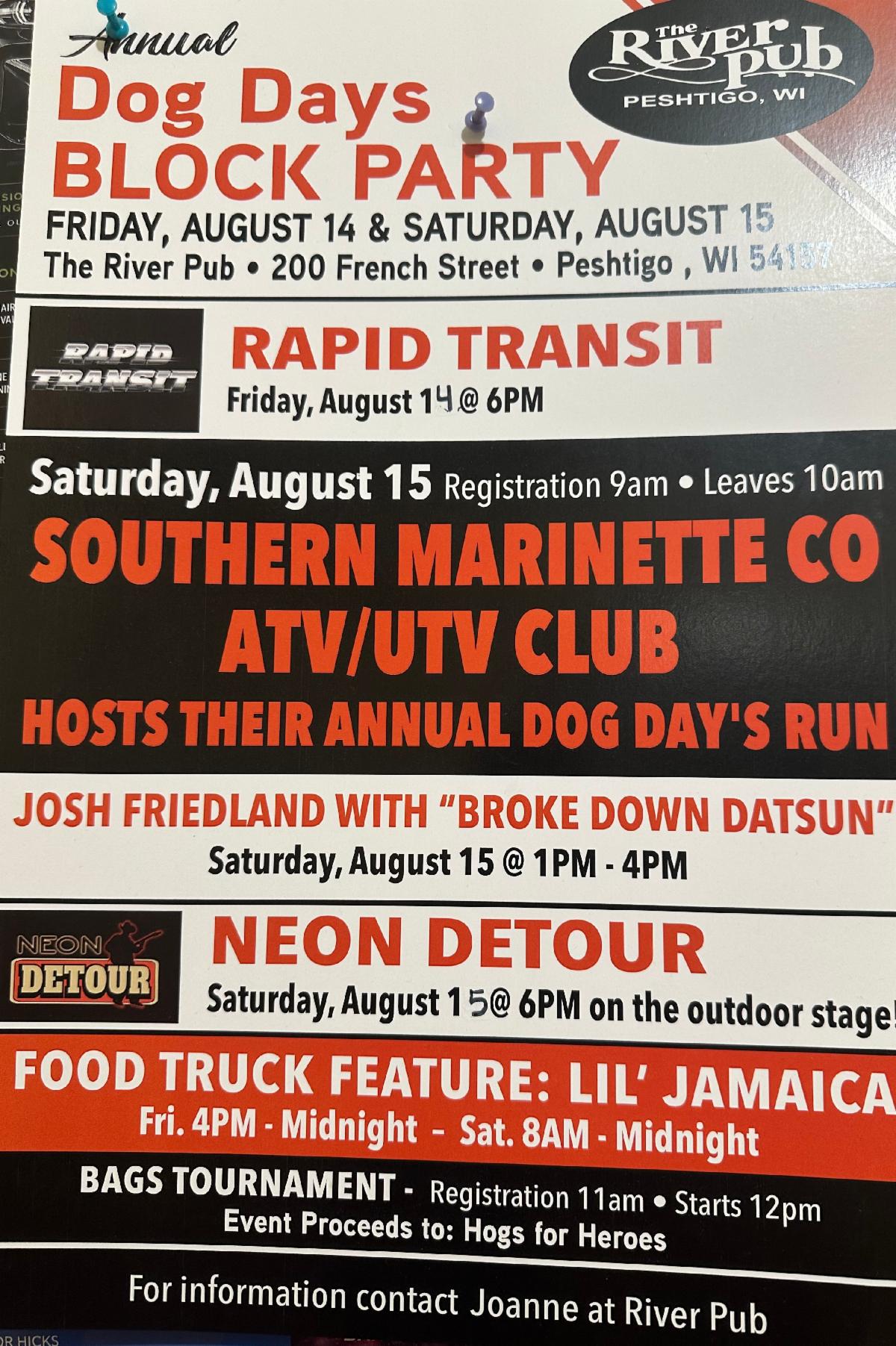
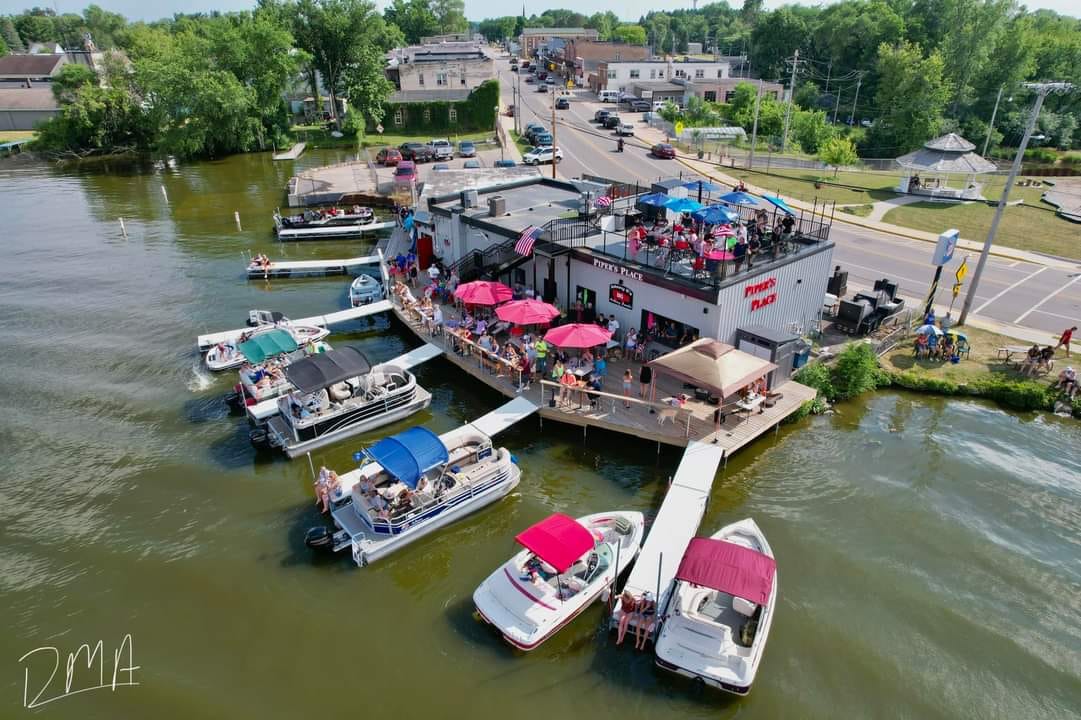
Please join us for a DOUBLE PRESENTATION OF KEYS CEREMONY on SATURDAY, AUGUST 15, 2026 AT 2:30 pm AT THE RIVER PUB IN PESHTIGO during their Dog Days Block Party. We will be hanging out from 12-4 pm for the chance to connect and take over the band’s stage to hand over two more sets of keys to change two more struggling lives.
|