Dear Valued Clients,
California law requires a different calculation for overtime than other states when flat sum bonuses are paid.
WHAT IS A "FLAT SUM" BONUS?
A flat sum bonus is a bonus for a flat amount that pays for something other than production, piece rate, or a commission. If you can potentially earn a bigger bonus or incentive by working more hours, this is not a flat-sum bonus. Examples of a flat-sum bonus may include, but are not limited to:
- Longevity bonus
- Seniority bonus
- Retention bonus
- Safety bonus
- Team Leader bonus
- CSI Bonus
- Bonus for working a weekend shift or being on-call over the weekend
- Generally speaking, bonuses tied to the quality of work instead of quantity of work
How the calculations are different between a flat sum bonus and a production bonus:
Here is an example (using the $5.10 Safety Incentive) to show the difference in the overtime calculation between a traditional production bonus using the federal overtime calculation method and the flat sum bonus overtime calculation method for non-exempt employees in California:
Production bonus overtime calculation
Divide the bonus by all hours worked and multiply that by 0.5 x the total number of overtime hours worked.
- Example: $5.10 weekly SH Safety Incentive bonus: 50 total hours worked in the week (includes 10 hours of overtime). $5.10 ÷ 50 hours = 0.102 x 0.5 x 10 hours = $0.61 in overtime.
Flat sum bonus overtime calculation adopted by the California Supreme Court
Divide the bonus by regular non-overtime hours worked during the month and multiply that by 1.5 x the total number of overtime hours worked.
- Example: $5.10 weekly SH Safety Incentive bonus: 50 total hours worked in the week (includes 10 hours of overtime). $5.10 ÷ 40 = 0.1275 x 1.5 x 10 = $1.9125 in overtime.
As you can see, the California method is over 3 times the amount of the Federal method. The court's reasoning is the California has had a long-standing policy against working overtime. (Historically, overtime was not a "reward" for workers who worked hard, but a penalty for employers. Overtime Laws were first passed during the depression and was an attempt to create more jobs for people.)
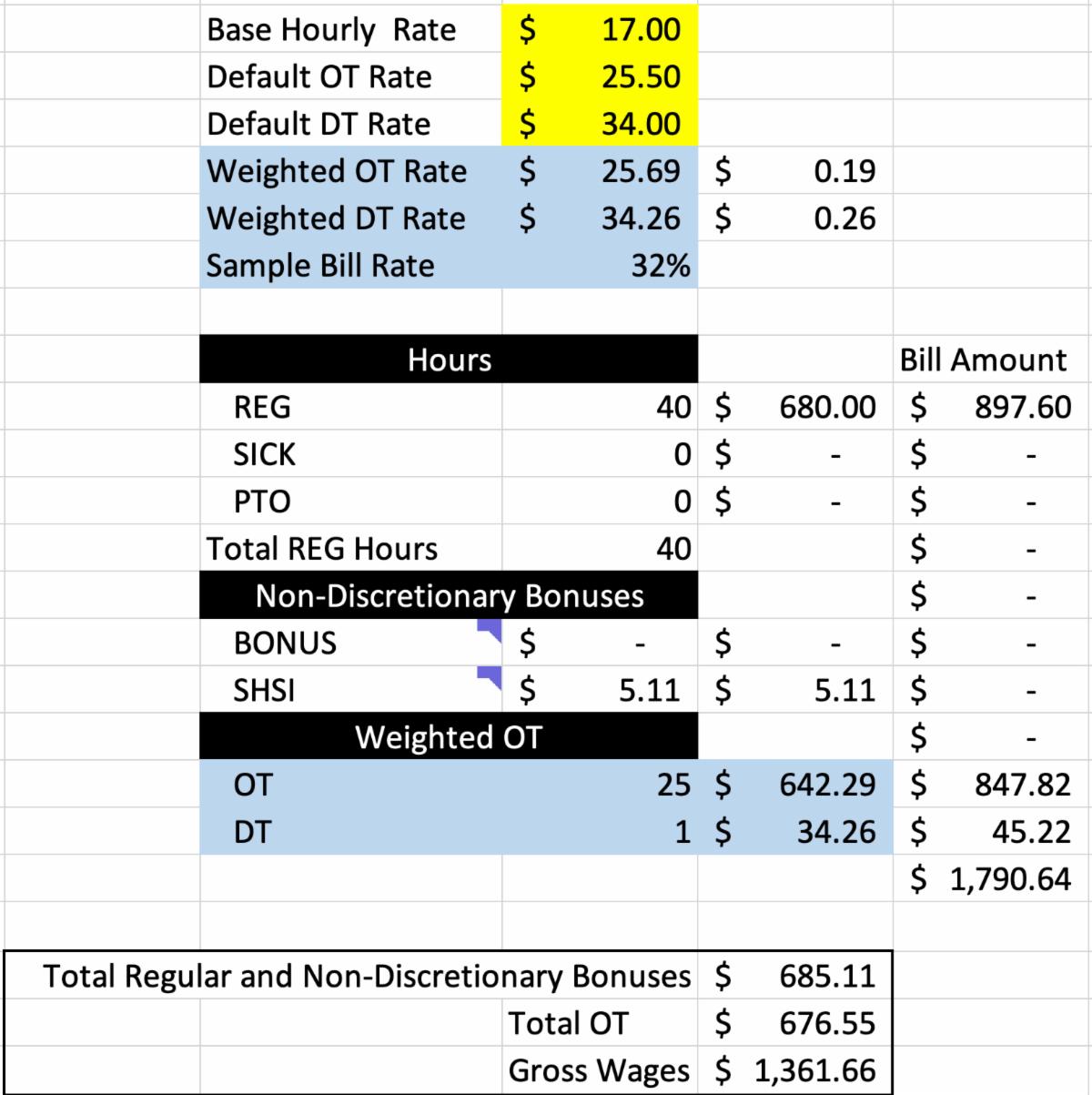
CALCULATION EXAMPLE