Did you receive this as a forwarded email? Join PAPREN to get monthly updates directly.
| |
Resources to support physical activity opportunity for older adults | |
Upcoming Network call - August 23 | |
|
We'll kick off the new year of programming in August with a presentation on the Intersections Initiative, a yearlong collaboration among America Walks, the League of American Bicyclists, and the Safe Routes Partnership supported by CDC as part of Active People, Healthy NationSM. The Initiative aims to build capacity to apply for infrastructure funding to support active and public transportation projects and identify the policies and practices that make this a reality. There will be an overview and ideas about research opportunities related to federal infrastructure funding.
All PAPREN members will receive the Outlook invitation for the upcoming Network call with meeting access information. Did you receive this newsletter as a forward? Email us to get the calendar invitation for this month and we'll add you to our list.
| |
|
Upcoming webinar: Assessing, Empowering, and Engaging People with Disabilities in the Outdoors
Thursday, August 10 10:00 ET (American Trails)
Register
Upcoming webinar: Active People, Healthy Nation 101
Tuesday, August 29 1:00 ET (CDC DNPAO)
Register
Upcoming webinar: Getting Around Town: Exploring Partnerships with Safe Routes to Parks
Tuesday, September 12 12:00 MT
Register
Upcoming webinar: Walk, Ride, and Roll Webinar Series - A Safer System for Student Travel: Enhancing Safe Routes to School Through Vision Zero
Wednesday, September 20 2:00 ET
Register
Upcoming webinar: How Trails Support Healthy Aging for All
Thursday, September 21 10:00 ET (American Trails)
Register
Upcoming conference: Safe Routes to School Summit 2023 (virtual)
October 24-26
Register
| |
|
Meeting time: 12-1 ET/11-12 CT/10-11 MT/9-10 PT
Next meeting: Aug 28
(Terry Horton, Northwestern University)
|
|
|
Meeting time:
1st Wednesdays 2-3 ET/1-2 CT/12-1 MT/11-12 PT
Next meeting: Sept 6
| |
Transportation Policy & Planning | |
Meeting time: 2nd Tuesdays 1-2 ET/12-1 CT/11-1 MT/10-11 PT
Next meeting: Aug 8
Discussion about next work group project
| |
|
New meeting day/time:
1st Fridays 1-2 ET/12-1 CT/11-12 MT/10-11 PT
Next meeting: Aug 4
| |
|
Meeting time:
2nd Tuesdays 2-3 ET/1-2 CT/12-1 MT/11-12 PT
Next meeting: Aug 8
Behind the Carton: 2022 School Milk Report (Samuel Hahn, from Center for Science in the Public Interest)
| |
|
Meeting time: 2nd Wednesdays 1-2 ET/12-1 CT/11-12 MT/10-11 PT
Next meeting: Aug 9
Discussion on updated Rural Active Living Call to Action
| |
|
SAVE THE DATE!
Active Living Conference
March 25-28, 2024
Chattanooga, TN
| |
Job Opportunities and Fellowships | |
|
Assistant Professor, San Diego State University: The School of Exercise and Nutritional Sciences at San Diego State University is searching for a full-time (10-month) tenure-track faculty member in the area of physical activity behavioral science. Requirements include an earned academic doctorate (Ph.D. preferred) in Kinesiology, Public Health, or related field. Individuals with research expertise in physical activity-related health behavior change mechanisms, interventions, and outcomes; community-based physical activity research; physical activity in youth and/or diverse and underserved populations; and/or mHealth are encouraged to apply. This position will be at the Assistant Professor rank and will begin August 2024. Candidates should apply via Interfolio. For questions, please contact Ashleigh Johnson, ajohnson12@sdsu.edu
ORISE Fellow opportunity in Physical Activity and Health Branch - Policy Analysis and Evaluation to Promote Active Communities: This fellowship will provide training in the Division of Nutrition, Physical Activity, and Obesity's (DNPAO) Priority Strategy in Physical Activity: Increasing Physical Activity Through Community Design. This strategy is focused on equitably increasing physical activity through the implementation of policies and activities to connect pedestrian, bicycle, or transit transportation networks (called activity-friendly routes) to everyday destinations, while being a team participant with a diverse group of public health professionals, including epidemiologists, behavioral scientists, and evaluation specialists. The selected participant will gain experience in research, evaluation, evidence synthesis, and translation for policy, systems, and environmental (PSE) strategies (e.g., active transportation plans, Complete Streets policies, comprehensive plans, demonstration projects, project funding criteria) related to equitably increasing physical activity through community design. The qualified candidate should have received a master's degree (e.g. Master of Public Health, Master of Science, Master of Urban Planning) in one of the relevant fields (e.g., Informatics, Statistical Analysis, Epidemiology, Urban/Community Planning, Public Policy, Psychology, Sociology), or be currently pursuing a master's or doctoral degree with completion before December 31, 2023. Degree must have been received within five years of the appointment start date. Deadline to apply is August 30. Applications will be reviewed on a rolling basis as they are submitted, and a candidate may be selected prior to the closing date for applications.
| |
|
New Research
Chen TJ, Whitfield GP, Watson KB, Fulton JE, Ussery EN, Hyde ET, Rose K. Awareness and Knowledge of the Physical Activity Guidelines for Americans, 2nd Edition. J Phys Act Health. 2023 May 12;20(8):742-751. doi: 10.1123/jpah.2022-0478. PMID: 37172953.
Hughey SM, Leen K, Marshall A, Adams JD, Bornstein B, Brown K, Davis WJ. Estimating physical activity levels for regular and non-regular bike share users in Charleston, South Carolina. Journal of Transport & Health, Volume 31, 2023, 101614, doi.org/10.1016/j.jth.2023.101614.
Navon L, Yuan K, Beck L. Notes from the Field: Emergency Department Visits for Nonfatal Pedal Cyclist Injuries Before and During the COVID-19 Pandemic, United States, 2019–2020. MMWR Morb Mortal Wkly Rep 2023;72:769–771. DOI: http://dx.doi.org/10.15585/mmwr.mm7228a3
PAPREN WORK GROUP PRODUCT: Tsai, MM, Olarte, DA, Hager, ER, Cohen, JFW, Turner, L. Prevalence of recess and supportive practices at a nationwide sample of public elementary schools in the United States. J Sch Health. 2023; DOI: 10.1111/josh.13368
Wang Y, Steenbergen B, van der Krabben E, Kooij H-J, Raaphorst K, Hoekman R. The Impact of the Built Environment and Social Environment on Physical Activity: A Scoping Review. International Journal of Environmental Research and Public Health. 2023; 20(12):6189. https://doi.org/10.3390/ijerph20126189
Van Dyke ME, Chen TJ, Nakayama JY, Moore LV, Whitfield GP. Changes in Physical Inactivity Among US Adults Overall and by Sociodemographic Characteristics, Behavioral Risk Factor Surveillance System, 2020 Versus 2018. Prev Chronic Dis 2023;20:230012. DOI: http://dx.doi.org/10.5888/pcd20.230012
New Resources
Taking Steps toward Mobility Justice: An Invitation to Learn More and Take Action: This resource from Safe Routes Partnership outlines three actions that advocates can take to reimagine how people move through their communities and address the inequities built into our transportation system. This list is primarily meant for nonprofit and public sector advocates who want to increase equitable access to everyday destinations for people walking and rolling. We have provided resources and intermediate steps to help illustrate how each of these big actions can happen.
Divided by Design: Smart Growth America’s new report illustrates the historic inequities created by the federal transportation program and demonstrates how current practices exacerbate those inequities today. It includes a unique analysis of both an unbuilt and built highway segment within Atlanta, GA and Washington, DC to quantify what was lost, who bore the brunt of the damage, and what could have been lost with highways that were never built.
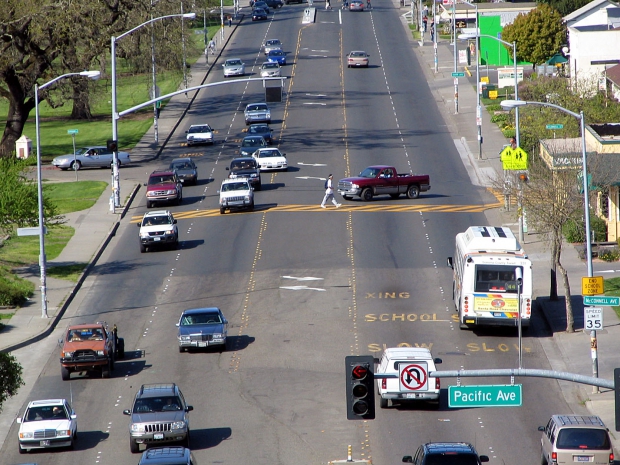
Improving Pedestrian Safety on Urban Arterials: Learning from Australasia: The Federal Highway Administration Global Benchmarking Program released a technical report that identified effective approaches and innovations used by both Australia and New Zealand to reduce pedestrian injuries and fatalities on urban arterial roadways. The countries embrace the principles of the Safe System Approach, which the U.S. Department of Transportation adopted as part of the National Roadway Safety Strategy. The study identified three key takeaways: the importance of policy and law in prioritizing pedestrian safety; the interconnectedness of movement and place in planning processes; and the need for proactive and interdisciplinary solutions in design and implementation.
Federal Highway Administration National Complete Streets Assessment: The Federal Highway Administration (FHWA) released high-level findings of the National Complete Streets Assessment, conducted to establish a national baseline of Complete Streets, active transportation, and similar efforts. The assessment involved all fifty State departments of transportation (DOTs), Washington, D.C., and Puerto Rico. The findings highlight that several States and local jurisdictions have adopted Complete Streets policies, which aim to create safe and accessible streets for all users. The assessment also reveals that DOTs develop their own Complete Streets principles and programs based on local initiatives. FHWA aims to provide additional guidance and tools to fully implement Complete Streets and plans to assess transferable lessons from each State DOT.
| |
Do you have resources, published papers, job opportunities or other announcements you'd like to share with the Network? | |
PAPREN Coordinating Center
PI: Stephenie Lemon, PhD, UMass Chan Medical School
PI: Jamie Chriqui, PhD, University of Illinois at Chicago
Coordinator: Karin Valentine Goins, MPH, UMass Chan Medical School
| |
The Physical Activity Policy Research and Evaluation Network is supported by Cooperative Agreement Number U48DP006381 from the US Centers for Disease Control and Prevention, Division of Nutrition, Physical Activity and Obesity. This newsletter is solely the responsibility of the authors and does not necessarily represent the official views of the Centers for Disease Control and Prevention or the DHHS.
| | | | |