|
I personally experienced a depth of yearning for my daughter, Erika, that I could barely stand to live with. It took a long, long time for me to learn how to live with it. Can you talk about yearning more and how that ties in with loss?
MF: I think of yearning like I think of thirst and hunger.
Yearning to me is the heart of grief,
and it really is the motivation—the
desire—to see them again and for
things to be back the way they were.
The reason I make an analogy to hunger and thirst is because I think we sometimes forget that having attachment bonds—those people we love so much—is critical for our survival, like food and water, and our brain knows that.
So our brain generates this feeling of yearning in the same way that it generates a feeling of hunger and thirst in order to motivate us to go out and be with people. We can make the same analogy between trying to find our loved ones and that yearning and craving. That feeling of craving can also describe that intensity of desire for this person.
But the place where I think there’s a
difference is when we think of craving
as something such as that for a
drug ... such as in drug addiction.
With yearning, it is a motivation for something that is healthy—that is necessary for our survival. With drug addiction you have a substance that’s taken over a naturally occurring part of the brain, and it isn’t healthy for us to keep stimulating it in that way. So you wouldn’t say if someone was craving water because they were dehydrated that they were addicted to water. It just doesn’t make sense because it is a natural, normal function of being human that we need water.
It is similarly a natural human function
that we need the ones we love.
SW: That is such an important concept for people to understand.
You know there is a woman who is one of my favorite poets, Ellen Bass. She writes one of my favorite poems entitled The Thing Is. In her poem she says, "When grief weights you down like your own flesh, only more of it, an obesity of grief." She refers to the obesity of grief, which I think paints a powerful picture of it.
MF: That is powerful.
Expected and Unexpected Deaths
SW: What about unexpected death versus knowing the person is going to die? I have had people, even professors, ask me whether or not knowing Erika was going to die allowed me to start the grieving process before she actually died ... that thing referred to as anticipatory grief. I found that, once Erika actually died, it was as much of a shock as if I had no idea. At least it felt that way. Would you address that?
MF: When we do research and ask people whether the death was expected, or even sometimes we put a timeframe out, such as Did you know in the week before that they would die? Did you know a month before? people who say yes they knew and people who say no they didn’t know all say, regardless of the knowing or not knowing, that it was completely out of the blue.
With a sudden, natural event, we do see higher levels of grief, but that is just on average. Unexpected deaths are harder for a brain to wrap itself around because there was no chance to adjust the prediction of what's coming at all. But having said that, and as you said, many people whose loved ones are in hospice or they are expected to die still experience that death as if it were an unexpected event. So even if it was an expected death, the grief itself feels so different than we were expecting it to feel. So even if someone knows the death is coming, they can't know what the grief will feel like.
SW: I often wonder if that’s tied in with the thing we talked about earlier where our brain keeps thinking the person is coming back, where it takes time for us to stop thinking that. I wonder, with an "unexpected" death, if that process might take even longer.
MF: I mean when we’re caring for a loved one who is terminally ill, our routines have already been disrupted. For instance, they’re not coming home from school at 4:00 P.M. every day. Already there are those lifestyle changes and routines in which our habits have also changed. So even though the person has not yet changed in the way they will after their death, many changes have already started taking place in our lives. With unexpected death, you don't have that. So with the unexpected death there is that sense that things suddenly go from zero to 60 and there's nothing in-between.
SW: In general, what message do you want to send to everyone impacted by death, including the grievers, the supporters, the professionals, and others?
MF: When I talk to students or clinicians, or even people sitting next to me on a plane, I find they have burning questions about grief. They ask: Is grief the same as depression? When people do not show their grief, is it because they are in denial? Is losing a child worse than losing a spouse? Then, very often, they ask me this type of question: I know someone whose mom/brother/best friend/husband died, and after six weeks/four months/eighteen months/ten years, they still feel grief. Is this normal?
After many years, it dawned on me
that the assumptions behind people’s
questions demonstrate that grief researchers
have not been very successful at broadcasting
what they have learned. That is what
motivated me to write this book. I am
steeped in what psychologist and grief
researcher George Bonanno
termed the new science of bereavement.
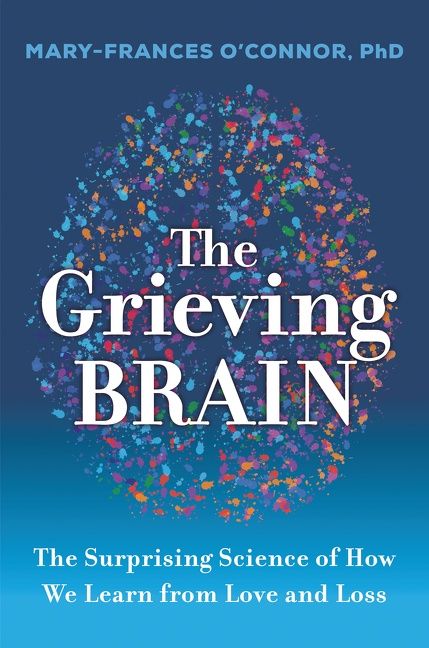
The type of grief that I focus on in my book applies to those who have lost a spouse, a child, a best friend, or anyone with whom they are close. I also explore other losses, such as the loss of a job, or the pain we feel when a celebrity whom we admire greatly and have never met dies. I offer thoughts for those of us who are adjacent to someone who is grieving, to help us understand what is happening for them. This is not a book of practical advice, and yet many who have read it tell me they learned things they can apply to their own unique experience of loss.
The brain has always fascinated humanity, but new methods allow us to look inside that black box, and what we can see tantalizes us with possible answers to ancient questions. Having said that, I do not believe that a neuroscientific perspective on grief is any better than a sociological, a religious, or an anthropological one. I say that genuinely, despite devoting an entire career to the neurobiological lens.
I believe our understanding of grief
through a neurobiological lens can
enhance our understanding, create a
more holistic view of grief, and help us
engage in new ways with the anguish
and terror of what grief is like.
Neuroscience is part of the conversation of our times. By understanding the myriad aspects of grief, by focusing in greater detail on how brain circuits, neurotransmitters, behaviors, and emotions are engaged during bereavement, we have an opportunity to empathize in a new way with those who are currently suffering. We can allow ourselves to feel grief, allow others to feel grief, and understand the experience of grieving—all with greater compassion and hope.
SW: Well, we are right on time. Thank you for taking the time to share this latest information, which I know will "enhance our understanding" of grief, as you stated above.
MF: It's been a pleasure seeing you again and spending this time with you.
|