Message from the President |
|
Hello fellow PAW members!
It feels good to see the change in season. Fall is something predictable and beautiful that is a pleasant reprieve from our strange world. I’m looking forward to some walks in the forest this week with my family. Change is also something that PAW is embracing in this new season of COVID-19. This change is part of our divergence from our annual conference to a rolling webinar series via Zoom. We held two well attended sessions in September and have six more in store this year. We hope you are able to join us in this mix of webinar sessions, general member meeting and Joint PAW/APA Award Ceremony. We will have some virtual social hours sprinkled in too! I wanted to give a shout out to our PAW Board Members for doing such a wonderful job being creative and positive during this unprecedented time of unknown. A HUGE thank you to our Executive Director, Fawn Wilson with AMI who has made our transition to the virtual world seamless (and painless). Please enjoy the newsletter features, which mostly speak to excellent upcoming opportunities for additional trainings from PAW and our Board Member organizations. I look forward to seeing many of you at these events!
As ever, we encourage ideas from our membership. Please reach out to us if you have ideas for virtual social hours, training requests, or need help seeking a specialist for a project you are working on. We also have a number of members taking the AICP exam, please reach out if you are interested in connecting with one of our studious planners for ideas and support. Remember, “Good planning doesn’t just happen…”
Cheers,
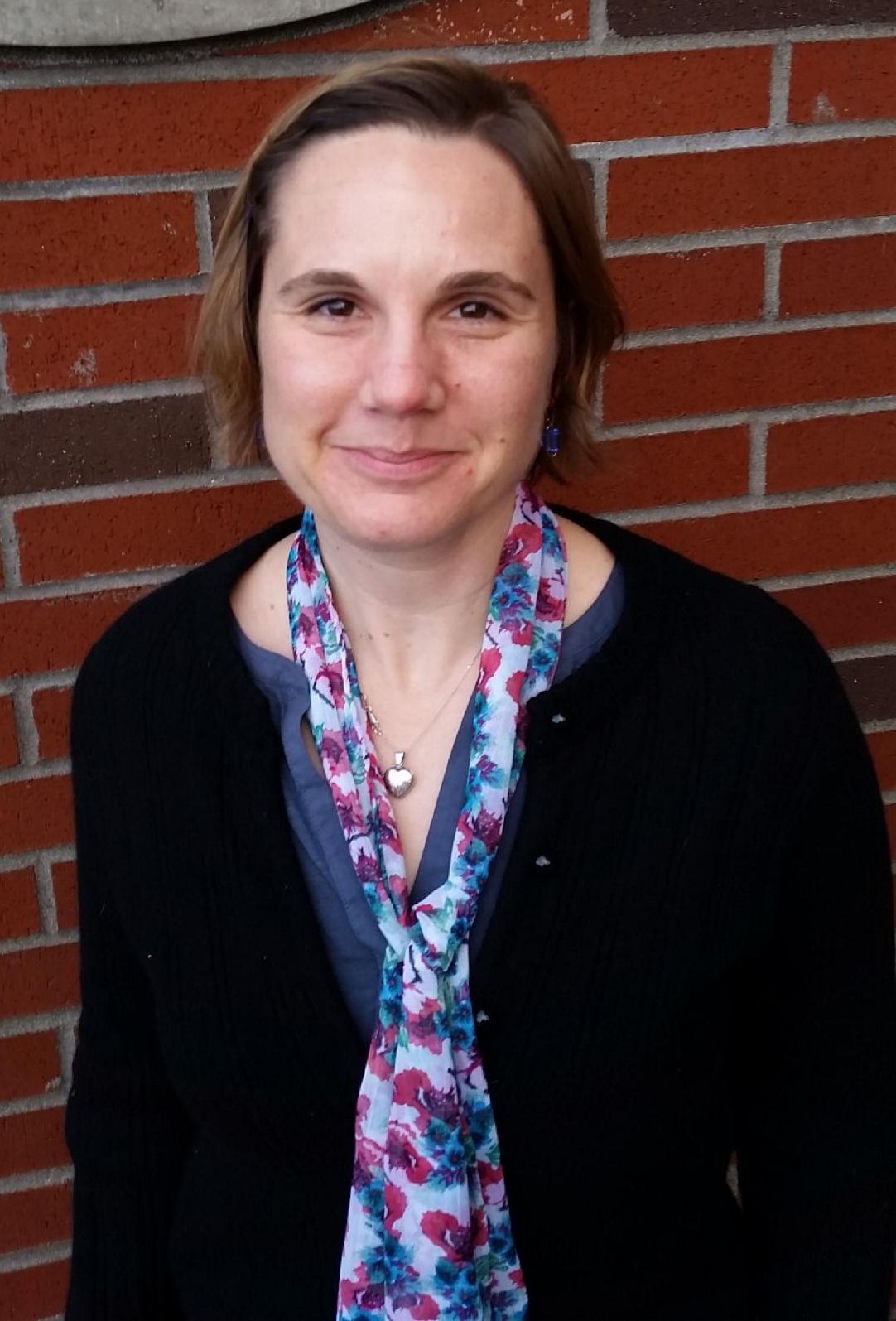
Marla S. Powers
PAW President, Conference Chair
Board Member since 2015
|
|
October 2nd: Downtown Revitalization- State of the Art |
|
October 2, 2020 | 12PM - 1PM
Where: Zoom
Cost: $20
Most downtowns in Washington State represent the center of the community’s economy, culture, and history. A sizable number of these downtowns face challenges such as increasing vacancy rates, infrastructure deterioration, and a poor organizational structure. Cities and towns throughout the state are taking action to strengthen and enliven their city centers. In this session, Breanne Durham will provide an overview of these revitalization efforts. Brian Scott will then share the details of the plan his firm prepared for Pullman, which incorporates strategies in the vanguard of downtown renewal.
|
|
|
|
Moderator: Pete Dickinson, , PAW Secretary
|
|
|
|
Breanne Durham,
Main Street Program Coordinator, Washington Trust for Historic Preservation
|
Breanne manages the Washington State Main Street Program, a statewide network of communities working to revitalize their downtown districts using the Main Street Approach®. In this role, Breanne provides on-site technical assistance to local Main Street programs across the state and coordinates a variety of educational opportunities including RevitalizeWA, the annual statewide preservation & Main Street conference.
A native of Eastern Washington, Breanne grew up in Clarkston and is a graduate of Whitworth University in Spokane. Prior to starting work for the Trust in 2015, Breanne spent five years as the Executive Director of Beautiful Downtown Lewiston, one of Idaho’s first designated Main Street programs.
|
|
|
|
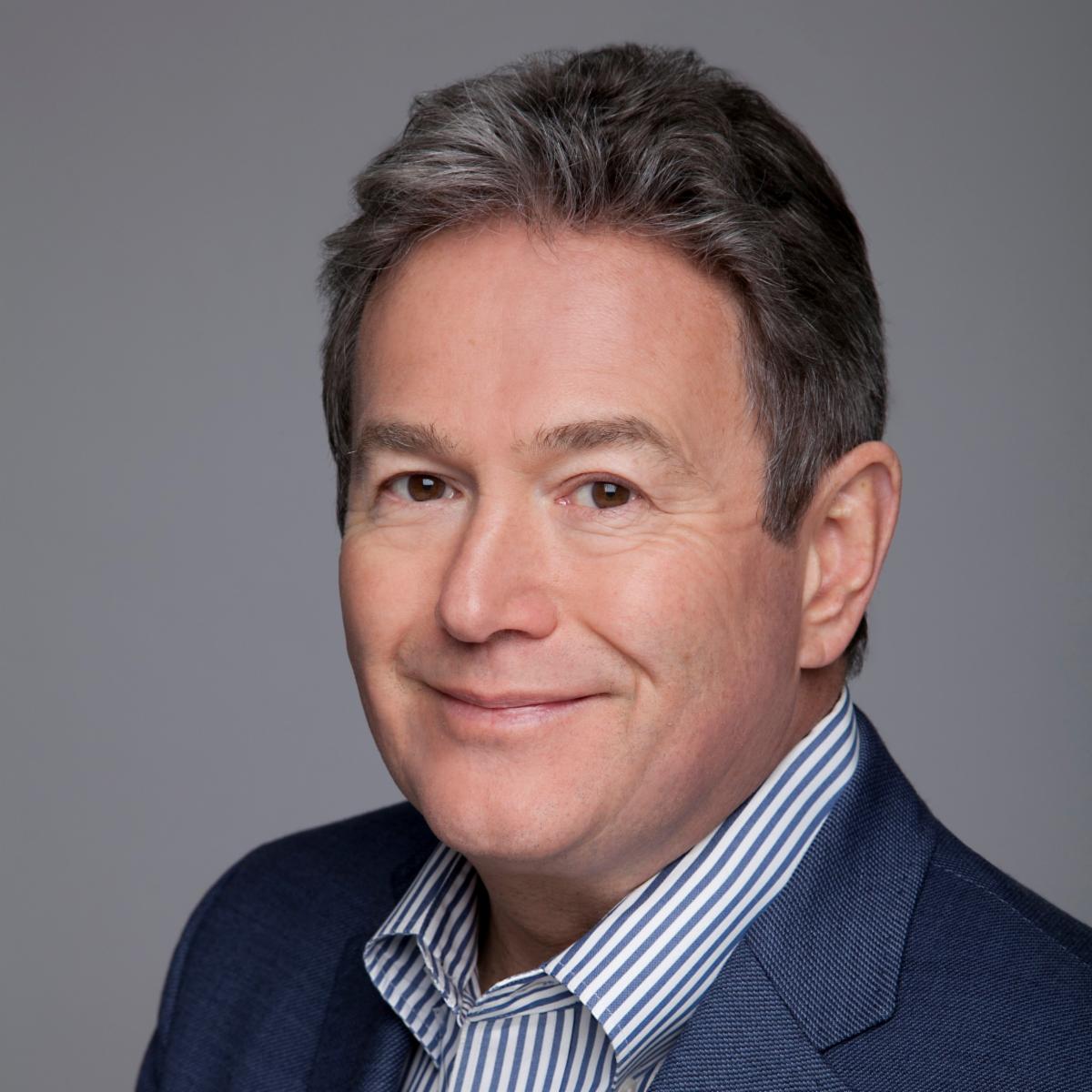
Brian Scott, Principal,
BDS Planning & Urban Design
|
Brian Scott founded BDS in 2009, and has more than 35 years of experience in comprehensive community development. With direct experience in private, nonprofit, and public organizations, he excels at the intersection of multiple sectors, interests, and perspectives. Brian is a widely respected facilitator, public speaker, and project leader with dozens of professional awards and volunteer assignments to his credit. Brian serves on the Board of Directors of the International Downtown Association (IDA) and chairs the research committee. He holds a Ph.D. in Urban Studies from Portland State University. |
|
October 16th: Case Law Update Webinar |
|
October 16, 2020 | 12PM - 1PM
Where: Zoom
Cost: $20
In this webinar longtime land use attorney Phil Olbrechts review recent, important land use cases applicable to Washington State, as well as cover the legal-and practical-aspects of holding virtual hearings as local governments adjust to manage risks associated with the spread of COVID-19.
|
|
|
|
Moderator: Marla Powers, PAW President
|
|
|
|
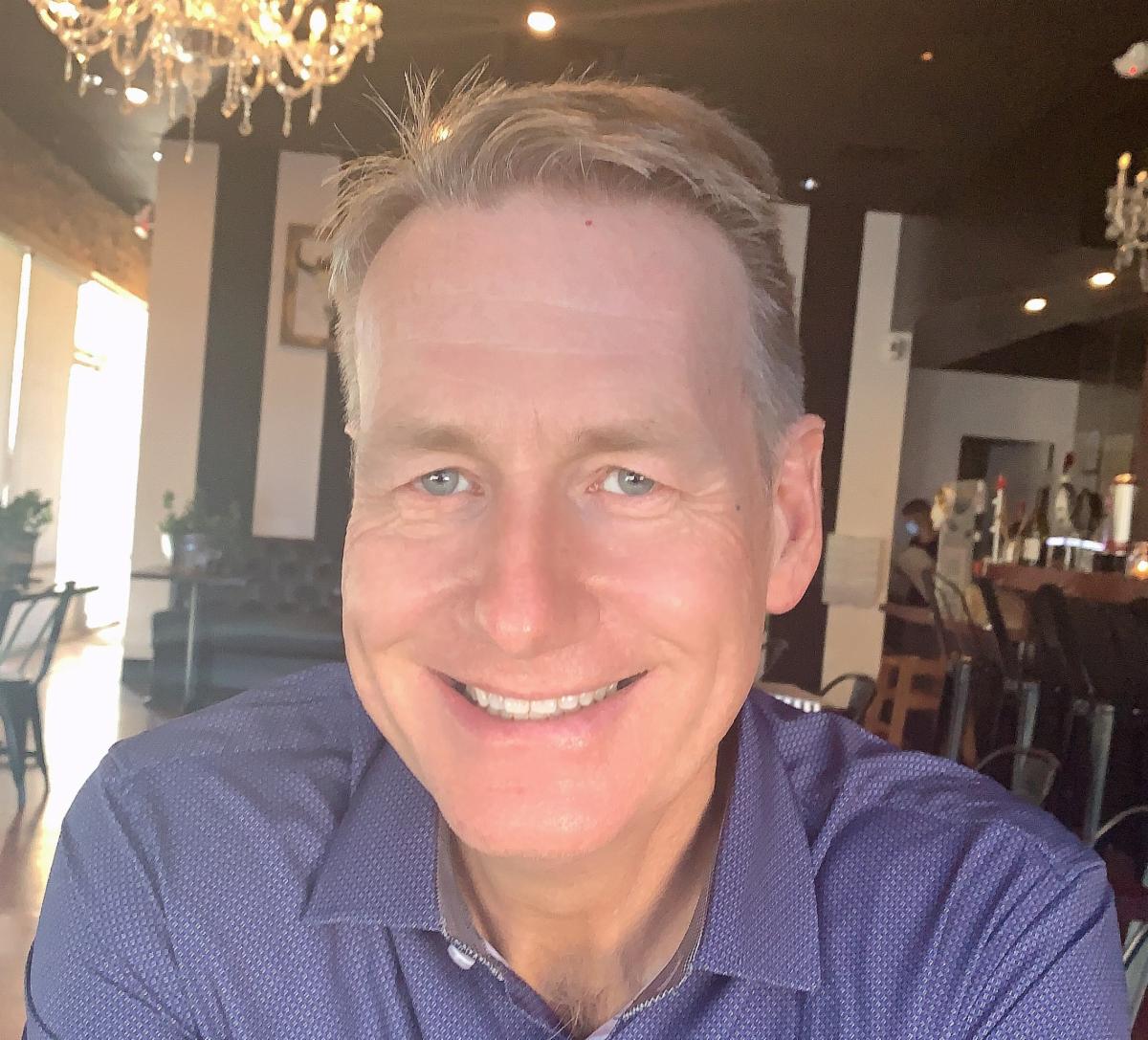
Phil A. Olbrechts
Attorney at Law, Olbrechts and Associates, PLLC
|
Phil A. Olbrechts is a hearing examiner for ten jurisdictions and city attorney for three others. He has published numerous articles on land use law and is the last editor of the “Short Course on Local Planning”, published by the Washington State Department of Commerce.
Phil has taught several land use courses at the University of Washington College of Architecture and Urban Planning and has made hundreds of presentations on land use law throughout the state in continuing legal education seminars, legal conferences and training programs for local appointed and elected officials.
He has presented at hundreds of Short Courses, and is a current member of the Board of Directors of the Planning Association of Washington.
Phil is an honors graduate of the Seattle University Law School and former partner at Ogden Murphy Wallace, PLLC. He is currently managing member of Olbrechts and Associates, PLLC.
|
|
WCIA is reimbursing members for up to two registrations per member for the upcoming . Reimbursement funding is available upon program completion. Please submit your reimbursement request through WCIA’s website, www.wciapool.org, click Education & Training, then click Training Reimbursements. For questions about reimbursement, please contact Member Services at memberservices@wciapool.org.
|
|
October 30th: Virtual Member Meeting |
|
October 30, 2020 | 6PM - 7:30PM |
|
|
|
Moderator: Pete Dickinson, PAW Secretary
|
|
Agenda:
6:00 PM | Welcome
- Adopt minutes from last year
- Overview of PAW
- Thank outgoing Board Members
- Board Member Election
- Welcome New Board Members
6:20 PM | Introduce the PAW/APA Joint Awards Program
7:00 PM | Networking/Social Hour
|
|
Thank you to Our Sponsors! |
|
Board Member Spotlight - Meagan Bailey, CFM |
|
Meagan Bailey is the Director of Planning and Community Development for the City of Dayton. Originally from Coeur d’Alene, Idaho, Meagan moved to Dayton after finishing her undergraduate degree in Conservation Planning and Management with the University of Idaho to accept a position as Planner 1 with Columbia County. After approximately 1 year after starting at Columbia County, Meagan’s predecessor retired – and the Board of County Commissioners appointed Meagan to fill the role as Interim Director. Meagan rose to the occasion and when the Director position was formally advertised, she applied, interviewed, and was selected for the position. After working for Columbia County for four years, Meagan applied for and transitioned to the Director position with the City of Dayton where she currently works.
|
|
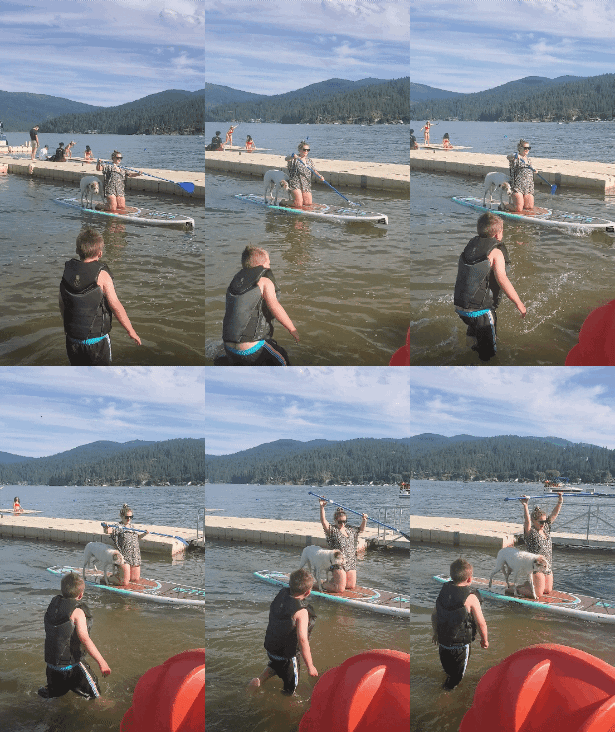
Meagan and Copper Finn paddle boarding |
|
Working in a small community and even smaller department, Meagan has taken on numerous rolls and has expanded her education and skills far beyond what she would have initially anticipated. She has received International Code Council certifications as a Permit Technician and Residential Plans Examiner to help aid the Building Department. Additionally, Meagan is a Certified Floodplain Manager with the Association of State Floodplain Managers. As the sole Planner for the City, she processes all short – and long – range planning efforts with the help of three council-appointed commissions. These commissions include the Dayton Planning Commission, the Historic Preservation Commission, and the Affordable Housing Commission. All commissions bring forth new energy and efforts to allow new growth for the City in a manner that ensures the preservation of the “small town” feel.
Currently, the City of Dayton is initiating the development of a Main St. Safety Action Plan to focus on Main St. redevelopment that increases safety, improves multimodal transportation opportunities, preserves the historic character, and beautifies the corridor. Meagan also spends time working on various committees throughout the community, and has actively participated in planning efforts that earned two governors awards, namely, the Southeast Washington Coalition Shoreline Master Plan Update in 2017 and the Blue Mountain Region Trails Plan in 2018. In 2019, and through
interlocal agreements, Meagan acted as the Planning Director for Columbia County, the City of Dayton, and the Town of Starbuck in a Regional Comprehensive Plan update. In effort to go above and beyond, all plans for redesigned and extensive community engagement took place to offer a thorough update to these plans.
Meagan joined the PAW Board in 2019 after attending the annual conference in Chelan. Since on the board, Meagan has offered new vision to outreach materials, conference topics and presenters, and boot camps. In her free time, Meagan enjoys spending time with her fiancé Cody and her dog, Copper Finn. Meagan enjoys reading romance novels, hiking, fishing for “anything that will bite” and exploring the plentiful and beautiful natural resources that abound Southeast Washington and the region. Meagan looks forward to the future with personal and professional development goals, beginning with achieving her AICP Certification in 2020.
|
|
FEMA's Building Resilient Infrastructures and Communities Grant Announcement - Opens Sept. 30th |
|
The Federal Emergency Management Agency (FEMA) makes federal funds available through the new Building Resilient Infrastructures and Communities (BRIC) grant program to states, local communities, tribes and territories (SLTTs) for pre-disaster mitigation activities. FEMA has published a Notice of Funding Opportunity (NOFO) for the BRIC grant program. The Fiscal Year 2020 (FY20) BRIC NOFO can be accessed at www.Grants.gov. FEMA encourages reviewing the BRIC NOFO before applying, as it provides detailed program information and other grant application and administration requirements.
To apply for funding made available for FY20 through the BRIC program, Applicants must adhere to the following Application and funding deadlines:
- Application Opening: September 30, 2020
- Application Deadline: January 29, 2021 (3:00 p.m. Eastern Standard Time)
FEMA will offer webinars on the FY20 Notice of Funding Opportunities for prospective applicants and tribal applicants.
-
Tuesday, August 25 at 2-3:30pm ET for prospective applicants
-
Thursday, August 27 at 2-3:30pm ET for prospective tribal applicants.
|
|
Housing Washington Conference - Oct. 6th |
|
Register for the free one day conference (9:00 – 1:00).
Speakers will address inclusive communities, racial justice, housing in the time of COVID-19 and other topics.
|
|
IACC Infrastructure, - Oct. 20-21 |
|
Registration is now open for the 2020 IACC Online Conference
presented on October 20 and 21.
Conference sessions include infrastructure funding, three sessions on tribal planning, transportation funding, broadband funding, water rights and utility taxes.
|
|
Short Course on Local Planning Update |
|
Three short courses are coming up, all on Zoom. To register, send an email with your name, organization, title (if applicable) and the date of the short course you wish to attend to shortcourse@commerce.wa.gov , preferably at least a week before the course.
Thursday, October 8, 2020: 6:00 – 7:30 p.m.
Short Course on Local Planning for Jurisdictions Partially Planning under the GMA. Hosted by the Town of Reardan.
Wednesday, October 14, 2020: 6:00 – 8:30 p.m.
Regular Short Course on Local Planning in conjunction with the Washington Chapter of the American Planning Association virtual conference.
Thursday, December 3, 2020: 6:00 – 8:30 p.m.
Regular Short Course on Local Planning, hosted by the Department of Commerce.
|
|
Save the Date: Western Planner Conference |
|
Telling the Stories of Who We Are
The 2020 Cultural Resource Protection Summit marks our 13th gathering, and as your well-being is always our greatest concern, we are going Virtual!! Our Summit family is still hard at work fulfilling the mission we have had since the Summit’s inception: The primary goal in organizing the annual Summit has been to facilitate amongst all affected parties an open, frank discussion about the intersection between cultural resources and land use. The Summit is designed to promote collaborative cultural resource planning as an effective means of finding resolution to issues before they escalate into emotionally-charged, divisive, and expensive stalemates or law suits.
This year, the Summit agenda includes an engaging array of cutting-edge topics that will encourage attendees to examine the ways we tell (or should be telling) the stories of the cultural resources we are responsible for protecting and how engaging storytelling might shape innovative solutions for today’s most pressing challenges to effective cultural resource protection. A tripartite Keynote, panel discussions, lightning talks, and small group discussions will highlight useful examples of the links between engaging CRM stories and responsible land use. We will also reserve time for Q&A and general socializing. It will be a much-needed boost to see one another, even if it must be virtually for now!
Please join us online for a two humanely-paced days that will help you improve your technical skills while deepening your connection to why we do this work. Then, with renewed commitment, move forward with helpful tools for protecting cultural resources and sharing the important stories they tell.
SUMMIT HIGHLIGHTS:
-
Retrospectives on 20+ years of CRM in our Region – Listen as a Keynote Panel representing Tribal, Agency, and Consultant viewpoints reflects on the last 20+ years of CRM. On Day 2, join representatives of the 5 claimant Tribes as they share their reflections on the Ancient One, also known as Kennewick Man.
-
Guided Plenary & Small Group Discussions on “To curate or To rebury” – What can/should we do with our archaeological collections? Join the discussion!
-
Lightning Talks (and Videos!) – Back by popular demand, join some of our most dynamic speakers as they take on the challenge of presenting a fascinating topic via 20 slides, each shown for only 20 seconds! This year, we will also be treated to two videos (anticipated) of 5 minutes or less.
-
Registration is now Open! Visit www.theleadershipseries.info for adjusted rates and to register online
-
Student Rates available! Email Mary Rossi (mary@eppardvision.org) for information. Be sure to submit a contest form, too (see next item)
-
Free Registration opportunity! Go to the Summit website and enter to win a free registration! One award will be made in each of these categories: Tribes, agencies, consultants, and students
|
|
Announcing DNR 2021 Urban & Community
Forestry Grants
|
|
Washington’s communities once again have an opportunity to restore, enhance and sustain forests in towns and cities through grants offered by DNR's Urban and Community Forestry program.
Washington cities, towns, counties, tribal governments, educational institutions, and 501(c)(3) non-profit organizations in Washington State can apply for funding.
Applicants may request from $5,000 to $20,000 in reimbursable, matching grant funds. This year, grant applications fall under two categories: Community Forestry Assistance grants and Environmental Justice grants.
|
|
Environmental Justice Grants
The purpose of this grant is to address social and environmental disparities in Washington communities by investing in community-identified urban forestry needs that advance environmental, social, and/or public health outcomes. This grant is an opportunity for environmental professionals and community advocates to collaborate on projects that address community-identified needs by leveraging the benefits of trees and forests. Eligible communities are, partially or entirely, located in at least one census tract that has scored an 8-10 in environmental health disparity according to the Washington Environmental Health Disparities Map.
Community Forestry Assistance Grants
The intent of this grant is to assist communities to develop urban forest planning and programming tools and activities that may not otherwise receive local funding. All Washington communities are eligible for this funding.
|
|
Applications are due December 10, 2020 by 4:00 PM PDT, and projects should be completed by April 30, 2023.
Available grant funding is provided on an annual basis by the Washington Department of Natural Resources and is pass-through and sub-grant funding from the United States Department of Agriculture (USDA) Forest Service's Urban and Community Forestry Program.
A grant kick-off webinar will be held on Tuesday, October 13th, 2020 to provide an overview and additional information.
|
|
Interested in applying but need helping thinking of a project idea? Keep reading below for more information.
Grants funds can be used for the following projects:
- Public tree inventories and management plans;
- Street/park tree inventories (public property)
- Tree Risk Assessment
- Urban Tree Canopy (UTC) Assessment;
- Urban Forest Management Plans;
- Prioritized planting plans
- Storm or fire response plans
- Pest preparedness plans
- Ordinance and policy development or revision
- Tree planting on public property*;
- Tree pruning to restore the health and structural stability
- Education and outreach, such as:
- Publications/Materials
- Staff trainings
- Events
- Other innovative projects, for example:
- Hiring professional facilitators, or other mutually trusted third party organizers, to convene engagement activities that mitigate for any historical or institutional power dynamics;
- Promoting community and/or tribal government involvement in addressing environmental health disparities and environmental justice related issues, and developing solutions and future project ideas to address them; and
- Tree planting to replace trees lost within the last three years as a result of natural events such as storms, floods, fires, earthquakes, or landslides.*
- Establishment of “food forest” or community orchard*
* planting projects should be identified within existing urban forest management or maintenance plans. In addition, a planting plan and separate 3-year maintenance plan are required for all tree planting projects.
What does a successful grant proposal look like in urban forestry? Below are a couple of examples:
|
|
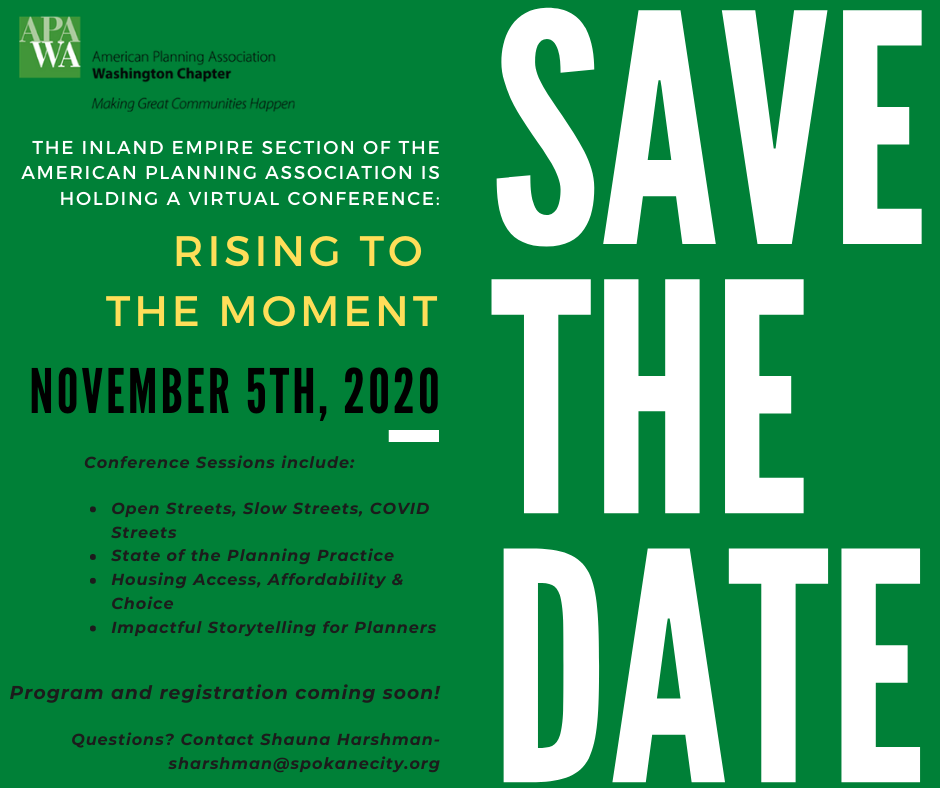
Save the Date: Inland Empire Section of the APA Annual Conference |
|
POETRY FOR HAPPY PLANNERS
Today I saw a site plan that I quite enjoyed
It was missing the north-arrow but it still complied
The applicant was a joy and even smiled as he walked
Until of course I told him he can’t build that on that block
He shook his cane in the air and snarled through his white beard
To all a good night he yelled to the office below as for me he said “nothing but coal” – C.D.
|
|
Interested in writing an article for the next newsletter? If submitted by November 1, 2020 we will mail you an official PAW T-shirt!
|
|
Planning Association of Washington
1-877-460-5880
info@planningpaw.org
|
|
|
|
|
|
|