|
This Week in Primary Care
The State Data -> State Policy Issue
--View as Webpage--
It’s the central question of Primary Care for All Americans: how do we get everyone who lives in the U.S. attached to a primary care clinician, community by community and state by state?
This week, we learn from Rhode Island and Massachusetts: measure the health of the primary care system, and then make a plan to turn it around. And if you’re reading from Massachusetts, now would be a great time to call your state reps – more below!
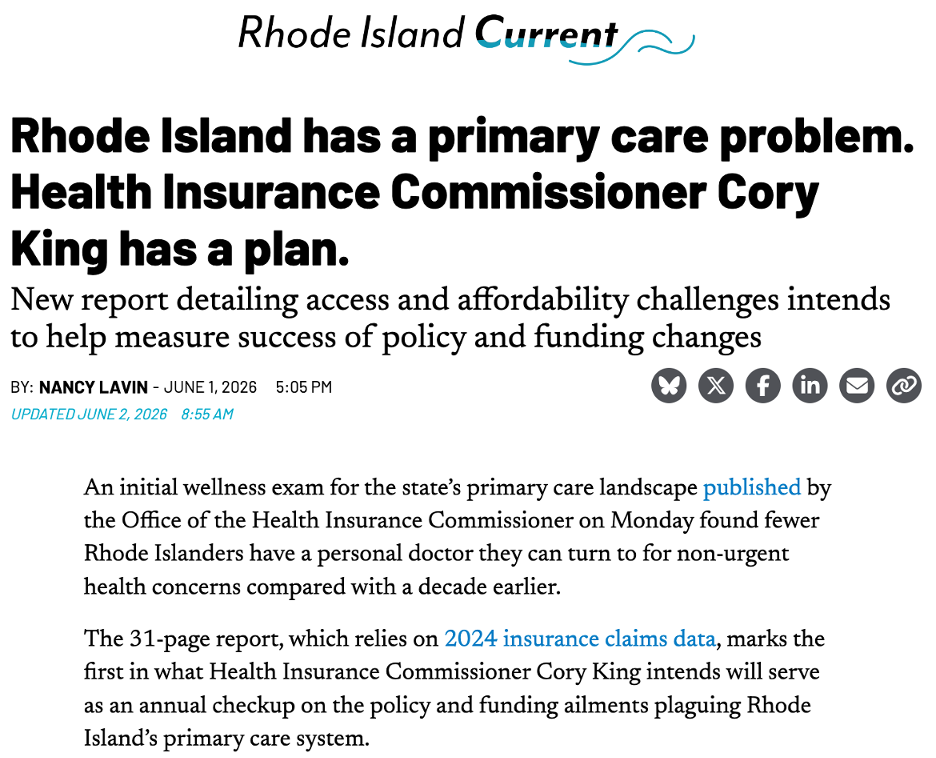
The Office of the Rhode Island Health Commissioner just published its inaugural report on the health of primary care in the state. It finds a system hamstrung by small and dwindling investment, workforce shortages, and dramatic inequities in who can access primary care. For every dollar spent on healthcare, commercial insurers pay less than 5 cents to primary care. Fewer Rhode Islanders have a primary care clinician now than ten years ago. Inequity abounds: 33% of Hispanic residents report not having a usual source of care, versus 6% of non-Hispanic white residents – echoed also across income and insurance type. At least 30% of residents missed out on preventive care this past year. The report estimates a need for at least 300 more primary care clinicians, on top of 700 clinicians already caring for 1700 people apiece.
But here’s the thing: the data are motivating action. Commercial insurers are required to ramp up their spending on primary care to at least 10 cents on the dollar by 2028. The legislature is poised to include $5 million in the 2027 budget for a new primary-care-focused medical school at the University of Rhode Island– which has been a key ask from PC4AA’s RI local workgroups. The legislature is also considering bills to expand loan forgiveness and establish scholarships for medical and nursing students who commit to practicing primary care in RI. The data may necessitate bolder action, too: PC4AA’s president, Michael Fine, calls for a “Marshall Plan” with strategic oversight of caregivers and payors, including addressing geographic and demographic barriers to universal primary care.
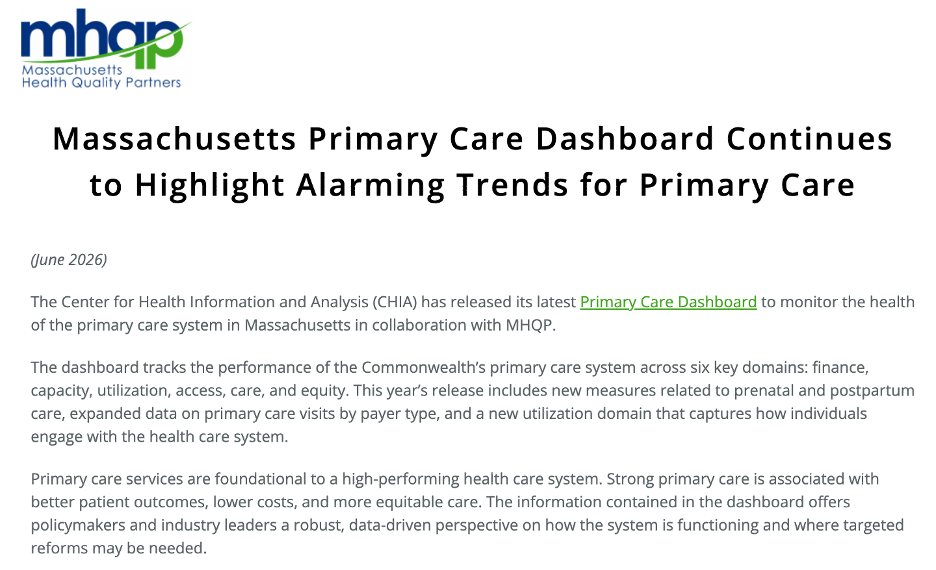
In neighboring Massachusetts, longstanding patient-experience organization Massachusetts Health Quality Partners teamed up with the state’s Center for Health Information and Analysis to track primary care’s “vital signs” starting in 2023. The 2026 Primary Care Dashboard, released last week, shows an aging workforce, only 18% of medical students becoming primary care doctors (22% in 2023), fewer people reporting preventative visits in the past year (75% from 81% in 2023), and 43% of MA residents reporting difficulty accessing needed healthcare. Of every dollar MassHealth/Medicaid pays for healthcare, 8.4 cents go to primary care, versus 6.6 cents for commercial insurers and less than 5 cents for Medicare Advantage.
Here, too, the data are compelling change. The state budget for next year includes $10 million for UMass medical students who commit to practicing family medicine in MA for five years. The MA Senate just passed An Act Relative to Primary Care for You, which would require commercial insurers to pay 15 cents on the healthcare dollar for primary care, change primary care payment from fee-for-service to per-person-per-month, guarantee equitable reimbursements to community health centers (now caring for >10% of MA residents), and increase funding for primary-care residency programs. This legislation started 7.5 years ago with a hallway conversation between people who would go on to be part of Primary Care for All Americans. The next step is for the MA House to pass its own bill by July 31st.
If you’re in MA, please take a moment to identify and call your state representative. You can share why you care about primary care or educate them on the 4 C’s; share a primary-care story from your life or something that stuck out to you from the Primary Care Dashboard; and ask them to pass a bill this July that helps get primary care to every MA resident.
A final note. What we want– and therefore want to measure– are real, effective, longitudinal primary care relationships, or “attachment.” But attachment is hard to measure, so both MA and RI used a proxy called “usual source of care,” which is self-reported, relies on recall, and includes urgent care and the emergency room as options. Though almost 90% of people in both states reported having a usual source of care, this measure almost certainly overestimates primary care attachment; other studies suggest only about 43% of American adults have a longstanding relationship with a primary care clinician.
PC4AA workgroups across the country are starting to think about how to measure and bolster real primary care attachment in their own communities. Join your local workgroup or start one, start planning your local primary care report, and check what your state is tracking. We can do this!
|