|
This Week in Primary Care
Train Primary Care Doctors Where They're Needed
--View as Webpage--
And we’re back!
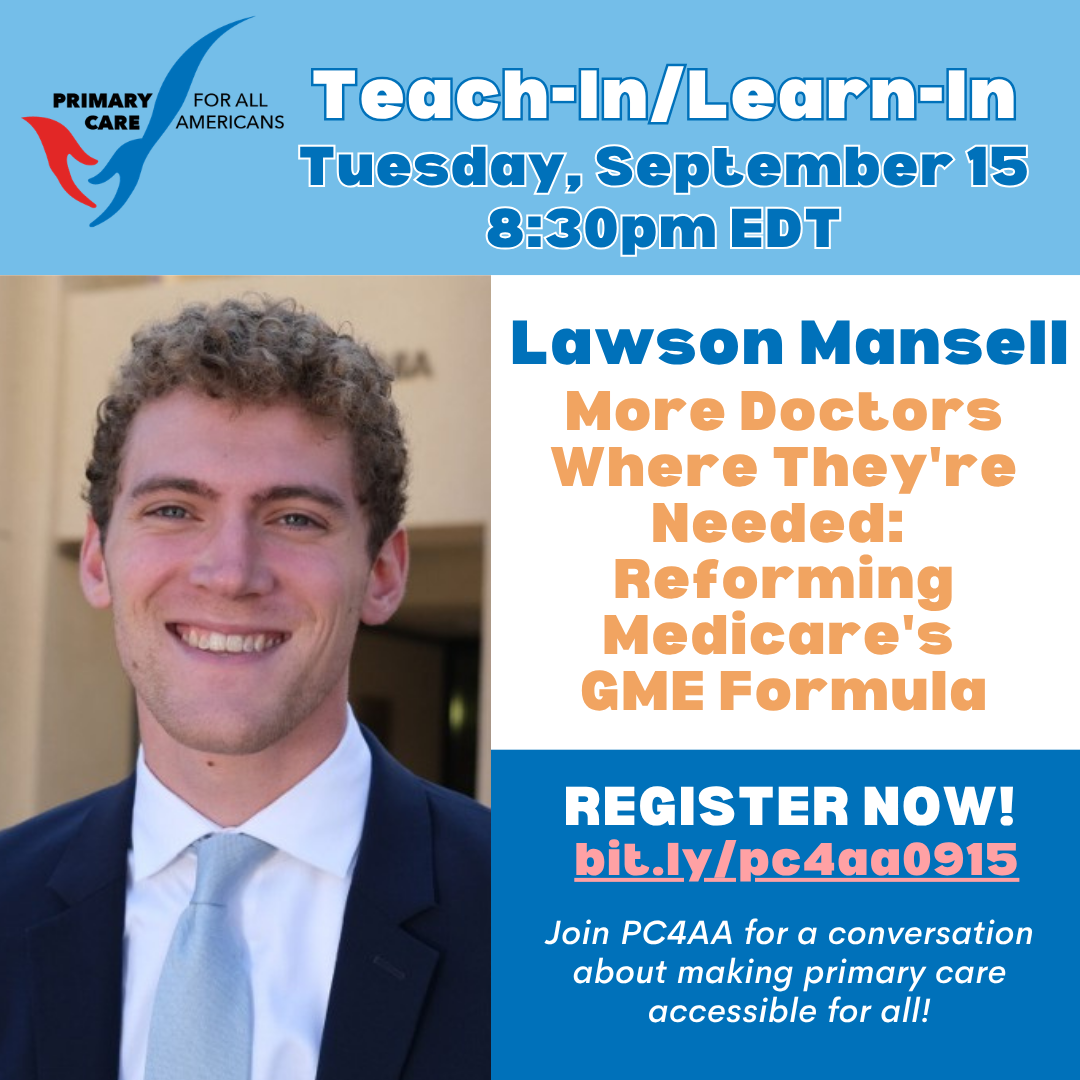
Last September we ran an issue on how to get more primary care doctors, which called out long-standing restrictions on federally funded residency slots. But how is that federal funding allocated, how does it shape what kind of doctors are trained and where, and how could Congress direct that public money to train the doctors the public needs? That’s what analyst Lawson Mansell and economist David Schwartzman explain in a new brief: More doctors where they're needed: Reforming Medicare's GME formula. If you like it (or have critiques!), join us TONIGHT for a Teach-In/Learn-In with one of the authors!
Their key takeaways are worth quoting verbatim (emphasis ours):
-
“At more than $21 billion annually, Medicare’s Graduate Medical Education (GME) payments are the federal government’s single largest investment in physician training, but the nearly 40-year-old formula for determining payments has not been meaningfully adjusted to address the growing mismatch between where doctors are needed and where they practice.
-
The current GME formula systematically disadvantages rural and small programs, depresses primary care training, and locks in a geographic distribution of residency slots disconnected from where physicians are needed most.
-
Reforming the formula, not simply adding more slots, is the most direct path to building the physician workforce Americans need. This paper offers Congress actionable options to turn GME funding into a real tool to modernize and strengthen the physician workforce to meet rising demand for medical care.”
With per-resident payments (direct GME) modulated by number of hospital beds, and payment to institutions (indirect ME) delivered via a percentage extra on each patient hospital discharge, the formula encourages inpatient/hospital-based specialist training over outpatient/clinic-based primary care training. In countries with the best health outcomes, 50%+ of the physician community practices primary care. But in the U.S. the percentage of residency slots expected to result in primary care doctors has fallen from 55% in 1981 to an estimated 14% in 2025. (Technically half of 2025 slots are in primary care fields, but these days only 12% of internists go into primary care, compared with 59% of pediatricians, 57% of combined medicine-pediatrics physicians and 92% of family physicians.)
Meanwhile, dramatic inequities are only widening: MA, CT, and NY are getting 17 times more GME funding per capita than MT, WY, and ID ($120,000 vs. $7,000 per 1000 people.) And increasing numbers of urban hospitals are using a loophole to register themselves as “rural,” to receive dollars specifically intended to redress dramatic inequities between urban and rural access to care.
Please read the brief, and bring your questions, challenges, and experiences to our Teach-In/Learn-In tonight with co-author Lawson Mansell!
|