|
WE HATE LANDSCAPE WEEDS AND PESTS! At PLM, we’re just as frustrated with landscape weeds and pests as you are. While we do our best to avoid treatments unless they pose a health risk or cause major damage, some pests simply can’t be ignored. What’s even more concerning is the arrival of new weeds and pests that haven’t historically been an issue in our area. To stay ahead of the problem, our upcoming budget proposals will include control measures for the following new pests:
European Chafer
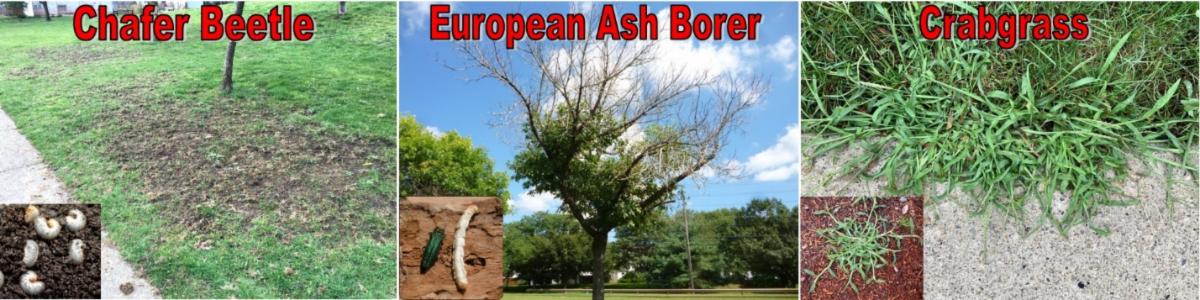
European Chafer is a newly introduced pest that damages lawns by feeding on roots as white grubs from August to May, leading to "drought-like" symptoms and attracting foraging animals like birds and raccoons, which cause further turf destruction. Adult beetles emerge in early summer (May-June) and can be found near lights at dusk. To manage them, a combination of improving lawn health and applying insecticides during their early grub stage is recommended.
Emerald Ash Borer
Emerald Ash Borer (EAB) is a destructive, invasive beetle that infests and kills ash trees. EAB has spread across North America since it was first detected in Michigan in 2002, killing hundreds of millions of ash trees. EAB was confirmed in Oregon in 2022, the first known case on the West Coast. Once EAB arrives in an area, it cannot be eradicated —which means it doesn't go away. Even though EAB will kill many ash trees in Oregon, there are steps we can take to slow its spread and limit its impacts.
Should we treat ash trees for emerald ash borer? | OSU Extension Service
Right now, OSU Extension suggests only treating the trees when the insect has been reported within 10 miles or so of the confirmed location. Currently, EAB is found throughout the Willamette Valley https://www.oregon.gov/odf/forestbenefits/Documents/eab-risk-map.pdf.
We are recommending treatment of Ash trees: What to do about emerald ash borer: Recommendations for tree protection in EAB-infested areas
Crabgrass
Crabgrass is a relatively new annual grassy weed in Oregon that thrives in hot, dry conditions, typically appearing in summer. Historically many people have called all undesirable grass Crabgrass, but before the past 5 years, it was not here in Oregon. Throughout the Midwest and East Crabgrass has been a perennial problem. With summer temperatures rising, we started seeing it here about 5 years ago. We now recommend applying a pre-emergent herbicide in the spring to prevent it’s spread.
https://extension.oregonstate.edu/ask-extension/featured/how-do-i-get-rid-crabgrass
|