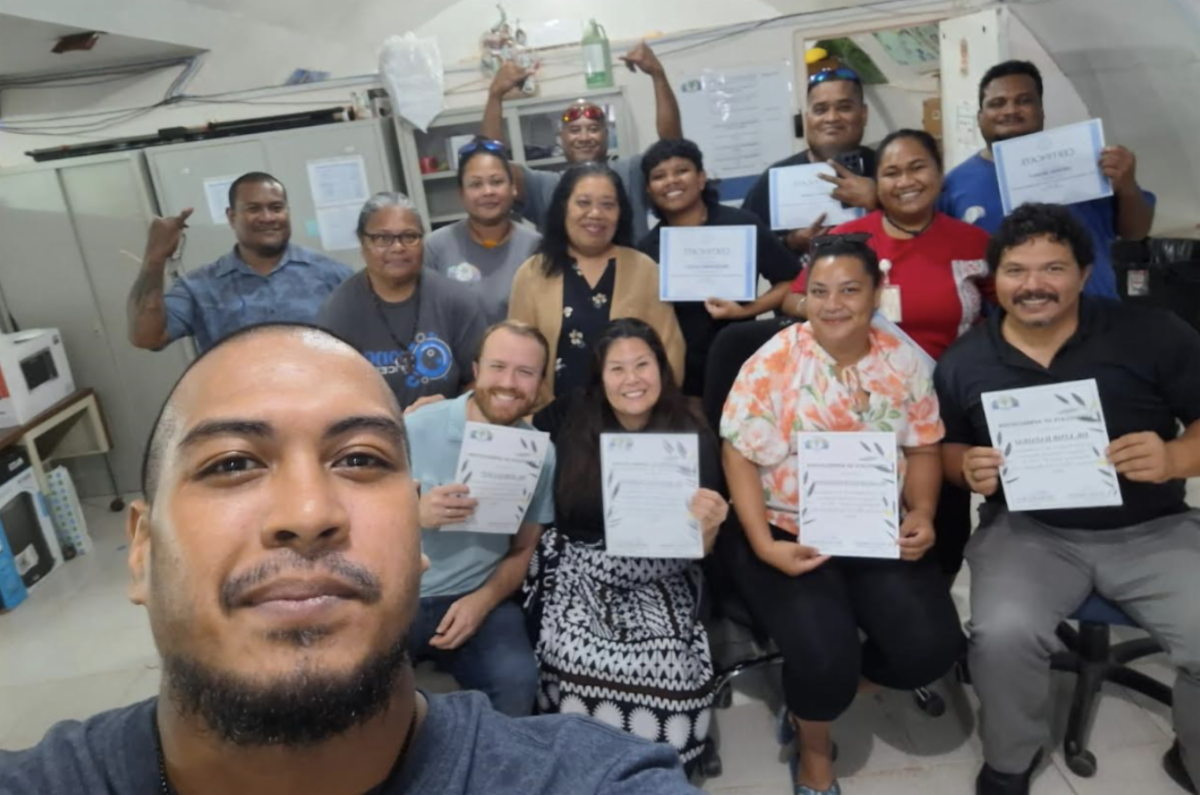
Palau Improves Dengue Outbreak Readiness with Early Warning System Training Workshop | | PIHOA vector team with Palau’s Ministry of Health and Human Services, Division of Environmental Health staff who attended the Dengue Outbreak Readiness Workshop from December 8-12, 2025 in Koror, Republic of Palau. | | |
Koror, Palau - The Pacific Island Health Officers’ Association (PIHOA) Secretariat conducted an Early Warning System (EWS) Dengue Outbreak Readiness Workshop in Koror, Republic of Palau, from December 8-12, 2025. The workshop aimed to operationalize Palau’s Dengue Case Management and Prevention Protocols into Standard Operating Procedures (SOPs), establish a Palau-specific EWS structure with defined alert thresholds, and enhance entomological analysis capacity.
Twelve participants from Palau's Ministry of Health and Human Services' (MHHS) Division of Environmental Health (DEH) joined in the training delivered by PIHOA's vector management team, which included Dr. Limb Hapairai, Dr. Tomás León, Ms. Jacquelyn Lefagoyal, and Ms. Rosanna Yoon Rabago. The highly interactive workshop incorporated a total of 14 SOPs into Palau’s Dengue Case Management and Prevention Protocols, covering mosquito surveillance, indoor residual spraying, targeted residual spraying, space spraying, risk communication, community engagement, quality assurance for pesticide and battery management, defining thresholds and response levels, and data collection and reporting.
Participants examined the role of the EWS to understand the future risk of potential dengue outbreaks based on Palau’s weather, mosquito habitats and abundance, and epidemiological data, as well as dengue activity elsewhere in the Pacific. To prevent and mitigate dengue transmission, epidemiological and entomological thresholds were established to facilitate early and appropriate action by the DEH vector team.
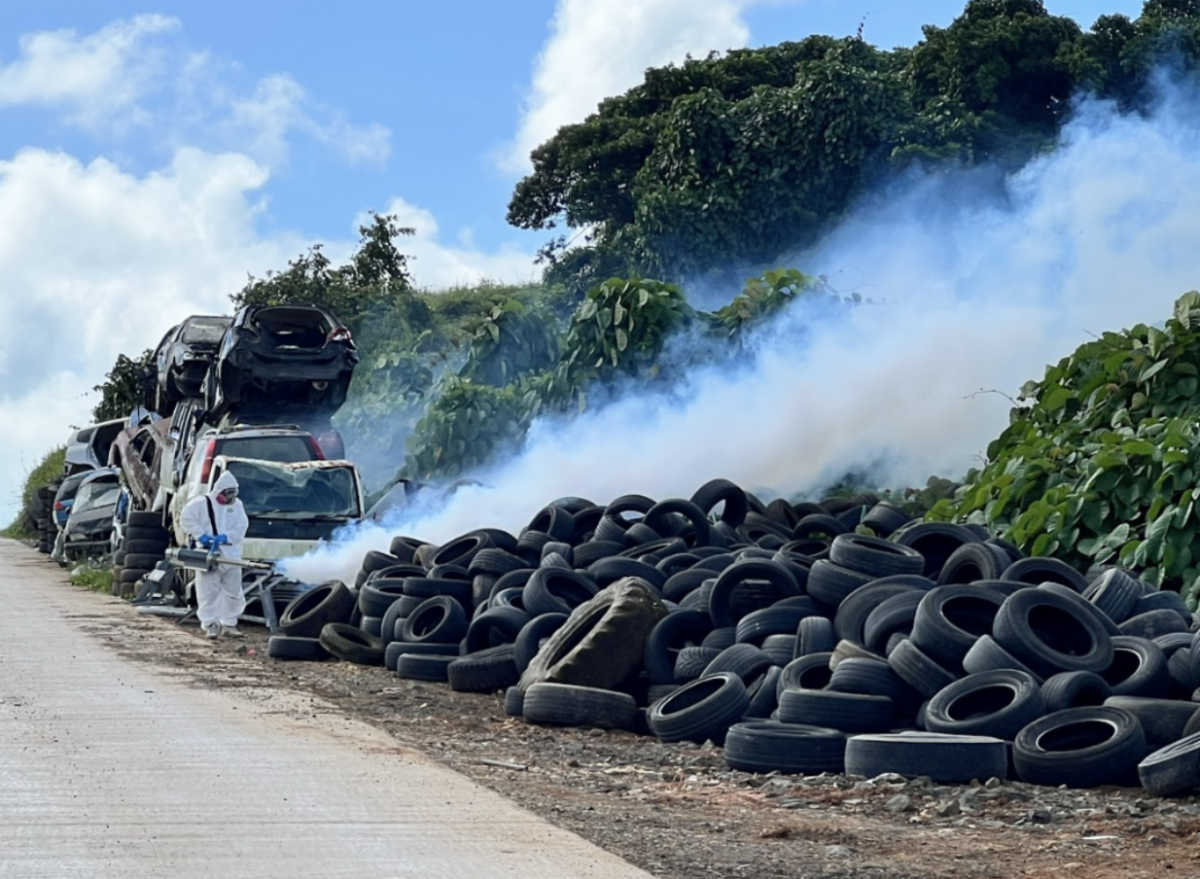
| | Palau MiHHS’ Division of Environmental Health staff, Clyde Etpison, using thermal sprayer to apply pesticides to control mosquitoes in a stack of tires at the Palau National Landfill in Aimeliik State, Republic of Palau on December 12, 2025. | | |
The workshop included a review of historical entomological and epidemiological data for past dengue outbreaks and instances of increased Aedes aegypti collections in Palau. Participants reflected on past response actions, identifying lessons learned to inform current and future planning for vector control response. This process emphasized data integration, strategizing around how that data would be shared, analyzed, and communicated, and who bore responsibility for different triggers and actions in the EWS plan. Because dengue outbreaks will usually be handled with an ICS structure, the specifics will necessarily be context-dependent; the workshop reviewed general workflows of when epidemiology, vector control, public health leadership, and other stakeholders would be involved in these processes.
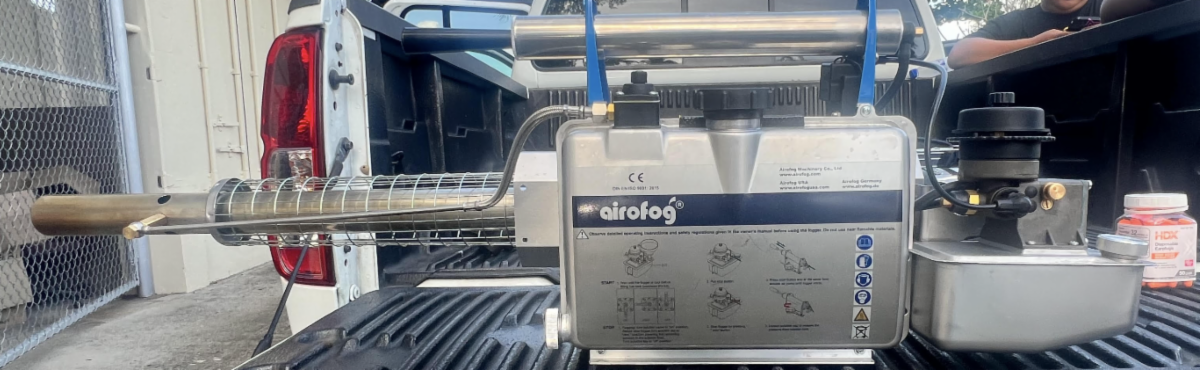
Through a donation from PIHOA Secretariat, Palau DEH staff were trained in the use of a thermal fogger, Airofog Thermal Fogger AT9, which is designed for larger-scale treatment and efficient application of insecticides in outdoor environments. The thermal fogger produces a dense ultra-fine fog that is capable of rapidly knocking down adult Aedes mosquitoes, which are vectors for dengue, chikungunya, and Zika virus. The benefit of using a thermal fogger is its ability to quickly penetrate thick vegetation, abandoned structures, yards, and difficult-to-access structures where adult mosquitoes rest.
| | |
Chief Calvin Johanes, DEH, MHHS said, “Our recent training, Early Warning System Dengue Outbreak Readiness Exercise, highlights real world application and best practices. A good example was the dumpsite thermal fogger spray. We plan, conduct exercise simulations, communicate and coordinate with the dumpsite department, instill risk communication, and then execute thermal fogger spray. This operation reinforces the importance of developing standards. Standards that will enable us to carry out our vector management plan and that need-to-know-how basis are followed on the same beats and tempos.”
PIHOA will continue to work closely with the Palau MHHS to improve outbreak readiness by strengthening capacity through the implementation of Palau’s dengue EWS.
| | This work is fully supported by funds made available from the U.S. Department of State (DOS), through its cooperative agreement with PIHOA entitled, Diminishing Dengue in the Indo-Pacific with Climate Services: Developing Predictive Models Towards a Regional Early Warning System (EWS) Against Dengue. The contents are those of the author(s) and do not necessarily represent the official views of, nor an endorsement, by DOS or the U.S. Government. | | |
###
About the Pacific Islands Health Officers' Association
PIHOA's mission is to improve the health and well-being of the USAPIs by providing, through consensus, a unified, credible voice on health issues of regional significance. Established in 1986, PIHOA is governed by and represents the collective interests of the USAPI health leadership from American Samoa, Federated States of Micronesia, Guam, Republic of the Marshall Islands, and the Republic of Palau.
PIHOA’s Secretariat, comprised of executive, administrative, and technical staff and consultants, provides support to the USAPI health agencies and leadership in the following priority areas: health workforce development; epidemiology and surveillance; health systems performance improvement; laboratory services; regional health leadership and policy advocacy; Pacific health security; and, partnership engagement and coordination. PIHOA has two offices in Honolulu, Hawai’i, and Hagåtña, Guam.
Media Contact
Billie Hiraishi
Communications Officer
billieh@pihoa.org
Limb Hapairai
Regional Medical Entomologist
limbh@pihoa.org
Rosanna Rabago
Technical Support Consultant
rosannar@pihoa.org
|
| | | |