Republic of the Marshall Islands Strengthened Vector Control and Community Engagement | |
| |
Majuro, Marshall Islands - The Republic of the Marshall Islands (RMI) Ministry of Health and Human Services (MOHHS) has worked diligently to expand and strengthen its dengue vector control efforts on Majuro Atoll in response to its Dengue outbreak declared on August 15, 2026. This included expanded community-based mosquito control operations, developing and dissemination of community engagement materials, and encouraging greater local government and community involvement in mosquito control and prevention efforts.
From August 27 to September 10, 2026, the MOHHS’ Environmental Health Unit (EHU) and Majuro Atoll Local Government (MalGov) worked alongside the Pacific Island Health Officers’ Association (PIHOA) Secretariat vector team to expand and improve field operations through more targeted household treatments based on available surveillance data, that included additional vector control measures such as thermal fogging and preventive mosquito control at public facilities. These efforts build on earlier MOHHS and PIHOA investments to strengthen mosquito vector surveillance and early warning systems, and on EH staff training and certification for workforce readiness.
Engaging Communities
| |
| |
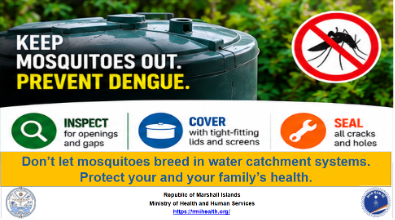
With support from the PIHOA Secretariat vector team deployed to Majuro, the MOHHS developed and rapidly disseminated a series of public educational materials, including brochures, flyers, posters, frequently asked questions (FAQs), press releases, and public service announcements via national radio and newspaper articles.
| |
| | |
These educational materials were vital to support MOHHS’ EHU vector management field teams to explain treatments, address concerns about pesticide use, and encourage households to take proactive preventive action. Messaging focused on preventing mosquito bites, eliminating breeding sites, and clarifying MOHHS’ EHU vector control team response activities in the communities.
Rapid Case Household Treatment
| |
| | | |
A significant milestone and demonstration of enhanced response capacity was the MOHHS EHU’s and MalGov teams' ability to respond to dengue cases within 72 hours of notification of positive cases.
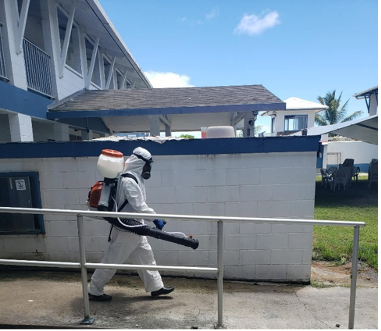
Teams conducted household inspections, identified and eliminated mosquito breeding sites, and applied targeted outdoor residual spray (TORS), targeted indoor residual spray (TIRS), and larvicides, as needed.
| |
| |
Response activities also targeted neighboring households within a 50-meter radius of the cases. This approach targets mosquitoes around affected households to help reduce the risk of dengue spreading.
Expanding Thermal Fogging Operations
| |
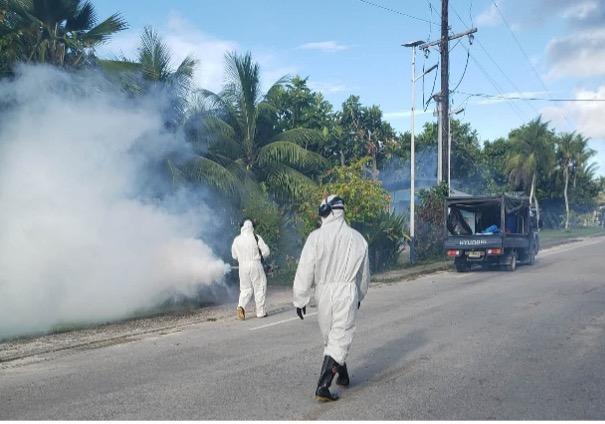
| The MOHHS EHU and MalGov further expanded thermal fogging in high-risk areas on Majuro Atoll to reduce adult mosquito populations. Hands-on training with the local teams focused on operating and maintaining newly acquired equipment, proper application techniques, and pesticide safety. The PIHOA Secretariat procured and shipped these supplies to the RMI | |
| | |
with funding support from the U.S. Centers for Disease Control and Prevention (CDC).
Prevention at Public Facilities
MOHHS and MALGov vector control teams further extended preventive vector control measures at local schools, churches, ports of entry, and other government buildings, which included targeted residual spraying, larviciding, and inspections of mosquito breeding sites to reduce mosquito populations in places where people regularly gather.
“Comparing our response during the 2019 dengue outbreak to our current mobilization clearly demonstrates our critical shift from a reactive stance to a highly proactive approach,” said Earlynta Chutaro, Director of Environmental Health.
Town Hall Meeting
| |
|
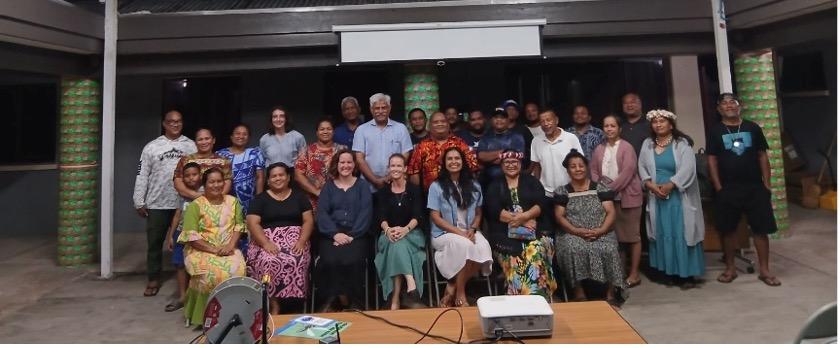
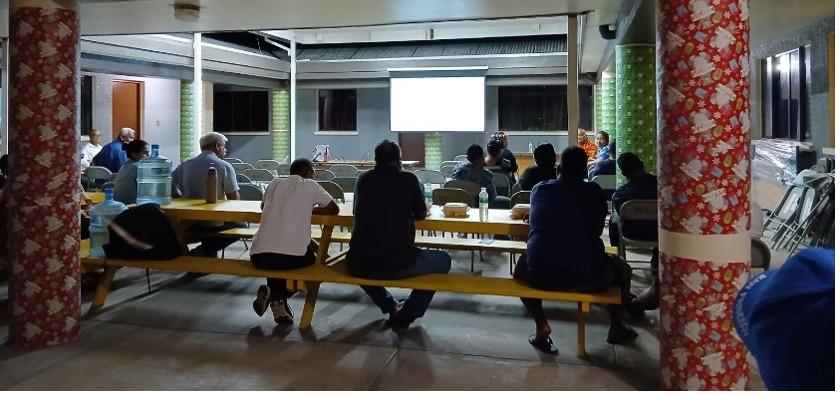
To ensure effective communication and enhanced community engagement, the MOHHS also organized town hall meetings across Majuro Atoll, bringing together traditional leaders, local landowners, MalGov, and community members to strengthen dengue information dissemination and mobilize community-supported prevention efforts.
Under the message “Health is a Shared Responsibility,” the town hall meetings emphasized the importance of community participation and engagement in prevention efforts such as coordinated sanitation efforts, removal of mosquito breeding sites, and cooperation with MOHHS and MalGov vector control teams.
| |
|
Technical experts in clinical care, epidemiology, and vector control from overseas partners, such as the CDC, participated in the town hall meetings to answer questions and provided additional guidance to prevent dengue transmission.
Dr. Dustin Bantol, Deputy Secretary for Primary Health Care, stated, “A significant 'leap' from reacting to the dengue outbreak in 2019 to proactively preparing for and mitigating it in 2026. We have enhanced abilities to detect, respond, and control the current dengue outbreak, thus protecting communities across RMI.”
The MOHHS continues to work with local authorities, communities, and regional technical partners to strengthen preparedness, prevent disease, and protect public health across the RMI.
| |
| This work is fully supported by funds made available from the U.S. Centers for Disease Control and Prevention (CDC) of the U.S. Department of Health and Human Services (HHS), through PIHOA’s Partnership Cooperative Agreement OT21-2101: Strengthening the Public Health Systems in the US-Affiliated Pacific Islands. The contents are those of the author(s) and do not necessarily represent the official views of, nor an endorsement, by CDC/HHS, or the U.S. Government. | | |
###
About the Pacific Islands Health Officers' Association
PIHOA's mission is to improve the health and well-being of the USAPIs by providing, through consensus, a unified, credible voice on health issues of regional significance. Established in 1986, PIHOA is governed by and represents the collective interests of the USAPI health leadership from American Samoa, Federated States of Micronesia, Guam, Republic of the Marshall Islands, and the Republic of Palau.
PIHOA’s Secretariat, comprised of executive, administrative, and technical staff and consultants, provides support to the USAPI health agencies and leadership in the following priority areas: health workforce development; epidemiology and surveillance; health systems performance improvement; laboratory services; regional health leadership and policy advocacy; Pacific health security; and, partnership engagement and coordination. PIHOA has two offices in Honolulu, Hawai’i, and Hagåtña, Guam.
Media Contact
Annelise Palacios Mata
Communications Officer
annelisep@pihoa.org
Limb Hapairai
Regional Medical Entomologist
limbh@pihoa.org
|
| | | |